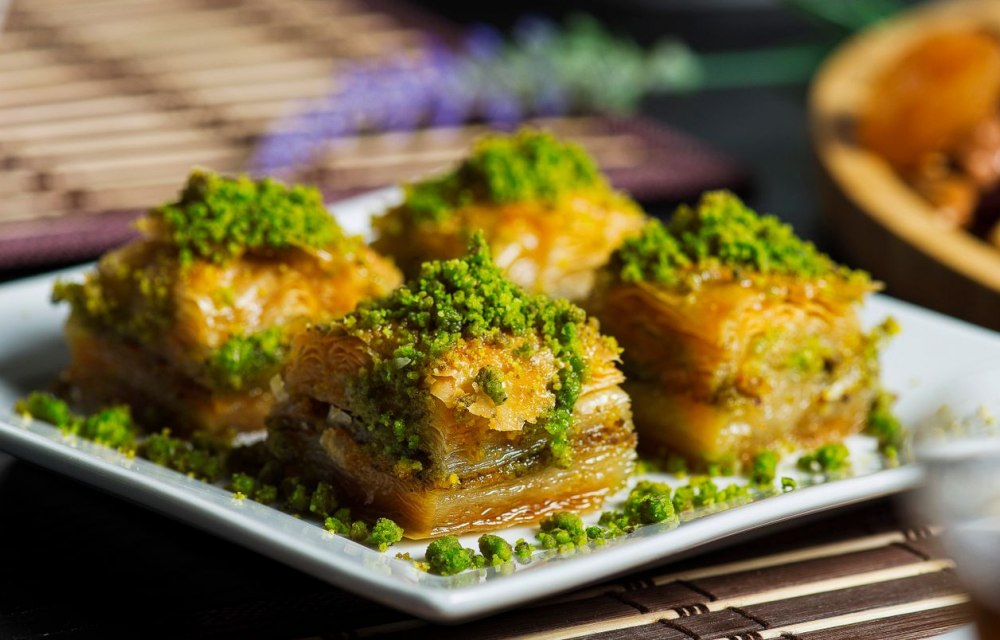
The intense green crumb scattered over baklava, künefe and lokum is no ordinary pistachio. It is the Antep fıstığı, the small, deeply coloured, oily pistachio of Gaziantep in the southeast, and it is one of the treasures of Turkish cooking. Smaller and greener than the pale snacking pistachios of California or Iran, it is grown for its colour and flavour rather than its size, and it carries a European protected name of its own.
This guide explains what makes the Turkish pistachio special, the difference between the two main kinds, how it is used across the sweets and savoury dishes, and the tree and harvest behind it. It sits within our wider guide to Turkish cuisine.
The Green Jewel of Gaziantep
Turkey is one of the world’s largest pistachio producers, and the heart of the industry is Gaziantep, so closely tied to the nut that the Turkish word for pistachio, fıstık, is often qualified simply as Antep fıstığı, the Antep pistachio. The nut is small, with a thin shell and a kernel of a striking deep green, the result of a high level of chlorophyll, and it is prized above all for that colour and its rich, oily, faintly resinous taste.
The reputation is formal as well as popular. Antep fıstığı carries a European protected geographical indication, tying the name to the nuts grown in its home region, in the same way that the city’s baklava is protected. For a Turkish pastry chef, the green of real Antep pistachio is non-negotiable, and it is what gives a good baklava or künefe its jewel-like top.
The Green Gold of the Southeast
In Gaziantep the pistachio is more than an ingredient, it is an economy. Turkey ranks among the top three pistachio producers in the world, and the city and the dry hills around it are the centre of the Turkish crop. So much local wealth rests on it that the nut is sometimes called green gold, and prices for the new harvest are followed closely each autumn. The pistachio and the baklava made from it are the twin engines of Gaziantep’s fame, the reason it became a UNESCO city of gastronomy, and a good part of the reason visitors come at all. Whole neighbourhoods of workshops shell, grind and roast the nut, and the warm smell of it drifting through the streets is part of the character of the city itself.
Antep and Siirt, the Two Kinds
Not all Turkish pistachios are the same, and the two main types are grown for different ends:
- Antep fıstığı: small, intensely green and oily, the pistachio of the pastry kitchen, ground or chopped into sweets and crusted over the top of them.
- Siirt fıstığı: the larger, rounder pistachio of the Siirt region, with a fuller shell, grown more for eating from the hand as a snack, roasted and salted.
A Turk reaching for a bowl of pistachios to nibble with tea may well choose the big Siirt nut, but a confectioner making baklava will insist on the small green Antep one. The two are not really rivals so much as different tools for different jobs. Both grow in the same hot southeastern belt, and the pistachio is in fact native to this part of the world, one of the few nuts that Anatolia and its neighbours gave to the rest of the table rather than received from it.
The Pistachio in the Kitchen
The Antep pistachio runs through the sweet half of Turkish cooking and into the savoury:
- Baklava and künefe: the classic use, ground between the pastry layers and showered green over the syrupy top, the heart of our guide to Turkish desserts.
- Lokum and katmer: studded through Turkish delight and folded with clotted cream into the pistachio pastry of Gaziantep.
- Fıstık ezmesi: a smooth pistachio marzipan, almost pure ground nut and sugar, a sweet in its own right.
- Fıstıklı kebap and içli köfte: the nut also turns up in the southeast’s meat cooking, in pistachio kebabs and stuffed bulgur dumplings.
- Menengiç coffee: a caffeine-free hot drink made from the roasted, ground fruit of the wild terebinth, the rootstock onto which pistachio trees are grafted, a smoky, nutty speciality of Gaziantep brewed and served much like coffee.
Wherever it appears, the pistachio is a marker of quality and of the southeast, and a dish topped with a generous green layer of it signals that no shortcut has been taken.
The Tree and the Harvest
The pistachio is a hardy tree suited to the hot, dry summers and cool winters of the southeast, and it is famously patient: a young tree can take many years to come into full bearing, and the best orchards are worked for generations. Cultivated trees are grafted onto the wild menengiç rootstock, the terebinth that grows across the region, which gives them their drought resistance.
Pistachios crop in alternate years, a heavy harvest followed by a light one, and the picking comes in late summer and early autumn. The harvest is still largely done by hand, whole families turning out to strip the clusters before the autumn rains, and it is as much a fixture of the southeastern year as the olive harvest is further west. The nuts are gathered, hulled and dried, and the finest are kept in the shell to protect the colour and the oil, since a shelled nut soon loses both. Much of the crop never leaves the region, going straight into the baklava workshops of Gaziantep. The alternate-year rhythm means a bumper season is always followed by a lean one, so prices swing from year to year, and growers and confectioners alike plan around the cycle. The very best green nuts, picked slightly early to lock in their colour, command the highest price of all and are kept back for the finest pastry.
Buying and Using Turkish Pistachios
For cooking, the small green Antep pistachio is what you want, sold either whole, slivered or ground to a coarse powder for dusting. The greener the kernel, the better, since colour is the surest sign of the true Antep type. Ground pistachio loses its freshness and its oil quickly, so it is best bought in small amounts or ground at home just before use. For snacking, the larger roasted and salted Siirt nut is the one to reach for, and either way the Turkish pistachio rewards being bought somewhere with a fast turnover, since freshness is everything with so oily a nut. Stored in the shell in a cool, dark place the nuts keep for months, while shelled or ground pistachio is best used within weeks; a vacuum pack or the freezer holds the colour and the oil for longer if you buy in bulk.
For all the economics and the protected names, the simplest pleasure of the Turkish pistachio is still the oldest one. A handful of the green nuts cracked open over a glass of tea, or a bright dusting on a fresh slice of baklava that tells you, before you even taste it, that no one has cut a corner.
Frequently Asked Questions
What is special about Turkish pistachios?
The Turkish pistachio, the Antep fıstığı of Gaziantep, is small, very green and oily, grown for colour and flavour rather than size. Its deep green comes from a high chlorophyll content, and it carries a European protected name that ties it to its home region. It is the pistachio prized for baklava and other sweets.
What is Antep fıstığı?
Antep fıstığı is the pistachio of Gaziantep, once known as Antep, in southeastern Turkey. It is the small, intensely green variety used in baklava, künefe and Turkish delight, and it holds a protected geographical indication that links the name to the nuts grown in the region.
What is the difference between Antep and Siirt pistachios?
Antep pistachios are small, green and oily and are used in pastry and sweets, while Siirt pistachios are larger and rounder and are grown mainly for eating as a roasted, salted snack. Confectioners use the Antep nut for its colour, while snackers often prefer the bigger Siirt one.
Why are Turkish pistachios so green?
The deep green of the Antep pistachio comes from a high level of chlorophyll in the kernel, a trait of the variety grown around Gaziantep. That colour is exactly why pastry chefs prize it, since it gives baklava and künefe their bright green crowning layer.
Sources and Further Reading
- Go Türkiye Gastronomy – the official tourism portal on Gaziantep and the food of the southeast
- EU Geographical Indications register – the European register that protects Antep Fıstığı
- Pistachio – a reference overview of the nut, its growing and its varieties