Belgium does not have a single national costume in the way that Scotland has the kilt or Japan has the kimono. The country’s cultural identity tends to show through its food and craft traditions rather than dress, and our overview of Belgian culture places the costume question in that broader context. The country was carved from three linguistic regions (Flanders in the north, Wallonia in the south, and a small German-speaking area in the east) and each developed its own folk dress rooted in its language, religion, and rural economy. The closest thing to a pan-Belgian costume is the Gille of Binche, a UNESCO-recognised carnival figure whose mask, straw-padded jacket, and clog procession has become the country’s most visible traditional attire abroad.
This guide covers the three main threads of Belgian traditional clothing: the Flemish klederdracht with its lace headdresses and farmer’s caps, the Walloon costume shaped by French occupation, and the Gilles of Binche that anchors the national carnival identity. The guide also covers the regional craft traditions (Bruges lace, Flemish wooden clogs) that remain active industries today, and the places where you can still see traditional dress worn for reasons other than tourism.
The Gilles of Binche: Belgium’s Carnival Costume
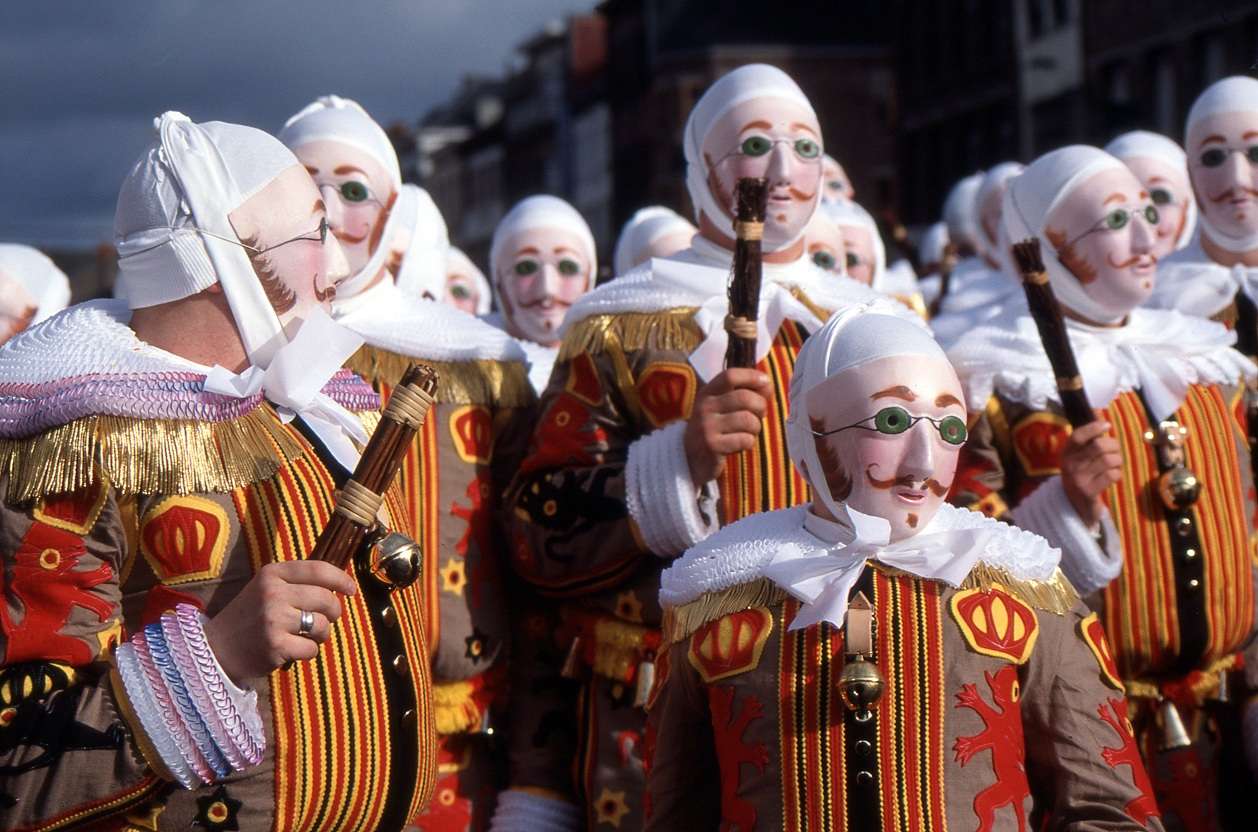
The Gille is the single most recognisable Belgian costume. Between 800 and 1,000 men in the city of Binche (Hainaut province, Wallonia) dress as Gilles on Shrove Tuesday, the last day of the three-day Carnaval de Binche. UNESCO added the Carnival to its list of Masterpieces of the Oral and Intangible Heritage of Humanity in 2003, and the event traces continuously to at least the 14th century, with some historians pushing the origin back to the 16th century when Emperor Charles V’s sister hosted celebrations in the town.
The Gille costume carries specific elements that every participant must wear:
- Jacket and trousers in red, yellow, and black (the Belgian national colours), decorated with embroidered patches of lions and crowns. The outfit is stuffed with straw at the chest and back to create a hunched, larger-than-life silhouette.
- A wax mask with round green-tinted spectacles, a small pointed moustache in the Napoleon III style, and pink cheeks. The mask is worn only until around noon.
- A large hat of ostrich feathers replaces the mask in the afternoon. Authentic feather hats rent for over $300 per day and can contain more than three hundred feathers.
- Wooden clogs (sabots) on the feet, carved from single blocks of poplar or willow.
- A bell belt with large brass bells that ring as the Gille walks, announcing his procession through the streets.
Spectators often combine a Binche visit with a tour of local chocolatiers; see our piece on Belgian chocolates for the chocolate houses of nearby Brussels and Bruges. The Gilles carry bundles of sticks (ramons) in the morning, with which they strike the ground to ward off evil spirits, and baskets of oranges in the afternoon, which they throw to the crowd. Catching a Gille’s orange brings good fortune for the year. Only men born in Binche or long-term residents may become Gilles, and the role usually passes from father to son.
Flemish Traditional Dress: The Klederdracht
The traditional Flemish women’s costume is called klederdracht, from the Dutch for “wearing attire”. The outfit belongs to the rural and religious life of pre-industrial Flanders and survives today at folklore festivals, religious processions, and historical reenactments.
The klederdracht’s core elements include a long dark skirt reaching the ankles, usually black or deep navy, paired with a fitted bodice over a white linen blouse. A starched white apron covers the skirt, and a lace-trimmed shawl crosses over the shoulders and fastens at the waist. The shoes are either wooden clogs for farm wear or black leather lace-up boots for Sunday church.
The most distinctive feature is the headdress, which varies sharply by province. In West Flanders, the poffer is a tall white cap of stiff lace with wings that frame the face. In the Kempen region of Antwerp, farmers’ wives wore a simpler round white cap with a pleated brim. In Limburg, the cap was often paired with a small lace collar. A woman’s wealth and marital status showed in the complexity of her cap: a wide, heavily embroidered poffer belonged to a married woman of means, while a plain cotton cap belonged to an unmarried farm worker.
Flemish men’s traditional dress was less elaborate: a dark wool suit with a waistcoat, a white shirt without a collar, a cap or wide-brimmed hat, and wooden clogs. The smock (kiel), a loose blue or grey tunic worn over the suit for farm work, appears in paintings of Flemish rural life from the 17th century onward and remained common until the 1930s.
Walloon Traditional Dress
Walloon folk costume developed under French cultural influence, especially after the French occupation of the Austrian Netherlands (1794-1814). The country’s equestrian heritage developed in parallel; our profile of the Belgian draft horse covers the breed that pulled the carts of Walloon farmers well into the 20th century. Walloon traditional dress looks lighter and more colourful than Flemish klederdracht: printed cotton skirts in floral patterns, brighter blouses, and less elaborate headgear.
The typical Walloon woman’s costume includes a knee-length or ankle-length skirt in printed cotton, a white blouse with puffed short sleeves, a laced bodice, and a simple white bonnet or a straw hat for outdoor work. Men wore French-style smocks (blouses), knee-breeches into the early 19th century, and later long trousers with a waistcoat and flat cap. Wooden clogs were universal for farm work in both regions.
Regional variations exist within Wallonia too. The Ardennes mountain villages developed heavier wool clothing suited to the cold climate. The coal-mining towns of the Borinage had their own utilitarian work dress for miners and their families. The Brussels region, sitting on the linguistic border, blended Flemish and Walloon elements.
Wooden Clogs: The Sabot and Klomp
Wooden clogs were the standard rural footwear across Belgium until the mid-20th century, known as klompen in Flanders and sabots in Wallonia. Carvers produced them by hollowing out single blocks of poplar, willow, or alder with specialised knives. A pair of working clogs lasted a farmer six to twelve months of daily wear, and a skilled carver could finish a pair in about two hours.
Belgium’s clog industry reached its peak in the 1880s, with several hundred carvers working across both regions. The craft declined rapidly after the First World War as leather boots became affordable and farms mechanised. Today fewer than twenty traditional clog makers remain active in Belgium, most of them working for heritage sites, folklore groups, and the Gilles of Binche.
For readers interested in a different Belgian living tradition that remains commercially active, our pieces on the history of the Belgian Malinois working dog and related livestock breeds cover the country’s agricultural lineage. Modern Belgian clogs still follow regional styles. The Flemish klomp has a pointed toe and a slight upward curl. The Walloon sabot is blunter and more rounded. Decorated clogs for festival wear have carved patterns, painted scenes, or inlaid metalwork on the top surface, and these can cost €80-200 per pair compared to €20-30 for plain working clogs.
Belgian Lace: The Craft Behind the Headdress
The lace headdress that tops the klederdracht comes from an industry that shaped Belgian textile history for four centuries. Bruges became Europe’s lace capital in the 16th century, with thousands of women producing bobbin lace in home workshops for export across Europe. Brussels developed its own lace style (point de gaze) in the 17th century, focused on delicate needle lace with floral patterns.
By 1700, an estimated 10,000 women in Bruges alone worked in lace-making, selling through merchant houses that shipped finished pieces to France, Spain, England, and the American colonies. The industry collapsed in the late 19th century under competition from machine-made lace, but hand lace-making survived as a heritage craft and a tourist industry.
Visitors to Bruges today can watch lace-making demonstrations at the Kantcentrum (Lace Centre) on Peperstraat, buy authentic hand-made lace from specialist shops, or take a one-day lace class. A genuine Bruges hand-made lace handkerchief costs €30-80, while larger pieces like table runners and wedding veils run €500-3,000. Machine-made tourist lace labelled “Belgian lace” usually comes from mills in China and retails for under €10. Travellers combining lace-shopping with other Belgian specialities often follow the regional food map covered in our guide to Belgian food.
Where to See Traditional Belgian Dress Today
Several events across the year draw out traditional Belgian clothing, and visiting these gives a clearer sense of the costumes than any museum display:
- Carnaval de Binche (February or March, Shrove Tuesday in Binche, Wallonia). The three-day carnival climaxes with the Gilles procession on Mardi Gras. Book accommodation six months ahead.
- Ommegang of Brussels (late June-early July, Grand Place). A historical procession reenacting the 1549 entry of Emperor Charles V into Brussels, with 1,400 participants in Renaissance-era costume.
- Aalst Carnival (February or March, Aalst, East Flanders). Less solemn than Binche, with satirical costumes and giant papier-mache figures. UNESCO removed Aalst from the Intangible Heritage list in 2019 following antisemitic floats; the event continues but is now controversial.
- Ducasse d’Ath (fourth weekend of August, Ath, Wallonia). Features giants and dragons in traditional costume, UNESCO-recognised.
- Bruges Heilig-Bloedprocessie (Ascension Day, Bruges). Religious procession with participants in medieval and Flemish klederdracht.
The Belgian Flag Dress: A Modern Invention
Shops selling national costumes for football matches, Eurovision events, and tourist souvenirs offer a modern “Belgian flag dress” in red, yellow, and black stripes. This outfit has no historical grounding in either Flemish or Walloon folk dress. It appeared in the 1980s as football fan wear and has spread through online costume retailers. A Belgian wearing such a dress at an international event is expressing national pride, not wearing traditional clothing in any meaningful sense.
The confusion between the flag dress and the Gilles costume feeds the common misconception that Belgium’s national dress is simply “something in red, yellow, and black”. The Gille’s costume does use the national colours, but the meaning comes from the specific embroidered patches, the mask, the straw padding, the bells, and the procession, not from the colour scheme alone.
Frequently Asked Questions
Does Belgium have an official national costume?
No. Belgium has no officially designated national costume. The country recognises multiple regional folk dress traditions (Flemish klederdracht, Walloon folk dress) and one internationally famous carnival costume (the Gille of Binche). The Gille is the most commonly identified as “the Belgian costume” abroad, though it belongs specifically to one town in Wallonia.
What is the difference between Flemish and Walloon traditional dress?
Flemish klederdracht uses darker colours (black, navy, white), features elaborate lace headdresses that vary by province, and descends from Dutch rural traditions. Walloon folk dress uses brighter printed cottons, simpler headwear, and shows French influence from the occupation period of 1794-1814.
Can tourists buy authentic Gilles costumes?
Yes, but the cost is significant. A full Gille outfit (jacket, trousers, mask, bells, clogs) costs €800-1,500 to buy, and the feather hat adds another €300-500 in rental fees for the day it is worn. The costume has no practical use outside the Binche Carnival context, and wearing a Gille outfit at the wrong event or in the wrong town is considered disrespectful by the Binche community.
Where can I see the Flemish klederdracht worn today?
Folklore groups in Bruges, Ghent, Antwerp, and smaller Flemish towns wear klederdracht at regional festivals and religious processions. The Bruges Heilig-Bloedprocessie on Ascension Day is one of the most visible occasions. Museums including the Museum voor Volkskunde in Antwerp and the Jubelpark Museum in Brussels display historical klederdracht outfits year-round.
What footwear goes with Belgian traditional costume?
Wooden clogs (klompen in Flanders, sabots in Wallonia) are the standard rural footwear across both regions. Festival and church wear used black leather lace-up boots or ankle shoes. The Gilles of Binche always wear wooden clogs as part of their procession.
How did Belgian lace end up in the headdress?
Bruges and Brussels became Europe’s major lace-making centres in the 16th and 17th centuries. Lace was expensive and prestigious, and rural women showed wealth and family status through the complexity of the lace in their caps. The Flemish poffer (the tall lace cap of West Flanders) became a wearable advertisement for the quality of local lace-making.
Sources and Further Reading
- Carnival of Binche – en.wikipedia.org/wiki/Carnival_of_Binche
- Gilles (carnival figures) – en.wikipedia.org/wiki/Gilles
- Binche city and carnival – britannica.com/place/Binche
- Carnival of Binche UNESCO listing – ich.unesco.org/en/RL/carnival-of-binche-00033
- Bruges Lace Centre – kantcentrum.eu