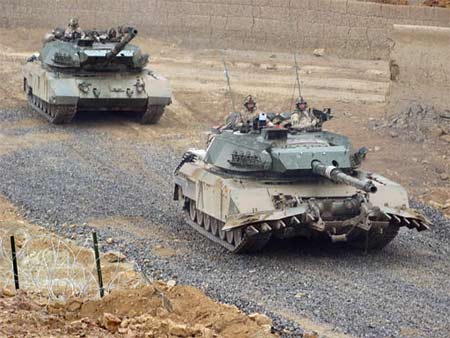
Canada has operated tanks since the First World War but has never maintained a large armoured fleet compared to NATO allies like the United States, Germany, or the United Kingdom. The Canadian Armed Forces currently field roughly 80 operational Leopard 2 main battle tanks in three variants – the 2A4, 2A4M, and 2A6M – alongside a fleet of LAV 6.0 infantry fighting vehicles and Textron TAPVs for patrol and reconnaissance. Canada’s tank history includes the domestically designed Ram tank of the Second World War, the Sherman variants that Canadian armoured regiments drove onto the beaches at Normandy, and the Cold War-era Leopard 1 that served for three decades before the Leopard 2 replaced it. This article covers the historical and current armoured vehicles of the Canadian military, from the Valentine tanks built in Montreal for the Soviet Union to the Leopard 2A6M C2 upgrades underway at the FFG facility in Bathurst, New Brunswick. The Canadian armoured corps has fought in two world wars, served in NATO during the Cold War, deployed on peacekeeping operations in the Balkans, and engaged in combat in Afghanistan – each conflict shaping the fleet’s composition and the country’s broader defense posture.
Second World War: Canada Builds Its Own Tanks
Canada entered the war without a domestic tank industry. The Canadian Pacific Railway’s Angus Shops in Montreal began producing the British-designed Valentine infantry tank in 1941, eventually building 1,420 units. Most of these went to the Soviet Union under Allied supply agreements, with only 30 retained in Canada for crew training. The Valentine gave Canadian industry its first experience with armoured vehicle manufacturing at scale.
The Ram tank, designed and built at the Montreal Locomotive Works, was Canada’s first domestically developed battle tank. The Ram I prototype rolled out in June 1941, based on the hull of the American M3 Lee but with a conventional rotating turret mounting a 2-pounder gun. Production shifted to the Ram II with a 6-pounder main gun after 50 Ram I units, and nearly 1,900 Ram IIs left the factory before production ended in July 1943. Canadian armoured units trained on the Ram but never deployed it in combat – by mid-1944, all front-line Canadian regiments had re-equipped with the American M4 Sherman. The Ram chassis found second use as the basis for the Sexton self-propelled gun and the Kangaroo armoured personnel carrier, both of which saw action in Northwest Europe.
The Grizzly was a Canadian-produced Sherman variant built at the same Montreal Locomotive Works. Only 188 Grizzly tanks were manufactured, featuring a cast hull and a 2-inch smoke mortar on the turret. Like the Ram, the Grizzly served primarily as a training vehicle while Canadian combat units received standard American Shermans.
Canadian Armoured Regiments in Combat
Canada fielded 12 armoured regiments and two armoured reconnaissance regiments during the Second World War, organized into two armoured divisions and two independent armoured brigades. All front-line regiments used Sherman tanks by the time they entered combat.
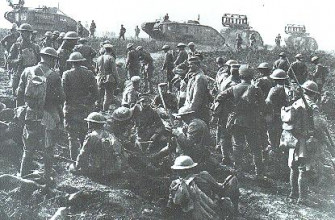
The 1st Canadian Armoured Brigade received Shermans in time for the invasion of Sicily in July 1943 and fought up the Italian peninsula through 1944. On D-Day, June 6, 1944, squadrons from the Fort Garry Horse and the First Hussars drove DD (Duplex Drive) amphibious Shermans – fitted with inflatable canvas screens and propellers – off landing craft into the English Channel and onto Juno Beach under fire. The Sherbrooke Fusiliers Regiment followed in the second wave. Canadian armour supported infantry through the Normandy campaign, the Falaise pocket, the Scheldt estuary clearing, and the final advance into Germany.
The fighting exacted a heavy toll. At Verrières Ridge south of Caen in July 1944, the Black Watch (Royal Highland Regiment) and the South Alberta Regiment lost over 300 men in a single day during Operation Spring, one of the costliest single-day losses for Canadian forces in Northwest Europe. Armoured engagements in the bocage hedgerow country of Normandy exposed the limitations of the Sherman against German Panther and Tiger tanks – the Sherman’s 75mm gun could not penetrate their frontal armour at combat range, and Canadian tankers learned to fight from flanking positions or call in air support to neutralize heavy German armour. The Canadian armoured experience in Northwest Europe shaped post-war doctrine around combined arms coordination between tanks, infantry, and artillery.
Key Canadian armoured vehicles of the Second World War:
- Valentine – British-designed infantry tank, 1,420 built in Montreal, most shipped to the USSR
- Ram I / Ram II – Canadian-designed medium tank, ~1,950 built, used for training and as APC/SPG chassis
- Grizzly – Canadian Sherman variant, 188 built, cast hull with smoke mortar
- M4 Sherman – American-built, standard combat tank for all Canadian regiments from mid-1944
- Sexton – 25-pounder self-propelled gun on Ram chassis, 2,150 built in Canada
Cold War: The Leopard 1 Era
After using a mix of British Centurion tanks and American M48 Pattons through the 1950s and 1960s, Canada purchased 114 Leopard C1 tanks from Germany in 1978. The Leopard C1 (a variant of the Leopard 1A3) served with Canadian Forces in Europe as part of NATO’s defense against the Warsaw Pact and later in domestic training roles. The tank carried a 105mm L7 rifled gun and weighed roughly 42 tonnes.
The Leopard C2, an upgraded version with improved fire control and thermal imaging, entered service in the late 1980s and remained operational through the early 2000s. Canada considered retiring its tank fleet entirely during the post-Cold War drawdown of the 1990s, a period when military planners questioned whether heavy armour had a role in the expeditionary operations that replaced territorial defense as the Canadian military’s primary mission. The long tradition of Canadian ground combat, however, kept the armoured capability alive through institutional advocacy within the army.
Canada deployed Leopard C2 tanks on peacekeeping and stabilization operations in the former Yugoslavia during the 1990s, where they provided force protection and deterrence for Canadian infantry units operating in Bosnia. The Balkans deployment demonstrated that even “peacekeeping” missions could require armoured firepower, a lesson that carried forward into the Afghanistan decision a decade later. The Leopard C2 also served in the Canadian contribution to NATO’s Kosovo Force (KFOR) in 1999.
Afghanistan and the Return of Heavy Armour
The Afghanistan deployment from 2002 to 2014 reversed the trend toward eliminating Canadian tanks. In 2006, Canadian troops in Kandahar province faced Taliban forces using improvised explosive devices, rocket-propelled grenades, and ambush tactics that light armoured vehicles could not adequately counter. The government fast-tracked a lease of 20 Leopard 2A6M tanks from Germany and 80 surplus Leopard 2A4 tanks from the Netherlands, deploying them to Afghanistan by 2007.
The Leopard 2’s 120mm smoothbore gun, composite armour, and mine-resistant underbody proved decisive in the Kandahar fighting. Canadian tankers from Lord Strathcona’s Horse (Royal Canadians) operated the Leopard 2 in temperatures exceeding 50 degrees Celsius, and the tanks withstood multiple IED strikes that would have destroyed lighter vehicles. Canadian crews used the Leopard 2 for fire support, route clearance overwatch, and direct engagement against fortified Taliban positions in grape drying huts and compound walls that lighter weapons could not penetrate.
The Afghan experience settled the debate over whether Canada needed tanks – the answer was yes, and the government purchased the leased and surplus vehicles outright. Canada also donated several Leopard 2A4 tanks to Ukraine in 2023 and 2024 to support that country’s defense, drawing from the training fleet and backfilling with vehicles returned from maintenance.
Current Canadian Armoured Fleet
The Canadian Armed Forces operate roughly 103 Leopard 2 tanks across three variants. The Leopard 2A6M, the most capable version, carries a longer L/55 120mm gun and enhanced mine protection. Twenty of these are being upgraded to the 2A6M C2 standard under a $76 million contract with Krauss-Maffei Wegmann, replacing analog fire control components with digital systems and improving optics. The conversion work runs at FFG Canada’s facility in Bathurst, New Brunswick, with completion expected by late 2025.
Beyond the Leopard 2, the Canadian Army’s armoured vehicle fleet includes:
- LAV 6.0 – eight-wheeled infantry fighting vehicle with 25mm chain gun, backbone of Canadian mechanized infantry battalions
- ACSV (Armoured Combat Support Vehicle) – LAV 6-based variants replacing the M113 and LAV II Bison, 360 ordered
- TAPV (Tactical Armoured Patrol Vehicle) – Textron-built patrol and reconnaissance vehicle, replacing the RG-31 and Coyote
- Leopard 2 ARV – armoured recovery vehicle variant for battlefield tank repair and towing
- Leopard 2 AEV – armoured engineering vehicle for obstacle clearance and route construction
The fleet faces a replacement decision by the mid-2030s when the current Leopard 2 tanks reach end-of-life. Canada is considering options including new-build Leopard 2A8 variants, the Korean K2 Black Panther, or participation in a European next-generation tank program. The decision will depend on NATO commitments, Arctic defense requirements, and budget pressures across the broader Canadian defense portfolio.
Frequently Asked Questions
What tanks does the Canadian Army use?
The Canadian Army operates Leopard 2 main battle tanks in three variants: the 2A4 for training, the 2A4M with enhanced mine protection, and the 2A6M with a longer 120mm gun. The fleet totals roughly 103 vehicles. Twenty 2A6M tanks are being upgraded to the C2 standard with modern digital fire control.
Did Canada build its own tanks in World War II?
Canada built the Ram tank at the Montreal Locomotive Works (nearly 1,950 produced) and the Grizzly Sherman variant (188 produced). Canada also manufactured 1,420 Valentine tanks, most of which were shipped to the Soviet Union. Canadian combat units used American-built Shermans in actual combat operations.
Why did Canada almost get rid of its tanks?
During the post-Cold War drawdown of the 1990s, military planners questioned whether heavy armour suited Canada’s shift toward expeditionary operations. The 2006-2014 Afghanistan deployment reversed this thinking when Leopard 2 tanks proved essential against Taliban ambush tactics and IED threats in Kandahar province.
What will replace Canada’s current tanks?
The current Leopard 2 fleet is expected to serve until approximately 2035. Canada is evaluating replacement options including new Leopard 2A8 variants, the Korean K2 Black Panther, and European next-generation tank programs. The decision depends on NATO commitments and Arctic defense needs.
Sources and Further Reading
- Canada.ca – Leopard 2 Family of Vehicles, Canadian Armed Forces equipment page (canada.ca)
- Juno Beach Centre – Canadian-Built Tanks and the Sherman Tank (junobeach.org)
- Army Recognition – Canada’s Upgraded Leopard 2A6MC2 Main Battle Tank (armyrecognition.com, 2024)
- Canadian Army Today – Tank Centralization: A Bridge to the Army’s Future Armoured Capability (canadianarmytoday.com)