Cuju, the ball game that FIFA recognized in 2004 as the earliest form of football, was already a military training exercise in China by the 3rd century BC and a court entertainment by the Han dynasty. The Chinese developed organized sports alongside their writing system, philosophy, and state bureaucracy – archery appeared in formal education by the Western Zhou period around 1046 BC, and martial arts training entered government-sponsored academies during the Xia era before 1600 BC. Ancient Chinese sports served three purposes simultaneously: military preparation, physical education within the Confucian curriculum, and popular entertainment tied to seasonal festivals. This article covers the major sports practiced across Chinese dynasties, the equipment and rules behind each, and how several of them connect to modern athletic traditions. From cuju fields to weiqi boards, from archery ranges to dragon boat rivers, sport in ancient China operated at the intersection of military readiness, intellectual cultivation, and popular culture – categories that modern Chinese athletic policy still treats as interconnected.
Cuju: The World’s Oldest Football
Cuju translates to “kick the ball” in Chinese. Players struck a ball with their feet toward a goal, and the rules prohibited using hands. The sport originated as a training drill for soldiers during the Warring States period (475-221 BC), where commanders used it to build stamina, coordination, and competitive drive. By the Han dynasty (202 BC to 220 AD), cuju had moved from military camps to the imperial court, and Emperor Wu of Han reportedly watched matches between teams of up to 12 players on a marked field with six goal posts at each end.
The ball itself evolved across dynasties. Han-era cuju balls were leather pouches stuffed with feathers or animal hair. Tang dynasty craftsmen replaced the stuffing with an inflated animal bladder wrapped in stitched leather panels – the same air-filled principle that modern footballs use, developed roughly a thousand years before European ball makers arrived at the same solution. Song dynasty cuju shifted from a two-goal competitive format to a single-goal accuracy game where players kept the ball airborne using feet, knees, shoulders, and head, passing through a hole in a silk net suspended between two bamboo poles.
Cuju declined during the Ming dynasty (1368-1644) as Confucian scholars criticized it as frivolous, and the Qing rulers who followed showed little interest in reviving it. FIFA’s official recognition in 2004, issued jointly with the Chinese Football Association, acknowledged Linzi (in present-day Shandong province) as the birthplace of football.
Archery and the Six Arts of Confucian Education
Confucius (551-479 BC) built his educational system around six arts (liu yi): ritual, music, archery, charioteering, calligraphy, and mathematics. Archery held a dual status – it was both a military skill and a test of moral character, since Confucian philosophy held that a straight shot reflected a straight mind. Students began archery training at age 15 in the Western Zhou educational system, and the practice continued through all subsequent dynasties as a marker of gentlemanly accomplishment.
Archery equipment evolved alongside metallurgy. Shang dynasty archers (roughly 1600-1046 BC) used bronze arrowheads. Zhou dynasty craftsmen refined composite bows using layers of wood, horn, and sinew laminated together – a construction method that produced more power from a shorter bow than a single-stave design. By the Han dynasty, iron arrowheads had replaced bronze, and crossbows had entered military service as a weapon that required less training than the composite bow while delivering comparable power.
Archery competitions served as both entertainment and diplomatic ritual. The ceremony called she (archery ritual) brought together officials and scholars for formal shooting matches accompanied by music, wine, and prescribed etiquette. The social hierarchy determined who shot in which order and how each round was scored.
Polo, Wrestling, and Mounted Sports
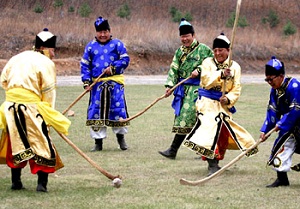
Polo (jiju or daqiu) entered China from Central Asia – likely Persia or the Tibetan Tubo Kingdom – and gained popularity during the Han and Tang dynasties. Tang dynasty emperors were enthusiastic polo players, and court records describe matches played on palace grounds with teams of mounted riders striking a wooden ball with long-handled mallets. Tang-era women also played polo, as documented in tomb murals and ceramic figurines from the 7th and 8th centuries. The sport required trained horses, expensive equipment, and dedicated grounds, which restricted it to the aristocracy and military officers.
Wrestling (jiaoli) has roots reaching back to the Qin dynasty (221-206 BC) and possibly earlier. The sport functioned as both military training and popular entertainment. Han dynasty emperors organized wrestling matches as court spectacles, and the form eventually split into several styles: shuai jiao (throw wrestling) persisted as a competitive sport through the imperial era and into the modern period.
Ancient Chinese sports tied to horses, military training, and physical combat:
- Jiju (polo) – mounted ball game adopted from Central Asia, popular under the Tang dynasty
- Jiaoli / shuai jiao – wrestling, used in military training from the Qin dynasty onward
- Wushu – martial arts systems that developed from military combat techniques into formalized practice sets
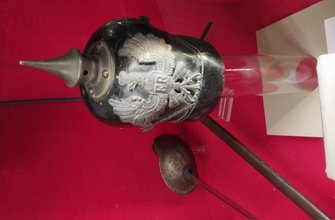
- Jiangshu (fencing) – swordplay practiced as both military skill and competitive sport
- Qigong – breath and movement exercises with roots in Daoist health cultivation, later integrated into martial arts
Board Games: Weiqi and Xiangqi
Weiqi, known internationally as Go, originated in China over 2,500 years ago. The game uses a 19-by-19 grid where two players place black and white stones to control territory. Chinese tradition attributes its invention to the legendary Emperor Yao, who supposedly created it to teach discipline to his son. Regardless of its actual origin, weiqi was established as a gentleman’s game by the Spring and Autumn period (770-476 BC) and held a position alongside calligraphy, painting, and music as one of the “four arts” (si yi) that defined cultured accomplishment in imperial China.
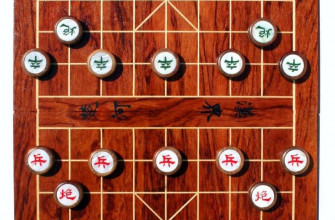
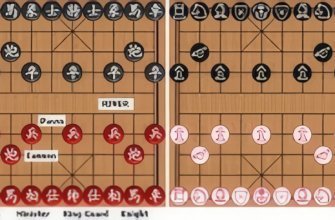
Xiangqi (Chinese chess) developed into its current form by the Song dynasty (960-1279), though earlier versions may date to the Warring States period. The game uses 32 pieces on a board divided by a “river” and shares conceptual roots with the Indian game chaturanga, the ancestor of Western chess. Xiangqi remains the most widely played board game in China, with an estimated 500 million players – public parks across Chinese cities host daily matches between retirees and casual players.
The economic structures of imperial China supported these games through a leisure class that had time for sustained intellectual competition. Professional weiqi players received court patronage during the Tang and Song dynasties, and the game’s strategic depth attracted military theorists who drew parallels between board positions and battlefield situations. The daily life of imperial Chinese households included these games as evening entertainment, and teahouses across major cities hosted weiqi and xiangqi matches that drew spectators and informal wagers.
Dragon Boat Racing and Festival Sports
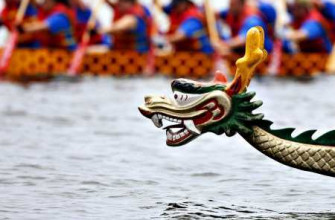
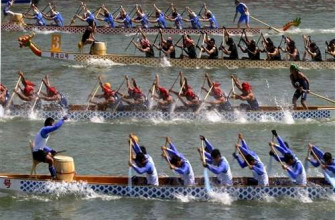
Dragon boat racing ties to the Duanwu Festival (Dragon Boat Festival), held on the fifth day of the fifth lunar month. The tradition commemorates the poet and minister Qu Yuan, who drowned himself in the Miluo River in 278 BC after the fall of the Chu state capital. Teams of paddlers racing long narrow boats decorated with dragon heads and tails became a ritual meant to drive away evil spirits and honor Qu Yuan’s memory. The sport spread from the Yangtze River region across all of southern China and eventually to Southeast Asia, where Chinese diaspora communities maintained the tradition.
Modern dragon boat racing has become a competitive international sport with standardized boat sizes, race distances, and governing bodies. The International Dragon Boat Federation organizes world championships, and the sport appeared as a demonstration event at multiple Asian Games. Chinese dragon boat teams dominate international competition, drawing on a talent pool that traces its paddling tradition back over two millennia.
Other seasonal sports included kite flying (during the Qingming Festival in spring), tug-of-war (documented as a military exercise and festival game from the Tang dynasty), and chuiwan – a game played with wooden clubs and balls on an open course that resembled golf. Chuiwan appears in Song dynasty paintings and texts, with players striking balls into ground-level holes across landscaped courses. The game declined during the Ming dynasty but remains documented in enough detail that historians have reconstructed its equipment and rules. Shuttlecock kicking (jianzi), where players keep a weighted feathered projectile airborne using feet and knees, has survived continuously from the Han dynasty into modern Chinese recreational culture.
Frequently Asked Questions
What was the most popular sport in ancient China?
Cuju (kick-ball) was the most widely documented sport across multiple dynasties. It served as military training during the Warring States period, became a court entertainment under the Han dynasty, and evolved into an accuracy-based game during the Song dynasty. FIFA recognized it in 2004 as the earliest form of football.
Did ancient Chinese play chess?
Xiangqi (Chinese chess) reached its current form during the Song dynasty (960-1279). The game uses 32 pieces on a board divided by a river, and an estimated 500 million people play it in China. Weiqi (Go), a territory-control game on a 19-by-19 grid, is over 2,500 years old and was considered one of the four essential arts of a cultured gentleman.
Was archery important in ancient China?
Archery was one of the six arts in Confucian education, practiced from age 15. It served as both a military skill and a test of moral character. Formal archery ceremonies (she) combined shooting with music, wine, and prescribed etiquette, making archery a social ritual as much as a physical exercise.
Where did dragon boat racing originate?
Dragon boat racing originated in the Yangtze River region as part of the Duanwu Festival, commemorating the poet Qu Yuan who drowned in 278 BC. The sport spread across southern China and into Southeast Asia through Chinese diaspora communities. Modern dragon boat racing is an international competitive sport governed by the International Dragon Boat Federation.
Sources and Further Reading
- Academy of Chinese Studies – Sports in Ancient China (chiculture.org.hk)
- DailyArt Magazine – Modern Sports Played in Ancient China (dailyartmagazine.com)
- Zhang Ruying – Traditional Chinese Games and Sports: Jiju, Chuiwan, Mushe, Touhu, Cuju (zhangruying.com)
- Brewminate – The Development of Leisure Sports in Ancient China (brewminate.com)