What Chinese New Year is and why it matters
Chinese New Year, called Lunar New Year worldwide and Spring Festival in mainland China, marks the start of the lunar calendar’s first month. The holiday lasts about two weeks and ends with the Lantern Festival on the fifteenth night. Celebrations begin with a family reunion dinner on New Year’s Eve and run through visits, parades, and ritual offerings until the lanterns light up the streets at the close.
The festival sits inside a five-thousand-year-old cultural heritage. Its current shape comes from generations of reinterpretation: rural agricultural cycles, imperial court rituals, Buddhist and Daoist motifs, and modern urban adaptations all left a layer. Most Chinese families today combine ancestor veneration, food traditions, and money gifting into a routine that looks similar across mainland China, Taiwan, Singapore, Malaysia, Indonesia, and Chinatowns worldwide.
The date moves between January 21 and February 20 because the lunar calendar runs out of step with the solar year. The first day of CNY falls on the second new moon after the winter solstice. Each year carries one of the twelve zodiac animals; see Chinese Zodiac Signs for the full pillar reference.
The themes that recur across centuries become recognisable once you see the pattern: red and gold colour schemes, even-numbered gifts, foods named for prosperity, lions and dragons in motion, and fireworks loud enough to scare off bad spirits. The rest of this guide breaks each theme out section by section.
The lunar calendar and the Year-Of system
The Chinese lunar calendar is one of the longest continuous chronological records in the world, with a dynasty-by-dynasty history covered in our ancient Chinese calendar guide. Astronomers in the Shang dynasty refined an earlier system, and tradition credits Emperor Huang Ti with formalising the cycle that still anchors festival dates. See Chinese Lunar Calendar for the full mechanics of the system.
A lunar year runs about 354 days. Lunar months track moon phases, so each begins on the new moon and runs 29 or 30 days. Without correction, the calendar would drift away from the seasons within a few decades, so the system inserts a leap month every two or three years. The leap-month rule keeps Spring Festival close to early or mid February in the Gregorian calendar.
Every year is paired with one of twelve zodiac animals (rat, ox, tiger, rabbit, dragon, snake, horse, goat, monkey, rooster, dog, pig) and one of five elements (metal, water, wood, fire, earth). The combination repeats every sixty years. People pay attention to their birth-year zodiac for personality readings, compatibility, and auspicious activity timing during CNY week. See Chinese Zodiac Compatibility for the matchups across all twelve animals.
Traditions and customs at home
The festive routine begins on the eighth day of the twelfth lunar month with the Laba Festival and ramps up across the final three weeks before New Year’s Eve.
Households clean from floor to ceiling in the days leading up to New Year’s Eve. The cleaning sweeps out bad luck from the previous year and clears space for the new. After the new year arrives, sweeping reverses meaning and is avoided for the first three days because the symbolic act would brush new luck out of the home.
The reunion dinner on New Year’s Eve is the single most important meal of the Chinese calendar. Families travel long distances to be home for it. Empty seats are filled with photos, ancestral plaques, or set places that honour distant or deceased relatives.
Red envelopes (hongbao) move money between generations. Elders give to children. Married couples give to unmarried adults. Bosses give to staff. The amount inside is always an even number and avoids the digit four, which sounds the same as the Mandarin word for death. Auspicious sums use eight (which sounds like prosperity) or six (which sounds like smooth flow).
Visits across the first week follow a soft hierarchy. Day one is for the immediate family. Day two visits the maternal side. Days three through six are for friends, in-laws, and colleagues. Day seven is renri, the symbolic birthday of all humanity. Most workers return to offices around day eight or nine.
The fifteen-day cycle ends with the Lantern Festival, when public spaces fill with paper lanterns and families eat sweet rice-flour dumplings called tangyuan.
Decorations: red and gold, lanterns, flowers
Red and gold dominate every CNY visual. Red wards off evil. Gold signals wealth. Households re-paint, replace cushion covers, and hang fresh paper cuttings to swap last year’s decor for new.
Spring couplets (chun lian) are paired strips of red paper with calligraphy on each side. They flank the front door. The lines are usually rhymed and balanced and offer wishes for prosperity, health, or harmony. Above the door sits a single character on red paper: most often Fu (luck), often hung upside-down because the words for “upside-down” and “arrived” are homophones, so an inverted Fu means “luck has arrived.”
Paper-cutting (jianzhi) supplies window decorations. Skilled cutters work in red rice paper with motifs of fish (abundance), flowers (renewal), and zodiac animals (the year’s host).
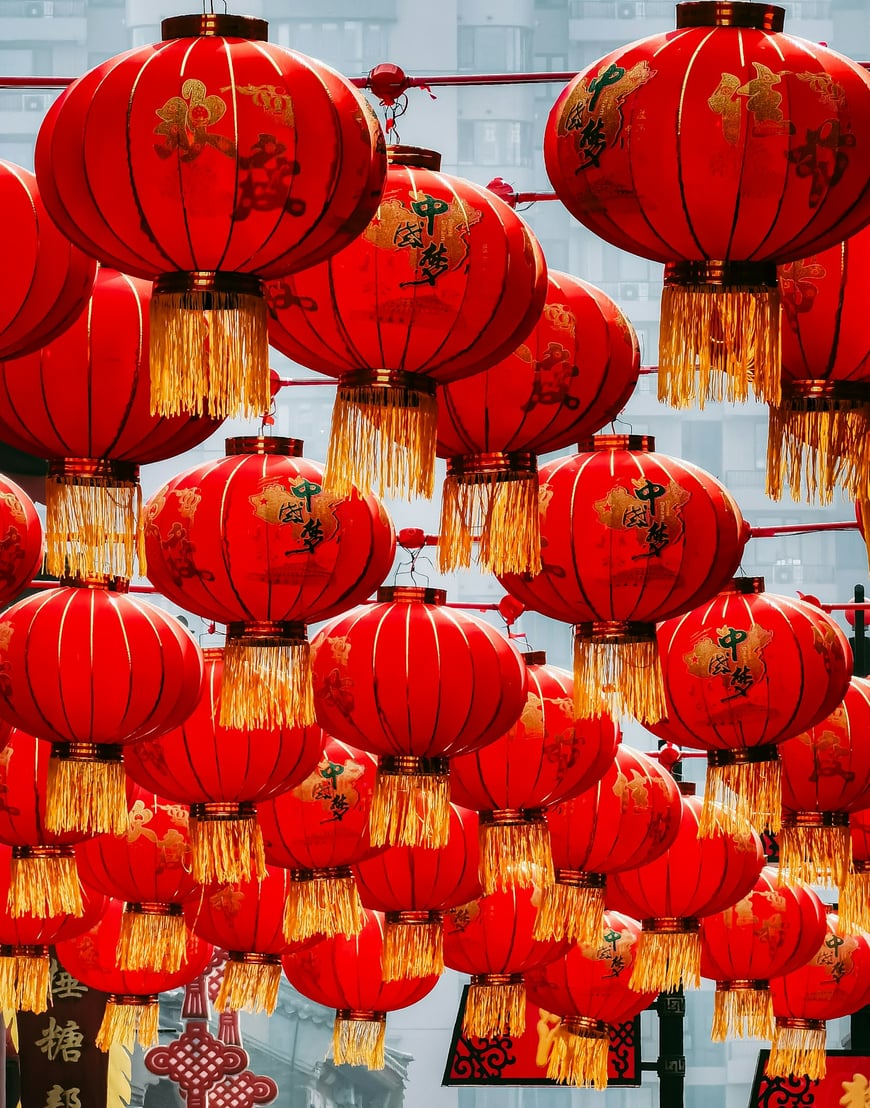
Lanterns hang in every public space and over many doorways. Most are red silk or paper with gold trim and tassels at the bottom. Larger versions appear in temples, shopping districts, and along parade routes. The Lantern Festival on day fifteen turns the streets into a scrolling gallery of riddles and lit shapes.
Cut flowers carry symbolic meaning beyond decoration. Plum blossoms (mei hua) signal courage and renewal because the trees flower against winter cold. Peach blossoms invite romance. Narcissus brings prosperity. Mandarin orange and kumquat trees, with vivid leaves and fruit, sit in pots near front doors.
Food: festive dishes, dumplings, recipes
Every dish at a CNY meal carries a homophone or visual symbol that delivers a wish.
Fish (yu) anchors the New Year’s Eve table. The word for fish sounds like the word for surplus. Tradition leaves part of the fish uneaten so that the surplus carries into the new year. Whole-fish presentation matters; cutting a fish in half cuts the wish in half too.
Dumplings (jiaozi) shape themselves to look like ancient gold or silver ingots. Northern Chinese families make them from scratch on New Year’s Eve and fold lucky coins, peanuts, or candies into a few of them. Whoever bites the coin gets the year’s first stroke of luck.
Spring rolls (chun juan) carry their own seasonal name and are eaten gold-fried so they resemble gold bars. Niangao (sticky rice cake) sounds like “year-high” and predicts continuous improvement.
Tangyuan, sweet glutinous-rice balls in syrup, close the Lantern Festival. The round shape echoes family reunion. Northern Yuanxiao is the same idea with a slightly drier filling and a different rolling technique.
Long noodles (changshou mian) appear at most family meals and are eaten without cutting because shortened noodles signal a shortened life. Citrus fruit (oranges, mandarins, kumquats) sits in piles on the table because both name and colour suggest gold.
For tea drinkers, Spring Festival is also a tea-gifting season. Pu’er, Tieguanyin, and aged white teas circulate among elders. See Chinese Tea Culture for the country’s broader tea tradition.
Activities for families and kids
Family activities dominate the first three days. Most fall into categories that have not changed much since the Qing dynasty.
Crafts. Children fold paper lanterns from red and gold paper, cut window decorations, and write their own Fu characters. Schools and community centres run craft sessions in the days before the festival.
Greetings. The standard New Year greeting is xin nian kuai le (“happy new year”) or gong xi fa cai (“congratulations and prosperity”). Cantonese speakers use gong hei fat choy. Children greet elders with both hands cupped and bow shallowly. The greeting unlocks a hongbao.
Games. Mahjong, card games, and dice games run through every kitchen, living room, and friend’s apartment for a week. Money changes hands but the stakes are usually nominal.
Calligraphy. Calligraphic spring couplets are written by the family member with the best hand or commissioned from a local calligrapher. Some families burn one practice copy as an offering to ancestors.
Temple visits. The first week sees family pilgrimages to local temples. Worshippers light incense, hang prayer cards, and toss coins into wishing wells. Buddhist temples run vegetarian feasts on day one.
Outdoor activities. Lion-dance troupes visit shops and homes for blessings. Children watch fireworks from balconies. In smaller cities, local night markets pop up for the full fifteen days and stay open until the Lantern Festival closes the cycle.
Public celebrations: parades, lions, dragons, fireworks
Public CNY in major cities runs on three pillars: parades, lion and dragon dances, and fireworks.
Parades. Big-city parades (Beijing, Shanghai, Hong Kong, Taipei, San Francisco, Sydney, London) feature floats, marching bands, costumed performers, and ceremonial dragons over a hundred metres long. The Beijing temple-fair circuit (Ditan, Longtan, Changdian) runs traditional folk parades inside and around major Buddhist sites for the full week. See Beijing City Guide for venue context.
Lion dance. Two performers wear the costume: one handles the head with both hands, one bends behind the body and holds the tail. The lion’s movements range from playful (chasing its tail, scratching, sleeping) to acrobatic (jumping between high posts called mei hua zhuang in southern style). The choreography ends with the lion accepting a head of lettuce or oranges hung from a building, “eating” them, and “spitting” the leaves toward the audience to spread abundance. Lion-dance troupes will visit a shop on request and earn a hongbao tucked into the costume.
Dragon dance. A team of nine to fifteen dancers carries a long dragon body on poles. The dragon chases a glowing pearl held aloft by a lead dancer, who spins and feints to keep the body in waveform motion. Dragons can run sixty metres or longer for parade use. The animal evokes power and water; see Year of the Dragon for the zodiac symbolism.
Fireworks. Firecrackers ward off Nian, the legendary new-year monster who is afraid of red, light, and loud noise. Major mainland cities have restricted fireworks for safety and pollution reasons in recent years, so big public displays now anchor the festival in centralised venues. Hong Kong’s harbour show on day two is one of the largest in the calendar.
Music, songs, and kung-fu performances
The CNY soundscape is built from drums, cymbals, and woodwind. The drum patterns drive lion-dance and dragon-dance troupes through their choreography. A standard troupe carries a giant tang gu drum, two cymbal players, and a gong. Each animal movement (head bobbing, eye blinking, tongue extending, tail curling) has a corresponding rhythm cue.
Festive songs surface across radio, shopping malls, and public-square loudspeakers from late January onward. Gong Xi Gong Xi is the most-recognised CNY song and dates to 1946. Newer pop CNY albums turn out every year from Hong Kong and Taiwan singers, with re-recorded standards plus new compositions.
Kung fu and wushu performances run alongside lion dance at temple fairs and shopping centres. Local martial-arts schools showcase student forms and demonstrate weapons routines (sword, staff, broadsword, spear). The style choice often follows the regional school: Hung Gar in Guangdong, Tai Chi in northern China, Wing Chun in Hong Kong.
Erhu and pipa players add a string layer at temple gatherings. Both instruments are old enough to predate most of the festival’s modern shape, and the repertoire includes traditional pieces about spring, planting, and family that fit the season’s themes.
Symbols and their meanings
Most CNY symbols draw on homophones (sound-alike words), imagery (visual likeness), or classical Chinese mythology.
Red. Chases away Nian and bad luck. Used for envelopes, lanterns, paper cuttings, couplets, clothing, candles.
Gold. Signals wealth and the imperial colour. Pairs with red across all decoration.
Dragon. Power, authority, water, the emperor. Dragon dances perform him in public. See Year of the Dragon for the zodiac thread.
Lion. Protection from evil, courage, and theatrical entertainment. Lion-dance troupes carry the symbol from house to house.
Lantern. Light against winter, the closing day’s central image. Each lantern at the Lantern Festival traditionally hides a riddle written on a slip of paper.
Fish. Surplus and abundance through the homophone yu. Carp specifically symbolise perseverance because they swim upstream.
Mandarin orange. Gold by colour and homophone. The Cantonese word for tangerine sounds like “luck.”
Plum blossom. Renewal and resilience because the tree flowers in winter.
Bat. Bian fu sounds like “good fortune.” Bat motifs appear on ceramics, embroidery, and paper-cuttings.
Peony. Wealth and feminine grace. Often paired with peacocks in textile motifs.
For deeper reading on symbol meaning across Chinese culture, see Chinese Family Symbols and Chinese Peace Symbols.
What to wear
Traditional CNY dress uses colours and motifs that mirror the decoration palette. Red, gold, and yellow are most common. White is avoided because it is the funeral colour. Black is acceptable but considered a more sober choice.
The qipao (cheongsam) is the most-recognised women’s silhouette. It is a fitted, high-collar dress with side slits, often in silk brocade, with frog-button closures down the side. Embroidered motifs on the qipao usually carry symbolic weight: phoenix, peony, dragon, plum blossom, or zodiac animals.
The tang suit (tangzhuang) is the menswear equivalent. Mandarin collar, knot buttons, embroidered front panels. Modern tang suits come in lightweight cotton or wool blends and pair with contemporary trousers.
Children often wear a smaller tang suit or qipao plus a small embroidered cap. Some families dress newborns in tiger-pattern shoes or hats for protection.
For modern celebration, casual red sweaters, scarves, or accessories cover the colour requirement without committing to formal wear. Many young people in mainland China now combine traditional collars or buttons with western-cut blazers.
For the deeper textile and silhouette tradition, see Traditional Chinese Clothing.
Chinese New Year around the world
Singapore runs one of the brightest CNY public programs outside mainland China. The Chingay parade, the River Hongbao light festival on the Marina Bay esplanade, and the Chinatown street market all run for the full two weeks. The city colours every public space red and gold during the festival.
Hong Kong’s flower markets in Victoria Park and Mong Kok set up overnight on the eve of New Year and stay open until the early morning. The fireworks show over Victoria Harbour on day two is one of the largest pyrotechnic displays in the calendar.
Taiwan keeps the festival quieter and family-focused. Taipei night markets stay open through the celebrations. Temples in older neighbourhoods draw long incense queues.
San Francisco’s Chinese New Year Parade is the largest outside Asia. The two-hundred-foot Golden Dragon at the parade’s tail closes the procession. The festival has run since the 1860s, making it one of the longest-running celebrations in the city.
London’s Chinatown around Gerrard Street shuts to traffic and runs lion dances, food stalls, and a stage program in Trafalgar Square.
Sydney runs a Lunar Lanterns trail across the inner harbour with twelve large illuminated zodiac animals over the festival fortnight.
Year-by-year quick reference
The first day of Chinese New Year shifts each year because of the lunar-solar drift. The table below lists zodiac-element pairings and Gregorian start dates for recent and upcoming lunar years.
| Year | Zodiac | Element | First Day |
|---|---|---|---|
| 2020 | Rat | Metal | January 25 |
| 2021 | Ox | Metal | February 12 |
| 2022 | Tiger | Water | February 1 |
| 2023 | Rabbit | Water | January 22 |
| 2024 | Dragon | Wood | February 10 |
| 2025 | Snake | Wood | January 29 |
| 2026 | Horse | Fire | February 17 |
| 2027 | Goat | Fire | February 6 |
| 2028 | Monkey | Earth | January 26 |
| 2029 | Rooster | Earth | February 13 |
| 2030 | Dog | Metal | February 3 |
The cycle continues with Horse and Goat (Fire element), Monkey and Rooster (Earth), Dog and Pig (Metal), then Rat and Ox (Water) again, before the wood pairings of Tiger and Rabbit close the decade. The full sixty-year cycle pairs each of the twelve zodiac animals with each of the five elements in turn before returning to the start.
For year-of references on the most-asked animals, see Year of the Rat, Year of the Dragon, or the full pillar at Chinese Zodiac Signs.