The Chinese character he, written хТМ, carries no battle and no enemy in its construction. Where the English word peace comes from a Latin root tied to treaties and the laying down of weapons, he is built from the radical for grain on the left and the radical for mouth on the right, an image of a mouth being fed. The character that Chinese culture has used for two and a half thousand years to mean peace points at fullness and harmony rather than the absence of conflict, and that distinction shapes how the symbol is read in classical philosophy, calligraphy, and the Chinese names for the modern world, a system where each character carries layered meaning – the same principle that guides parents when choosing Chinese girls’ names. This article walks through the etymology of the character, its place alongside the other peace character ping, and the philosophical and modern uses that rest on it.
The visual vocabulary of peace and harmony shares several characters with the Chinese love symbols covered in our separate guide, especially 和 (harmony) and the paired mandarin-duck motif.
Key Chinese Peace Characters
- He (和): harmony, fullness – radicals for grain + mouth. The foundational Confucian peace term.
- Ping (平): level, balanced, calm – image of a scale at rest. Used in pingan (safety) and taiping (great peace).
- Heping (和平): the compound of he + ping, the modern Chinese word for peace as a political and diplomatic concept.
- Taiping (太平): great peace, the classical term for periods of stable imperial rule.
- Pingan (平安): safety and tranquillity, the standard New Year greeting and traveller’s charm.
- Hexie (和谐): harmony/harmonious, the political slogan for ‘harmonious society’ used since the mid-2000s in mainland China.
The Grain in the Mouth Etymology
The character he first appears in oracle bone script during the Shang dynasty, the ritual records inscribed on turtle shells and ox scapulae between roughly 1600 and 1046 BCE. The form on the bones already shows the two radicals that the character keeps today: a stylised drawing on the left of a stalk of grain with the head bending under its own weight, and a square on the right that represents an open mouth. The combined character carried meanings around being fed, around eating together, and by extension around the social state of a community where everyone had enough.
By the time of the Han dynasty seal scripts, the character had stabilised into its modern shape and had taken on the wider meaning of harmony or peace. Classical commentators including the second-century lexicographer Xu Shen, in his Shuowen Jiezi character dictionary, traced the meaning of he to the act of voices joining in song or to the sound of food being shared. The grain radical also appears in many other characters that touch on agricultural plenty, including those for benefit and for autumn, the harvest season.
The mouth radical anchors characters for speech, names, and other social acts. At the centre of he sits the social act of eating together rather than silence or stillness, which classical Chinese culture treated as the foundation of community.
Balance and the Character Ping
Alongside he, the second character that Chinese uses for peace is ping, written х╣│. Where he begins from the image of fullness, ping begins from the image of flatness or balance. The earliest forms of ping in oracle bone script show what some etymologists read as a balance scale at rest, with the two pans level and nothing tipping to one side.
The character carries meanings around being level, being calm, being even, being fair, and being at peace, and these senses run through classical Chinese vocabulary in compound words. Taiping means great peace, the term used in classical historiography for periods of stable rule when the central government held the country together. Heping means peace in the broader sense and is the modern Chinese word for peace as a political concept, including the diplomatic peace between states.
Pingan means safety and tranquillity and is the standard greeting on Chinese New Year cards and on travellers’ good-luck charms. The combination of he and ping produces the modern term heping used in the names of treaties, peace organisations, and diplomatic agreements, including the Chinese rendering of the United Nations Security Council and the International Day of Peace observed each year on 21 September. Calligraphers often write he and ping together as a paired scroll for hanging in homes and offices.
Peace as Harmony Not Absence
The argument that he carries a different sense of peace from the European tradition rests on more than character etymology. Classical Chinese philosophical texts treat peace as a positive state of harmony among parts rather than as the gap between wars. The Confucian Analects and Doctrine of the Mean both use he in passages that describe a well-ordered family, a stable state, or a virtuous person in terms of the right relations between parts.
The most often cited line, from the Doctrine of the Mean, runs that he is the universal way under heaven and that when joy, anger, sorrow, and pleasure each reach their proper measure, the result is called he. The character is used here as a name for the balanced functioning of the inner emotional life rather than as the name for any external political condition. The Daoist Daodejing uses he in a related but different sense, treating it as the natural state of things that arises when artificial interventions are kept low.
Chapter 42 of the Daodejing describes he as the meeting of yin and yang energies that produces the ten thousand things, the standard classical term for the visible material order. In both schools, peace is something present rather than something missing, and the character he was chosen to anchor that meaning.
The Symbol in Confucian and Daoist Thought
The Confucian school made he one of its central ethical and political terms. The Analects of Confucius, compiled by the followers of Master Kong in the centuries after his death around 479 BCE, contain several passages that use he to draw a line between proper agreement and forced uniformity. The most often quoted of these reads that the gentleman seeks harmony but not sameness, while the small man seeks sameness but not harmony.
The distinction between he, harmony among different parts that retain their character, and tong, sameness in which differences are erased, became a recurring theme in later Confucian writing on the family, the state, and the broader social order. Mencius, the second great Confucian after Confucius himself, picked up the same vocabulary and added the line that the harmony of people is more important than the timing of heaven or the favourable lay of the land. The Daoists treated he in a different register, as a quality of the natural world that emerges when human meddling steps back.
The Zhuangzi, the second core Daoist text after the Daodejing, uses he in passages on the equalisation of things and on the calm that follows the abandonment of strenuous striving. Across the centuries, both schools fed the wider Chinese understanding of peace as a balanced active state rather than as a vacuum.
From Calligraphy to Modern Use
The character he has stayed among the most often brushed characters in Chinese calligraphy from the Han dynasty to the present. Calligraphic scrolls bearing the single character he, sometimes paired with ping, are a common gift at weddings, housewarmings, business openings, and the lunar new year. The character also appears on painted plates, embroidered cloths, decorative coins, and door amulets across Chinese homes inside and outside the mainland.
Modern uses include the official names of organisations, periodicals, and political concepts: the Chinese name of the People’s Republic of China includes the character he in Zhonghua Renmin Gongheguo, where gongheguo means republic, a compound that reads as the country of common harmony. The word hexie, meaning harmony or harmonious, has been used as a political slogan in mainland China since the mid-2000s, attached to the official goal of a harmonious society. Outside the mainland, Japanese culture inherited the character as wa, where it serves as a one-character label for traditional Japanese aesthetics, cuisine, and clothing as opposed to imported Western styles.
The single character carries a long history of meaning that compresses agriculture, music, philosophy, and politics into a few brushstrokes. Hong Kong, Macau, and Taiwan continue to use the traditional form of the character on shop signs, festival banners, and printed books, while mainland China prints the same character in its standard form on everything from school textbooks to news headlines. The persistence of the character across script reforms, political turnovers, and the wider script simplification of the twentieth century is itself a small marker of how firmly this single ideogram sits in the cultural toolkit.
How do you write peace in Chinese?
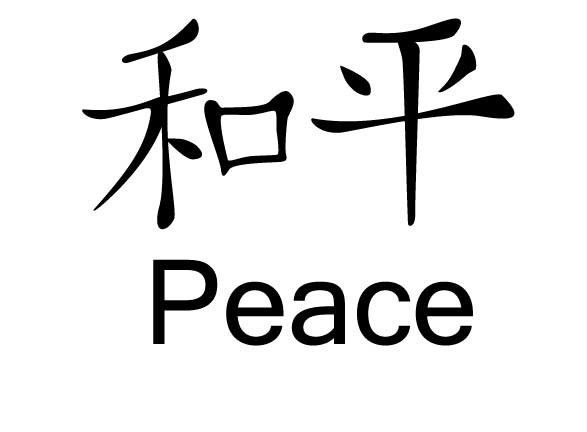
The primary Chinese character for peace-as-harmony is he, written 和. The character for peace-as-balance is ping, written 平. The modern compound word for peace in the diplomatic and political sense is heping, written 和平. Calligraphers often brush he or heping on scrolls given as gifts at weddings, housewarmings, and the lunar new year.
What are the main Chinese symbols for peace?
The two core characters are he (和, harmony from grain and mouth) and ping (平, balance and calm). The compound heping (和平) is the standard modern word for peace. Taiping (太平, great peace) names periods of stable rule. Pingan (平安, safety) appears on New Year cards and good-luck charms. Hexie (和谐, harmonious) has been used as a mainland Chinese political slogan since the mid-2000s.
Frequently Asked Questions
What is the Chinese character for peace?
The two main Chinese characters for peace are he, written хТМ, and ping, written х╣│. He carries the sense of harmony and fullness and is built from the radicals for grain and mouth. Ping carries the sense of being level and balanced. The compound heping means peace in the broader political sense.
What does the character he mean by itself?
The character he combines the radical for grain on the left with the radical for mouth on the right. The image is of a mouth being fed, and the broader meaning runs from being fed and at ease to harmony among parts in a well-ordered system.
Is the Chinese idea of peace different from the Western one?
The Chinese tradition treats peace as a positive state of harmony among parts rather than as the absence of war. Confucian and Daoist texts both use he in this active sense. The English word peace, by contrast, descends from a Latin root tied to treaties and the laying down of weapons.
Buddhist iconography pairs peace and compassion motifs with Chinese zodiac signs, particularly the gentle trine of Rabbit, Sheep, and Pig that folklore associates with harmony.
Sources and Further Reading
- Xu Shen, Shuowen Jiezi, Han dynasty character dictionary, available in modern annotated editions
- D. C. Lau, translator, The Analects, Penguin Classics
- Brook Ziporyn, translator, Zhuangzi: The Complete Writings, Hackett Publishing
- Cihai Chinese encyclopaedic dictionary, Shanghai Lexicographical Publishing House