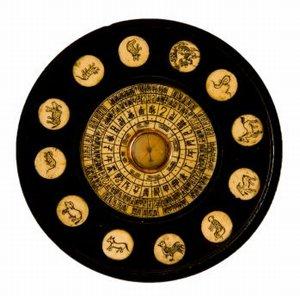
Chinese zodiac history stretches back at least 3,500 years. The earliest traces sit on Shang dynasty oracle bones, unearthed from royal tombs at Anyang in Henan province, where archaeologists working from 1899 onward recovered bone fragments inscribed with animal-sign notation. The fully formed 12-animal cycle we know today was codified a thousand years later under the Han dynasty, written down by the first-century scholar Wang Chong in his Lunheng treatise. From there the zodiac spread across East Asia with Buddhist missionaries and merchant networks, reaching Vietnam, Korea, Japan, Tibet, Mongolia, and Thailand, each of which kept most of the Chinese system while swapping one or two animals for local substitutes.
This page traces the zodiac from Shang oracle bones through the modern day, explains the Great Race myth (including why the cat is missing), and maps the regional variants across East and Southeast Asia. For the 12 animals themselves, see our Chinese zodiac signs overview.
Shang Dynasty Origins (c. 1600-1046 BCE)
The Shang capital at Anyang (modern-day Yinxu archaeological site) produced tens of thousands of oracle-bone fragments, mostly ox scapulae and turtle plastrons used in divination. Shang kings heated the bones until they cracked, read the patterns, and recorded the questions and answers in the world’s earliest Chinese script. Among the records are animal-based time markers, though scholars still debate whether the full 12-animal cycle existed in the Shang era or only a subset.
What the Shang definitely had was the 10 Heavenly Stems and 12 Earthly Branches system for marking days. The 12 Earthly Branches later pulled in the zodiac animals as mnemonic anchors, giving Rat-zǐ, Ox-chǒu, Tiger-yín, Rabbit-mǎo, and so on. Whether the Shang themselves saw Rat for zǐ (as happens in the fully developed Han system) is still unresolved.
Zhou and Warring States Period (1046-221 BCE)
The Zhou dynasty inherited the Shang stem-branch calendar and expanded its ritual use. During the Warring States era (475-221 BCE), when philosophers like Confucius, Mencius, Mozi, and Laozi developed competing schools of thought, the idea of associating human character with natural cycles took deeper root. The zodiac animals began appearing in popular culture, though the 12-animal cycle was not yet universally standardised.
Discoveries in Hubei province, including bamboo strip texts from the 4th-3rd century BCE, show partial zodiac lists using animal names for time units. Some of these early lists swap the order: one version puts the Worm before the Rat, another puts the Deer in place of the Dragon.
Han Dynasty Codification (206 BCE-220 CE)
The Han dynasty produced the 12-animal zodiac in the form we recognise. Wang Chong, writing around 80 CE in his rationalist treatise Lunheng (Balanced Discussions), listed the 12 animals in the standard order: Rat, Ox, Tiger, Rabbit, Dragon, Snake, Horse, Sheep, Monkey, Rooster, Dog, Pig. Wang Chong’s purpose was skeptical: he questioned whether animals really influenced human character. His list survived because Lunheng was preserved in imperial libraries.
The Han period also saw the zodiac absorbed into mainstream folk practice. Funerary art from Han tombs depicts zodiac animals alongside deities and guardian figures. By the end of the Han dynasty, birth-year animal identity was a standard part of a person’s social introduction.
The Jade Emperor and the Great Race
Folk tradition explains the zodiac order through the Great Race myth, which circulated widely from the Tang dynasty (618-907 CE) onward. The Jade Emperor, supreme deity in Chinese folk religion, announced a contest: the first 12 animals to cross a wide river would earn zodiac positions in the order of their arrival.
Key scenes in the myth:
- The Rat and the Cat, both weak swimmers, planned to ride on the Ox’s broad back. The Rat, fearing losing, pushed the Cat into the water midway and jumped off at the riverbank to win first place.
- The Ox arrived second, too honest to complain.
- The Tiger came third, exhausted from swimming across the strong current.
- The Rabbit hopped across on stepping stones and arrived fourth.
- The Dragon, who could fly, came fifth because he paused to bring rain to a village on the way.
- The Snake hid on the Horse’s hoof and jumped off at the finish line, claiming sixth.
- The Horse, startled by the Snake, came seventh.
- The Sheep, Monkey, and Rooster worked together on a raft and arrived as a trio in eighth, ninth, and tenth.
- The Dog, distracted by the river’s freshness, bathed before finishing and arrived eleventh.
- The Pig stopped to eat, slept through most of the race, and straggled in last.
The Cat, tricked by the Rat, missed the race entirely. Chinese folklore uses this origin story to explain why cats hunt rats to this day. Vietnamese tradition diverges here: the Cat completed the crossing and kept its zodiac slot, displacing the Rabbit.
Tang and Song Dynasty Refinement (618-1279 CE)
The Tang dynasty spread the zodiac across East Asia alongside Buddhist missionary work and trade along the Silk Road. Tang emperors commissioned zodiac-animal guardian statues for imperial tombs, and Tang-era poets used zodiac imagery in verse.
The Song dynasty added element theory to the zodiac system. Song astrologers paired the 12 animals with the five Wu Xing elements, producing the 60-year sexagenary cycle in its modern form. For the elements and cycle in detail, see the Chinese Zodiac Elements page. Song printing technology (block-printed almanacs, widely circulated) made zodiac identification accessible across social classes for the first time.
Spread to Vietnam, Korea, and Japan
Buddhist monks carried the zodiac across East Asia from the Tang dynasty onward. Each receiving culture adapted the system:
- Vietnam: swapped the Rabbit for the Cat (mèo) and the Ox for the Water Buffalo (trâu), reflecting local fauna. The 10 other animals stayed.
- Japan: kept all 12 animals but replaced the domestic Pig (豬) with the Wild Boar (猪 inoshishi). Japanese tradition also observes the Fire Horse year (1906, 1966, 2026) with folk beliefs about daughters born in that year having fiery temperaments.
- Korea: preserved all 12 Chinese animals and the stem-branch system (called ganji in Korean).
- Tibet: added some animals to the list in certain local traditions, giving variant cycles used in Tibetan astrology.
- Mongolia: adopted the Chinese 12-animal zodiac through Buddhist influence.
- Thailand: uses the 12-animal zodiac with local names and associates the signs with a different set of colours and days of the week.
Ming and Qing Dynasty Popular Culture (1368-1912)
The Ming-era novel Journey to the West (Xi You Ji), published around 1592, cemented the Monkey animal in global culture through its hero Sun Wukong, the Monkey King. Ming porcelain, Qing-era New Year prints, and imperial court fashion all used zodiac iconography extensively.
The Qing dynasty standardised almanac publishing. Yearly Qing almanacs (tong shu) listed zodiac compatibility, lucky days by element, and auspicious dates for weddings, construction, and business openings. These almanacs still publish today in mainland China, Hong Kong, Taiwan, and overseas Chinese communities.
Modern Era and Global Reach (1912-Present)
The Republican era (1912-1949) saw reformers push for Western calendar adoption, but the zodiac survived as cultural tradition even as official dates moved to the Gregorian system. Mao Zedong’s Cultural Revolution (1966-1976) discouraged traditional practices including zodiac astrology, though folk observance continued in homes and villages.
Reform-era China, from 1978 onward, revived zodiac celebration as part of broader cultural traditionalism. Dragon years, in particular, produce measurable birth-rate spikes: 2000 and 2012 both saw Chinese birth rates climb by 5-10 percent as parents timed pregnancies for Dragon children. The zodiac now appears on airline tickets, Starbucks cups, Lunar New Year postage stamps in dozens of countries, and international fashion collections from Gucci to Lunar New Year capsule lines.
Frequently Asked Questions
How old is the Chinese zodiac?
The stem-branch calendar underpinning the zodiac dates to at least the Shang dynasty around 1200 BCE. The full 12-animal system in its modern form was codified under the Han dynasty, with Wang Chong’s Lunheng (c. 80 CE) giving the oldest surviving complete list.
Why is the cat not in the Chinese zodiac?
The Great Race myth explains that the Rat tricked the Cat out of the race. Historical reality is likely simpler: domestic cats reached China relatively late, after the 12-animal system had already set, though they were present in Han-era Chinese households.
Why does the rat come first?
The Great Race story credits the Rat’s cunning (riding on the Ox and jumping off first). The symbolic reading: Chinese culture historically rewarded cleverness and opportunism as much as strength or size.
Who invented the Chinese zodiac?
No single inventor. The system evolved from Shang-era divination practices over roughly a thousand years. Han-dynasty scholar Wang Chong wrote the oldest surviving standardised list, but the system was already in wide folk use when he recorded it.
Is the Chinese zodiac related to Western astrology?
The two systems developed independently. Chinese zodiac is birth-year based and uses animals; Western astrology is birth-month based and uses constellations. They share some thematic overlap (personality reading, compatibility advice) but have different origins and methods.
What is the difference between Chinese and Japanese zodiac?
Japan kept the Chinese system almost intact but swapped the Pig for the Wild Boar. Japanese tradition also puts more weight on the Fire Horse year’s cultural significance than mainland China does.
Sources and Further Reading
- Wang Chong, Lunheng (Balanced Discussions), Han dynasty text – classics.mit.edu
- Oracle bone research – Anyang archaeological site – Institute of Archaeology, Chinese Academy of Social Sciences
- The Cambridge History of Ancient China – Michael Loewe and Edward L. Shaughnessy (eds), Cambridge University Press
- Chinese Almanacs and Folk Religion – Patrice Fava, Ecole Francaise d’Extreme-Orient
- Zodiac iconography across East Asia – Asia Society asiasociety.org