Costa Rica’s traje tipico dates back to the mid-1800s, shaped by colonial Spanish dress codes, European cashmere imports, and indigenous textile techniques that survived three centuries of occupation. Each of the country’s seven provinces developed its own version of the costume, tied to local climate, available materials, and cultural ancestry. The garments show up at civic parades, folk dance festivals, and national holidays – never as everyday wear, but as a deliberate statement of regional identity. This guide covers the women’s and men’s costumes province by province, the festivals where you can see them, and how daily dress in Costa Rica compares to formal tradition.
How the Traje Tipico Developed Over Four Centuries
Before Spanish colonizers arrived in the early 1500s, indigenous groups across Costa Rica wore garments made from plant fibers, bark cloth, and animal skins. The Chorotega people in the northwest used cotton they cultivated and dyed with natural pigments. Spanish rule replaced most indigenous clothing practices with European-style garments by the late 1600s, though certain construction methods – layered skirts, woven sashes, bright dye patterns – carried forward into the colonial-era dress that became the foundation of the traje tipico.
The coffee boom of the 1830s and 1840s connected Costa Rica to European markets. Ships that carried coffee beans to London and Paris returned with cashmere fabric, silk thread, and lace. Guanacaste and Puntarenas provinces adopted cashmere for petticoats and blouses first, and the material spread to the Central Valley within a decade. Wealthier families dressed in imported fabrics; farming households used locally woven cotton. That economic split shaped two tiers of the same costume – one for landowners at formal events, another for campesino families at local celebrations.
By the early 1900s, the traje tipico had settled into the forms still worn at festivals. European fashion influence faded after Costa Rican independence solidified, and the costume became a fixed cultural symbol rather than an evolving style. Regional differences crystallized as each province claimed specific color palettes, accessories, and silhouettes.
Women’s Traje Tipico: Layers, Color, and Provincial Identity
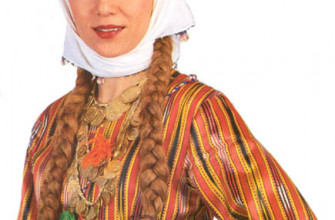
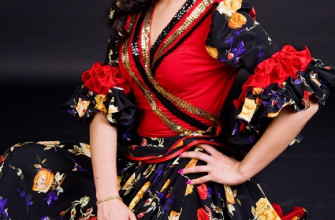
The women’s costume shares a common skeleton across all seven provinces: a blouse (cotona or camisola) with puffed sleeves, a long layered skirt with ruffled hems, and a combination of hair ornaments, ribbons, and jewelry. The details vary enough between provinces that someone familiar with the tradition can identify a dancer’s home region at a glance.
The blouse sits off the shoulders or features a high neck depending on province. Puffed sleeves – sometimes called “pumpkin sleeves” in Guanacaste – flare outward and taper at the elbow or wrist. Ruffles, lace trim, and embroidered patterns decorate the neckline and sleeve edges. The skirt (gola) reaches the ankles, often with two or three tiers of ruffled fabric in contrasting colors. A wide sash or cummerbund cinches the waist, pulling the silhouette together.
Accessories complete the outfit: natural flowers tucked behind one ear, velvet ribbon chokers with gold medallions, combs decorated with colored ribbons, and leather sandals or black patent-leather boots depending on the formality of the event. Earrings and bracelets add metallic accents. The color combinations follow provincial tradition rather than personal preference, making each costume a form of geographic shorthand.
Costa Rica Traje Tipico by Province
- Guanacaste: bright gola skirts with ribbon trim, white blouse, floral headpiece
- San Jose: refined cotton dress with lace detail, influenced by urban European fashion
- Cartago: darker tones, heavy lace blouse, wool skirt for the cooler highland climate
- Heredia: subdued colours, embroidered apron, coffee-country styling
- Alajuela: lighter fabrics, floral prints, adapted to the warmer lowland temperatures
- Puntarenas: Pacific coastal influence, cotton dress, wider brimmed hat for sun protection
- Limon: Caribbean Afro-Costa Rican prints, brighter colours, influenced by Jamaican and Trinidadian dress traditions
Provincial Variations in Women’s Dress
San Jose’s costume centers on white and purple fabrics. Women wear a black velvet necklace with a gold medallion and place natural flowers in their hair. A black ribbon appears both in the hair and on the blouse, distinguishing the capital’s style from its neighbors. The overall look leans formal, reflecting San Jose’s role as the administrative center.
Heredia breaks from the bright palette that defines most Costa Rican provinces. Women here wear darker, more opaque colors – deep blues, blacks, and muted tones. The blouse uses cotton or plain silk with a high neckline. A black silk shawl drapes over the back, and the footwear shifts to black patent-leather ankle boots rather than sandals. The effect reads more conservative than festive.
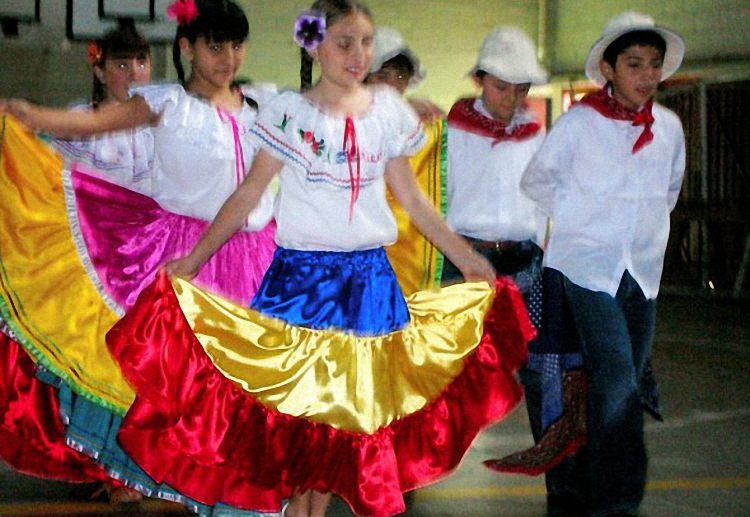
Guanacaste, the center of Costa Rican folklore, favors the brightest colors. White cotton petticoats with flights pair with camisoles featuring pumpkin sleeves. Dancers performing the Punto Guanacasteco – the national folk dance – spin long gola skirts in sweeping arcs, showing off layers of red, blue, and yellow fabric.
Cartago’s style reflects its colonial history as the former capital. Blouses feature fine lace detailing, with some pieces historically imported from the United Kingdom. The look carries an older, more European feel than the costumes of other provinces.
Puntarenas adds a large Madrid-style shawl as the signature outer garment. During Holy Week, women decorate their costumes with sequins and colorful muslin flowers. Fans form part of the basic ensemble, a practical addition in the province’s coastal heat. Pointed boots or black patent-leather boots replace the sandals seen elsewhere.
Limon stands apart from the rest. The Caribbean province’s costume reflects Afro-Caribbean heritage rather than Spanish colonial roots. Women wear white cotton blouses with colorful trim and patterned skirts, paired with African-style turbans. During carnival celebrations, the dresses shift toward elaborate carnival-style designs with bold geometric patterns.
Alajuela keeps its costume relatively austere compared to Guanacaste or Puntarenas. A wide cotton shirt with flights, a brightly colored rebozo (shawl), and a silk petticoat in soft colors make up the base. A black velvet ribbon with a cross or gold medallion hangs at the neck, and combs adorned with colored ribbons hold the hair in place.
Men’s Costume: White Cotton and the Red Sash
The men’s traje tipico follows a simpler template across provinces. A white or light-colored cotton shirt – long-sleeved in formal versions, sometimes short-sleeved in Guanacaste’s heat – pairs with white cotton pants. The signature piece is a wide red sash (faja) wrapped around the waist, visible in every provincial variation. A red neckerchief tied at the front adds a second accent of color.
Headwear matters. A white or natural straw brimmed hat (sombrero) completes the outfit, shaped differently by region. Guanacaste’s hats tend wider to block the northwestern sun. Central Valley versions sit narrower. Leather sandals called caites serve as the standard footwear, though some provinces substitute closed shoes for formal occasions.
The white cotton reflects the working life of campesinos – farmers who spent their days in Costa Rica’s coffee fields and cattle ranches. The red sash and neckerchief provided the only color in a practical outfit designed for tropical heat. Cartago’s men stood out by adding calico jackets, beaver hats in white or black, and linen ties or vests, borrowing from European formal wear more than other provinces.
Festivals and Occasions Where Traditional Dress Appears
The Dia de los Boyeros (Day of the Oxcart Drivers), held every second Sunday of March in San Antonio de Escazu, draws the largest concentration of traditional costumes in the country. Over 100 painted oxcarts parade through town, each driven by a boyero in full traje tipico – white shirt, red sash, wide-brimmed hat. A priest blesses the crops and animals that farmers bring to the parade. Marimba bands play while families eat traditional food and browse handcraft stalls.
Folk dance performances at regional festivals showcase the costumes in motion. The Punto Guanacasteco, declared Costa Rica’s national dance in 1972, features couples in full provincial dress performing sweeping footwork patterns. Other traditional dances – La Cajeta, El Torito, El Zapateado, La Botijuela – each call for specific costume elements. Guanacaste’s annual cultural festivals in July draw dance troupes from across the country.
Independence Day (September 15), Annexation of Guanacaste Day (July 25), and Dia de las Culturas (October 12) all feature traditional dress at civic ceremonies, school parades, and public gatherings. Unlike neighboring Guatemala or Peru, where indigenous dress remains daily wear in many communities, Costa Ricans reserve the traje tipico for these designated celebrations.
Everyday Dress in Modern Costa Rica
Outside festivals, Costa Ricans dress in the same casual Western clothing found across Latin America – jeans, t-shirts, sneakers. One cultural pattern stands out to visitors: men across the country prefer long pants over shorts for daily errands, even in 30-degree heat. Shorts appear at beaches and at home but rarely in towns, markets, or restaurants. The habit traces back to Catholic modesty norms that shaped Costa Rican social expectations for generations.
Women dress more flexibly, though knee-length skirts remain more common than mini-skirts in rural towns. Urban San Jose follows international fashion trends closely. Beach towns along both coasts – the Pacific side near Manuel Antonio and the Caribbean coast near Limon – lean casual, with tourists and locals mixing surf-culture clothing with tropical prints.
The gap between festival dress and everyday wear keeps widening. Younger Costa Ricans may own a traje tipico for school performances or civic events but treat it as costume rather than wardrobe. Guanacaste’s rural communities maintain the strongest everyday connection to traditional aesthetics, with artisan workshops producing handwoven textiles and leather sandals for both local use and tourist sales.
Frequently Asked Questions
What do people in Costa Rica wear on a daily basis?
Costa Ricans wear Western-style casual clothing – jeans, t-shirts, and sneakers dominate. Men tend to wear long pants rather than shorts outside the beach, a cultural norm rooted in Catholic modesty traditions. Visitors can dress casually in tourist areas and beach towns without drawing attention.
What is the Punto Guanacasteco and what costumes does it require?
The Punto Guanacasteco is Costa Rica’s national folk dance, declared so in 1972. Women wear long, brightly colored gola skirts with white puffed-sleeve blouses and hair flowers. Men dress in white cotton with a red sash, red neckerchief, and straw hat. The dance involves sweeping spins that showcase the layered skirt fabric.
Do all Costa Rican provinces have the same traditional costume?
Each of the seven provinces has distinct costume details. Guanacaste uses the brightest colors and pumpkin-sleeved blouses. Heredia favors dark, muted tones. Limon incorporates Afro-Caribbean elements like turbans. Cartago features British-imported lace. The differences reflect each region’s specific colonial history, climate, and cultural roots.
When can tourists see traditional Costa Rican clothing?
The best opportunities are the Dia de los Boyeros parade in Escazu (second Sunday of March), Guanacaste cultural festivals in July, Independence Day celebrations on September 15, and Annexation of Guanacaste Day on July 25. Folk dance performances at regional festivals and civic ceremonies throughout the year also feature full traje tipico.
What materials are used in Costa Rica’s traditional costumes?
Cotton forms the base fabric for most garments. Historically, wealthier families used imported cashmere and silk from Europe, brought in through the coffee trade. Lace – some of it from the UK – decorates blouses in Cartago. Leather provides sandals (caites) and boots. Modern reproductions use a mix of cotton, synthetic blends, and commercially available lace.
Sources and Further Reading
- SensorialSunsets – Where Does the Costa Rican Typical Costume Come From (sensorialsunsets.com)
- CostaRicaInfoLink – Costa Rica Typical Costumes by Province (costaricainfolink.com)
- Tico Times – Celebrating Cultural Heritage: National Boyero Day in Costa Rica (ticotimes.net, 2023)
- Visit Costa Rica – Cultural Manifestations in Guanacaste (visitcostarica.com, official tourism board)