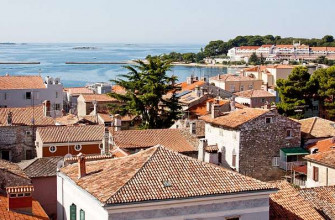
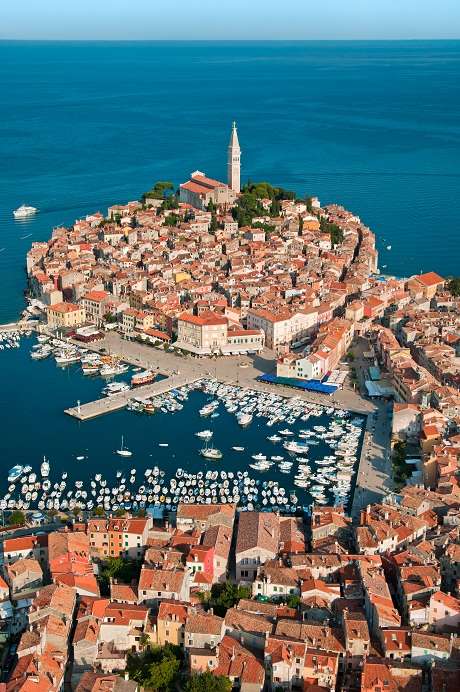
Rovinj sits on the western coast of Croatia’s Istrian Peninsula, a harbour town of roughly 14,000 residents whose terracotta-roofed old town rises on an egg-shaped hill out of the Adriatic Sea. The Venetian Republic ruled Rovinj for 514 years, from 1283 to 1797, and the architectural imprint still runs through the town: fluted window frames, winged-lion reliefs on civic buildings, and the cobblestone carrugi alleys that zigzag up to the baroque Church of St Euphemia. Modern Rovinj blends that medieval core with 22 small islands in the surrounding archipelago, a working fishing harbour, and a mature tourism industry built around Istrian cuisine, Adriatic diving, and day trips along the peninsula.
This guide walks through Rovinj’s historical background, the old town’s main sights, the nearby islands and beaches, Istrian food and wine, day trips to Pula, Porec, and Brijuni, practical climate and transport information, and recommended itineraries for families, couples, and food-focused travellers.
Location and Historical Background
Rovinj lies 40 kilometres south of Porec, 35 kilometres north of Pula, and roughly 110 kilometres from Trieste in Italy. The town occupies a peninsula that was an island until 1763, when the narrow strait separating it from the mainland was filled in by the Venetian authorities. The old town’s highest point – the bell tower of St Euphemia – reaches 61 metres and is visible from ships approaching along the Istrian coast.
Rovinj’s documented history stretches back to the 3rd century CE when a Roman settlement called Arupinium appeared on the island. The town fell under Byzantine rule in the 6th century and under Venetian control from 1283. The Venetians built the defensive walls, the current street grid, and most of the churches. After Napoleon ended the Venetian Republic in 1797, Rovinj passed to Austria, then briefly to Italy after the First World War, and finally to Yugoslavia and modern Croatia.
The population shifted dramatically at several points. Italian was the dominant language through the early 20th century; a large Italian-speaking community left after 1945 during the Istrian exodus (an estimated 250,000 Istrian Italians departed for Italy). Today Croatian dominates, though Italian remains a co-official language in Istria, most street signs are bilingual, and many older residents still speak the Istro-Venetian dialect.
The Old Town and Main Sights
Rovinj’s old town is compact enough to walk end-to-end in 15 minutes, but rewards 2-4 hours of exploration. The streets funnel uphill from the harbour to the Church of St Euphemia at the top.
- Church of St Euphemia: the baroque cathedral at the hill’s summit, completed in 1736. The 60-metre bell tower (modelled on the Campanile in Venice’s Piazza San Marco) holds a weather-vane statue of Saint Euphemia, who legend says rotates to face the direction bad weather is approaching. The saint’s remains, brought to Rovinj from Constantinople in the 9th century, rest inside a Roman-era marble sarcophagus.
- Grisia Street: the artistic heart of Rovinj, a cobbled street lined with galleries, studios, and craft shops running up toward St Euphemia. Every second Sunday in August the street hosts an open-air art exhibition where dozens of painters display and sell work.
- Balbi’s Arch: built in 1680, the main entrance to the old town from the Tito Square (Trg Marsala Tita). The arch carries a Turkish head carving on the outer side and a Venetian face inside, symbolising medieval Rovinj’s geopolitical orientation.
- Tito Square (Trg Marsala Tita): the main waterfront square, lined with cafes and facing the harbour. The clock tower on the square carries a winged lion relief, the Venetian symbol of civic authority.
- Rovinj Heritage Museum (Muzej Grada Rovinja): in a 17th-century baroque palace, covering local archaeology, Venetian-era paintings, and a modern art collection. Entry includes access to the palace courtyard with its stone well.
- Batana House (Kuca o batani): a small cultural museum dedicated to the traditional Rovinj fishing boat called batana. The UNESCO Intangible Cultural Heritage list includes the batana tradition.
- Seven of the original seven medieval town gates: three still standing (St Benedict’s Gate, Portica, and the Gate of the Holy Cross)
The best way to see the old town is from the water. Small tour boats depart from the main harbour for half-hour loops around the peninsula, passing under the cathedral’s cliff and showing the waterfront facade that photographs well in late-afternoon light.
Beaches and the Rovinj Archipelago
Rovinj’s archipelago includes 22 named islands and islets stretching from Zlatni Rt (Golden Cape) park in the south to the rocky coast north of the town. The two largest islands, both developed for tourism, are Crveni Otok (Red Island) and Sveta Katarina (Saint Catherine).
- Crveni Otok (Red Island): technically two islands joined by a causeway, lying 2 kilometres offshore. The island hosts large resort hotels, tree-shaded beaches, and hiking paths through Mediterranean pine forest. Passenger boats run every 30-60 minutes from the old town harbour (10-minute crossing).
- Sveta Katarina (Saint Catherine Island): the smaller, closer island directly opposite the harbour. A historic villa and small hotel sit among cypress and pine. Good option for half-day trips combining a beach, lunch, and return.
- Zlatni Rt (Golden Cape) Park Forest: a 95-hectare peninsula south of the old town, planted with Aleppo pine and holm oak in the 19th century. Walking and cycling paths run the length; small pebble coves appear every few hundred metres. The park is free to enter and gives the best on-foot access to quieter beaches.
- Cuvi Beach: a long pebble beach south of the old town, popular with families for its shallow entry and nearby cafes
- Porton Biondi: pebble beach north of the old town, a favourite for its proximity to the ferry terminal and traditional Rovinj waterfront views
- Bale Beach: gravel beach at the far north edge of the town, quieter than the southern beaches and better for windsurfing when the bora wind blows
Adriatic water around Rovinj is clear and typically 24-26 degrees Celsius in July and August, dropping to 18 degrees in May and October. Italian tourists tend to dominate the beaches in August; May, June, and September produce noticeably less crowded conditions.
Water Sports and Diving
Rovinj’s protected harbour and calm Adriatic waters make it a base for most standard watersports. Local operators offer:
- Scuba diving: two major shipwrecks lie within a short boat ride. The Baron Gautsch, a passenger liner sunk in 1914 at 40 metres depth, is Croatia’s most famous wreck dive. The John Gilmore, a cargo ship, rests at 25 metres and suits open-water certified divers.
- Snorkelling: the rocky shoreline around Zlatni Rt and the Rovinj islands offers good visibility and Adriatic marine life including octopus, bream, and occasionally seahorses
- Kayaking: single and tandem kayaks rent by the hour or day; popular routes circle Sveta Katarina and pass the Zlatni Rt coastline
- Stand-up paddleboarding: rentals along Cuvi Beach and Porton Biondi
- Sailing: bareboat charters from the Marina ACI run through the Kvarner and Istrian coasts; skippered day trips are offered for non-sailors
- Windsurfing and kitesurfing: best in the Bale Beach area during bora wind conditions (November-April)
- Para-sailing and jet ski: operators on the southern beaches offer standard resort activities
The Baron Gautsch wreck, in particular, draws divers from across Europe. The ship sank with over 240 passengers on board and remains a designated war grave; diving permits are strictly regulated and usually arranged through one of the Rovinj dive centres (Diving Center Rovinj and Scuba Duba among the main operators).
Istrian Food and Wine
Rovinj sits within an Istrian food region that produces some of the Mediterranean’s most distinctive ingredients. Three products in particular drive the regional cuisine:
- White truffles from Motovun forest, 50 kilometres inland. Motovun truffles are considered among the three best truffle varieties in the world, rivalling those of Alba in Italy. Season runs September to January.
- Istrian olive oil: recognised under EU Protected Designation of Origin since 2016. Small olive groves carpet the Istrian interior; many producers offer farm visits and tastings.
- Malvazija wine: the white grape variety that dominates Istrian viticulture. Crisp, mineral, and well-suited to seafood. Red wines from the Teran grape also come from Istria, paired locally with truffles and aged cheeses.
Rovinj restaurants range from waterfront tourist spots to refined establishments focused on seasonal Istrian cooking. Classic regional dishes include:
- Fuzi pasta with truffle: hand-rolled twisted pasta with white truffle shavings during autumn season
- Pljukanci: hand-pinched fresh pasta, usually served with olive oil, garlic, and seafood
- Boskarin beef: the Istrian white cattle breed, protected and raised on small farms across the interior. Served as ragu, steak, or pasticada (slow-stewed)
- Brudet: seafood stew with tomato, garlic, and red wine, served with polenta
- Crni rizoto: black risotto with cuttlefish ink, a standard Adriatic seafood dish
- Scampi na buzaru: langoustines cooked in white wine, olive oil, and breadcrumbs
- Pasta with wild asparagus in spring months
- Prsut Istrijanski: Istrian dry-cured ham, comparable to Italian prosciutto
The best non-touristy eating happens in the village restaurants of Bale (inland), Bracevac, and Rovinjsko Selo (5-10 kilometres from Rovinj). The Konoba Rovinj and Monte Restaurant inside the old town offer Michelin-recognised fine dining; the waterfront restaurants are good for atmosphere but quality varies.
Day Trips from Rovinj
Rovinj works well as a base for the southern and central Istrian peninsula:
- Pula: 35 kilometres south, home to a 1st-century Roman amphitheatre (Pula Arena) preserved almost intact, plus the Temple of Augustus, Forum, and a major port. The amphitheatre still hosts concerts and the annual Pula Film Festival.
- Porec: 40 kilometres north, famous for the Euphrasian Basilica (6th-century Byzantine, UNESCO World Heritage Site) with original mosaic interior
- Motovun: 50 kilometres northeast, a hilltop medieval town with panoramic views over truffle forests. The village hosts the annual Motovun Film Festival in late July.
- Brijuni National Park: 15 islands off the coast, accessible by boat from Fazana (12 kilometres south of Rovinj). Brijuni holds Roman-era villa ruins, dinosaur footprints, and the former residence of Yugoslav leader Tito.
- Lim Bay (Limski Kanal): a 10-kilometre fjord-like inlet 10 kilometres north of Rovinj, famous for oyster and mussel farms. Boat trips from Rovinj usually include a seafood lunch at a farm restaurant.
- Hum: claimed as the smallest town in the world with roughly 20 residents, 90 minutes inland from Rovinj. The medieval walled village holds a 12th-century church and makes a good half-day drive.
- Groznjan: artists’ village on a hilltop 80 kilometres northeast, known for summer jazz workshops and craft studios
- Rijeka: 100 kilometres east, Croatia’s third-largest city and a 2020 European Capital of Culture. A full day trip or an overnight stop.
A rental car produces the most flexibility for Istrian touring. Distances are modest (Pula to Porec takes under 90 minutes) and the coastal road (A9/A8 motorways plus the D75 coastal route) is well-signed. Public buses serve Pula, Porec, and Rovinj with regular connections; inland villages are harder to reach without a car.
Climate and Best Time to Visit
Rovinj has a Mediterranean climate with hot dry summers and mild rainy winters. The bora wind occasionally hits in winter and spring, producing gusty cold spells that clear the air but disrupt ferry schedules.
- May to mid-June: 18-25 degrees, sea warming to 20 degrees, wildflowers in the countryside, lowest summer tourist volume
- Mid-June to August: 25-32 degrees, sea 24-26 degrees, peak tourist season with Italian and German visitors dominating. Hotel prices highest.
- September: 23-28 degrees, sea still 22-24 degrees, Italian families departed, best balance of weather and quiet
- October: 17-23 degrees, truffle season starts, some beaches empty by midmonth
- November to March: 8-15 degrees, occasional cold snaps, most beach-focused businesses close. Urban restaurants and Istrian inland destinations remain open.
Truffle enthusiasts favour September-November for fresh white truffles and March-May for spring specialities. The Rovinj Photo Days festival runs each May and adds an arts dimension to early-season visits.
Transport and Practical Information
Rovinj does not have an airport. The three usable entry points:
- Pula Airport (PUY), 40 kilometres south, the closest option with direct flights from most European capitals during summer. Transfer to Rovinj by bus, taxi (30 minutes, roughly 40-50 euros), or rental car.
- Trieste Airport (TRS) in Italy, 120 kilometres north, served by more budget carriers. Bus and rental car transfers cross the Slovenia-Croatia border (passport still required despite EU membership of both).
- Venice Marco Polo Airport (VCE), 230 kilometres northwest, with a broader flight network. Transfer by private driver (3 hours) or train + bus combinations.
Getting around Rovinj itself:
- Walking: the old town is car-free and entirely walkable. Most hotels and apartments sit within 15 minutes on foot.
- Local buses: connect Rovinj to surrounding towns and to the southern beach areas
- Water taxis and ferries: run to Crveni Otok, Sveta Katarina, and occasionally Pula
- Rental cars: several agencies in town; handy for Istrian day trips
- Bicycles and e-scooters: several rental points in the old town, useful for Zlatni Rt park and the Bale Beach area
The Croatian currency is the euro (adopted January 2023, replacing the kuna). Credit cards are accepted at most restaurants and hotels; smaller tavernas and market stalls prefer cash. Tipping 10 percent is standard at restaurants.
Accommodation Options
Rovinj’s hotel market splits into three tiers:
- Luxury: Hotel Monte Mulini, Grand Park Hotel Rovinj, Hotel Lone. Five-star properties near the Zlatni Rt park, prices 400+ euros per night in summer.
- Mid-range: Hotel Adriatic, Hotel Eden, Hotel Park, Island Hotel Istra on Crveni Otok. Four-star properties at 150-300 euros per night in summer.
- Apartments and pensions: independent properties in the old town and Borik neighborhood. Prices 60-150 euros per night, offering kitchens and local character.
Booking 2-4 months ahead is recommended for July and August visits; September and May bookings rarely need that lead time. For a broader view of Croatia holiday options including other destinations, see our all-inclusive Croatia holidays guide, and for boat-based itineraries the Croatia boat holidays page.
Frequently Asked Questions
Where is Rovinj in Croatia?
Rovinj sits on the western coast of the Istrian Peninsula in northwestern Croatia, 35 kilometres north of Pula, 40 kilometres south of Porec, and roughly 110 kilometres from Trieste, Italy. The town faces the Adriatic Sea with 22 small islands in its surrounding archipelago.
Is Rovinj worth visiting?
Rovinj combines a preserved medieval old town with Adriatic beaches, Istrian cuisine (white truffles, olive oil, malvazija wine), and easy access to major day-trip destinations like Pula, Porec, and Brijuni National Park. The small-scale of the town makes it especially rewarding for visitors who dislike crowded large resort destinations.
How do you get to Rovinj?
Pula Airport, 40 kilometres south, is the closest arrival point with direct summer flights from most European capitals. Trieste in Italy (120 kilometres) and Venice (230 kilometres) offer alternatives with broader flight networks. Transfers to Rovinj run by bus, private driver, taxi, or rental car.
What language is spoken in Rovinj?
Croatian is the dominant language, with Italian as a co-official regional language across Istria. Most street signs are bilingual. Older residents still speak the Istro-Venetian dialect. English is widely spoken in tourist services.
When is the best time to visit Rovinj?
May to mid-June and September offer the best balance of warm weather, swimmable sea temperatures (20-24 degrees), and smaller crowds than peak summer. July and August bring the warmest sea (26 degrees) but heaviest tourist numbers and highest prices. October brings truffle season for food-focused visits.
What is the Rovinj archipelago?
The Rovinj archipelago is a cluster of 22 small islands and islets off the town’s coast. The two largest, Crveni Otok (Red Island) and Sveta Katarina (Saint Catherine), host hotels and beaches reachable by frequent passenger boats. Smaller islets suit private boat excursions and diving.
Is Rovinj better than Dubrovnik?
The two cities offer different experiences. Dubrovnik has grander fortifications and dramatic old-town walls but sits in a heavily touristed southern Dalmatia. Rovinj is smaller, quieter, and integrates Italian-Istrian culture through food and architecture. Travellers seeking atmospheric small towns prefer Rovinj; those wanting dramatic landscapes lean toward Dubrovnik.
What currency does Rovinj use?
Croatia adopted the euro in January 2023, replacing the former kuna. Credit cards work at most hotels and restaurants; smaller tavernas and market stalls prefer cash. Banks and ATMs are widely available in the old town.
Sources and Further Reading
- Istria and Croatia: A History – Oliver Domsa, Croatian Heritage Foundation
- Rovinj Tourist Board official guide – tzgrovinj.hr
- The Batana Ecomuseum heritage programme – batana.org
- Istrian Peninsula travel coverage – Lonely Planet Croatia
- Baron Gautsch wreck documentation – Maritime Heritage Centre
- UNESCO Intangible Cultural Heritage listing for batana boatbuilding – unesco.org