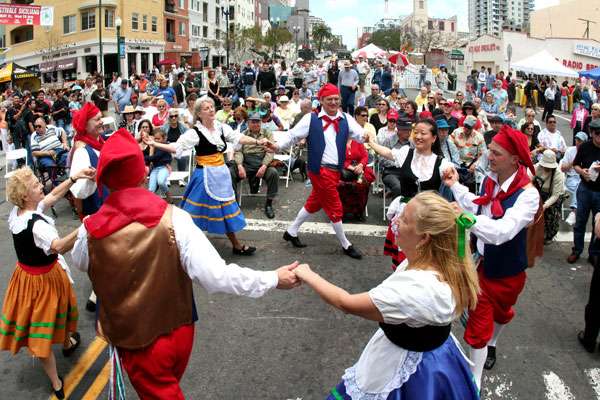
Italy observes 12 national public holidays per year, and its regional calendar adds hundreds of local festivals tied to patron saints, harvests, and historical events. The country shuts down almost entirely on days like Ferragosto (August 15) and Christmas, while regional celebrations like the Palio di Siena and the Venice Carnival draw visitors from across the world. Italian holidays split into three categories: state holidays mandated by law, Catholic religious observances that carry public holiday status, and local festivals that vary from town to town. This breakdown covers all three types, month by month, with the specific traditions that define each.
National Public Holidays: The 12 Official Dates
The Italian government recognizes 12 public holidays when banks, government offices, and most businesses close. Workers receive full pay for these days, and shops operate on limited schedules or close entirely. The dates remain fixed each year except for Easter and Easter Monday, which follow the Catholic liturgical calendar.
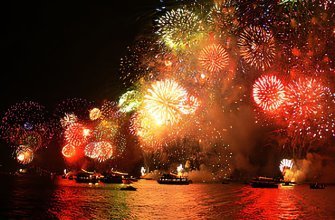
- January 1 – Capodanno (New Year’s Day): fireworks, public concerts, and the tradition of eating lentils at midnight for prosperity
- January 6 – Epifania (Epiphany): La Befana, a folkloric old woman, brings sweets to children; markets and parades mark the end of the Christmas season
- Easter Sunday and Easter Monday – Pasqua and Pasquetta: Easter Monday (Pasquetta) is the unofficial start of spring, celebrated with outdoor picnics
- April 25 – Festa della Liberazione (Liberation Day): marks Italy’s liberation from Nazi occupation in 1945; parades and civic ceremonies nationwide
- May 1 – Festa dei Lavoratori (Labor Day): a free outdoor concert in Rome’s Piazza San Giovanni draws hundreds of thousands
- June 2 – Festa della Repubblica (Republic Day): commemorates the 1946 referendum that ended the monarchy; a military parade runs along Via dei Fori Imperiali in Rome
- August 15 – Ferragosto (Assumption Day): the peak of Italian summer holidays; cities empty as families head to beaches and mountains
- November 1 – Ognissanti (All Saints’ Day): families visit cemeteries to clean graves, light candles, and place flowers
- December 8 – Immacolata Concezione (Immaculate Conception): marks the start of the Christmas season; Rome’s firefighters climb a ladder to place a wreath on the column of the Virgin Mary in Piazza di Spagna
- December 25-26 – Natale and Santo Stefano (Christmas and St. Stephen’s Day): midnight mass, family meals built around regional recipes, and two consecutive days off work
Carnival Season: Venice, Viareggio, and the Battle of the Oranges
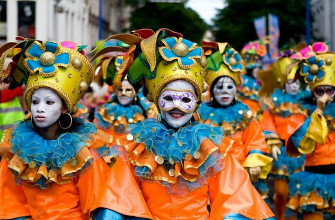
Carnival runs for roughly two weeks before Lent, ending on Shrove Tuesday (Martedi Grasso). The Venice Carnival is the largest and oldest, dating back to at least the 11th century. Participants wear elaborate masks in styles called Bauta, Moretta, Gnaga, and Volta, most of them inspired by 18th-century Venetian fashion. The Gran Teatro water show on the Grand Canal and the volo dell’angelo (flight of the angel) from the Campanile in St. Mark’s Square headline the program.
Viareggio’s carnival, running since 1873, features enormous papier-mache floats that satirize political figures. The floats parade along the seaside promenade over four consecutive Sundays. In Ivrea, near Turin, the Battaglia delle Arance (Battle of the Oranges) fills the town’s streets with organized teams throwing oranges at each other from horse-drawn carts, reenacting a medieval rebellion against a local tyrant. The battle uses roughly 500 tons of oranges each year.
Easter and the Holy Week Processions
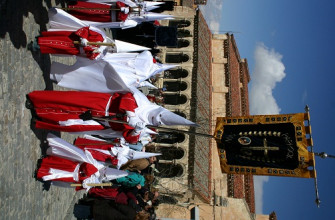
Settimana Santa (Holy Week) brings religious processions to towns across Italy, with the most dramatic events concentrated in southern regions. Florence holds the Scoppio del Carro (Explosion of the Cart) on Easter Sunday – a 350-year-old tradition where a cart loaded with fireworks is ignited in front of the Duomo using a mechanical dove sent along a wire from the high altar inside the cathedral. A successful explosion predicts a good harvest.
Sicily’s Holy Week processions in Trapani run for 24 consecutive hours on Good Friday and Saturday, with 20 wooden sculptural groups carried through the streets on the shoulders of local guilds. The processions date to the Spanish colonial period. In Rome, the Pope leads the Via Crucis (Way of the Cross) at the Colosseum on Good Friday evening, broadcast to an international audience.
Summer Festivals: Palio, Ferragosto, and Open-Air Events
The Palio di Siena runs twice each summer – July 2 and August 16 – in Piazza del Campo. Ten of Siena’s 17 contrade (city wards) compete in a bareback horse race that lasts roughly 90 seconds. Months of preparation, alliances, and rivalry between contrade build toward each race. The winning contrada celebrates with street banquets that can last for days. Siena’s residents identify with their contrada from birth, and the Palio carries emotional weight that goes far beyond sport.
Ferragosto on August 15 traces its origins to the Roman festival Feriae Augusti, established by Emperor Augustus in 18 BC as a period of rest after the harvest. The Catholic Church layered the Feast of the Assumption over the same date. Modern Italians treat the weeks around Ferragosto as peak vacation time. Factories close, urban life pauses, and coastal towns fill with families from the interior.
The summer opera season at the Arena di Verona, a Roman amphitheater that seats 15,000, runs from June through September and stages grand productions of Aida, Tosca, and La Traviata. The Festival dei Due Mondi in Spoleto, founded in 1958, combines opera, theater, dance, and visual art across two weeks in late June and early July.
Autumn and Winter: Harvest Fairs and Christmas Markets
The Alba International White Truffle Fair runs from October through November in the Piedmont town of Alba. Tartufo bianco d’Alba (white truffle) sells at auction for thousands of euros per kilogram, with record prices exceeding 100,000 euros for single specimens. The fair includes truffle hunts, cooking demonstrations, and a medieval donkey race called the Palio degli Asini.
Christmas markets (Mercatini di Natale) fill the squares of northern Italian towns from late November through early January. The markets in Bolzano and Merano, in the German-speaking South Tyrol region, follow the Austrian Christkindlmarkt tradition with wooden stalls selling handcrafts, spiced wine (vin brule), and roasted chestnuts. Naples builds elaborate presepe (nativity scene) displays along Via San Gregorio Armeno, where artisan workshops have produced handmade figurines for centuries.
La Befana closes the Italian holiday season on January 6. According to folklore, an old woman refused to follow the Three Wise Men to Bethlehem and now searches house to house, leaving sweets for good children and coal (usually candy coal) for naughty ones. Venice celebrates with the Regata della Befana, where rowers dressed as La Befana race gondolas along the Grand Canal. In Verona, a large Befana puppet is burned in a public ceremony called the rogo della vecia.
Local Patron Saint Festivals
Every Italian town celebrates the feast day of its patron saint (festa patronale) with a local public holiday. These are not national days off, but businesses in the town typically close. Rome celebrates Saints Peter and Paul on June 29. Milan honors Sant’Ambrogio on December 7, the traditional opening night of the opera season at La Scala. Naples marks San Gennaro on September 19 with the ritual liquefaction of a vial of dried blood attributed to the saint – if the blood liquefies, it predicts good fortune for the city.
Smaller towns hold processions, fireworks, and communal meals on their patron’s day. The festa patronale often includes a sagra (food festival) featuring a local specialty – roasted chestnuts in mountain villages, seafood along the coast, porchetta in central Lazio. These hyperlocal celebrations give each town its own calendar anchor beyond the national holidays. Some sagre have grown into regional draws – the Sagra del Pesce in Camogli fries fish in a four-meter pan on the harbor, and the Sagra della Castagna in Soriano nel Cimino fills streets with chestnut vendors and wood-fired roasters each October.
Frequently Asked Questions
How many public holidays does Italy have per year?
Italy has 12 official national public holidays. Banks, government offices, and most businesses close on these days. Each town also celebrates its own patron saint’s feast day as a local holiday, adding one more day off for local workers.
What is Ferragosto and why does Italy shut down?
Ferragosto falls on August 15 and combines the ancient Roman harvest rest period (Feriae Augusti, established in 18 BC) with the Catholic Feast of the Assumption. Most Italians take vacation during the weeks surrounding this date, and factories, shops, and offices close across the country.
What happens during the Venice Carnival?
The Venice Carnival runs for about two weeks before Lent, featuring elaborate masked costumes, the Gran Teatro water show, the Flight of the Angel ceremony, and masked balls. The tradition dates back to at least the 11th century. Masks follow historical styles including Bauta, Moretta, and Gnaga designs.
What is La Befana?
La Befana is a folkloric figure celebrated on January 6 (Epiphany). According to tradition, she is an old woman who brings sweets to good children and candy coal to naughty ones. Venice holds the Regata della Befana with costumed rowers, and Verona burns a large Befana puppet in a public ceremony.
Sources and Further Reading
- Italia.it – Epiphany in Italy: Befana Meaning and Traditions (official Italian tourism portal)
- Tour Italy Now – Italian Public Holidays Calendar and Traditions (touritalynow.com)
- Salt & Wind Travel – Top 10 Italian National Holidays Every Traveler Must Know (saltandwind.com)
- Guide to Italy – Italian Regional Festivals and Celebration Calendar (guidetoitaly.com)