The Haudenosaunee Confederacy – known in English as the Iroquois – developed a weapons arsenal built for woodland combat in the forests of what is now upstate New York, southern Ontario, and the Great Lakes region. Their principal arms included the longbow, the ball-headed war club, the stone tomahawk, knives, and lances, each designed for a specific tactical role in the ambush-and-raid warfare that the Confederacy practiced against neighboring nations and, later, against European colonial forces. The Haudenosaunee originally consisted of five nations – Mohawk (Kanien’keha:ka), Seneca (Onondowaga), Oneida (Onyota’a:ka), Onondaga, and Cayuga – and expanded to six when the Tuscarora joined around 1722. This article covers each weapon type, the materials and construction methods behind them, how the Beaver Wars changed Haudenosaunee armament, and the role that European musket trade played in reshaping the military balance of northeastern North America.
The Longbow and Arrow
The Haudenosaunee longbow served as the primary ranged weapon for both hunting and warfare. Crafted from a single stave of hickory, ash, or elm – hardwoods available throughout the northeastern forests – the bow measured roughly 1.5 meters and required substantial upper-body strength to draw. Bowstrings came from twisted plant fiber or animal sinew. A skilled Haudenosaunee archer could launch up to 20 arrows in the time a colonial-era soldier needed to fire, reload, and aim a single-shot musket, giving bow-armed warriors a significant rate-of-fire advantage in close-range woodland encounters.
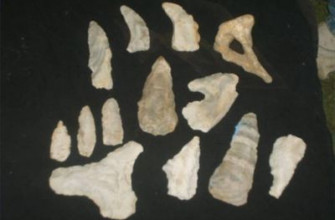
Arrowheads were shaped from flint, chert, or animal bone through a process called flint knapping – striking and pressure-flaking the stone into a sharp triangular point. After European contact, Haudenosaunee craftspeople began using traded iron and brass to forge metal arrowheads that held a sharper edge and resisted breakage better than stone. Arrow shafts came from straight shoots of dogwood or viburnum, fletched with turkey or hawk feathers split and bound with sinew.
The bow remained the dominant Haudenosaunee weapon through the early 1600s. Its effectiveness depended on the dense forest terrain that characterized the region – trees and underbrush provided cover for archers and broke up the open-field formations that European musket tactics required.
The Ball-Headed War Club
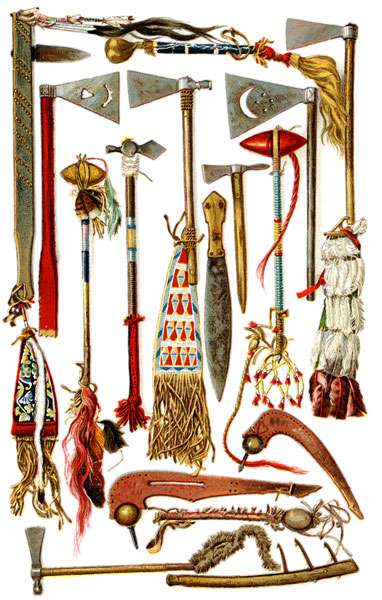
The war club held a central place in Haudenosaunee close-combat fighting. The most common design was the ball-headed club – a hardwood shaft roughly 60 centimeters long with a heavy spherical knob carved from the same piece of wood at one end. The ball concentrated impact force into a small striking area, making the weapon effective against both unarmored opponents and those wearing leather or wooden armor.
Haudenosaunee warriors carried war clubs during raids, ambushes, and the hand-to-hand fighting that followed an initial volley of arrows. The club’s weight and balance made it suited to close-quarters combat in forest clearings and inside enemy palisade walls. Decorative carvings, paint, and attached feathers marked individual clubs as personal weapons, and some surviving examples in museum collections carry incised designs that may represent battle counts or clan membership.
A variant called the gunstock club appeared after European contact. Shaped to resemble the stock of a musket, this club sometimes incorporated a metal blade set into the striking end. The gunstock club spread across multiple eastern nations during the 17th and 18th centuries and became a widely adopted Indigenous weapon form across northeastern North America.
Tomahawks: From Stone to Trade Metal
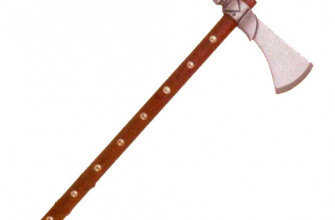
The pre-contact Haudenosaunee tomahawk was a hand axe with a stone head hafted onto a short wooden handle. Warriors used it both as a thrown weapon and as a melee tool for close fighting. A trained thrower could strike a target at 15 to 20 meters with reasonable accuracy, though the weapon was more reliable as a hand-held striking tool than as a projectile.
European trade transformed the tomahawk. Dutch, English, and French traders supplied iron and steel tomahawk heads in exchange for beaver pelts, and the metal heads replaced stone within a generation of sustained contact. The trade tomahawk came in several forms:
- Hatchet-style – a simple axe head on a wooden handle, the most common trade form
- Pipe tomahawk – a hollow-handled version with a pipe bowl on the poll (back of the head), used for both fighting and ceremonial smoking
- Spike tomahawk – a narrow spike replacing the axe blade, designed for penetrating armor and thick clothing
The tomahawk became a symbol of Haudenosaunee martial identity that extended beyond its practical function. Burying the tomahawk (burying the hatchet) signaled peace between nations, while raising the tomahawk declared war – a diplomatic vocabulary that passed into English-language idiom.
Knives, Lances, and Shields
Flint and bone knives served as sidearms and utility tools. Warriors carried them at the waist for use in close combat when other weapons became impractical – inside longhouses during raids, for example, or when grappling with an opponent. European trade replaced stone blades with iron and steel knife blades during the 1600s, and the trade knife became standard equipment for warriors, hunters, and everyday household tasks.
Lances appeared in Haudenosaunee combat but less prominently than among Plains nations who fought from horseback. The Haudenosaunee fought on foot in forested terrain, and the lance functioned primarily as a thrusting weapon for defensive positions – particularly during attacks on palisaded villages where defenders could stab downward at attackers scaling the walls. Some lances served ceremonial roles in council proceedings and victory celebrations.
Haudenosaunee warriors used wooden shields covered with rawhide during the pre-contact period, though shields declined in use after muskets made them ineffective against projectiles. Body armor made from wooden slats bound together with cord offered limited protection against arrows and clubs and saw use during the inter-tribal conflicts that preceded the Beaver Wars.
Woodland Warfare Tactics
Haudenosaunee military strategy relied on speed, concealment, and psychological impact rather than the massed infantry formations that European armies used. War parties traveled light, carrying weapons, dried corn, and little else. They moved through forests on foot and along rivers by birch bark or elm bark canoe, covering distances that colonial observers found remarkable. A documented tactic involved paddling canoes deep into enemy territory at night, then sinking them with weighted stones to hide them underwater while the war party struck overland.
Ambushes formed the core of Haudenosaunee offensive operations. Warriors positioned themselves along forest trails or river portage routes and attacked from concealment, opening with a volley of arrows (later musket fire) before closing with war clubs and tomahawks. Palisaded village attacks required different methods – fire arrows, coordinated wall-scaling, and sustained pressure to breach wooden fortifications. The 17th-century ethnohistorical record, including French Jesuit Relations and Dutch colonial reports, documents these assault techniques in detail.
Haudenosaunee warriors also practiced what colonial sources called “mourning wars” – raids intended to capture prisoners who would replace community members lost to warfare or disease. Captives could be adopted into Haudenosaunee families, effectively becoming members of the nation. This practice served a demographic function during periods of high mortality from European-introduced diseases and sustained the Confederacy’s population base through decades of continuous warfare.
The Beaver Wars and the Musket Transition
The Beaver Wars (roughly 1640-1701) reshaped Haudenosaunee weaponry and warfare. By the 1640s, overhunting had depleted the beaver population in Haudenosaunee territory, threatening the fur trade that supplied European goods – including firearms. The Confederacy launched a series of campaigns to control beaver-rich territory in the Great Lakes region, destroying the Huron (Wendat) Confederacy, the Erie, the Neutral Nation, and the Susquehannock over several decades.
Dutch traders at Fort Orange (present-day Albany, New York) supplied the Haudenosaunee with muskets starting in 1648, giving them a firepower advantage over neighboring nations that had not yet acquired European weapons in large numbers. The military balance across the northeast shifted as musket-armed Haudenosaunee war parties struck targets hundreds of kilometers from their home territory. The French countered by arming their Algonquin and Huron allies, escalating the conflict into a proxy war between European colonial powers fought through Indigenous forces.
By the early 1700s, the musket had replaced the bow as the Haudenosaunee primary ranged weapon. However, warriors continued to carry war clubs and tomahawks for close combat, and these weapons retained their ceremonial and diplomatic significance long after firearms became standard military equipment.
The Great Peace of Montreal in 1701 ended the Beaver Wars and established a framework of neutrality between the Haudenosaunee and French-allied nations. The Confederacy’s military capacity, built on both traditional and European weaponry, played a central diplomatic role during the colonial period. British and French negotiators courted Haudenosaunee alliances precisely because the Confederacy fielded warriors equipped with muskets, traditional weapons, and tactical knowledge that no European army could replicate in the northeastern forests.
Frequently Asked Questions
What weapons did the Iroquois use?
The Haudenosaunee (Iroquois) used longbows with flint-tipped arrows, ball-headed war clubs, stone tomahawks (later replaced by metal trade tomahawks), knives, lances, and wooden shields. After European contact in the 1600s, they acquired muskets through the Dutch fur trade, which eventually replaced the bow as the primary ranged weapon.
What was the Haudenosaunee war club made from?
The ball-headed war club was carved from a single piece of hardwood – typically ironwood, maple, or ash. A heavy spherical knob at one end concentrated striking force. The clubs measured roughly 60 centimeters and were used in close combat during raids and ambushes in forested terrain.
How did European trade change Haudenosaunee weapons?
Dutch, English, and French traders exchanged iron tomahawk heads, steel knives, and muskets for beaver pelts beginning in the early 1600s. Metal replaced stone in most weapon heads within a generation. Muskets acquired through the Dutch fur trade after 1648 gave the Haudenosaunee a decisive advantage during the Beaver Wars.
Did the Iroquois fight on horseback?
The Haudenosaunee were woodland warriors who fought on foot. Their terrain – dense northeastern forests, river valleys, and palisaded villages – did not suit cavalry tactics. Horses were adopted by Plains nations further west. Haudenosaunee mobility came from war canoes on rivers and rapid foot movement through forest trails.
Sources and Further Reading
- The History Junkie – Iroquois Weapons (thehistoryjunkie.com)
- The Canadian Encyclopedia – Iroquois Wars (thecanadianencyclopedia.ca)
- Project MUSE – An Ethnohistorical Analysis of Iroquois Assault Tactics Used Against Fortified Settlements, Ethnohistory journal
- Potawatomi.org – Colonial and Intertribal Wars: Beaver Wars 1628-1701 (potawatomi.org)