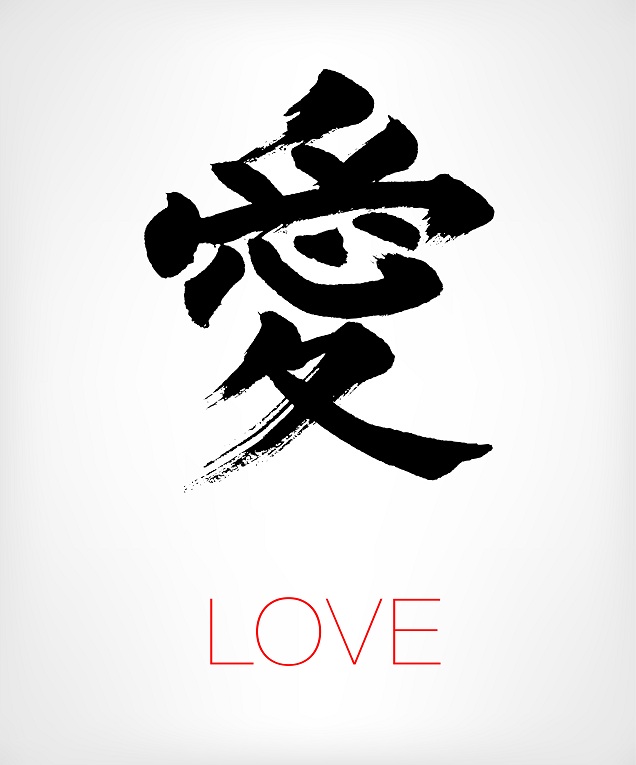
The Chinese character for love is 爱 (ài) in simplified script and 愛 in traditional script. The older traditional form contains the heart radical 心 at its centre, which simplification removed in the 1956 reform. Critics of the simplification argued that removing the heart made the character semantically poorer, and the traditional version remains the preferred form in calligraphy, tattoos, and wedding decorations even in mainland China where the simplified script is standard for everyday use.
This guide covers the main Chinese love symbols: the 爱 / 愛 character in both scripts, the Double Happiness 囍 used at weddings, the dragon and phoenix pair that represents balanced love, the mandarin-duck pairing that stands for lifelong partnership, and the Chinese Valentine’s Day festival of Qixi that gathers all these symbols into a single night.
The Love Character: 爱 (Simplified) vs 愛 (Traditional)
The traditional character 愛 has thirteen strokes and four components: 爫 (a claw or hand) at the top, 冖 (a cover), 心 (the heart) at the centre, and 夊 (a slow walk) at the bottom. The visual logic reads as a hand offering shelter to a heart that walks slowly, a composition that scholars interpret as “love walks carefully, carrying the heart”.
Simplified 爱 drops the central heart and replaces the bottom with 友 (friend). The resulting character has ten strokes and a cleaner silhouette, and supporters of the reform argue that it strengthens the link between love and friendship. Opponents see the removal of the heart as the single most debated change in the simplification programme, and they cite 愛 as evidence that older forms carried philosophical content that simplification lost.
In practice, both characters appear in the same cultural spaces. Wedding invitations often use 愛 for its visual richness even when the rest of the text is simplified. Street signs and contracts use 爱. Tattoos split roughly evenly, and Chinese family name research databases record both as valid variants of the same word. Our overview of the history of Chinese writing covers the 1956 simplification in more detail.
Double Happiness: 囍 (Shuāngxǐ)
囍 is the Double Happiness symbol, the most recognisable Chinese wedding marker. The character stacks two copies of 喜 (xǐ, happiness) side by side into a single square glyph. The meaning is literal compression: one joy doubled, the combined happiness of the bride and groom at the moment of their union.
The origin story attributes 囍 to Wang Anshi, a Song dynasty (960-1279) scholar who received news of passing the imperial examination on the morning of his wedding. To celebrate both honours at once, he wrote the two 喜 characters side by side and sent the calligraphy to his bride’s family. Whether Wang Anshi actually invented the symbol or whether the story was attached to a pre-existing design after the fact, 囍 became the standard wedding ornament by the late Song period and has remained unchanged in form for about a thousand years.
Modern Chinese weddings use 囍 on every horizontal surface. Red paper cut-outs appear on doors, windows, walls, the backs of chairs at the banquet, and the cars that carry the wedding party. The couple’s families often commission a calligrapher to write a single large 囍 for display at the ceremony; the calligraphy is then kept as a family heirloom and hung in the couple’s new home for the first year of their marriage.
The colour is always red, which stands for luck, celebration, and life in Chinese tradition. A black or white 囍 is considered inappropriate at weddings because white symbolises mourning. Our guide to Chinese family symbols covers the related family-themed characters that often appear alongside 囍 at weddings.
Dragon and Phoenix: The Balanced Couple
The dragon (龍, lóng) and phoenix (鳳, fèng) paired together form the most common animal love symbol in Chinese culture. The dragon represents the yang energy of the male principle: powerful, upward-moving, associated with the sky, clouds, and rain. The phoenix represents the yin energy of the female principle: graceful, warm, associated with the sun, fire, and renewal. A dragon and phoenix pictured together stand for a balanced marriage where male and female energies complement rather than compete.
Wedding motifs typically show the dragon circling upward on the left and the phoenix gliding downward on the right, with a shared pearl (the symbol of wisdom or the soul) between them. The pairing appears on wedding invitations, wedding dress embroidery, bridal jewellery, and palace decorations; imperial weddings historically used the dragon-phoenix motif on the throne behind the emperor and empress as the central decoration. Readers interested in the garments themselves can consult our guide to traditional Chinese clothing, which covers the red qipao and other wedding dress styles in detail.
The symbolism also extends to family structure beyond the couple. A “dragon father and phoenix mother” producing children is a traditional idiom for an ideal household. Modern Chinese interior design still uses dragon-phoenix paintings or ceramics as housewarming gifts for newly married couples, usually paired with a 囍 calligraphy above the main sofa.
Mandarin Ducks: Lifelong Partners
Mandarin ducks (鴛鴦, yuānyāng) mate for life, and Chinese folk tradition makes them the symbol of marital fidelity and lifelong companionship. A pair of mandarin ducks painted or embroidered together represents a couple that stays together through the full sequence of life’s stages, not only at the moment of wedding but through old age and into the afterlife.
The symbol carries a gentler meaning than the dragon-phoenix pairing. Dragon-phoenix stands for energetic complement; mandarin ducks stand for quiet persistence. The two are not alternatives; many weddings use both, placing the dragon-phoenix at the ceremonial centre and mandarin ducks on more personal items like embroidered pillowcases, bed sheets, and household gifts exchanged between the two families.
Chinese feng shui practitioners place mandarin-duck figurines in the “relationship corner” of the bedroom (the southwest corner by compass direction) to strengthen a marriage or attract a new partner. The figurines are always sold in pairs, and separating them is considered unlucky. Shop owners who display single ducks or mismatched pairs usually do not sell them until the pair is complete.
Qixi: The Chinese Valentine’s Day
Qixi (七夕, qīxī) is the traditional Chinese festival for lovers, celebrated on the seventh day of the seventh lunar month (usually late August in the Gregorian calendar). Our explainer on the Chinese lunar calendar shows how the festival’s date shifts from year to year against the Western calendar. The festival grew from the legend of the weaver girl Zhinü and the cowherd Niulang, two lovers separated by the Milky Way and allowed to meet only once a year when a flock of magpies forms a bridge across the sky for them to cross.
The legend structures Chinese romantic ideals in ways that Valentine’s Day does not. Western Valentine’s Day celebrates love that is present and easy. Qixi celebrates love that endures across separation: the weaver girl and the cowherd wait an entire year for one night together, and the festival asks lovers to honour the patience, loyalty, and trust that make long-distance or delayed love possible.
Modern Qixi in mainland China and Taiwan has absorbed Western Valentine’s Day gift-giving, with red roses, chocolate, and dinner reservations becoming standard. The older traditional activities (girls making offerings to Zhinü, couples watching the Milky Way together, families telling the legend to children) survive alongside the commercial version, especially in smaller cities and rural areas.
Love Knot and Paired Fish
The Chinese love knot (盤長結 panchang jie, one of the eight auspicious knots of Buddhist tradition) is an endless loop woven from a single red cord with no start and no end. The knot represents an unbroken bond and is given between couples at anniversaries, attached to wedding gifts, or worn as a pendant. The craft of tying love knots (中國結, Chinese knotting) is a traditional art form still taught in schools across Taiwan and mainland China.
Paired fish (雙魚, shuāngyú) carry a secondary love meaning alongside their primary symbolism of abundance and plenty. A pair of goldfish swimming together represents marital harmony. Carp are specifically associated with perseverance in love, drawing on the legend of the carp that leapt over the Dragon Gate at the source of the Yellow River and transformed into a dragon: a lover’s persistence can transform an ordinary relationship into something noble.
Both motifs appear at weddings and anniversaries, usually on ceramics, embroidery, or jade pendants. Gifts featuring paired fish or love knots are appropriate for wedding guests who want something more subtle than the bold 囍 while still expressing a wish for the couple’s happiness.
How to Use Chinese Love Symbols in Decor and Tattoos
Chinese couples incorporate love symbols into their home decor in specific places. The bedroom takes mandarin-duck figurines (southwest corner for feng shui placement), 囍 calligraphy on the wall above the headboard, and sometimes a dragon-phoenix painting on the opposite wall. The living room usually carries a large 愛 or 家 (family) calligraphy as the main decoration. The front door takes 福 (fortune) at New Year and 囍 at a wedding.
Chinese tattoos featuring love characters have a mixed record among native speakers. Common warnings:
- Use the correct character: 爱 and 愛 are both valid; some tattoo flash books contain poorly drawn versions with incorrect stroke counts. Always verify with a native speaker before booking.
- Avoid mirrored or rotated characters: Some tattoo artists copy reference images that have been flipped, and a mirrored 愛 is meaningless.
- Avoid combining random characters: “Love forever” in Chinese is not 愛 永 (a literal character-by-character substitution), but 永恆 的 愛 or 永遠 之 愛 with correct word order. Literal translations from online tools often produce gibberish.
- Consider the calligraphic style: A printed font looks flat as a tattoo. Commissioning a calligrapher to write the character in running or cursive script produces a more visually compelling result and reduces the risk of your tattoo looking like a menu.
- Pair with a symbol that makes sense: 愛 paired with 囍 makes cultural sense for a wedding tattoo. 愛 paired with a random zodiac animal does not and marks the tattoo as a Western tourist choice rather than a considered design.
Frequently Asked Questions
What is the Chinese symbol for love?
The primary character is 爱 in simplified Chinese and 愛 in traditional Chinese, both pronounced ài. The traditional form contains the heart radical 心 at its centre, which was removed in the 1956 simplification. Both forms are in current use; calligraphers and tattoo clients often prefer the traditional 愛 for its visual richness.
What does the Double Happiness symbol mean?
囍 (Double Happiness) is formed by writing the character 喜 (happiness) twice side by side. It symbolises the joined happiness of a bride and groom at their wedding, and it appears on red paper cut-outs, wedding cakes, invitations, and decorations throughout the ceremony. The origin is traditionally attributed to Song dynasty scholar Wang Anshi.
What are dragon and phoenix in Chinese weddings?
The dragon (male yang energy) and phoenix (female yin energy) shown together represent a balanced marriage. The motif appears on wedding invitations, dress embroidery, bridal jewellery, and ceremonial decorations. Imperial Chinese weddings placed the dragon and phoenix on the throne canvas behind the emperor and empress.
When is Chinese Valentine’s Day?
Qixi Festival falls on the seventh day of the seventh lunar month, usually in late August in the Gregorian calendar. The festival celebrates the legend of Zhinü and Niulang, two lovers separated by the Milky Way who meet once a year on a bridge formed by magpies. Modern Qixi has absorbed Western Valentine’s Day gift-giving, with roses and chocolate now standard alongside older traditional rituals.
Can I get 爱 as a tattoo?
Yes, but take the care suggested above: verify the stroke order with a native speaker, choose between 爱 (simplified) and 愛 (traditional) based on which culture you want to reference, and consider commissioning a calligrapher for the final design rather than copying from a tattoo flash book. Mirrored or rotated characters are the single most common mistake in Western tattoos of Chinese love symbols.
Do simplified and traditional characters mean the same thing?
Yes. 爱 and 愛 mean exactly the same word (love) and are interchangeable in meaning. The difference is visual: the simplified version has ten strokes and drops the heart radical, the traditional version has thirteen strokes and retains the heart. Usage is regional: simplified dominates in mainland China and Singapore, traditional dominates in Taiwan, Hong Kong, and the Chinese diaspora. Our longer guide to Chinese peace symbols follows similar simplification patterns in characters for harmony and calm.
Sources and Further Reading
- Double Happiness calligraphy history – en.wikipedia.org/wiki/Double_Happiness_(calligraphy)
- Chinese symbols for love – lingoace.com/blog/chinese-symbol-for-love
- Qixi Festival and Zhinü legend – chinadaily.com.cn/culture/qixi
- Chinese knotting and love knots – en.wikipedia.org/wiki/Chinese_knotting
- Mandarin duck symbolism in feng shui – en.wikipedia.org/wiki/Mandarin_duck