The history of Chinese writing spans more than 3,200 years of documented use, from the oracle bone inscriptions of the Shang dynasty around 1200 BCE through the simplified character reforms that the People’s Republic of China introduced in the 1950s. Chinese is the oldest writing system in continuous use anywhere in the world, and its characters – called hanzi in Mandarin – served as the foundation for the Japanese kanji, the Korean hanja, and the Vietnamese chu Han systems that developed across East Asia during the first millennium CE.
The writing system moved through several distinct script stages across the dynasties:
- Oracle bone script (jiaguwen): Shang dynasty, ~1200 BCE, carved on turtle shells and ox bones
- Bronze inscriptions (jinwen): Western Zhou, ~1046-771 BCE, cast onto ritual vessels
- Seal script (zhuanshu): standardised under the Qin dynasty, 221 BCE, by chancellor Li Si
- Clerical script (lishu): Han dynasty, simplified angular strokes for administrative use
- Regular script (kaishu): mature by Tang dynasty, standard printed form today
- Running script (xingshu): faster handwriting variant with linked strokes
- Cursive script (caoshu): rapid brush abbreviation, artistic calligraphy
This article traces each of those stages oracle bone script under the Shang, bronze inscriptions under the Zhou, seal script standardised under the Qin, clerical script developed under the Han, and the regular script that reached its mature form by the Tang dynasty and remains the standard printed form today. This article traces each of those stages, covers the structural logic of Chinese characters, and explains the modern split between simplified and traditional character sets.
Oracle Bone Script and the Shang Dynasty
The oldest confirmed Chinese writing is the oracle bone script, called jiaguwen, found on the shoulder blades of oxen and the plastrons of turtles excavated from the Shang dynasty royal capital at Yinxu near the modern city of Anyang in Henan province. Shang diviners heated the bones until they cracked and then read the cracks as answers to questions about harvests, military campaigns, weather, and royal health. The questions and sometimes the outcomes were carved into the bone surface in characters that are recognisable ancestors of modern hanzi.
Archaeological work at Yinxu since the 1920s has recovered more than 150,000 oracle bone fragments containing roughly 4,500 distinct characters, of which around 1,700 have been deciphered with confidence. The script already shows a mixture of pictographic, ideographic, and phonetic elements, which means the writing system was well past its earliest stages by the time it appeared in the Shang archaeological record.
The oracle bone script dates to the reign of Wu Ding and later Shang kings, roughly 1200 to 1046 BCE. Earlier marks on Neolithic pottery from sites such as Banpo and Jiahu have been proposed as proto-writing, but most palaeographers treat these as isolated symbols rather than as elements of a working script.
Bronze Inscriptions Under the Zhou
The Western Zhou dynasty that conquered the Shang around 1046 BCE continued and expanded the writing tradition through inscriptions cast onto bronze ritual vessels. These inscriptions, called jinwen or zhongdingwen, recorded land grants, military victories, treaties, and dedications to ancestors, and they provide the earliest Chinese texts that run to substantial length – some Zhou bronzes carry inscriptions of 400 characters or more.
The bronze script is rounder and more uniform than the angular oracle bone characters, partly because the casting process smoothed the lines and partly because the scribes who prepared the moulds had more control over the forms than the bone carvers. The script remained in use across the Eastern Zhou period and into the Warring States, with regional variants developing as the feudal states drifted apart politically.
The bronze inscriptions are a primary source for early Chinese economic and political history, and several of the key texts cited by historians of the Zhou period survive only in their bronze-cast versions.
The Qin Standardisation and Seal Script
The Qin conquest of the other warring states between 230 and 221 BCE brought the entire core area of Chinese civilisation under a single government for the first time, and one of the first reforms of the new empire was the standardisation of the writing system. The chancellor Li Si supervised a project to replace the regional script variants with a single standard called small seal script, or xiaozhuan.
Small seal script simplified and regularised the older forms, making the characters more symmetrical and the stroke patterns more predictable. The reform served a practical administrative purpose: a unified empire needed its tax records, legal codes, military dispatches, and boundary markers to be legible across the full territory. The standardisation of writing under the Qin sits alongside the standardisation of currency, weights, and measures as part of the broader Qin unification project traced in our reference on ancient China’s timeline.
Seal script survived beyond the Qin dynasty as the standard form for official seals, which is why the script carries the word seal in its English name. Personal name seals, called yinzhang or tu zhang, are still carved in seal script today for use on documents, paintings, and calligraphy.
Clerical Script and the Shift to Brushwork
The Qin dynasty’s own administrative volume outgrew the slow, curved forms of seal script. Government clerks developed a faster writing style called clerical script, or lishu, that flattened the round strokes of seal script into angular horizontal and vertical lines with distinctive thick-thin variation and a characteristic flick at the end of horizontal strokes.
Clerical script became the dominant writing form across the Han dynasty from 206 BCE to 220 CE and represents the point at which Chinese writing shifted from a carved or cast medium to a brush-and-ink medium. The invention of paper during the Han period accelerated this transition by providing a cheap, portable writing surface that favoured brush strokes over carved lines.
The structural change from seal to clerical script was the most radical single transformation in the history of Chinese writing. The curved, pictographic forms of the older scripts gave way to the angular, abstract character shapes that readers of modern Chinese recognise today.
Regular Script, Running Script, and Cursive
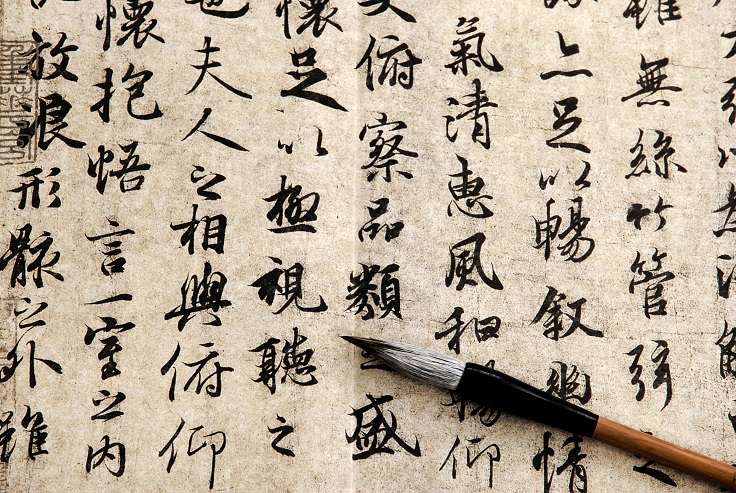
Regular script, called kaishu, developed from clerical script in the late Han and Three Kingdoms period and reached its mature form by the Tang dynasty in the seventh and eighth centuries. Kaishu standardised the stroke order, stroke count, and proportions of each character into the forms used in modern printed Chinese and in formal handwriting. The Tang dynasty calligraphers Ouyang Xun, Yan Zhenqing, and Liu Gongquan established models of regular script that Chinese calligraphy students still copy today.
Running script, called xingshu, developed as a faster handwriting variant that links some strokes together without fully simplifying the character. Cursive script, called caoshu or grass script, pushes this abbreviation further, reducing characters to a few rapid brush movements that are difficult to read without training. Running and cursive scripts are used for personal writing, artistic calligraphy, and informal notes rather than for printed text or official documents.
Simplified and Traditional Characters
The People’s Republic of China introduced simplified Chinese characters in two rounds of reform, the first published in 1956 and a revised list issued in 1964, as part of a broader campaign to raise literacy rates by reducing the number of strokes in the most commonly used characters. The simplification affected roughly 2,200 characters, with reductions ranging from minor stroke deletions to wholesale replacements.
Traditional characters, called fantizi, remain the standard in Taiwan, Hong Kong, Macau, and in many overseas Chinese communities. The result is a practical split in the modern Chinese-language world: mainland China, Singapore, and Malaysia use simplified characters, while Taiwan, Hong Kong, and Macau use traditional. Both sets are encoded in the Unicode standard, which now includes more than 97,000 CJK unified ideographs covering Chinese, Japanese, Korean, and Vietnamese character usage.
Chinese Characters in Japanese, Korean, and Vietnamese
Chinese characters spread across East Asia alongside Buddhism, Confucian scholarship, and Chinese administrative practices during the first millennium CE. Japan adopted Chinese characters as kanji and combined them with two syllabic scripts, hiragana and katakana, to write Japanese. Korea used Chinese characters as hanja alongside the Hangul alphabet introduced in 1443 by King Sejong. Vietnam used Chinese characters as chu Han alongside the chu Nom script before switching to the Latin-based quoc ngu system under French colonial influence in the early twentieth century.
The cross-border life of Chinese characters means that a reader who learns the 3,000 to 4,000 characters needed for modern Chinese literacy can also read substantial portions of historical Japanese, Korean, and Vietnamese texts, a shared literary inheritance that runs across more than a thousand years of East Asian intellectual history.
Frequently Asked Questions
How old is Chinese writing?
The oldest confirmed Chinese writing is the oracle bone script from the Shang dynasty, dated to roughly 1200 BCE, giving the system more than 3,200 years of documented use. Earlier marks on Neolithic pottery from sites such as Banpo and Jiahu have been proposed as proto-writing, but most palaeographers treat these as isolated symbols rather than elements of a working script.
What is oracle bone script?
Oracle bone script, called jiaguwen in Chinese, is the earliest confirmed form of Chinese writing. Shang dynasty diviners carved questions onto ox shoulder blades and turtle plastrons, heated them until they cracked, and read the cracks as answers. More than 150,000 oracle bone fragments have been recovered from the Shang royal capital at Yinxu near Anyang in Henan province.
What is the difference between simplified and traditional Chinese characters?
Simplified characters were introduced by the People’s Republic of China in the 1950s and 1960s to raise literacy rates by reducing the stroke count of commonly used characters. Traditional characters, called fantizi, remain the standard in Taiwan, Hong Kong, and Macau. Mainland China, Singapore, and Malaysia use simplified characters. Both sets are encoded in the Unicode standard.
How many Chinese characters are there?
The Kangxi Dictionary of 1716 listed around 47,035 characters. The Unicode standard now includes more than 97,000 CJK unified ideographs. Modern Chinese literacy requires knowledge of around 3,000 to 4,000 characters, which cover roughly 99 percent of the characters encountered in everyday reading.
Did Japanese and Korean writing come from Chinese?
Japan adopted Chinese characters as kanji during the first millennium CE and combined them with two syllabic scripts, hiragana and katakana, to write Japanese. Korea used Chinese characters as hanja alongside the Hangul alphabet introduced in 1443. Vietnam used Chinese characters as chu Han before switching to the Latin-based quoc ngu system in the early twentieth century.
Sources and Further Reading
- Qiu Xigui, Chinese Writing, Early China Special Monograph Series, Society for the Study of Early China, translated by Gilbert L. Mattos and Jerry Norman, 2000
- William G. Boltz, The Origin and Early Development of the Chinese Writing System, American Oriental Society, 1994
- Imre Galambos, Orthography of Early Chinese Writing: Evidence from Newly Excavated Manuscripts, Budapest Monographs in East Asian Studies, 2006
- National Museum of China, oracle bone and bronze inscription collection pages, chnmuseum.cn
- Unicode Consortium, CJK Unified Ideographs documentation, unicode.org
Oracle bone inscriptions from the Shang dynasty, which underpin the earliest Chinese script, include animal-based time notation that later developed into the 12 Chinese zodiac signs.