
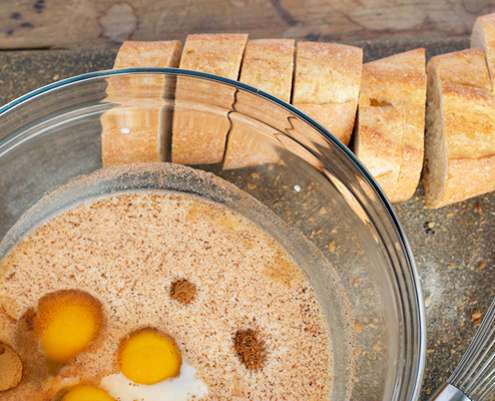
French toast in France is called pain perdu, lost bread, and the name gives away the dish’s original purpose as a way to save stale baguette from the bin rather than as a brunch menu item. A French household in 1850, a village bakery in 1920, and a Paris cafe in 2026 all build the same basic pain perdu from the same four ingredients: a slice of slightly stale bread, an egg, a splash of milk, and a knob of butter in the pan. What changes is the batter ratio, the bread choice, and what the cook does with the pan once the first side has started to colour. A visitor ordering pain perdu from a Saint-Germain cafe at eleven in the morning is eating a dish with a longer history than the cafe itself.
Pain Perdu, the Lost Bread, and Where the Name Comes From
The French name pain perdu translates as lost bread, a reference to stale bread that would otherwise be thrown out and that the dish rescues by soaking it in an egg-and-milk batter and frying it in butter. Medieval and early modern French cookery books call the dish various names: pain a la romaine, pain dore, tostees dorees in a fourteenth-century manuscript attributed to the chef Taillevent. By the nineteenth century pain perdu had become the dominant French name, used across regional cookery books from Brittany to Provence with small variations in the batter. The dish reaches much of Europe under similar names that all share the lost-bread idea: torrijas in Spain, often flavoured with cinnamon and served during Holy Week, fotzelschnitten in the German-speaking cantons of Switzerland, arme ritter or poor knights in Germany, pofesen in Austria, and the English poor knights of Windsor recorded in seventeenth-century English recipe books. The American name French toast is first recorded in the late nineteenth century and is a misattribution, since the dish predates anything a modern reader would call French cuisine and was never a specifically French invention.
The Place of Pain Perdu in the French Breakfast and the Gouter
French breakfast, the petit dejeuner, is a light meal built around coffee or tea, a tartine of baguette with butter and jam or a croissant, and for children a bowl of chocolat chaud or cereal. Pain perdu does not sit at the centre of the French breakfast the way bacon and eggs sit at the centre of an English breakfast. It appears on the weekend, on a slow Sunday morning when the household has a day-old baguette that has lost its crackle, and it appears at the gouter, the four-o-clock afternoon snack that French children eat after school. The gouter is a real meal in a French family rhythm, sitting between lunch at noon and dinner at seven-thirty or eight, and the dishes that belong to it include pain au chocolat, a wedge of baguette with a square of dark chocolate, a slice of quatre-quarts pound cake, a crepe with jam, and pain perdu dusted with sugar. Cafe and brasserie menus in Paris, Lyon, and Marseille have added pain perdu to the brunch section since the brunch concept arrived from the United States in the 1990s, and the dish often shows up on those menus in a more elaborate form with caramel sauce, fresh fruit, or a scoop of vanilla ice cream. At home the dish runs simpler and closer to the nineteenth-century recipe.
The Batter: Ratios a French Home Cook Uses
A working pain perdu batter for six slices of stale baguette or brioche runs on a simple ratio that French home cooks adjust to taste. For six thick slices, whisk three eggs with around 250 millilitres of whole milk, a tablespoon of sugar, a pinch of salt, and a teaspoon of vanilla extract or the scraped seeds of half a vanilla pod. A small grating of fresh nutmeg or a pinch of ground cinnamon is common in regional variants, although the classic Paris version keeps the flavouring to vanilla and sugar alone. For a richer batter, swap half the milk for single cream or use brioche instead of baguette as the bread. For a lighter version, drop the sugar from the batter and add it at the end as a dusting of icing sugar or a drizzle of honey. The batter works in a shallow wide bowl that lets the cook lay each slice flat rather than pushing it down into a narrow jug. Soaking time matters: a slice of stale baguette needs around thirty seconds to a minute in the batter, long enough to soak through without falling apart, while a slice of brioche needs a shorter dip of fifteen to twenty seconds because the softer crumb absorbs the liquid faster. Fresh bread does not work for pain perdu. The whole point is to use bread that has gone dry, and fresh baguette will turn to mush in the batter before it can hold a crust in the pan.
The Pan, the Butter, and the Turn
A pain perdu cook heats a heavy-based frying pan, ideally cast iron or a solid non-stick pan, over medium heat and lets a large knob of butter melt and foam without browning. The temperature matters: butter that sits too long in the pan will brown and burn and will carry that burnt flavour through the crust of the bread, while butter that has not foamed yet will not crisp the surface. Lay the soaked slice into the foaming butter, cook for around two to three minutes until the underside turns a deep golden brown, and turn the slice once with a flat spatula or a wooden fish slice. Cook the second side for another two to three minutes. Turning the slice more than once breaks the crust and releases the soaked egg mixture back into the pan as a thin omelette that sticks to the bread. The finished slice should carry a thin dark-gold crust on both faces, a tender interior that has absorbed the custard and set, and a faint buttery smell rather than a burnt one. Serve at once. Pain perdu does not hold well under a lid and does not reheat in a microwave without going rubbery. If a cook is making six slices for a family, keep the finished slices on a warm plate in a 70-degree Celsius oven while the rest cook, for up to ten minutes.
What to Serve with Pain Perdu in a French Kitchen
French home presentation of pain perdu runs simpler than the American brunch version. A dusting of icing sugar through a fine sieve is the most common finish, paired with a spoon of apricot or strawberry jam on the side of the plate. A drizzle of honey from a local producer, a spoon of creme de marrons chestnut cream for autumn and winter, or a scoop of fromage blanc with a swirl of maple or sugar syrup are the variants a Paris brasserie will offer. Maple syrup, which is the default American topping, is a newer import in France and is mostly found at brunch-oriented cafes and in supermarket imported-goods sections. A fresh fruit garnish matches the season: sliced strawberries or raspberries in June and July, a compote of peach or apricot in August, caramelised apples or pears in the autumn, and a spoon of rhubarb compote in spring. A cup of hot chocolate, a small cafetiere of filter coffee, or a pot of loose-leaf tea goes alongside. Wine is not part of the usual pain perdu pairing, although a small glass of sweet white wine from Sauternes or Monbazillac can work for a late dessert version of the dish at the end of a dinner, where the pain perdu is served warm with vanilla ice cream and a spoon of caramel.
Regional Versions and the Leftover-Brioche Dessert Trick
Norman cooks fold a spoon of Calvados apple brandy into the batter and serve the finished pain perdu with baked apples and a scoop of Normandy double cream. Breton cooks use the leftover crumb from a kouign-amann or a butter brioche from a Pont-Aven bakery as the base rather than baguette, giving a richer dessert version. Gascon and south-western cooks sometimes soak the bread in armagnac-spiked milk and serve the dish with prunes cooked in red wine. The dessert version of pain perdu, served at the end of a dinner rather than at breakfast or at the gouter, comes from a French home tradition of rescuing the last third of a slightly stale brioche from the pantry on a Sunday evening and turning it into a warm pudding with a scoop of vanilla ice cream. A home cook does not need the restaurant trick of soaking brioche overnight under a weight. A slice of stale brioche, the egg-and-milk batter from the section above, and a foaming pan of butter will give a good pain perdu within ten minutes.
Frequently Asked Questions
How does pain perdu differ from American French toast?
Pain perdu is the French dish of stale bread soaked in an egg-and-milk batter and fried in butter, whose name translates as lost bread. The recipe is the ancestor of what Americans call French toast, although the French version runs simpler in flavouring, uses stale baguette or brioche rather than sliced sandwich bread, and is served with icing sugar or jam rather than with maple syrup.
Can I use fresh bread for pain perdu instead of stale?
No. The whole point of the dish is to rescue bread that has gone dry, and fresh baguette will disintegrate in the batter before it can hold a crust in the pan. Bread that is one or two days old, with a firm crumb and a slightly dry crust, gives the best result.
When do French people eat pain perdu?
At weekend breakfast, at the four-o-clock gouter snack for children after school, and occasionally as a dessert at the end of a dinner with a richer brioche base. Pain perdu is not part of the weekday petit dejeuner, which runs on a tartine of baguette with butter and jam.
What topping do French cooks use on pain perdu?
A dusting of icing sugar is the most common finish, often with a spoon of apricot or strawberry jam on the side. Honey, creme de marrons chestnut cream, fromage blanc, and seasonal fruit compotes are other home-kitchen options. Maple syrup is an American habit that has reached a small number of brunch cafes in France.
Sources and Further Reading
- Guillaume Tirel called Taillevent, Le Viandier, fourteenth-century French cookery manuscript, Bibliotheque nationale de France digital collection
- Alexandre Dumas, Grand Dictionnaire de cuisine, 1873, Biblioteque nationale de France
- Ginette Mathiot, Je sais cuisiner, Albin Michel
- Jane Grigson, English Food, Penguin
- Observatoire du pain, French bread consumption data, observatoiredupain.fr