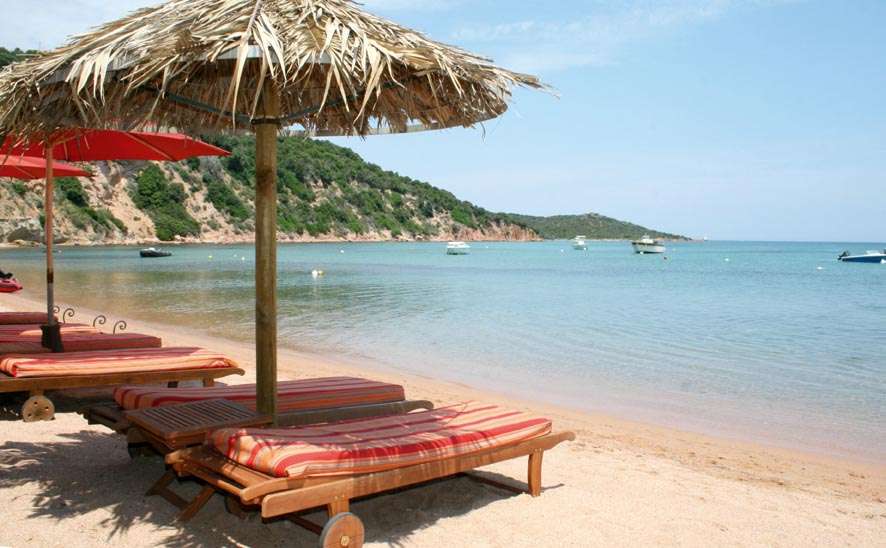
The Pampelonne strand stretches 4.7 kilometres between Cap du Pinet and Cap Camarat on the Ramatuelle commune, not on Saint-Tropez itself, and runs through 19 official beach concessions plus an even longer line of free public sand. Saint-Tropez town sits a short drive away around the bay and holds a separate cluster of small in-town beaches that English guides rarely list. This guide pulls the full concession order north to south, the actual sun lounger prices at Club 55, Nikki Beach, Tahiti Plage and the rest, the eight free alternatives within walking distance of the peninsula, and the practical parking and bus options for the six access points. The Pavillon Bleu status of the peninsula and the broader Loi Littoral framework are covered in our wider French Riviera beaches pillar.
Saint-Tropez peninsula at a glance
The Saint-Tropez peninsula is a triangular landmass at the southern end of the Var coast. Saint-Tropez itself sits on the northern tip facing the Bay of Saint-Tropez and Sainte-Maxime across the water, Ramatuelle commune occupies the centre, and Cap Camarat marks the southern point. The east coast carries the Pampelonne strand, the south coast holds Cap Camarat with its lighthouse and the Plage de l’Escalet, and the west coast turns inland toward Cogolin and the Gulf of Saint-Tropez. The peninsula’s three-substrate geology fits inside the wider French coastal landforms picture.
Beach geography splits into three zones:
- Town beaches: small coves and sand pockets within Saint-Tropez commune limits, all free, all walking distance from the old port (Bouillabaisse, Ponche, Graniers, Canoubiers)
- Pampelonne strand: 4.7 km of continuous sand between Cap du Pinet and Cap Camarat, on Ramatuelle commune, divided between concession zones and free public sections
- South peninsula coves: granite-and-pebble inlets south of Pampelonne, mostly free, including Plage de l’Escalet, Bonne Terrasse and Plage de la Moutte
A practical note for first-timers: when a French source says “plages de Saint-Tropez” it usually means the Pampelonne strand on Ramatuelle commune, not the in-town beaches. The town has its own port-side coves but the headline beach action sits four to six kilometres south of the old port.
Pampelonne: 19 concessions north to south
Pampelonne operates under a specific concession scheme set by a 2017 prefectural order. Nineteen establishments run beach restaurants and lounger zones, split between 11 demountable structures dismantled every October on the maritime public domain and 8 permanent buildings on communal public domain that stay year-round. Below is a north-to-south reading of the twelve main operating concessions; the remaining seven slots cycle through smaller seasonal operators.
| Order N to S | Concession | Style |
|---|---|---|
| 1 | Cap 21 | Family club at the north end near Cap du Pinet |
| 2 | La Reserve a la Plage | Hotel beach extension |
| 3 | Tahiti Plage | Founded 1946, oldest beach club, fixed-menu restaurant |
| 4 | Nikki Beach | Party brand, sushi-and-rose lunches |
| 5 | Bagatelle Beach | Argentine grill, sister concept to Bagatelle New York |
| 6 | Club 55 | Founded 1955, de Colmont family, fixed lunch menu |
| 7 | L’Epi Plage | Mid-range, long-running single-family ownership |
| 8 | Le Cabanon | Smaller scale, fish-focused menu |
| 9 | Verde Beach | Eco branding, lighter Mediterranean menu |
| 10 | Plage des Jumeaux | Hotel-attached, mid-luxe positioning |
| 11 | Moorea Plage | South strand family establishment |
| 12 | Manoah Beach | Near the Cap Camarat south end |
Free public sections sit between the concession zones near the centre of the strand and at both ends. The free strips are the same fine sand as the paid sections, and the lifeguard service runs continuous water-quality samples for the whole 4.7 km, so swimming conditions do not change between paid and free zones.
The two oldest names, Tahiti Plage from 1946 and Club 55 from 1955, set the template for everything that followed. Tahiti was the first beach restaurant after the war, opened by Felix Buffin as a wooden cabin with a fishing-net awning. Club 55 began as the on-set catering for Roger Vadim’s 1956 film shoot of “Et Dieu crea la femme” and never closed once filming ended.
Sun lounger prices and what you actually pay
Pampelonne prices spread across a wide range. Free public sections cost zero. Mid-tier concessions like Tahiti Plage charge in the 30 to 55 euro range for a single sunbed-and-umbrella set. Headline brands like Club 55, Bagatelle and Nikki Beach run higher, especially in July and August when Balinese day-beds replace the standard loungers. Lunch menus follow the same gradient.
| Concession | Lounger pair per day | Bali day-bed | Lunch menu |
|---|---|---|---|
| Public section | Free | Not offered | Bring own |
| Tahiti Plage | 35-55 euros | 150-200 euros | 55 euros fixed |
| L’Epi Plage | 30-50 euros | 120-180 euros | 50 euros |
| Le Cabanon | 35-55 euros | 150-200 euros | 55 euros |
| Verde Beach | 40-60 euros | 180-250 euros | 60 euros |
| Plage des Jumeaux | 40-60 euros | 180-250 euros | 60-75 euros |
| Club 55 | 45-55 euros | 200-300 euros | 75-95 euros |
| Bagatelle Beach | 50-80 euros | 250-400 euros | 90+ euros |
| Nikki Beach | 40-80 euros | 200-400 euros | 60+ euros |
Booking opens in April for July and August; the headline four (Club 55, Bagatelle, Nikki, Verde) close out by mid-May. Mid-range concessions like L’Epi Plage and Le Cabanon still take walk-ups in June and shoulder weeks of September. Walk-ups to the free public sections work any time, though by 11 a.m. the popular middle strip is full in peak season.
A practical move French visitors use: book a lunch table at Club 55 or Tahiti Plage with no sunbed reservation, walk to the free public section after lunch, and skip the day-bed surcharge while still tasting the headline restaurants. The two activities run sequentially in three hours.
Town beaches around the old port
Saint-Tropez itself holds a string of small, free beaches inside the commune limits. None match Pampelonne for scale but all sit within a 15-minute walk from the old port. They suit travellers who base in town and want a swim without driving across the peninsula.
- Plage de la Bouillabaisse: 200 metres of sand on the west side of the bay, free, sheltered from the Mistral, lifeguard in season, family-friendly with a shallow shelf for children
- Plage de la Ponche: a 50-metre pocket inside the old fishing port, pebbles, the oldest bathing spot in town, often pictured on French postcards from the early 1900s
- Plage des Graniers: 150 metres east of the citadel, mixed sand and rock, a five-minute path from the harbour, smaller crowds than Bouillabaisse
- Plage des Canoubiers: 400 metres of sand on the bay side toward Sainte-Maxime, free parking on the road, view across the water to the Maures range
- Plage des Salins: 1 kilometre stretch on the open coast north of Pampelonne, free, less crowded, sand with a few rock pockets, no concessions
Salins is the practical alternative for travellers who want the open-coast experience without paying Pampelonne concession prices. The parking lot at Salins runs about 5 euros per day, and the lifeguard station is staffed from late June to mid-September.
Plage de l’Escalet and the south peninsula
Plage de l’Escalet sits under Cap Camarat at the southern end of the peninsula. The site is a string of granite coves and small sand pockets with no concessions, free entry, and a municipal parking lot at about 7 euros per day. The water is the clearest on the peninsula because there is no river outflow nearby and the granite shelf filters sediment effectively.
The Sentier du Littoral coastal path runs north from Escalet along the cliff edge for about three kilometres to the southern end of Pampelonne, and south for about one kilometre to the Cap Camarat lighthouse. Walking the full Escalet-to-lighthouse loop takes 90 to 120 minutes round-trip with photo stops. Snorkellers use the reef shelf off the headland for visibility up to 15 metres in calm weather.
Two further south-peninsula beaches deserve a mention:
- Bonne Terrasse: a 200-metre cove south of Pampelonne with rough sand, no concessions, popular with Saint-Tropez locals who avoid the crowds at the main strand
- Plage de la Moutte: a hidden 100-metre pocket south of town, accessed by a short footpath, free, no facilities, used mainly by residents
For driver-travellers basing in Ramatuelle village, Escalet plus Bonne Terrasse make a full day at zero concession cost. The Cap Camarat lighthouse, perched on a cliff above the southern peninsula, offers a 360-degree view over the coast on clear days.
Getting there: parking, bus 875, six access points
Pampelonne has six road access points along its 4.7 km length, each with its own parking lot and concession cluster. The access points run, north to south:
- Cap du Pinet: northernmost, smallest parking, closest to Saint-Tropez town at about a 15-minute drive
- Chemin des Tamaris: central-north, access to the Tahiti and Nikki Beach zone
- Route de l’Epi: mid-strand, access to L’Epi Plage and Club 55
- Route des Bouillabaisses: mid-south, access to Verde and Jumeaux
- Route de Bonne Terrasse: south, access to Moorea and Manoah
- Cap Camarat: southernmost, access to Escalet with a separate municipal lot
Parking rates split between commune lots and concession-managed lots:
- Commune lots: 4 to 5 euros per day in shoulder season, 7 to 8 euros in July and August, walking distance to the public sand sections
- Concession lots: 10 to 20 euros per day, closer to the paid restaurants and lounger zones, often bundled with a lunch booking
Bus line 875 runs from Saint-Tropez Marechal Foch terminal to Ramatuelle village, with a Pampelonne stop on the way. The ticket costs about 3 euros, the trip takes 15 to 20 minutes, and the service runs hourly in season from June to September. A taxi from central Saint-Tropez to Pampelonne runs 25 to 35 euros each way depending on traffic and the access point chosen.
Visitors arriving by yacht use the small dinghy landing pontoons at the Cap 21 and Tahiti Plage zones. Most concessions accept walk-up arrivals from anchored yachts, with a transfer service in season. Travellers who prefer to base outside town and skip hotel rates entirely consider the Var camping option; our overview of the best campsites in France maps the 5-star concentration along this stretch.
How Saint-Tropez became Saint-Tropez
The town’s history is older and more specific than the celebrity-tourism framing suggests. The key dates run:
- 1470: Rene of Anjou, Count of Provence, grants Saint-Tropez a special charter to repopulate the village after Black Death and Saracen raids. The charter exempts residents from royal taxes in exchange for arming themselves and defending the coast. This is not “independent state” status as older English guides claim, but a fiscal-military privilege within the County of Provence.
- 1481: Provence is annexed to France under King Louis XI on the death of Charles III of Provence. Saint-Tropez follows, keeping its 1470 charter privileges. The town never came under Louis XIV, a common misattribution in older travel writing.
- 1637: A 200-strong town militia repels 23 Spanish galleys attempting to land. The anniversary becomes the Bravade de Saint-Tropez, still celebrated every 15 to 17 May with costumed processions and ceremonial musket volleys.
- 1946: Felix Buffin opens Tahiti Plage as the first post-war beach restaurant on Pampelonne, a basic wooden cabin with a fishing-net awning.
- 1955: Bernard and Genevieve de Colmont open Club 55 as on-set catering for Roger Vadim’s film crew. The kitchen never closes once filming ends.
- 1956: Vadim releases “Et Dieu crea la femme” with Brigitte Bardot, shot largely in Saint-Tropez and on Pampelonne. The film makes Saint-Tropez the symbol of post-war French youth tourism.
- 1965: Bardot buys La Madrague, her clifftop house on the Saint-Tropez coast. The yacht harbour grows from a fishing port into a luxury marina over the following decade.
- 2017: The current prefectural order on Pampelonne concessions takes effect, locking in the 11-demountable-plus-8-permanent split that still applies today.
The village was never an independent merchant state and never came under Louis XIV. Older English-language guides repeat the claim because the 1470 charter is frequently misread as a sovereignty grant, but every Provencal local archive treats it as a fiscal exemption within the Comte de Provence.
Frequently Asked Questions
Is Pampelonne in Saint-Tropez or Ramatuelle?
Pampelonne sits on Ramatuelle commune, not on Saint-Tropez. The beach is associated with Saint-Tropez by tourism branding because the town sits 4 to 6 kilometres north and most visitors arrive through Saint-Tropez ferries or hotels. The Ramatuelle mayor administers all concession permits.
Why does Saint-Tropez not carry the Pavillon Bleu label?
Saint-Tropez and Ramatuelle have not applied for Pavillon Bleu in recent rounds. The label depends on commune application and infrastructure investment in sewage, waste management and biodiversity protection. The communes prioritise their existing concession revenue and have skipped the renewal cycle. Water quality on Pampelonne is monitored separately by ARS PACA and by lifeguard testing, so absence from the Pavillon Bleu list does not indicate poor water.
What does a Pampelonne sun lounger actually cost?
Mid-range concessions charge 30 to 55 euros per day for a sunbed-and-umbrella pair. Headline brands like Club 55, Bagatelle and Nikki Beach run 45 to 80 euros for the same setup. Balinese day-beds cost 150 to 400 euros depending on the club. Free public sections cost nothing and sit within 200 metres of every concession.
Which Saint-Tropez beach is best for families with young children?
Plage de la Bouillabaisse on the west side of the town bay has the shallowest shelf and the most stable lifeguard coverage. Plage des Canoubiers and Plage des Salins offer free or low-cost parking and broader sand. Tahiti Plage on Pampelonne keeps a family atmosphere with sun loungers and a fixed-menu restaurant aimed at sit-down lunches rather than party clubs.
When is the best time to visit Saint-Tropez beaches?
Mid-June and early September give the best balance of warm water at 22 to 24 degrees and lower crowds. July and August deliver peak heat with 25 to 26 degree water but also the highest concession prices, the longest restaurant waits, and 11 a.m. parking saturation. April and May suit Sentier du Littoral walking without swimming.
Sources and Further Reading
- Commune de Ramatuelle, Pampelonne concession scheme
- Saint-Tropez Office de Tourisme
- Var Tourisme regional office
- Conservatoire du Littoral coastal access maps
- Cote d’Azur France regional tourism board
- L’Officiel des terrains de camping
- Provence Lovers Saint-Tropez beach reference
- Iconic Riviera Pampelonne beach club directory