Budapest, the capital of Hungary, has firmly established itself as one of Europe’s most rewarding short-break destinations. Once a hidden gem, the city now welcomes millions of visitors a year who come to admire its grand 19th-century boulevards, world-famous thermal baths, dramatic Danube panoramas, and vibrant cultural scene. While a long weekend is enough to scratch the surface, anyone hoping to combine the city with day trips to the Danube Bend or Lake Balaton should plan at least four or five full days. This 2026 guide covers everything you need to know — history, transport, sights, museums, nightlife, and practical tips.
Budapest at a Glance — Three Cities in One
Budapest is, in reality, three historic cities fused into one. On the western, hilly bank of the Danube lies Buda, with its medieval Castle District perched high above the river. On the flat eastern plain spreads Pest, the lively commercial and cultural heart of the modern city. North of Buda sits Óbuda (“Old Buda”), the ancient Roman settlement that predates them all. The unification of these three towns in 1873 gave birth to the Budapest we know today.
The Hungarian capital embodies everything travellers love about Central Europe: grand 19th-century architecture, a deep-rooted love of opera, classical music, and folk traditions, world-class coffee houses, and a polite, reserved population that quietly takes great pride in its cultural heritage. Yet Budapest also has a youthful, modern edge — its famous ruin bars, riverside food halls, and craft-beer scene make it one of the most exciting nightlife capitals in Europe.
A Short History of Budapest
Budapest’s history is a story of conquest, destruction, and rebirth.
- 3rd century BC — Celtic tribes settle in the area.
- 1st century AD — The Romans found Aquincum in present-day Óbuda, planting vineyards and building thermal bathhouses.
- 9th century — Magyar tribes arrive from the Volga region and gradually adopt Christianity.
- 1000 AD — Stephen I (later Saint Stephen) is crowned the first King of Hungary on Christmas Day, marking the birth of the Hungarian state.
- 13th century — Mongol invasions devastate the region, prompting the construction of stone fortresses.
- 1541–1686 — The Ottoman Turks rule Buda for nearly 150 years, leaving behind the city’s first thermal bathhouses.
- 18th–19th centuries — Under the Habsburgs, especially during the Austro-Hungarian dual monarchy (1867–1918), Budapest enjoys a golden age of growth, with grand boulevards, the Opera House, and the Parliament rising along the Danube.
- 1873 — Buda, Pest, and Óbuda are formally united into Budapest.
- 1944–45 — During the final months of World War II, Budapest suffers terrible damage. Roughly three-quarters of buildings are damaged and every bridge across the Danube is destroyed by retreating Nazi forces.
- 1956 — A heroic uprising against Soviet rule is brutally crushed by Russian tanks.
- 1989–1990 — Communism collapses; Hungary holds its first free elections.
- 2004 — Hungary joins the European Union, accelerating the city’s renewal and tourism boom.
Budapest Culture — A City of Music and Theatre
Budapest is a city where culture is woven into daily life. Locals take their classical music, opera, ballet, and folk traditions seriously, and even matinee performances on a Saturday afternoon are filled with smartly dressed audiences of all ages.
The Hungarian State Opera House on Andrássy Avenue is an absolute must-see. Reopened in 2022 after a major restoration, it ranks among the most beautiful opera houses in Europe, with gilded ceilings, frescoes, and a sumptuous neo-Renaissance interior. Even if you don’t catch a performance, take a guided tour in English. The Erkel Theatre is the city’s second opera house, with a more modern interior but an equally rich programme. For lighter fare, the Budapest Operetta Theatre stages musicals and operettas in a glittering Art Nouveau hall.
Classical concerts are held throughout the city — the Liszt Academy of Music, Müpa Budapest (the Palace of the Arts), and St. Matthias Church on Castle Hill are among the most magical venues. For a taste of Hungarian folk traditions, look out for evening shows by the Hungarian State Folk Ensemble or at the Hungarian Heritage House — your hotel concierge can help you book.
Getting Around Budapest
Budapest has one of the most efficient and affordable public transport systems in Europe. The network combines a four-line metro, an extensive tram and bus system, suburban (HÉV) trains, and even scheduled boat services along the Danube.
The Yellow Line (M1) is the most charming part of the system. Opened in 1896, it was the first underground railway on the European continent and is now a UNESCO World Heritage Site. Take a ride beneath Andrássy Avenue to admire the beautifully preserved wooden carriages and Art Nouveau station entrances. The remaining lines — M2 (Red), M3 (Blue), and the modern driverless M4 (Green) — connect virtually every major district.
Single tickets, blocks of ten, and 24/72-hour travel cards can be bought at metro stations, ticket machines, and tobacco shops. For most short-stay visitors, the best option is the Budapest Card, which combines unlimited public transport with free entry to many museums, discounts at thermal baths and restaurants, and a free guided walking tour. Cards are sold for 24, 48, 72, 96, or 120 hours and are available at the airport, tourist offices, and major metro stations.
Budapest also has three major international railway stations: Keleti (Eastern), Nyugati (Western), and Déli (Southern). Most international rail passes, including Eurail and Interrail, are valid in Hungary.
Budapest Airport — Ferenc Liszt International
Budapest’s only international airport is Budapest Ferenc Liszt International Airport (BUD), located about 24 km southeast of the city centre. Once known as Ferihegy, it was renamed in 2011 in honour of the famous composer. It is a modern, efficient airport with two terminals and is served by major carriers from across Europe and beyond, including Wizz Air, Ryanair, easyJet, Lufthansa, KLM, British Airways, and Qatar Airways.
To reach the city centre you have several options:
- Bus 100E (Airport Express) — the fastest and cheapest official option, running directly from the terminal to Deák Ferenc tér in the city centre in roughly 40 minutes.
- Bus 200E + Metro M3 — take the 200E to Kőbánya-Kispest station, then the blue M3 line into the centre.
- Official airport taxi (Főtaxi) — the only authorised taxi operator at the airport, with fixed zone-based fares.
- miniBUD shuttle — a shared shuttle service that takes you door-to-door to your hotel.
Budapest Weather and Best Time to Visit
Budapest has a continental climate with four distinct seasons. Summers (June–August) are warm and sometimes hot, with daytime highs of 26–30°C and occasional thunderstorms. Spring and autumn are arguably the best times to visit, with mild weather, fewer crowds, and beautiful light for photography. Winters (December–February) are cold, often dipping below freezing and bringing snow that turns the city into a fairy-tale wonderland — and the famous outdoor thermal baths into steaming open-air spas.
Tourist Information Offices
The official Budapestinfo Points, run by the city’s tourism board, are excellent first stops for maps, leaflets, current event programmes, and Budapest Card sales. The most central locations are at Deák Ferenc tér, the airport, and inside the Buda Castle complex. Most hotels also act as informal information points, and concierges can help with restaurant bookings, tickets, and tour reservations.
Top 10 Things to Do in Budapest
- Explore Castle Hill, the Royal Palace, Fisherman’s Bastion, and St. Matthias Church.
- Climb Gellért Hill for panoramic views and visit the Citadella and the Liberty Statue.
- Stroll along Andrássy Avenue to Heroes’ Square.
- Take in some culture — opera, classical concerts, or a folk performance.
- Cross the iconic Chain Bridge over the Danube.
- Take a day trip to the Danube Bend — Szentendre, Visegrád, and Esztergom.
- Soak in a historic thermal bath like Széchenyi or Gellért.
- Visit Memento Park, the open-air museum of Communist-era statues.
- See the Great Synagogue, St. Stephen’s Basilica, and other landmark churches.
- Take a guided tour of the magnificent Hungarian Parliament Building.
Castle Hill, Buda Castle & the Royal Palace
The Castle District sits high above the river on the Buda side, accessible from the Pest side via the Chain Bridge and a short ride on the historic funicular, or by walking up. Inside the district you’ll find the Royal Palace (home to the Hungarian National Gallery and the Budapest History Museum), the Vienna Gate, the Magdalen Tower, and the National Archives.
Beneath Castle Hill lies a labyrinth of caves, cellars, and tunnels that have been used since prehistoric times — some are open to visitors as the famous Buda Castle Labyrinth. Wander along Úri utca (Gentlemen’s Street) and Disz tér to admire restored medieval and Baroque townhouses standing side by side.
Fisherman’s Bastion
The neo-Romanesque Fisherman’s Bastion (Halászbástya), with its seven fairy-tale turrets, offers one of the most spectacular views in Budapest — straight across the Danube to the Parliament Building. Built between 1895 and 1902, it’s particularly magical at sunrise and after dark.
Óbuda (Old Buda)
This beautifully restored district north of the Castle preserves the atmosphere of old Hungary. Stroll along Fő utca to see the elegant Town Hall, the Zichy Mansion, and Roman ruins from ancient Aquincum. The Király Baths, originally built by the Turks in the 16th century, still operate today.
The Citadella and Liberty Statue
The Citadella is a 19th-century Habsburg fortress crowning Gellért Hill. Although currently undergoing extensive renovation, the surrounding viewpoints offer some of the best panoramas in the city. Above it stands the Liberty Statue, a 14-metre-tall figure holding a palm leaf, illuminated dramatically at night. Originally erected in 1947 as a Soviet-era monument, its inscription was changed after 1989 to commemorate all those who died for Hungarian freedom.
Andrássy Avenue and Heroes’ Square
Andrássy Avenue is Budapest’s grandest boulevard, a tree-lined UNESCO World Heritage Site running from Erzsébet tér to Heroes’ Square. Almost every building features intricate plasterwork or sculpture, and the avenue is home to the State Opera House, the House of Terror Museum, and dozens of luxury cafés. At its end stands Heroes’ Square, dominated by a 36-metre column topped by the Archangel Gabriel and flanked by two semicircular colonnades displaying statues of Hungary’s most famous kings and historical figures. Either side of the square stands the Museum of Fine Arts and the Kunsthalle art gallery.
The Danube and the Chain Bridge
The Danube is at its most majestic as it flows through the centre of Budapest, almost a kilometre wide in places. The Széchenyi Chain Bridge, the city’s first permanent bridge across the river, opened in 1849 and remains its most iconic. Recently renovated, it once again connects Buda and Pest in style. Walking it at night, with the Castle and Parliament floodlit on either bank, is one of the most romantic experiences in Europe.
Day Trips from Budapest
The Danube Bend
About 40 km north of Budapest, the Danube takes a dramatic right-angle turn around a string of small hills. The Danube Bend (Dunakanyar) is one of Hungary’s most picturesque regions and an easy day trip by car, train, bus, or boat.
Szentendre
A picture-postcard town just north of Budapest, Szentendre is famous as an artists’ colony. Its narrow cobbled streets, Baroque buildings, Greek Orthodox churches, and small museums make it a delightful half-day escape. Try to wander beyond the tourist-shop-lined main square and explore the quieter residential lanes for a more authentic feel.
Visegrád
Perched high above the Danube, Visegrád Citadel offers breathtaking views of the river bend. Built in the mid-13th century to defend against Mongol invasions, the fortress later became a royal residence before being destroyed by the Turks. The Royal Palace ruins were rediscovered in the 1930s and partially reconstructed.
Esztergom
Once the royal capital of Hungary and birthplace of King (Saint) Stephen I, Esztergom is now the seat of the Catholic Church in Hungary. The city is dominated by the immense Esztergom Basilica — the largest church in Hungary and one of the largest in Europe. Don’t miss the crypt, the panoramic dome viewpoint, and the medieval coronation cross.
Budapest Thermal Baths
Budapest is the only capital city in the world to sit atop more than 100 natural thermal springs, and bathing has been a way of life here since Roman times. A visit to at least one of the city’s famous thermal baths is essential.
- Széchenyi Baths — the largest and most popular, with 18 indoor and outdoor pools set inside a yellow neo-Baroque palace in City Park. Famous for its outdoor thermal pools steaming in the snow during winter.
- Gellért Baths — Art Nouveau elegance at its finest, attached to the historic Hotel Gellért beneath Gellért Hill.
- Rudas Baths — built by the Turks in 1550, with a stunning octagonal Ottoman dome and a rooftop pool offering city views.
- Király Baths — another atmospheric Turkish-era bathhouse.
- Lukács Baths — popular with locals and known for its medicinal waters.
Vajdahunyad Castle and City Park
City Park (Városliget) sits just behind Heroes’ Square. Inside it, you’ll find the fairy-tale Vajdahunyad Castle, originally built from wood for the 1896 Millennium Celebrations and later rebuilt in stone due to its popularity. Each section of the castle copies a different historical Hungarian building. The park also contains Budapest Zoo, the Municipal Circus, the Széchenyi Baths, and the recently renovated House of Music Hungary.
Memento Park (Statue Park)
Memento Park, located in southwest Budapest, is one of the city’s most original attractions: an open-air museum where dozens of monumental Communist-era statues — Lenin, Marx, Soviet soldiers, and other relics of the regime — have been preserved rather than destroyed. Walking among these silent giants is a fascinating and slightly surreal experience.
Churches and Synagogues
Dohány Street Synagogue
The recently restored Dohány Street Synagogue is the largest synagogue in Europe and one of the largest in the world, with seating for over 3,000 worshippers. Its colourful Moorish-Byzantine façade is striking, and the on-site Jewish Museum tells the deeply moving story of Hungarian Jewry, including the tragic events of the Holocaust.
St. Stephen’s Basilica
Szent István Bazilika took more than 50 years to complete (1851–1905) and is the most important Catholic church in Budapest. Inside, the right hand of King Stephen I — Hungary’s most sacred relic — is preserved in a gilded reliquary. The dome offers superb views over Pest.
Matthias Church
On Castle Hill, the Matthias Church dates back to the Middle Ages and was the coronation site of several Hungarian kings. The colourful tiled roof, ornate frescoes, and soaring Gothic arches make it one of Budapest’s most photogenic landmarks.
The Hungarian Parliament Building
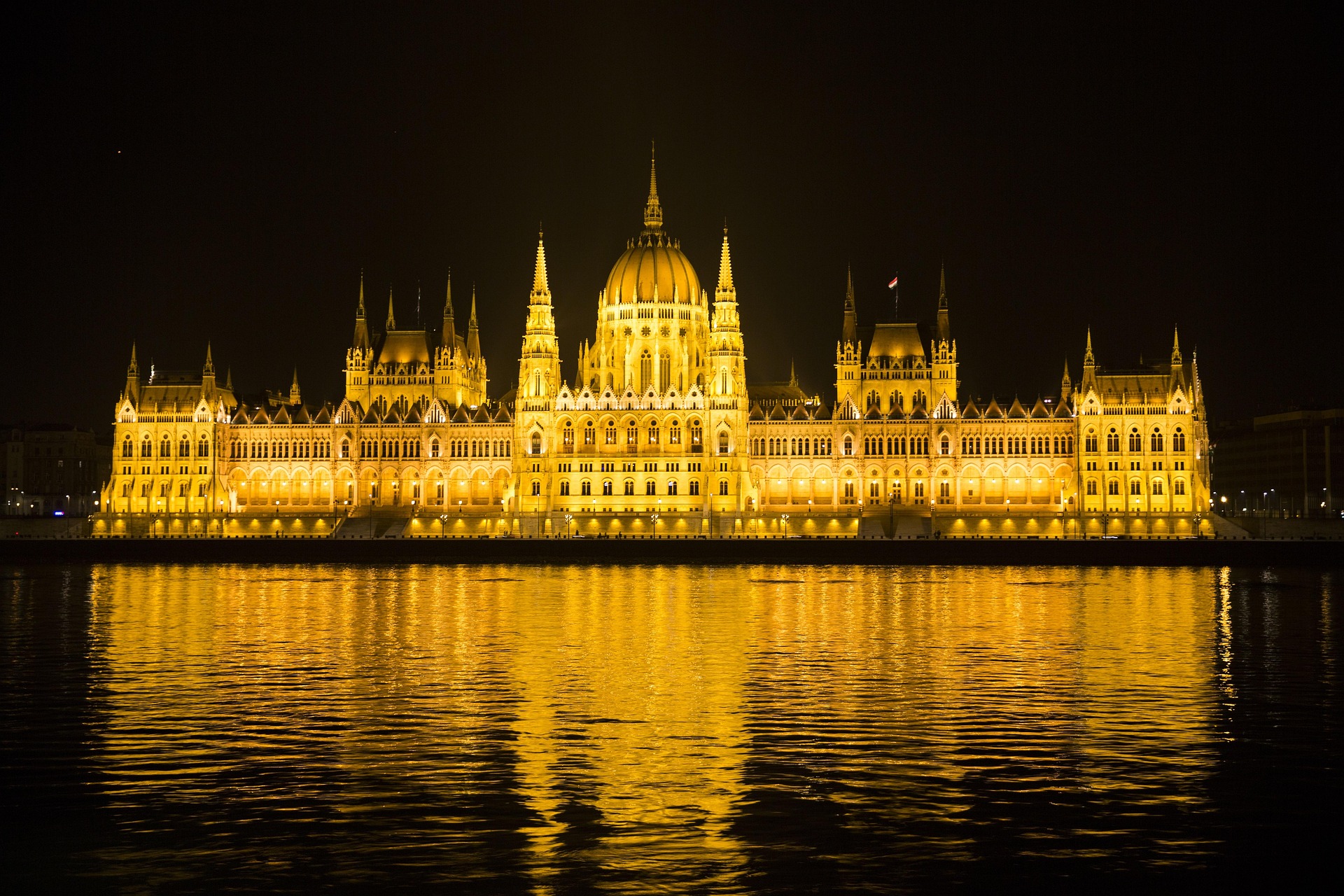
Completed in 1904 and stretching nearly 270 metres along the Danube, the Hungarian Parliament Building (Országház) is one of the largest and most spectacular legislative buildings in the world. Loosely modelled on the British Houses of Parliament, it combines Gothic Revival and neo-Renaissance styles with breathtaking interiors of marble, gold leaf, and frescoes.
Guided tours in English run daily and take in the grand staircase, the Hungarian Crown Jewels beneath the central dome, and the lavish ceremonial halls. Tickets sell out quickly, especially in summer, so book online via the official website well in advance. The dome rises 96 metres — a deliberate reference to 896 AD, when the Magyars first arrived in the Carpathian Basin.
The Best Museums in Budapest
- Hungarian National Gallery — inside the Royal Palace, with art from the 12th century to today.
- Museum of Fine Arts — on Heroes’ Square, housing major European masterpieces from El Greco to Goya.
- Hungarian National Museum — the country’s oldest museum, telling Hungary’s story across the ages.
- Budapest History Museum — inside the Royal Palace.
- House of Terror — a chilling but essential museum on Andrássy Avenue, housed in the former headquarters of both the Nazi and Communist secret police.
- Hospital in the Rock — a Cold War-era hospital and nuclear bunker carved into the hill beneath the Castle District.
- Holocaust Memorial Center — a deeply moving tribute to Hungary’s wartime tragedy.
- Ludwig Museum — modern and contemporary art at the Müpa complex.
- Underground Railway Museum — at Deák Ferenc tér metro station.
- Memento Park — the open-air Communist statue museum.
Budapest Tours
From hop-on hop-off buses to walking tours, river cruises, and even Trabant rides through the old Communist districts, Budapest offers tours to suit every taste and budget. Highly recommended:
- Free walking tours — several reliable companies offer tip-based guided walks of the Old Town, Jewish Quarter, and Castle District.
- Danube river cruises — sightseeing cruises run by day and evening, with optional dinner and live music.
- Parliament guided tour — book online in advance.
- Jewish Heritage walks — exploring the Dohány Street Synagogue and the historic Jewish Quarter.
- Caving tours beneath Buda Hill.
Budapest Nightlife — Ruin Bars and Riverside Lounges
Budapest’s nightlife is vibrant, varied, and astonishingly affordable by Western European standards. The undisputed stars are the city’s famous ruin bars (romkocsmák) — eclectic, atmospheric drinking dens carved out of abandoned buildings in the old Jewish Quarter (District VII). The most legendary is Szimpla Kert, a maze of mismatched rooms, salvaged furniture, art installations, and live music. Other classics include Instant-Fogas, Mazel Tov, Csendes, and Anker’t.
For something more polished, head to a Danube-side rooftop bar like 360 Bar or High Note SkyBar. Music lovers will find everything from underground techno and live jazz to traditional Hungarian folk. The riverside A38, a converted Ukrainian stone-carrier ship, is one of the city’s best concert venues.
Where to Stay in Budapest
Budapest offers everything from five-star international hotels to charming boutique guesthouses, design hostels, and unique Danube-moored “botels”. The most convenient base for first-time visitors is in the Inner City of Pest (District V) or the trendy Jewish Quarter (District VII), which puts you within walking distance of most major sights, restaurants, and ruin bars.
- Luxury — Four Seasons Hotel Gresham Palace, Aria Hotel Budapest, Matild Palace, Ritz-Carlton Budapest, Corinthia Hotel Budapest.
- Mid-range — Hotel Rum, Hotel Gellért (currently undergoing renovation), Mystery Hotel Budapest.
- Budget & hostels — Maverick City Lodge, Wombat’s Hostel, Pal’s Hostel.
- Unique stays — boat hotels (botels) moored along the Pest embankment.
Booking online a few weeks in advance usually secures the best rates, and prices fluctuate significantly with the season — expect higher prices around New Year, the Sziget Festival in August, and Christmas markets in December.
Final Thoughts
From the steaming pools of the Széchenyi Baths to the gilded interiors of the Opera House, from a moonlit walk across the Chain Bridge to a glass of Tokaji wine in a candlelit ruin bar, Budapest is a city that captivates every visitor. Its blend of history, architecture, music, food, and effortless charm makes it one of the most rewarding destinations in Europe — not just for a short break, but for any traveller in search of a city that truly has it all.