Madrid rewards visitors who arrive without a fixed plan. The Spanish capital spreads across a high plateau at 650 meters above sea level, and its wide boulevards, shaded parks, and centuries-old plazas create a city that works just as well on foot as it does by metro. Art collections here rank among the deepest in Europe, the food scene runs from century-old taverns to modern market halls, and the locals rarely sit down to dinner before 10 p.m. This guide covers the major landmarks, practical transport tips, day trip options, and the neighborhoods worth exploring after dark.
The Prado Museum and the Art Triangle
The Museo del Prado opened in 1819 and holds roughly 8,000 paintings, though only around 1,500 are on display at any given time. The collection centers on European art from the 12th to the early 20th century, with particular depth in Spanish, Flemish, and Italian works. Diego Velazquez’s Las Meninas, Francisco Goya’s Black Paintings, and Hieronymus Bosch’s The Garden of Earthly Delights draw the largest crowds. The museum receives around 3 million visitors per year, second only to the Louvre among European art museums.
Opening hours run Monday through Saturday from 10:00 to 20:00 and Sundays from 10:00 to 19:00. Free entry is available during the last two hours each day. Plan on at least three hours for a focused visit, though dedicated art lovers can easily spend a full day inside.
Two other major museums sit within walking distance. The Museo Reina Sofia, a few blocks south, houses Pablo Picasso’s Guernica along with works by Salvador Dali and Joan Miro. The Thyssen-Bornemisza Museum fills the gap between the other two collections, covering Impressionism, Expressionism, and Pop Art. Together, these three institutions form the so-called Golden Triangle of Art, and a combined ticket covers all three at a reduced price.
The Royal Palace and Its Surroundings
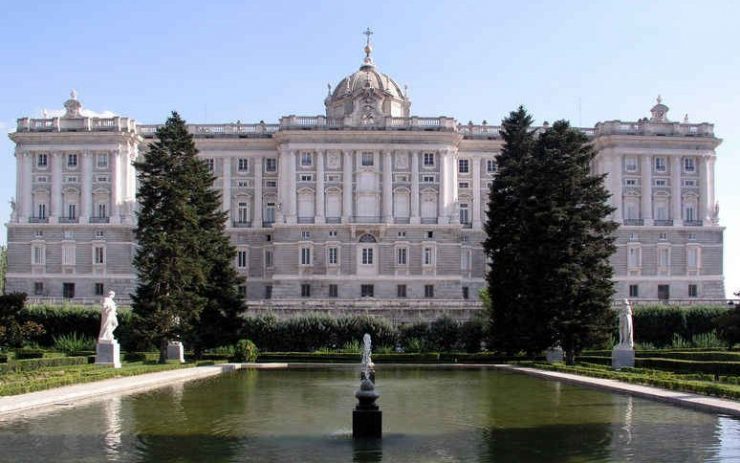
The Palacio Real sits on a bluff above the Manzanares River at the western edge of the old city. King Philip V commissioned the building after fire destroyed the previous Alcazar in 1734, and construction lasted from 1738 to 1764. The palace contains 3,418 rooms, making it the largest royal palace in Western Europe by floor area – roughly twice the size of Buckingham Palace or Versailles.
The Spanish royal family does not live here. The building serves as a ceremonial venue and museum, with about 50 rooms open to the public. Highlights include the Throne Room with its ceiling fresco by Giovanni Battista Tiepolo, the Royal Pharmacy, the Royal Armoury, and the world’s only complete Stradivarius string quintet. The palace exterior, built from granite and white Colmenar limestone, faces the Plaza de Oriente, a semicircular garden lined with statues of Spanish monarchs.
Directly south, the Almudena Cathedral shares the same plaza. Construction began in 1883 but the cathedral was not consecrated until 1993. The contrast between its neoclassical exterior (designed to match the palace) and its neo-Gothic interior makes it an unusual stop. Across the street, the Sabatini Gardens and Campo del Moro park offer green space with views back toward the palace facade.
Retiro Park and the Crystal Palace
Parque del Buen Retiro covers 125 hectares east of the Prado Museum. The land served as a private royal retreat from the 1630s onward, and it opened to the public in 1868. UNESCO added it to the World Heritage list in 2021 as part of the Paseo del Prado and Buen Retiro landscape.
The Estanque Grande, a rectangular artificial lake covering 37,000 square meters, sits at the park’s northern end. Rowboat rentals operate daily, and a tall monument to King Alfonso XII overlooks the water from a curved colonnade. South of the lake, the Palacio de Cristal – a glass-and-iron pavilion built in 1887 for a Philippines exhibition – now hosts temporary art shows organized by the Reina Sofia Museum. The building was the first non-industrial iron-and-glass structure in Spain, and its architect, Ricardo Velazquez Bosco, modeled it on London’s Crystal Palace.
Other park features worth finding include:
- The Rosaleda rose garden, planted in 1915, with over 4,000 rose bushes
- The Paseo de las Estatuas, a promenade lined with stone statues
- The Fallen Angel statue, said to be the only public sculpture in Europe dedicated to Lucifer
- The Velazquez Palace, another exhibition space near the Crystal Palace
Plaza Mayor, Puerta del Sol, and Gran Via
These three landmarks form the commercial and social spine of central Madrid. Plaza Mayor, completed in 1619 under Philip III, is a rectangular enclosed square surrounded by three-story residential buildings with 237 balconies. The square hosted bullfights, markets, public executions, and royal ceremonies over the centuries. Today, cafes fill the arcades, and a bronze equestrian statue of Philip III stands at the center. The Sunday stamp and coin market has operated here for decades.
Puerta del Sol, five minutes east on foot, functions as the city’s geographic and symbolic center. A small plaque on the sidewalk marks Kilometer Zero, the point from which all Spanish national roads are measured. The clock tower on the old post office building (now the regional government headquarters) is where Spaniards gather on New Year’s Eve to eat twelve grapes at midnight – one for each chime. The bronze Bear and the Strawberry Tree statue nearby has become the unofficial symbol of Madrid.
Gran Via cuts diagonally northwest from Cibeles to Plaza de Espana. The boulevard was carved through the old city between 1910 and 1929, and its early-20th-century buildings range from Beaux-Arts to Art Deco. The Telefonica Building, completed in 1929, was Spain’s first skyscraper. Gran Via now serves as the main shopping and theater district, sometimes called the Spanish Broadway for its concentration of musical venues.
Day Trips to Toledo and Segovia
Both cities sit within 90 minutes of Madrid by train or bus and make solid single-day excursions.
Toledo, 70 kilometers south, was Spain’s capital until 1561 and still carries the outline of its medieval past. The old city sits on a granite hill surrounded on three sides by the Tagus River. The Cathedral of Toledo, built between 1226 and 1493, ranks as a major example of Spanish Gothic architecture. El Greco lived and painted in Toledo for the last 37 years of his life, and the El Greco Museum displays several of his works. The city’s narrow streets also hold two medieval synagogues, a mosque, and the Alcazar fortress, making it a compressed lesson in the coexistence of Christian, Jewish, and Islamic cultures in medieval Spain.
Segovia, 90 kilometers northwest, is defined by two structures: the Roman aqueduct and the Alcazar. The aqueduct, likely built around 112 AD during the reign of Trajan, stretches 813 meters through the city center and reaches 28.5 meters at its tallest point. Its 24,000 granite blocks hold together without mortar. The Alcazar of Segovia, perched on a rocky promontory shaped like a ship’s bow, dates to at least the 12th century and reportedly inspired the castle design in Disney’s Snow White and the Seven Dwarfs.
Key practical details for both day trips:
- High-speed AVE trains reach Toledo from Madrid Atocha in 33 minutes; Segovia is 27 minutes from Chamartin station via AVE
- Round-trip train tickets typically cost between 12 and 25 euros depending on timing
- Bus services run frequently from Madrid’s Estacion Sur (Toledo) and Moncloa station (Segovia) at lower prices
- Arriving early (before 10:00) avoids the heaviest crowds at both locations
Food, Markets, and the Madrid Eating Schedule
Madrid operates on a different clock than most European capitals. Lunch runs from 14:00 to 16:00, and dinner rarely starts before 21:00 – often later on weekends. Adjusting to this schedule unlocks the full range of the city’s food culture.
The Mercado de San Miguel, a restored iron-and-glass market hall near Plaza Mayor, offers a curated selection of tapas, cured meats, cheese, wine, and pastries from individual stalls. Prices here skew toward tourist levels, but the quality and variety make it a reasonable introduction to Spanish food categories. For a more local atmosphere, the Mercado de San Anton in Chueca or the Mercado de la Paz in Salamanca serve residential neighborhoods.
Traditional Madrid dishes lean toward hearty, meat-centered cooking. Cocido madrileno, a slow-cooked chickpea stew with pork, chorizo, and vegetables, appears on many restaurant menus as a daily special, particularly during colder months. Bocadillo de calamares – a fried squid sandwich on a crusty roll – is sold from stands and small bars around Plaza Mayor. For dessert, the chocolate con churros at Chocolateria San Gines, open since 1894, draws lines at all hours.
Nightlife Districts and the Madrid Schedule
The city’s late-night culture is not an exaggeration – it is the standard rhythm. Bars in central neighborhoods begin filling around 22:00, and clubs do not reach capacity until 01:00 or later. Several distinct zones cater to different crowds.
Malasana, centered on Plaza del Dos de Mayo, leans toward independent bars, live music venues, and a younger crowd. Chueca, the adjacent neighborhood to the east, is Madrid’s main LGBTQ+ district and hosts a dense concentration of cocktail bars and terrace cafes. La Latina, south of Plaza Mayor, is the traditional Sunday afternoon spot – the Rastro flea market runs there every Sunday morning, and the surrounding streets fill with people moving between small tapas bars afterward. Huertas, also called the Barrio de las Letras, sits between Puerta del Sol and the Prado and mixes tourist-friendly venues with older, more local spots.
For late-night clubs, the Kapital (seven floors of different music styles), Sala El Sol, and Teatro Barcelo remain long-running options. Most charge cover fees of 12 to 20 euros that include one drink.
Getting Around: Metro, Buses, and Walking
Madrid’s metro system opened in 1919 and now covers 13 lines with over 300 stations, making it the third-largest underground network in Europe by track length. A single ride costs 1.50 to 2.00 euros depending on distance, and a Tourist Travel Pass (abono turistico) offers unlimited rides for one, two, three, five, or seven days. The metro runs from 06:00 to 01:30 daily.
Most major sightseeing targets cluster within a walkable zone. The route from the Royal Palace through Plaza Mayor and Puerta del Sol to the Prado Museum covers roughly 3 kilometers and passes through the densest concentration of historic sites. Retiro Park sits just east of the Prado. Gran Via connects to this central zone and adds another kilometer of ground to cover.
Taxis are metered and relatively affordable compared to other Western European capitals. A ride from the airport (Adolfo Suarez Madrid-Barajas) to the city center runs at a flat rate of 30 euros. The metro also connects the airport to central Madrid via Line 8, though a 3-euro airport supplement applies.
Frequently Asked Questions
How many days should I spend in Madrid?
Three full days allow time for the major museums, the Royal Palace, Retiro Park, and a solid sampling of the food and nightlife scene. Adding a fourth or fifth day opens up one or two day trips to Toledo, Segovia, or the Royal Site of San Lorenzo de El Escorial.
Is the Madrid metro safe and easy to use?
The metro is clean, well-signed in Spanish and English, and runs frequently during operating hours. Standard urban precautions apply – watch for pickpockets during rush hours on crowded lines, particularly Line 1 and at Sol station. The system accepts contactless bank cards and the Tarjeta Multi rechargeable card.
What is the best time of year to visit Madrid?
Spring (April through June) and autumn (September through October) offer warm days without the extreme heat of July and August, when temperatures regularly exceed 38 degrees Celsius. Winter is mild compared to northern Europe but can drop near freezing at night. Hotel prices peak during Easter week (Semana Santa) and major holiday periods.
Sources and Further Reading
- Museo Nacional del Prado – Opening Times and Prices
- Royal Palace – Tourism Madrid Official Site
- Royal Palace of Madrid – Wikipedia
- Parque del Buen Retiro – Wikipedia
- Aqueduct of Segovia – Wikipedia
- Madrid Tourism Official Portal