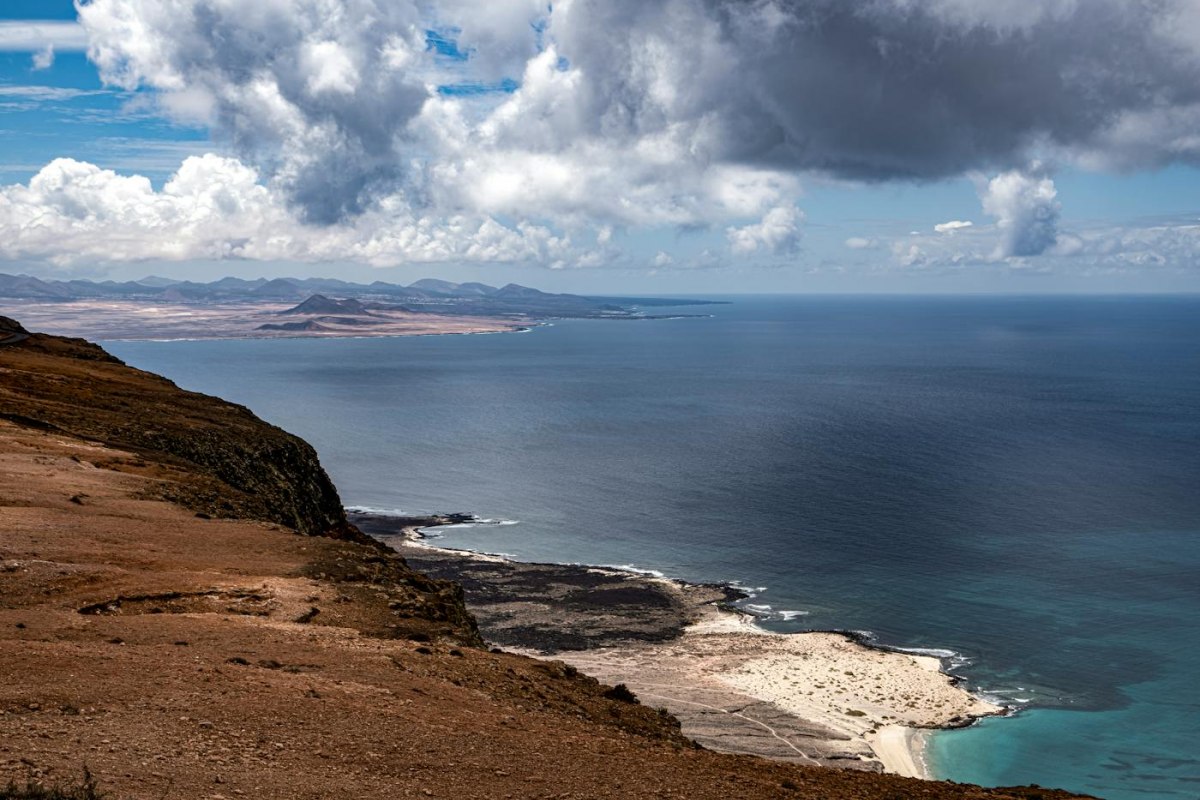
Fuerteventura rewards travellers who treat it as more than a beach. The oldest of the Canary Islands sits around 100 kilometres off the Saharan coast, and beneath the dunes and resort strips lies a layered story: two aboriginal kingdoms split by a stone wall, a fishing-and-goat economy that produced the first protected goat cheese in Spain, and a windmill culture built around toasted grain. This guide maps the island by what you actually do there, links through to detailed guides for each activity and area, and threads in the local history that the standard top-ten lists skip.
Orientation: one island, two old kingdoms
Before the Castilian conquest the island was called Herbania, and a low wall ran across the narrow isthmus at La Pared, dividing it into two warring chiefdoms. The north was Maxorata, ruled by the king Guise; the south was Jandia, ruled by Ayose. Both surrendered in 1402 to the Norman adventurers Jean de Bethencourt and Gadifer de la Salle, who began the European conquest of the Canaries here. The name Majoreros, still used for the island’s people, comes straight from Maxorata. You can stand between the two kings at the Mirador de Guise y Ayose near Betancuria, where two bronze statues over four metres tall face each other across the valley.
Knowing this geography helps you plan. The island runs roughly 100 kilometres north to south, distances between resorts are large, and the wind that defines the coast is strongest on the open south and the exposed north. A short overview of the main resort bases sits in our guide to the best all inclusive resorts in Fuerteventura, and the fuller picture of where to base yourself is in the where to stay guide.
Beaches, dunes and natural pools
The coastline carries roughly 150 kilometres of sand, the longest run of beach in the Canaries, and the variety is the point. The headline stretches divide cleanly by what you want from them:
- Grandes Playas and the Corralejo dunes: a protected field of mobile sand at the northern tip, the largest dune system in the archipelago, with shallow turquoise water on the lee side. Full detail sits in our guide to things to do in Corralejo.
- Cofete: a wild 12-kilometre arc on the back of the Jandia peninsula, reached by a long unpaved track, with strong currents that make it a place to walk rather than swim.
- La Concha, El Cotillo: a reef-sheltered lagoon on the north-west coast where the water stays calm and shallow, the safest family swimming on the island.
- Sotavento: a tidal lagoon on the south-east coast that fills and drains with the tide, shallow enough for beginners and strong enough to host a world windsurfing and kiteboarding event each summer.
A wider rundown of the sand, including the quieter coves, is in our guide to the best beaches in Fuerteventura.
Wind and water sports
The same trade wind that cools the afternoons turns the island into one of Europe’s serious wind-sport bases. The Sotavento lagoon near Costa Calma is the centre of gravity: its protected inner water lets beginners learn while the open bay outside the sandbar carries the wave riders. The annual World Cup brings the top of the sport to the same beach each summer. Our windsurfing and kitesurfing guide breaks down the schools, the seasons and the right spots for your level.
Beyond the board sports, the clear Atlantic water supports diving and snorkelling around the volcanic reefs, and operators run boat trips for spotting dolphins and whales off the coast. The details on the marine trips are in our guide to dolphin and whale boat trips.
Volcanoes and the inland landscape
Fuerteventura is the most eroded of the Canaries, so its volcanoes read as soft cones rather than sharp peaks. The most rewarding short hike is Calderon Hondo near Lajares, a young crater roughly 50,000 years old reached by an easy, free trail that ends at a viewpoint over the caldera and the northern dune fields. Barbary ground squirrels beg along the path. The malpais, the rough lava badlands around the northern volcanoes, makes up some of the island’s strangest walking country, covered in our volcano walk guide.
Inland and north of La Oliva rises Tindaya, the mountain the aboriginal Majoreros held sacred. Its slopes carry more than 300 podomorfos, foot-shaped rock carvings thought to mark a ritual site, and the mountain remains protected. The interior also holds the island’s quietest driving, and our jeep safari guide and quad biking guide cover the off-road routes through it.
Betancuria and the island’s history
Jean de Bethencourt founded Betancuria around 1404 as the first capital of the Canary Islands, sited deep inland in a green valley so that the open Atlantic raiders could not see it from the sea. The defence was not enough: Berber pirates sacked and burned the town late in the sixteenth century, and it was rebuilt around the church of Santa Maria. Today it is one of the prettiest villages in the Canaries, with cobbled lanes, white houses and the island’s archaeological museum, which tells the pre-Hispanic Majorero story in full. The drive up from the east coast through the Vega de Rio Palmas is one of the best on the island. Our full guide to Betancuria covers the old capital in depth.
Historic villages and the colonels’ island
Away from the beaches, the interior villages hold a heritage the resort coast hides, and a few sites are genuinely worth the drive:
- La Oliva and the Casa de los Coroneles: La Oliva was the island’s capital from 1834 to 1956, and the colonels who governed Fuerteventura for generations ruled from the grand Casa de los Coroneles, one of the finest examples of palatial civil architecture in the whole archipelago, now a cultural centre open to visitors.
- The church of Pajara: the seventeenth-century Iglesia de Nuestra Senora de Regla carries an extraordinary carved stone portal whose Mesoamerican-looking motifs have led many specialists to link it directly to Aztec art brought from the New World, a genuine puzzle found on no other Canary church.
- Ecomuseo La Alcogida, Tefia: seven restored houses of a rural hamlet lived in until the 1970s, where artisans demonstrate palm weaving, lacework, pottery and stonework, the clearest window into the hard farming life that shaped the island.
- The windmill museum at Antigua: the restored Molino de Antigua keeps its grain-grinding machinery intact and explains the gofio culture that the molinos served.
Local food: cheese, gofio and salt
The island’s food culture is older and stronger than the resort buffets suggest, and three things anchor it:
- Queso Majorero: made from the raw milk of the native majorera goat, this was the first goat cheese in Spain to win a Protected Designation of Origin, granted on 16 February 1996. The island has long kept more goats than people, and the cured wheels, often rubbed with paprika, gofio or oil, are sold across the six municipalities.
- Gofio: toasted, milled grain that the aboriginal Canarians ate and that islanders still fold into soups, desserts and breakfast. It was ground in the island’s molinos and molinas, the windmills that became a Majorero symbol; the restored mill and grain museum at Antigua shows the machinery intact.
- Sea salt: at Salinas del Carmen on the east coast, working salt pans more than 400 years old still crystallise Atlantic salt by evaporation, and the on-site Museo de la Sal explains the trade that once preserved the island’s fish catch.
Beyond those three pillars, the island’s table is built on goat and fish. The signature dish is sancocho, salted wreckfish or sea bass poached and served with potatoes, sweet potato, a thick gofio paste and mojo, traditionally a Holy Week plate; cabra, slow-cooked goat, and the wrinkled papas arrugadas with red and green mojo appear on every menu. Cheese-lovers can follow a quesera route: the island has around 29 active cheese dairies, many open for tasting, working the milk of the hardy cabra majorera breed that outnumbers the human population. The wider Canarian and Spanish table sits in our guide to traditional food in Spain, and shoppers can read where to buy it in our Fuerteventura shopping guide.
A literary footnote: Unamuno’s exile
In March 1924 the writer and philosopher Miguel de Unamuno was banished to Fuerteventura by the Primo de Rivera dictatorship for his attacks on the regime. He expected a punishment and found a landscape that moved him, calling the bare island a place that stripped life to its essentials. He ate its gofio and cheese, walked its plains, and wrote the sonnets later collected as De Fuerteventura a Paris before escaping to France a few months later. His house in Puerto del Rosario is now a small museum, and a bust of him stands on the slope of Tindaya.
Stargazing under a protected sky
One of the island’s least-known attractions only appears after dark. Fuerteventura was declared a Starlight Reserve in 2015, the third in the Canaries after La Palma and the Teide peaks, a certification backed by a UNESCO-linked initiative that commits the island to protecting its night sky from light pollution. With so little development, dry clear air and a position far south, the island has some of the darkest accessible skies in Europe, and NASA has described it as a window to the universe. The interior away from the resorts, around Tindaya, Betancuria and the central plains, gives superb naked-eye views of the Milky Way, and several rural farms and operators run guided astronomy nights with telescopes. Bringing a blanket and driving fifteen minutes inland from any resort on a moonless night is one of the cheapest and most memorable things to do on Fuerteventura.
Festivals and local life
The island’s calendar still turns on its religious and rural traditions, and timing a visit to one is a way into the real Majorero culture:
- Romeria de la Virgen de la Pena: the island’s biggest festival, a pilgrimage to the patron saint’s sanctuary at Vega de Rio Palmas near Betancuria on the third Friday of September, when islanders converge on foot and by decorated ox-cart, donkey and camel for masses, folk music and food.
- Carnival: the towns, especially Puerto del Rosario and Corralejo, hold lively carnival celebrations in late winter with costumes, parades and music.
- Town and harbour fiestas: each village keeps its own saint’s day through the summer, the coastal ones with a Virgen del Carmen sea procession of fishing boats in July.
Day trips by boat
Two short crossings open up the rest of the archipelago:
- Isla de Lobos: a tiny protected islet 15 minutes by ferry from Corralejo, with a single hamlet at El Puertito, a lagoon, a lighthouse and a capped daily visitor quota that keeps it quiet. Bring your own water and food.
- Lanzarote: the neighbouring island is around 25 to 40 minutes by ferry from Corralejo, close enough for a day trip to its volcanoes and the works of the artist Cesar Manrique. The crossings and options are in our guide to boat trips between Lanzarote and Fuerteventura.
Family days and rainy-day options
The island is built for relaxed family travel, and the calm-water beaches do most of the work. When you want a fixed attraction, the two reliable ones are Acua Water Park in Corralejo, the island’s only water park, formerly known as Baku Family Park, with pools, slides and a children’s area, and Oasis Wildlife Fuerteventura near La Lajita in the south, a large zoo and botanical garden where the camel safari, the sea lion show and the reptile house fill a full day. A fuller list, including the soft-play and beach-club options, sits in our guide to family activities in Fuerteventura. Keen birdwatchers should read our birdwatching guide, since the plains hold Egyptian vultures and the rare houbara bustard.
When to go and how to get around
Fuerteventura runs mild all year, with daytime highs around 21C in winter and the high 20s in late summer, which makes it a winter-sun staple for northern Europe. A few practical notes shape a trip:
- The calima: a few times a year a Saharan dust haze blows in from Africa, dropping visibility and raising the temperature for a day or two. It passes quickly and is the price of sitting so close to the desert.
- A rental car: distances are long and public transport thins out away from the main routes, so a car turns the interior, the history and the remote beaches into easy reach. Transfers and car hire from the airport are covered in our airport transfer guide.
- The whole island is a UNESCO Biosphere Reserve, declared in 2009, which shapes how the protected coasts, dunes and the islet of Lobos are managed and why building is capped in so many places.
Getting there and choosing a base
All flights land at Fuerteventura Airport at El Matorral, just south of the capital Puerto del Rosario, with direct routes from across northern Europe and short hops from the other Canary Islands. Where you stay shapes the trip more than the hotel does, because the resort areas sit far apart:
- Caleta de Fuste: closest to the airport at around 15 minutes, sheltered bay, the easiest base for families and first-timers.
- Corralejo: the liveliest town, 35 to 40 minutes north, next to the dunes and the Lobos and Lanzarote ferries.
- Costa Calma and Jandia: the south, 60 to 90 minutes away, for the longest beaches and the strongest wind, with the wild Jandia peninsula and the town of Morro Jable beyond.
- El Cotillo: the laid-back north-west village for calm lagoons and a slower pace.
A suggested week on the island
One way to fit the island together without backtracking across its length:
- Days one and two: settle into your base, swim the Corralejo or Sotavento beaches, and take the short ferry to Isla de Lobos.
- Day three: drive the interior loop through Betancuria, the Mirador de Guise y Ayose and the windmill museum at Antigua, tasting Majorero cheese on the way.
- Day four: walk the Calderon Hondo crater near Lajares, then unwind at the La Concha lagoon in El Cotillo.
- Day five: cross the rough track to Cofete on the Jandia peninsula for the wildest beach and the Villa Winter story.
- Day six: take a windsurfing or kitesurfing lesson at Sotavento, or a dolphin boat trip from the harbour.
- Day seven: a ferry day trip to Lanzarote, or the Salinas del Carmen salt museum and the capital’s market for gofio and local crafts.
Frequently asked questions
How many days do you need in Fuerteventura?
A beach-and-pool break works in a long weekend, but seeing the island properly, with Betancuria, Cofete, Lobos, a volcano walk and the northern villages, takes about five to seven days with a rental car.
What is Fuerteventura best known for?
Its beaches and dunes, its year-round wind that draws windsurfers and kitesurfers to Sotavento, and its native goat cheese, the Queso Majorero, the first goat cheese in Spain to receive a Protected Designation of Origin.
Is Fuerteventura better than the other Canary Islands?
It depends on what you want. Fuerteventura has the longest, emptiest beaches and the strongest wind sports, but fewer big resorts and less green than Tenerife or Gran Canaria. It suits travellers who want sand, space and water sports over nightlife and lush scenery.
Can you see Lanzarote from Fuerteventura?
Yes. The two islands sit close together across a narrow strait dotted by the islet of Lobos, and ferries from Corralejo reach Lanzarote in well under an hour, which makes a day trip easy.
What should you not miss in the interior?
Betancuria and its archaeological museum, the Mirador de Guise y Ayose with its giant statues of the two aboriginal kings, the windmill and grain museum at Antigua, and the sacred mountain of Tindaya near La Oliva.
Sources and further reading
- Consejo Regulador de la Denominacion de Origen Queso Majorero
- Reserva de la Biosfera Fuerteventura, official biosphere reserve
- Cabildo de Fuerteventura, island council
- Miguel de Unamuno en Fuerteventura, Turismo y Cultura de Canarias
- Casa de los Coroneles, La Oliva, Gobierno de Canarias cultural centre
- Cabildo de Fuerteventura, Starlight Reserve certification