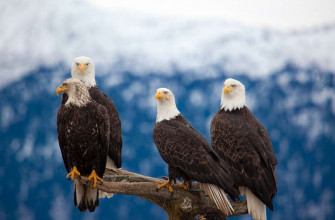
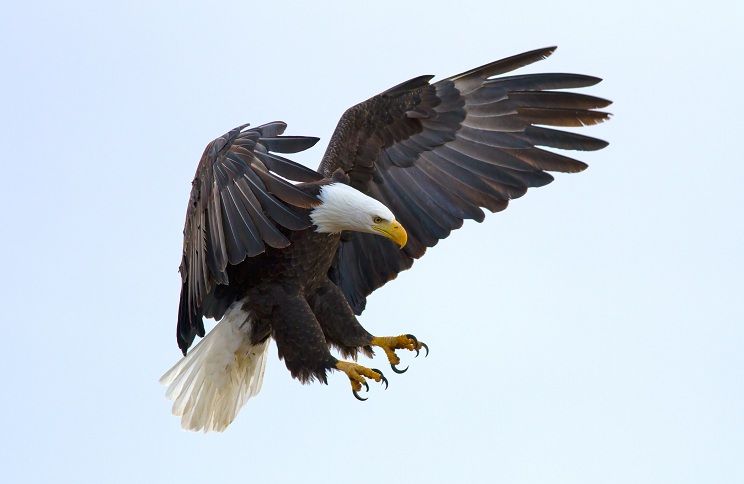
The American bald eagle habitat spans nearly the entire North American continent, from the Aleutian Islands of Alaska through the contiguous United States and into northern Mexico, with secondary populations across most of Canada. Haliaeetus leucocephalus is the only sea eagle endemic to North America, and its habitat preferences reflect that classification: large bodies of open water, tall mature trees or cliff faces for nesting, low human disturbance, and abundant fish populations. Bald eagle habitat covers an estimated 4.5 million square kilometres across its breeding and wintering range, making this species among the most broadly distributed raptors in North America. This guide covers geographic range, preferred habitat features, nesting sites, diet, migration patterns, population recovery since the DDT ban in 1972, and prime locations where wild bald eagles can still be seen.
Geographic Range: Alaska to Mexico
The bald eagle’s range covers all 49 US states outside Hawaii. The densest populations sit in Alaska and the Pacific Northwest, where coastal and riverine habitat supports year-round eagle presence. Alaska alone holds an estimated 30,000-40,000 bald eagles, more than any other US state. The Chilkat River valley near Haines, the Kenai Peninsula, and the coast of Prince William Sound all carry exceptional concentrations during autumn salmon runs.
In the contiguous 48 states, major population centres include:
- Pacific Northwest: Washington, Oregon, and northern California – riverine habitat along the Columbia, Willamette, and Klamath watersheds.
- Great Lakes region: Minnesota, Wisconsin, Michigan – boreal forest lake habitat with abundant walleye and northern pike.
- Chesapeake Bay watershed: Maryland, Virginia, Delaware – estuarine habitat with wintering concentrations along the Bay shoreline.
- Florida: Large resident population using freshwater lakes, the Gulf Coast, and the Everglades edge.
- Mississippi River corridor: Iowa, Illinois, Missouri, Arkansas – river-bottom habitat with large wintering roosts below hydroelectric dams where ice-free water concentrates fish.
Southern Mexico marks the species’ southernmost breeding range, with small populations in Sonora, Sinaloa, and along the northern Gulf of California coastline. Breeding density drops off sharply below the latitude of northern California on the Pacific side and the Carolinas on the Atlantic side.
Preferred Habitat Features
Bald eagles need three habitat elements at a single location: open water for hunting, tall mature trees or cliff faces for nesting and perching, and limited human disturbance during the breeding season.
Water requirements:
- Large lakes and reservoirs (100+ acres), which produce stable fish populations.
- Rivers with year-round flow and accessible fishing pools.
- Estuarine coastlines where freshwater rivers meet saltwater.
- Open seas within 16-32 kilometres of shore, for Alaska and Pacific Northwest populations.
Nesting tree requirements:
- Height: 15-40 metres, taller than surrounding canopy.
- Strong horizontal branches or main-trunk forks able to support a 1,000-2,000 kg nest.
- Visibility: open view over water, with clear approach flight lines.
- Species used: old-growth Douglas fir, ponderosa pine, white pine, loblolly pine, bald cypress, cottonwood, and large deciduous trees including oak and sycamore.
Where tall trees are unavailable – Aleutian Islands, parts of Arctic Alaska, some arid Western states – eagles nest on cliffs, rock outcroppings, or artificial structures including power pylons and communication towers. The physical structural requirement for a stable nest platform is more important than tree species.
Nesting Sites and Reproductive Behaviour
Bald eagles mate for life and typically return to the same nest year after year, adding new material each breeding season. Nests grow to enormous size with repeated use. The largest documented bald eagle nest, recorded near St Petersburg, Florida, in 1963, measured 2.9 metres across, 6 metres deep, and weighed over 2,700 kilograms. More typical nests measure 1.5-1.8 metres across and weigh 500-800 kilograms.
The breeding cycle:
- Pair bonding: Eagles pair between ages 4 and 5 years. Courtship includes elaborate aerial displays including cartwheel flights where paired birds lock talons and tumble downward.
- Nest construction: November to February depending on latitude. Southern populations breed earlier; Alaskan populations breed in late spring.
- Egg laying: Usually 2 eggs laid over 3-6 days. Incubation by both parents.
- Incubation period: 34-36 days.
- Fledging: 10-12 weeks from hatching. Juveniles depend on parents for another 4-6 weeks after first flight.
- Sibling competition: The first-hatched chick often dominates feeding, and the second chick sometimes starves in years of poor prey availability.
- Age at first breeding: 4-5 years, when the white head and tail are fully developed.
Nest site loyalty creates long-term habitat predictability. Once an eagle pair claims a territory, they typically defend it against intruding adult eagles for the duration of both birds’ lives (20-30 years). The same nest may be occupied by successive generations of the same lineage for 40-60 years.
Diet and Hunting Techniques
Bald eagles are opportunistic predators with a diet dominated by fish but including a wide range of other prey. Fish make up 50-90% of the diet depending on season and location, with salmon and trout species preferred on the Pacific Coast, and freshwater species (catfish, shad, perch, carp) dominant in interior locations.
Other prey categories:
- Waterfowl: Ducks, coots, grebes, and seabirds, particularly vulnerable during winter when ice reduces fishing opportunities.
- Mammals: Rabbits, muskrats, small rodents, occasionally raccoons or young foxes.
- Reptiles: Turtles and snakes, especially in southern populations.
- Carrion: Dead fish and mammal carcasses make up a significant portion of winter diet; Franklin’s complaint that eagles “do not get their living honestly” stemmed from this scavenging habit.
- Human-source food: Landfill scavenging, roadkill consumption, and fish discarded at commercial docks.
Hunting techniques include the soar-and-strike (spotting prey from high altitude then diving), still-hunting from a perch (common at riverine locations), kleptoparasitism (stealing fish from ospreys, gulls, and other fish-eating birds), and wading to catch fish in shallow water.
Bald eagles can lift prey up to about half their own body weight (roughly 2-3 kilograms) in sustained flight. Heavier prey must be consumed at the capture site or dragged across the water surface to shore.
Migration and Seasonal Movements
Bald eagles exhibit partial migration – northern populations move south in winter, while populations in temperate latitudes are largely resident year-round. The general pattern:
- Alaska and Canadian populations: Migrate south in autumn, wintering along the Pacific Coast from British Columbia to northern California, or along the Mississippi River system.
- Northern US populations (Minnesota, Wisconsin, Michigan, New England): Partial migration – some individuals move south, others remain if open water persists.
- Mid-latitude US populations (Chesapeake Bay, Great Lakes, Pacific Northwest): Largely resident year-round with short-distance local movements following fish availability.
- Southern US populations (Florida, Gulf Coast, Southwest): Resident. Some juveniles disperse north in summer and return south in autumn.
Major migration staging areas include the Chilkat Valley (Alaska) in October-December, the Skagit and Nooksack rivers (Washington) in November-February, Mississippi River pools 14-17 (Iowa-Illinois) in January-February, and Blackwater National Wildlife Refuge (Maryland) in November-March. Eagle congregations at these sites can exceed 1,000 individuals during peak periods, creating premium wildlife viewing opportunities.
Population Recovery Since the DDT Ban
DDT use in US agriculture from 1945 through 1972 caused catastrophic reproductive failure in bald eagles. DDT metabolites (primarily DDE) accumulated in fish tissue, concentrated further up the food chain in eagles, and caused eggshell thinning that made successful reproduction nearly impossible. By 1963, the contiguous US bald eagle population had crashed to approximately 487 breeding pairs, down from an estimated 100,000 pairs before European colonisation.
Key recovery milestones:
- 1940: Bald and Golden Eagle Protection Act enacted (originally Bald Eagle Protection Act).
- 1967: Listed as endangered under predecessor to Endangered Species Act.
- 1972: DDT banned for agricultural use in the United States.
- 1973: Endangered Species Act signed into law.
- 1978: Listed as endangered under Endangered Species Act in 43 states; threatened in five.
- 1995: Downlisted from endangered to threatened throughout the lower 48.
- 2007: Fully delisted from the Endangered Species Act.
- 2021: US Fish and Wildlife Service estimated 316,700 bald eagles in the contiguous 48 states, with a further 30,000-40,000 in Alaska.
Recovery was driven primarily by the DDT ban and by habitat protection under the Clean Water Act of 1972, which restored fish populations in previously polluted rivers. Captive breeding and reintroduction programmes played a secondary role. The species recovery ranks among the most successful conservation stories in US wildlife management history and is regularly cited in Endangered Species Act debates. The same protective legal framework is covered from the cultural angle in our piece on Native American eagle symbols.
Where to See Wild Bald Eagles
Top wildlife viewing locations with confirmed wild bald eagle populations:
- Chilkat Bald Eagle Preserve, Alaska: October-December, up to 3,000 eagles on salmon runs.
- Skagit River, Washington: Rockport and Marblemount, November-February, guided float trips available.
- Mississippi River pools 14-17, Iowa-Illinois: Lock and Dam 15 at Rock Island is the most accessible viewing spot, January-February.
- Conowingo Dam, Maryland: One of the largest wintering concentrations on the East Coast, November-March.
- Klamath Basin, Oregon-California: Lower Klamath National Wildlife Refuge, November-March, up to 500 eagles.
- Reelfoot Lake State Park, Tennessee: December-February, guided pontoon tours.
- Everglades National Park, Florida: Anhinga Trail and Flamingo area, year-round.
- Apalachicola National Forest, Florida: Breeding pairs December through May.
- Blackwater National Wildlife Refuge, Maryland: Year-round resident population with winter concentration.
- Lake Guntersville State Park, Alabama: January “Eagle Awareness Weekends” with guided tours and open-flight demonstrations.
For background on one of the listed destinations, see our full guide to Lake Guntersville State Park, which covers the January Eagle Awareness programme in detail along with cabin, chalet, and campground options.
Observation best practices: bring 8x or 10x binoculars, wear neutral clothing, keep a minimum 100 metre distance from nest trees, avoid approaching birds on the ground, and never feed wild eagles. Active nests are federally protected and approaching within 200 metres during the nesting season can trigger enforcement action. For the combined eagle-and-flag motif that builds on the biology covered here, see our piece on the bald eagle with the American flag.
Threats and Ongoing Conservation Concerns
Despite delisting, bald eagles face continuing threats that require management attention:
- Lead poisoning: Eagles that scavenge gut piles left by hunters using lead ammunition develop acute or chronic lead toxicity. Estimated at 20-40% prevalence in necropsied eagles in some regions.
- Electrocution: Older power pylon designs without raptor-safe spacing kill hundreds of eagles annually.
- Collision with vehicles: Eagles scavenging roadkill are struck by cars; winter-concentration roads show highest mortality.
- Wind turbine collisions: A growing concern in some Western states, especially in migration corridors.
- Habitat loss: Waterfront development removes nesting trees and eliminates quiet shoreline habitat.
- Secondary poisoning: Rodenticides and insecticides continue to reach eagles through their prey in lower-but-measurable concentrations.
- Climate change: Projected range shifts and fishery disruption in northern latitudes over the coming decades.
The broader cultural and legal protections covered in our piece on the American bald eagle symbol remain in force under the Bald and Golden Eagle Protection Act, the Migratory Bird Treaty Act, and the Lacey Act. Possession of feathers or other parts is also regulated – see our guide on American bald eagle feathers uses.
Frequently Asked Questions
Where do bald eagles live in the United States?
Bald eagles live in all 49 US states outside Hawaii. The densest populations are in Alaska (30,000-40,000 birds) and the Pacific Northwest. Major populations in the lower 48 occupy the Great Lakes region, Chesapeake Bay, Florida, the Mississippi River corridor, and the Pacific Coast from Washington to northern California.
Do bald eagles migrate?
Partial migration. Northern populations (Alaska, Canada, upper Midwest) move south for winter. Mid-latitude populations are largely resident year-round. Southern populations (Florida, Gulf Coast) are resident with some juvenile dispersal northward in summer. Winter concentrations below hydroelectric dams and along ice-free rivers are prime viewing opportunities.
What kind of trees do bald eagles nest in?
Bald eagles nest in tall mature trees 15-40 metres high, taller than the surrounding canopy, with strong horizontal branches and a clear view of nearby water. Douglas fir, ponderosa pine, white pine, loblolly pine, bald cypress, cottonwood, oak, and sycamore are the most commonly used species. On treeless coasts (Aleutian Islands, Arctic Alaska), eagles nest on cliff faces or artificial structures.
How big is a bald eagle nest?
A typical bald eagle nest measures 1.5-1.8 metres across and weighs 500-800 kilograms. The largest documented nest, recorded in Florida in 1963, measured 2.9 metres across, 6 metres deep, and weighed over 2,700 kilograms. Pairs reuse and add to nests for decades, creating some of the largest tree-nest structures of any bird species.
What do bald eagles eat?
Fish dominate the diet (50-90% depending on location and season), supplemented by waterfowl, small mammals, reptiles, and carrion. Hunting techniques include diving from altitude, still-hunting from perches, kleptoparasitism (stealing from other birds), and wading in shallow water. Eagles can lift prey up to half their own body weight in sustained flight.
When were bald eagles removed from the endangered species list?
The bald eagle was downlisted from endangered to threatened in 1995, then fully delisted from the Endangered Species Act in 2007 after population recovery from roughly 487 breeding pairs in 1963 to over 9,700 pairs by 2006. The species remains protected under the Bald and Golden Eagle Protection Act and the Migratory Bird Treaty Act.
Can I visit a bald eagle nest?
Not without restrictions. Active nests are federally protected, and approaching within 200 metres during the nesting season can violate the Bald and Golden Eagle Protection Act. Public viewing platforms and National Wildlife Refuges offer legal viewing opportunities at safe distances. Several state parks including Lake Guntersville (Alabama), Reelfoot Lake (Tennessee), and Blackwater NWR (Maryland) run managed viewing programmes.
Sources and Further Reading
- US Fish and Wildlife Service – Bald Eagle species profile – fws.gov/species/bald-eagle
- Cornell Lab of Ornithology – All About Birds Bald Eagle – allaboutbirds.org
- Audubon Society – Bald Eagle guide – audubon.org/field-guide
- American Eagle Foundation – eagles.org
- US Geological Survey – Bald Eagle population estimates 2020-2021 – usgs.gov