A Chinese family treats naming as a months-long project that pulls in calligraphy, the lunar calendar, an elemental energy chart, often a paid 起名 (qǐmíng, name-giving) consultant, and a quiet veto from the paternal grandfather. The result has to clear three filters at once: sound right when read aloud, balance visually on paper, and survive scrutiny across an extended kin network. This guide explains the working system that produces a Chinese given name in 2024, from the xing/ming structure to the 五行 elemental cure logic to the actual top characters appearing on Public Security Bureau registries this year.
Most pages on Chinese baby names hand back a flat list of 100 to 500 entries with a sentence per name. That format ignores the operational layer Chinese parents work through. Globerove covers the system: the 八字 method, the 字辈 generational poem, the 三才五格 stroke numerology, the naming taboos, and the regional name reports released by city-level Public Security bureaus each January. Specific gendered name picks live in the spokes – girls’ names with classical poetry citations, boys’ names and male character patterns, and homophone taboos with examples.
How Chinese Names Work: The xing/ming Structure
A Chinese name reads family-first. 王小雨 is Wáng Xiǎoyǔ – Wang as the surname and Xiaoyu as the given name. The surname (姓 xìng) sits in front and is one character in 99% of cases, inherited from the father. Wang, Li, Zhang, Liu, and Chen account for roughly a third of the population. For full surname history and dynastic origins, see the most common Chinese surnames.
The given name (名 míng) follows. It uses one or two hanzi from a working pool of about 3,500 commonly registered characters out of the 8,105 in the Common Standard Chinese Character List. Two-character given names dominate: a 2010s study cited by Wikipedia found that over three-quarters of mainland Chinese citizens carry two-character given names, and the share rises in younger cohorts. The combinatorial reason is plain. With about 5,000 surnames active across 1.4 billion people, two characters give parents enough room to avoid the duplicate-full-name overload that would otherwise crash through school registers, bank databases, and 户口 (household registration) lookups.
Chinese nobility historically carried up to four parallel name forms: 名 (míng, personal name), 姓 (xìng, clan name), 氏 (shì, lineage name), and 字 (zì, courtesy name). Republican-era educated families maintained the 字 (a name used by peers in adulthood) and 号 (hào, a self-chosen style name) into the 1940s. The 1949 reforms flattened the system, and modern citizens carry only the surname plus given name on official documents.
Choosing Characters: Sound, Meaning, and Stroke Balance
Picking the two characters takes weeks in most families. The process runs through a sequence of practical filters that has changed in tooling but not in logic since the late Qing era.
Sound comes first. Mandarin’s four tones generate melodic contours, so a parent reads the full three-syllable sequence aloud to test the flow. A name with three identical tones reads flat – 王宇舒 (Wáng Yǔshū) is all third tone if the surname is read on its own and creates a monotonous string. A name with abrupt fourth-fourth-fourth tones reads aggressive. Parents look for a balanced tonal arc, often falling-rising-rising or rising-flat-falling.
Meaning enters next. Each candidate character is checked against a 康熙字典 (Kāngxī Zìdiǎn) entry or a digital descendant. Character meanings shift across classical, literary, and modern usage; parents pick based on the modern reading but appreciate the classical roots. The same syllable rendered with different hanzi delivers radically different meanings: yīng can be 英 (hero), 樱 (cherry blossom), 莺 (oriole), or 颖 (ear of grain), and the chosen character is the actual semantic content of the name.
Visual balance closes the round. Parents write candidate names by hand to evaluate stroke density. A name where the surname is heavy (鞠 jū at 17 strokes, 翟 zhái at 14, 黎 lí at 15) and the given name is sparse looks bottom-heavy on paper, so the family rebalances. Calligraphy aesthetics shape the final choice as much as semantic preference. For more on how surname stroke load shapes the visual logic, see the surname history reference.
The Five Elements (五行) and Eight Characters (八字)
The 八字 (bāzì, “eight characters”) is a personal energy code derived from the child’s lunar birth date. Each of the four time pillars – year, month, day, hour – contributes a 天干 (heavenly stem) plus a 地支 (earthly branch), producing eight characters in total. The conversion runs against the lunar calendar; date-to-pillar lookup tables and online calculators are widely used. Parents who take 八字 seriously treat the Chinese lunar calendar dates as the source of truth, since solar Gregorian dates do not produce a clean pillar mapping.
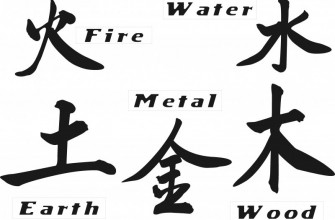
Each pillar maps to one or more of the 五行 (wǔxíng), the five interacting forces:
- 木 mù – wood. Growth, flexibility, springtime energy.
- 火 huǒ – fire. Heat, expansion, summer energy.
- 土 tǔ – earth. Stability, centering, late-summer transition.
- 金 jīn – metal. Contraction, sharpness, autumn energy.
- 水 shuǐ – water. Flow, depth, winter energy.
A 八字 reading shows which of the five elements the child carries in excess and which is 缺 (quē, missing or weak). The standard remedy: write a character containing the missing element’s radical into the given name as a balancing cure. A child born with 缺水 (water deficiency) might receive a name with 沐, 涵, 江, or 海 – all carrying the 氵 water radical. A 缺火 chart pulls toward 烨, 炎, 暖, or 昭 with the 火 or 日 radical. The cure logic is the working backbone behind why so many 2024 newborn names cluster around water-radical characters: parents whose charts point that way reach for the same pool.
The 八字 layer also influences which Chinese zodiac animal sits in the year pillar, and the interaction between zodiac and elements feeds into the consultant’s recommendation. A daughter born in a Wood Rabbit year on a 缺金 chart will receive a different cure list than a son born the same year on a 缺水 chart, even when other variables match. The system is gender-neutral at the elemental level; the specific character choices for each sex are addressed in the relevant gender spoke.
Generational Naming: 字辈 and Family Poems
A 字辈 (zìbèi) is a multi-character poem composed by a clan ancestor and stored in the family genealogy. Each character of the poem assigns the shared given-name character for one generation. Siblings and paternal cousins born into the same generation all carry that character, usually in the second position of a two-character given name. The next generation rotates to the next character of the poem. A poem of 20 characters covers 20 generations, after which the clan composes a continuation.
The Zhang family of Hefei, Anhui, raised four daughters in the 1920s named 张元和, 张允和, 张兆和, and 张充和, who all share the radical 儿 in the second-character position because the Zhang family poem assigned that radical to their generation. The family had operated the 字辈 sequence for over twenty generations before urban migration thinned the practice. Two of the sisters became prominent literary figures, and their generationally-marked names are recognizable to anyone familiar with the genealogy convention.
The system has decayed in mainland cities since the 1950s. The Cultural Revolution disrupted clan record-keeping, the one-child policy collapsed the cousin pool that 字辈 was designed to coordinate, and post-2000 urban parents began to view the inherited shared character as a constraint on aesthetic choice. The practice still operates in rural Fujian, Zhejiang, Guangdong, and Hunan, inside Hakka clans with strong genealogical institutions, and in overseas Chinese communities in Singapore, Malaysia, and Taiwan that maintained the records through the 20th-century disruptions.
Cross-cultural parallels exist. Korean 항렬 (hangnyeol) uses an analogous generation-character system inside extended families. Vietnamese mid-name (Văn for men, Thị for women historically) carries a related generation-marker function in some clans. Japanese has no direct equivalent, since clan-poem genealogies did not develop into a naming convention there.
Three Talents and Five Grids (三才五格): Stroke Numerology
The 三才五格 (sāncái wǔgé) method overlays the chosen characters with a stroke-count numerology derived from the 康熙字典. Each hanzi has a fixed Kangxi stroke count, and the totals across the surname and given-name positions produce five “grid” numbers and three “talent” pillars that map to an 81-number lucky table. The system was imported from Japanese 姓名判断 (seimei handan) in the early 20th century and naturalized into Chinese 起名 practice through Taiwan and Hong Kong consultancies.
The five grids (五格 wǔgé):
- 天格 (tiāngé, heaven grid) – sum of surname strokes plus 1.
- 人格 (réngé, human grid) – sum of last surname character plus first given-name character.
- 地格 (dìgé, earth grid) – sum of given-name characters.
- 总格 (zǒnggé, total grid) – sum of all surname plus given-name strokes.
- 外格 (wàigé, outer grid) – total grid minus human grid plus 1.
The three talents (三才 sāncái) – 天 heaven, 人 human, 地 earth – read the relationships among the first three grids and produce a compatibility verdict per pair. The 81-number table assigns a fortune valence to each grid total. Some numbers are flagged as auspicious, others as warning, and a small set is treated as gender-conditional. Online calculators on sites like 周易 and Taiwanese baby-name portals automate the math; a paid consultant returns a shortlist of name combinations that pass all five grids and the three-talent compatibility check.
Mainland urban families consult 三才五格 as one input among several rather than the deciding rule. Taiwan, Hong Kong, Singapore, and Malaysia treat the verdict as more binding, often rejecting a candidate name purely on a grid-failure flag. The gendered subset of favorable numbers – which subset applies to daughters versus sons – is covered in the gender-specific spokes rather than here.
Naming Taboos: What Parents Avoid
Three rules constrain every choice. A child is never named after a living elder, since direct namesakes violate Confucian seniority order and create awkward kinship address. A father whose given name contains 伟 (wěi) will not register a son with 伟 in his given name; the same applies across uncles, paternal grandparents, and notable lineage ancestors named in the genealogy.
Homophones of unlucky words get cut. 死 (sǐ, death) is automatically excluded as a radical, and characters that sound close to taboo words across regional dialects get filtered out at the family-discussion stage. A Cantonese-speaking parent will avoid a character that reads cleanly in Mandarin but produces an unlucky homophone in Cantonese, since the family will hear the name in both registers across daily life. Fuller examples of homophone-driven rejections live on the funny Chinese names reference, which catalogs the common pitfalls.
Tonal flow is the third filter. Beyond the family-elder taboo and the homophone scan, the chosen sequence must read aloud cleanly across the three syllables. Parents speak the full name as if calling the child across a room and reject candidates that sound mush, harsh, or repetitive. Characters with romantic associations like 爱 (ài, love) or 喜 (xǐ, joy) are popular in given names but get cut when the surname pairing produces an unintended romantic-couple reading – 黄爱 reads close to 黄爱 (yellow love) in some dialect contexts and gets sidelined. A small set of family-related characters carry similar conditional risks depending on the surname.
Modern Trends: 2024 Newborn Name Statistics
Public Security Bureau registries in major Chinese cities publish 2024 newborn name reports each January. The pattern across Nantong (Jiangsu), Chongqing, Sichuan, and Huai’an reveals a clear cohort rotation. The 子涵 / 梓萱 / 子轩 names that ruled 2010-2018 dropped out of regional top twenties, replaced by names built around the radicals 沐, 汐, 玥, 瑶, 泽, and 辰.
The Nantong 2024 report from the city’s Public Security Bureau put 沐辰 (Mùchén) at first place for boys after two years at second, and 沐瑶 (Mùyáo) at first for girls after climbing from eighth in 2023. Seven of the top twenty given names in Nantong contained the character 沐. Sichuan’s 2024 statistics named 浩宇 (Hàoyǔ) as boys top after consecutive years and 汐玥 (Xīyuè) as girls top, with thousands of registrations carrying that exact pairing. Chongqing’s 2024 report listed 瑞泽 (Ruìzé), 星辰 (Xīngchén), 璟泽 (Jǐngzé), 沐辰, and 奕辰 as the boys top five, with 泽 and 辰 leading the most-used character ranking. Huai’an in Jiangsu showed 瑞泽 and 沐瑶 at the top, with each appearing in roughly 8 of every 1,000 newborn names recorded.
The cultural shift these names mark goes back through four discernible waves since 1949:
- 1949-1965 – 建国 (jiànguó, build the country), 桂英 (guìyīng, osmanthus heroine), 援朝 (yuáncháo, aid Korea). State-ideological and rural floral.
- 1980s – 军 (jūn, army), 勇 (yǒng, brave), 英 (yīng, hero) for both sexes. Reform-era ambition without strong gender split.
- 1990s-2000s – 张伟, 王丽, 李娜. Plain two-syllable names that produced the highest registry-duplication rates in modern history.
- 2010s – 子涵, 梓萱, 子轩. Drama-driven 古风 lite. By 2018 schoolyards listed three or four 子涵 per class.
- 2024 – 沐瑶, 沐辰, 汐玥, 瑞泽. Water-radical, single-source aesthetic, regional MPS reports converging on 沐 and 泽.
Why 沐 and 泽 dominate 2024: both carry water radicals (氵), making them 五行 cures for the wave of dragon-year and snake-year babies whose charts skewed toward fire excess. Both have classical sources – 沐 in the Lunyu line 浴乎沂 and 泽 across the Shijing – giving them moral backing. Both look balanced on smartphone keyboards, an unspoken but real selection pressure. The Ministry of Public Security operates a 重名查询 (chóngmíng cháxún) duplicate-check service through the national government services platform, where a parent enters a candidate full name and the system returns the count of registered citizens already carrying that exact combination. Parents looking for non-saturated names use this to avoid the 子涵 fate.
Beyond Han Chinese: Names from Ethnic Minorities
The People’s Republic recognizes 56 official ethnic groups (民族 mínzú), and naming traditions outside the Han majority follow different structural rules. A pillar on Chinese baby names that ignores this layer is incomplete, since roughly 8.9% of the population belongs to non-Han groups and their naming practices vary as widely as Hindi versus Spanish.
Tibetan (藏族 zàngzú) names typically run four characters or four syllables, with the first two given by a senior monk after consultation. A girl might be named 卓玛 (Zhuómǎ, transliterating Drolma, the female bodhisattva Tara) or 央金 (Yāngjīn, from Yangzin, the goddess of music). The name often refers to a Buddhist deity, a virtue, or a celestial body, and Tibetan families do not use surnames in the Han sense. The given name carries the full identifying weight.
Uyghur (維吾爾族 wéiwú’ěrzú) names follow an Arabic-influenced patronymic structure: a personal name plus a mid-dot separator plus the father’s name. A daughter might be registered as 古丽·赫依拉 (Gǔlì · Hèyīlā), with 古丽 (Gulnar, “rose”) as her personal name and 赫依拉 her father’s. The mid-dot is the visible diacritic that signals Uyghur naming on official documents.
Yi (彝族 yízú) names use a structure with a gender-marker prefix in some sub-groups: 莫 (mò) for women, 阿 (ā) for men. The cultural icon 阿诗玛 (Āshīmǎ), the heroine of a Yi epic poem and a 1964 film, carries the male prefix because the original epic’s gender conventions differ from later registry rules. Modern Yi parents often pick names that read across the gender markers, especially in urbanized Yi communities in Sichuan.
Manchu (满族 mǎnzú) families largely shifted to Han-style xing/ming after the Qing dynasty, but a quiet revival of Manchu personal names began after 2000 in Liaoning and Jilin. Mongolian (蒙古族 měnggǔzú) names retain the patronymic-then-personal-name order in Inner Mongolia, with names like 乌兰 (Wūlán, “red”) common among girls. Zhuang (壮族 zhuàngzú), the largest minority by population, blend Han-style structure with Zhuang-language semantic roots in Guangxi. Hui (回族 huízú) families often pair a Han surname with a given name carrying Arabic or Persian etymology.
Names by Gender: Where to Go Next
The pillar covers the system. The gendered name pools live in dedicated spokes, each with its own differentiator layer.
Chinese girls’ names covers the female-specific traditions: classical poetic citations from the Shijing and Chuci with characters and translations, Republican-era literary women’s names with etymologies, a rare-character table of registry-approved hanzi, the female-favorable 三才 number subset, and the female 五行 cure radical map keyed to 缺水 / 缺火 / 缺金 / 缺木 / 缺土 charts.
Chinese boys’ names covers the male equivalents: characters tied to mountains, strength, ambition, and historical figures; the male-specific 三才 favorable numbers; common patterns in two-character given names where one character carries virtue and the other carries action; and the modern 2024 boys’ top picks from MPS registries (沐辰, 浩宇, 瑞泽, 星辰).
Funny Chinese names documents the homophone pitfalls that get rejected during the family-discussion stage: regional-dialect taboos, accidental obscenity reads, and historical name-rejection cases.
Common Chinese names covers surname history: the dynastic origins of Wang, Li, Zhang, Liu, Chen, Yang, Zhao, Huang, Zhou, and Wu, and how clan migration shaped regional surname concentration.
Frequently Asked Questions
What is the difference between xing and ming in a Chinese name?
姓 (xìng) is the surname, inherited from the father, written first, and almost always one character. 名 (míng) is the given name, chosen by parents, written second, and one or two characters in length. The full Chinese name reads xing-then-ming, opposite of Western order. A name like Wang Xiaoyu places Wang as the xing and Xiaoyu as the ming.
How do Chinese parents pick a name today?
The standard sequence: read the surname plus candidate given name aloud to test tonal flow, write the candidate by hand to check visual stroke balance, look up classical and modern meanings of each candidate character, run a 八字 reading if the family takes that seriously to identify a 五行 deficient element, calculate 三才五格 grid totals against the 81-number lucky table, check the MPS 重名查询 service for over-saturation, then submit two or three finalists to the paternal grandparents for sign-off. Some families skip layers; few skip all of them.
What is the 八字 method?
八字 (bāzì, “eight characters”) is a personal energy code derived from the four pillars of the lunar birth date: year, month, day, and hour. Each pillar contributes a 天干 stem and a 地支 branch, totaling eight characters. The reading identifies which of the five elements the child has in excess and which is deficient. The deficient element guides the radical choice in the given name as a balancing cure – a 缺水 chart pulls the name toward water-radical characters, a 缺火 chart toward fire-radical ones.
Are generational names (字辈) still used?
The 字辈 system has thinned in mainland Chinese cities since the 1950s and especially since 2000. Rural Fujian, Zhejiang, Guangdong, and Hunan still operate active 字辈 sequences. Hakka clans, Taiwanese families with maintained genealogies, and overseas Chinese communities in Singapore and Malaysia preserve the practice more strongly. A 2010s urban-mainland survey would show low single-digit percentages of newborn names following an inherited generational character; the same survey in rural Fujian would show a substantial minority.
Can foreigners adopt a Chinese name?
Yes, and the process follows the same character-selection logic Chinese parents use. A non-Chinese adult or family picks a surname (often a sound-match or semantic-match to the original surname) plus a one or two character given name. Behind the Name and Wikipedia’s Chinese given name article list registry-approved characters with reliable etymologies. A 八字 layer is optional for foreigners; many skip it and pick by sound and meaning. The chosen name is then used in business cards, study contexts, and friendly social use, though it does not replace the legal Western name on a passport.
How do I check if a Chinese name is too common?
The Ministry of Public Security operates a 重名查询 (chóngmíng cháxún, “duplicate name check”) service through the national government services platform 国家政务服务平台. A registered parent enters a candidate full name and the system returns the count of citizens nationally carrying that exact combination. Names above a threshold of 5,000 to 10,000 nationally are usually flagged by parents who care about non-saturation. Names like 张伟 and 王伟 each cross 250,000 active citizens, the high end of the duplication scale.
Sources and Further Reading
- Wikipedia – Chinese name (general overview of the xing/ming system, historical name forms, and modern conventions)
- Wikipedia – Generation name (字辈) (cross-East-Asian comparison of generational naming poems)
- gov.cn – China’s 2024 newborn statistics (National Bureau of Statistics: 9.54 million newborns, 520,000 increase over 2023)
- Guangming Daily – 2024 regional newborn name reports (Sichuan, Huai’an, Changzhou statistics, the 沐 and 泽 wave)
- The Paper (澎湃) – 2023 newborn name report (Foshan and national MPS data on the 子涵-to-沐瑶 transition)
- Britannica – Confucianism (the virtue framework 仁义礼智信 that underwrites the meaning side of character selection)