Tea (茶 chá) was a Chinese drink for nearly five millennia before the West learned to brew it. Lu Yu (陆羽) wrote the first manual on it in the 760s. The Song court turned it into a powdered ceremony seven hundred years before the Japanese matcha tradition formalised the same idea. The Ming emperor in 1391 abolished the powdered form by decree and started the loose-leaf tradition that reached Europe through the Dutch East India Company in 1610. UNESCO inscribed China’s traditional tea processing techniques on its Representative List of the Intangible Cultural Heritage of Humanity in November 2022, recognising the body of practice that produces the six tea categories and over two thousand named tea products.
China’s tea regions reward a detour on almost any route, and our China travel guide covers getting between them.
This guide covers the long history, the six categories of Chinese tea (六大茶类 liù dà chá lèi) and what makes each different, the UNESCO 2022 inscription and its seven core processing techniques, the canonical ten famous teas (中国十大名茶), the named regions worth tracking, the Tea Horse Road (茶马古道 chámǎ gǔdào) that carried Yunnan tea bricks to Tibet, the gongfu cha (工夫茶) brewing ritual, the role of tea in Chinese health belief and social life, and a practical guide for where to drink tea in China today.
The 4,700-Year Story of Tea in China
The legend names Shennong, the mythical farmer-emperor of Chinese agriculture, as the discoverer of tea. The traditional date is 2737 BCE, when a leaf supposedly fell into his pot of boiling water. The story is mythology, not history, and serves the same role as the apple in the European narrative of Newton: a memorable image rather than a verifiable event.
The historical record begins later. Tea was used as medicine in southwestern China by the Han dynasty, around the second century BCE. The Sichuan and Yunnan border country grew the first cultivated bushes, and tea moved north as the trade did. By the Tang dynasty (618-907 CE), tea drinking had spread from medicinal use into a broader cultural practice.
Lu Yu (陆羽 Lù Yǔ), who lived from 733 to 804 CE, wrote the Cha Jing (茶经 Chájīng, the Classic of Tea) between 760 and 762. The three-scroll, ten-chapter book set out cultivation, processing, brewing equipment, water selection, and connoisseurship in detail. Lu Yu is still called the Sage of Tea (茶圣 chá shèng) in China and Japan, and the Cha Jing remains the foundational document of East Asian tea culture.
A second Tang poet completed the canonical pair. Lu Tong (卢仝 Lú Tóng, 790 to 835), known by his pseudonym Yuchuanzi, was a recluse who never took an official post and devoted his writing to tea. His most famous work is the Seven Bowls of Tea (七碗茶歌 Qī Wǎn Chá Gē), written after a friend sent him a gift of new spring tea. The poem traces the effect of each successive cup: the first moistens the throat, the second dispels loneliness, the third clears the digestion and the five thousand volumes of memory, the fourth raises a light sweat that carries away life’s troubles, the fifth purifies the bones, the sixth opens the path to enlightenment, and the seventh need not be drunk because it has already lifted the drinker to the realm of the immortals. The Seven Bowls is the second canonical Chinese tea text, paired with Lu Yu’s Cha Jing across more than a millennium of Chinese tea writing.
The Song dynasty (960-1279) refined tea into a powdered ceremony, beating ground tea with water in a wide bowl using a bamboo whisk (点茶 diǎnchá). Emperor Huizong (宋徽宗 Sòng Huīzōng), who reigned from 1100 to 1126, wrote the Da Guan Cha Lun (大观茶论 Dà Guān Chá Lùn, Treatise on Tea of the Daguan Era) in 1107, the only tea treatise authored by a Chinese emperor. The work covers tea cultivation, processing, water selection, the proper preparation of powdered tea, and the imperial aesthetic standards for tea ware. Japanese Zen monks studying in China brought the powdered-tea practice home, and it became the matcha-driven chanoyu tradition. The Ming dynasty (1368-1644) shifted China itself away from powdered tea: the founding emperor Zhu Yuanzhang issued a 1391 decree abolishing tribute tea cakes, and loose-leaf brewing (泡茶 pàochá) in a teapot became the norm. That format then travelled west on Dutch and British trade ships in the seventeenth century.
The Six Tea Categories 六大茶类
Chinese tea classification rests on processing and oxidation level rather than on plant variety. All six categories come from Camellia sinensis, the same species, treated differently after picking:
- Green tea (绿茶 lǜchá) – leaves heated soon after picking to halt oxidation; pan-fired or steamed; vegetal, fresh flavour. Examples: 龙井 Lóngjǐng, 碧螺春 Bìluóchūn, 黄山毛峰 Huángshān Máofēng.
- White tea (白茶 báichá) – young buds with minimal processing, dried in the open air; subtle, slightly sweet. Examples: 白毫银针 Báiháo Yínzhēn (Silver Needle), 白牡丹 Bái Mǔdān.
- Yellow tea (黄茶 huángchá) – rare; similar to green but with a wrapping step (闷黄 mēnhuáng) that produces gentle re-oxidation. Examples: 君山银针 Jūnshān Yínzhēn, 蒙顶黄芽 Méngdǐng Huángyá.
- Oolong (乌龙茶 wūlóngchá) – partially oxidised, anywhere from 20 to 80 percent; broadest flavour range of any category. Examples: 铁观音 Tiěguānyīn, 大红袍 Dà Hóng Páo, 凤凰单丛 Fènghuáng Dāncóng.
- Black tea (红茶 hóngchá, “red tea” in Chinese) – fully oxidised; malty, full-bodied. Examples: 祁门红茶 Qímén Hóngchá (Keemun), 正山小种 Zhèngshān Xiǎozhǒng (Lapsang Souchong), 滇红 Diānhóng (Yunnan).
- Dark tea (黑茶 hēichá) or post-fermented – microbial fermentation after the tea is dried; ages well; 普洱 pǔ’ěr is the famous category. Examples: 生普 shēng (raw) and 熟普 shú (ripe) pu-erh, 六堡茶 Liù Bǎo Chá.
What the West calls black tea, China calls red tea (红茶 hóngchá). What China calls black tea (黑茶 hēichá) refers to the post-fermented category covered by pu-erh. The mismatch in vocabulary causes a lot of confusion in shops abroad.
UNESCO 2022: Traditional Tea Processing Recognised
On 29 November 2022, at the seventeenth session of the UNESCO Intergovernmental Committee for the Safeguarding of the Intangible Cultural Heritage held in Rabat, Morocco, the committee inscribed “Traditional tea processing techniques and associated social practices in China” on the Representative List of the Intangible Cultural Heritage of Humanity. The inscription consolidated 44 separate Chinese tea-related elements that had been documented at the national heritage level since the early 2000s. China now holds 43 items on the UNESCO Intangible Cultural Heritage Representative List, the largest count for any single state party.
The inscription documents seven core processing techniques that distinguish Chinese tea craft:
- 杀青 shāqīng – “killing the green”, the high-heat step that inactivates enzymes and stops oxidation in green and yellow teas. Pan-firing in iron woks is the most common method; steaming is older and survives in some regions.
- 闷黄 mēnhuáng – “stifling yellow”, the wrapping step unique to yellow tea, where partially processed leaves are wrapped and left to develop a gentle re-oxidation.
- 渥堆 wòduī – “wet piling”, the controlled microbial fermentation step in ripe pu-erh and other dark teas. The technique was standardised at the Kunming Tea Factory in 1973.
- 萎凋 wěidiāo – “withering”, the moisture-loss step that softens the leaf and begins biochemical transformation in oolong, black, and white teas.
- 做青 zuòqīng – “making the green”, the gentle bruising and rest cycles that develop oolong’s partial oxidation. The most labour-intensive Chinese tea processing technique.
- 发酵 fājiào – “fermentation” in the Chinese sense, the full oxidation that produces black tea.
- 窨制 yìnzhì – “scenting”, layering tea leaves with fresh flowers (jasmine, osmanthus, magnolia) so the tea absorbs the floral aroma. Repeated for premium scented teas.
The inscription pairs the seven techniques with the social practices that accompany them: tea ceremonies, hospitality customs, tea-house culture, and the family rituals that surround tea drinking. UNESCO listed the practice for its role in transmitting Chinese cultural knowledge across generations and communities. The inscription gives Chinese tea craft the same international heritage status that French wine, Korean kimchi, and Japanese washoku already held.
The Ten Famous Teas of China 中国十大名茶
The Chinese tea canon recognises a list of ten famous teas (中国十大名茶 Zhōngguó shí dà míng chá) that gather the most prestigious named teas across the major producing provinces. The list varies slightly by source, but the version below follows the standard that the Ministry of Culture and Tourism uses for official heritage documentation.
| Tea | Category | Province / Origin |
|---|---|---|
| 西湖龙井 Xīhú Lóngjǐng (West Lake Dragon Well) | Green | Zhejiang, West Lake (Hangzhou) |
| 碧螺春 Bìluóchūn (Spring Snail Green) | Green | Jiangsu, Dongting Mountains (Lake Tai) |
| 黄山毛峰 Huángshān Máofēng (Yellow Mountain Fur Peak) | Green | Anhui, Huangshan |
| 君山银针 Jūnshān Yínzhēn (Junshan Silver Needle) | Yellow | Hunan, Junshan Island in Dongting Lake |
| 信阳毛尖 Xìnyáng Máojiān (Xinyang Fur Tip) | Green | Henan, Xinyang |
| 铁观音 Tiěguānyīn (Iron Goddess of Mercy) | Oolong | Fujian, Anxi |
| 武夷岩茶 Wǔyí Yánchá (Wuyi Rock Tea, including Da Hong Pao) | Oolong | Fujian, Wuyi Mountains |
| 祁门红茶 Qímén Hóngchá (Keemun Black) | Black | Anhui, Qimen |
| 都匀毛尖 Dūyún Máojiān (Duyun Fur Tip) | Green | Guizhou, Duyun |
| 六安瓜片 Lù’ān Guāpiàn (Lu’an Melon Slice) | Green | Anhui, Lu’an |
The list is dominated by green teas (six of ten), which matches the historical pattern of Chinese domestic consumption. Anhui province appears three times. Fujian’s two entries are both oolongs and supply the bulk of premium oolong production. The list omits pu-erh and Lapsang Souchong (Zhengshan Xiaozhong), both of which are major export categories but sit outside the canonical ten-tea reference. Two of the ten have a long-standing origin story attached: Biluochun was renamed by the Kangxi Emperor in 1699 from the older 吓煞人香 “Frightening Fragrance” to its current poetic name, and Tieguanyin takes its name from a Qing-era legend about a poor farmer who received the original cutting from the goddess Guanyin in a dream.
Famous Regions and Varietals
Each Chinese tea province grows its own headline varietals. Knowing the names by region cuts through most marketing:
Hangzhou in Zhejiang produces 龙井 Lóngjǐng, the Dragon Well green tea, on the slopes around West Lake. Pre-Qingming (early April) Longjing commands the highest premiums and tastes of chestnut and fresh grass. The Hangzhou city guide covers the lake town and the tea-mountain villages such as Longjing village and Meijiawu where the bushes grow. Hangzhou also hosts the 中国茶叶博物馆 Zhōngguó Cháyè Bówùguǎn (China National Tea Museum), the only state-level tea museum in the country, opened in 1991 on a hillside overlooking the Longjing tea fields.
Anxi county in Fujian gives 铁观音 Tiěguānyīn, the Iron Goddess oolong, made in two distinct styles: light (jade) Tieguanyin with floral orchid notes, and traditional roasted Tieguanyin closer to a baked oolong. The Wuyi mountains, also in Fujian, are home to 大红袍 Dà Hóng Páo, the Big Red Robe rock oolong, growing on cliff terraces. 武夷岩茶 Wǔyí yánchá (rock tea) from Wuyi has a roasted, mineral character no green tea matches. UNESCO inscribed the Wuyi Mountains landscape as a mixed cultural and natural World Heritage site in 1999.
Yunnan in the southwest, where the tea plant originally grew wild, produces both 滇红 Diānhóng Yunnan black tea and 普洱 pǔ’ěr. Pu-erh from old-growth ancient trees in 西双版纳 Xīshuāngbǎnnà can age decades. The wet, humid climate suits microbial fermentation; aged 生普 sheng (raw) pu-erh from the 1980s sells at auction in the tens of thousands of US dollars per cake.
Sichuan in the west has the oldest tea cultivation history in China. 蒙顶山 Méngdǐng Mountain in Ya’an prefecture is documented as the first deliberately cultivated tea garden in Chinese sources, with continuous production attributed to the second-century BCE Daoist Wu Lizhen (吴理真). Mengding produces 蒙顶甘露 Méngdǐng Gānlù (Mengding Sweet Dew) green and 蒙顶黄芽 Méngdǐng Huángyá yellow tea. Sichuan tea historically served the Tibetan tea trade through the Ya’an to Kangding section of the Tea Horse Road.
Hubei province preserves 恩施玉露 Ēnshī Yùlù (Enshi Jade Dew), the last surviving Chinese steamed green tea. The steaming technique passed to Japan during the Tang and survived there as the basis of gyokuro and sencha, while pan-firing displaced steaming across most of China during the Ming. Enshi Yulu is now a living link to the older Chinese tea-processing tradition.
Other regional names worth knowing: 碧螺春 Bìluóchūn (Green Snail Spring) from Jiangsu’s Dongting Mountains, harvested before the rainy season; 祁门红茶 Qímén Hóngchá from Anhui, the basis of many English breakfast blends; 君山银针 Jūnshān Yínzhēn yellow tea from Junshan Island in Hunan’s Dongting Lake; 都匀毛尖 Dūyún Máojiān from Guizhou.
The Tea Horse Road 茶马古道
The Tea Horse Road (茶马古道 chámǎ gǔdào) was a 1,500-kilometre network of mule trails that connected the tea-producing southwest of China with the Tibetan Plateau. The trade began in the Tang dynasty and continued through the Ming and Qing periods. Chinese merchants carried compressed bricks of dark tea, mostly pu-erh and 茯砖 fúzhuān (Fu brick tea), to Tibetan traders who exchanged horses for tea at a fixed government-supervised rate. The Chinese state needed cavalry horses; the Tibetans needed tea as a staple for their high-altitude diet of butter, barley, and yak meat. The exchange ran through dedicated state agencies, including the Ming Tea Horse Office (茶马司 chámǎsī).
Two main routes carried the trade. The Yunnan route ran from the Pu’er and Xishuangbanna tea districts north through Dali, Lijiang, Shangri-La, and the Mekong gorge into the Tibetan border at Markam, then west to Chamdo, Lhasa, and on to Nepal and India. The Sichuan route ran from Ya’an north-west through Kangding (Dartsedo), Litang, and Batang into central Tibet. Mule caravans (马帮 mǎbāng) of fifty to several hundred animals were the standard transport, led by guides who memorised the route across decades of seasonal travel.
The trade declined in the early twentieth century as motor roads displaced mule transport, and the Sichuan-Tibet Highway completed in 1954 and the Yunnan-Tibet Highway completed in 1973 finished the displacement. Several Tea Horse Road towns survive today as preserved cultural-tourism destinations: 沙溪古镇 Shaxi Old Town in Yunnan, 丽江古城 Lijiang Old Town inscribed by UNESCO in 1997, 束河古镇 Shuhe Old Town, and 独克宗 Dukezong in Shangri-La all date their economic history to the Tea Horse trade. The Yunnan provincial museum and the Pu’er city tea museum hold the major institutional collections on the route.
The Gongfu Cha Ceremony 工夫茶
Gongfu cha (工夫茶 gōngfū chá), literally “tea brewed with skill”, is the small-vessel multi-infusion technique that emerged in the Chaozhou region of Guangdong during the Ming and Qing dynasties. It is now the standard ritual for serious oolong and pu-erh drinking across China and the Chinese diaspora.
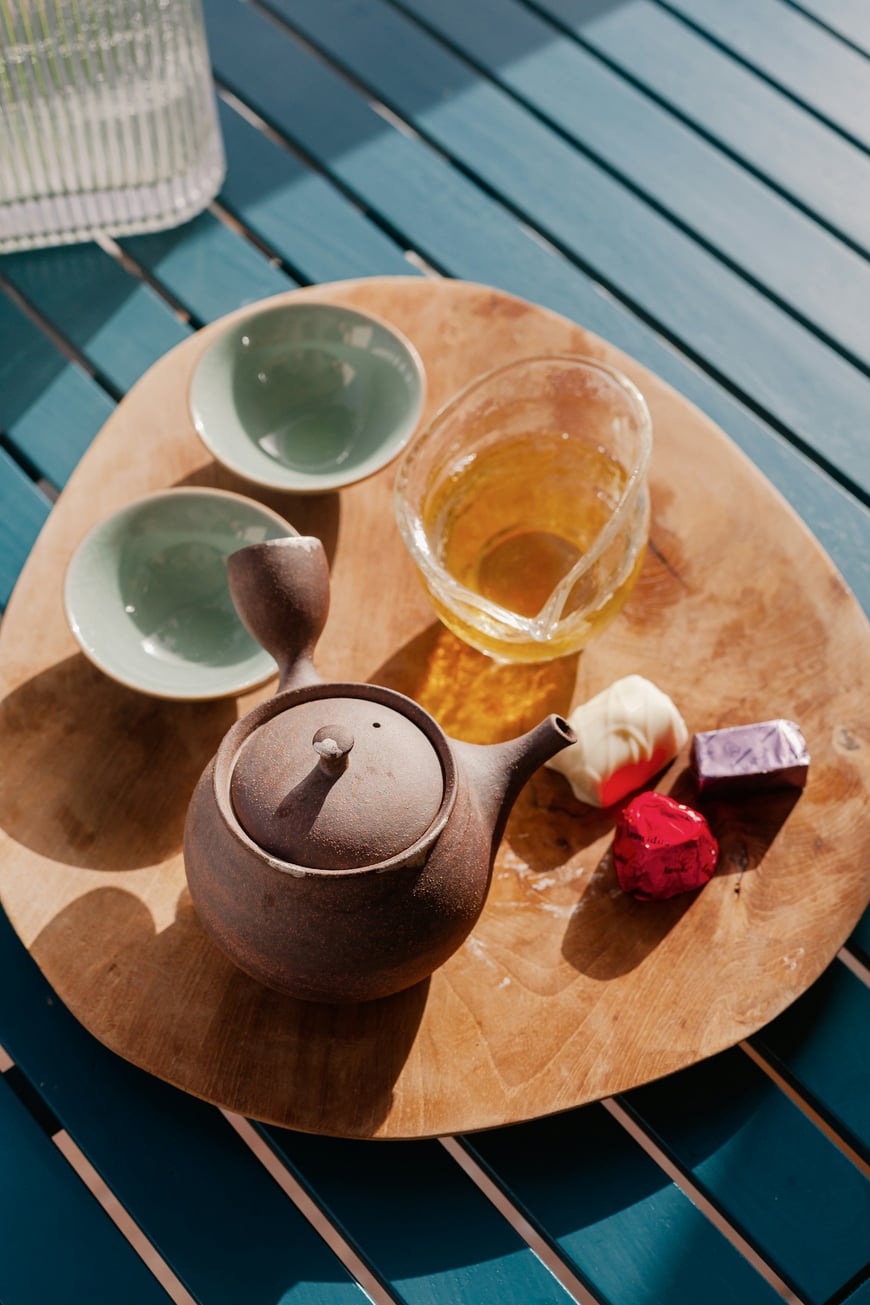
The setup uses a small clay teapot (宜兴 Yíxīng ware is the famous regional tradition, made from 紫砂 zǐshā purple-iron clay that absorbs flavour) or a covered cup called a 盖碗 gàiwǎn, three small drinking cups, a fairness pitcher (公道杯 gōngdào bēi) for distributing the brew evenly, and a sniffer cup (闻香杯 wénxiāng bēi). The leaves fill the pot to roughly half the volume.
The first wash, the rinse infusion, runs about ten seconds and is poured out, not drunk. Subsequent infusions are short, between ten and thirty seconds, and a good oolong yields six to ten distinct rounds before fading. Water temperature varies by category: 70 to 80 degrees Celsius for green and yellow, 90 for white, 95 to 100 for oolong, black, and pu-erh. The same leaves brewed Western-style (one infusion in a large mug) lose most of what gongfu cha exposes.
Tea and Chinese Health Beliefs
Chinese tea drinking carries a parallel framework of traditional medicine. The classification of teas as warming or cooling matches the yin-yang taxonomy of ancient Chinese medicine. Green and white teas are cooling and recommended in summer or for inflammatory conditions; black and aged pu-erh are warming and preferred in winter or for digestive issues.
The Chinese pharmacopoeia lists tea as a digestive aid, a mild diuretic, and a stimulant. Modern research has confirmed the catechin antioxidants in green tea and the L-theanine compound that produces tea’s distinct calm-alertness effect, distinct from coffee’s pure stimulation. Pu-erh’s microbial fermentation produces compounds linked to lipid-lowering effects in some studies.
Herbal blends sit beside true tea in the Chinese cabinet but are not technically tea. Chrysanthemum, jujube, goji, and licorice each have their own indications in Chinese herbal medicine and frequently appear in 茶艺 cháyì (tea-arts) blends. The line between tea and tisane is sharper in China than in much of the West, where chamomile is sold as tea.
Tea in Social Life
Tea hospitality is the default social gesture in Chinese homes. A guest receives tea before a single word of business is exchanged. The host pours, the guest taps two fingers on the table to thank the host without interrupting the conversation. The two-finger tap reportedly originated when the Qianlong emperor (Qing dynasty) travelled in disguise; his servant could not bow without revealing the emperor’s identity, so finger-tapping became the substitute. The story is plausibly apocryphal but the gesture is universal in modern China.
Tea houses (茶馆 cháguǎn or 茶社 cháshè) are still social hubs in cities such as Chengdu, where People’s Park’s century-old tea houses host card players, mahjong tables, and the occasional ear-cleaner with a roll of bamboo tools. The Chengdu tea-house culture is the most extant version of pre-revolutionary Chinese teahouse society. Daily life in ancient China covers the historical version, which centred on poetry recitations, official meetings, and discreet political gatherings.
Family tea ritual surfaces around the Chinese New Year, weddings, and ancestor veneration. Chinese family symbols include the gathering at the round table for tea after dinner. Chinese traditions and culture covers the wedding tea ceremony in which the couple serves tea to their parents to formally enter the new family. Ancient Chinese culture provides the longer historical frame.
Modern Chinese Tea Industry
China grew about 3.18 million tonnes of tea in 2023, around 49 percent of global output, well ahead of India’s 1.37 million tonnes (FAO and ITC figures, latest available data). Domestic consumption absorbs most of it; export volume sits behind Sri Lanka and Kenya, but premium pu-erh and Tieguanyin command higher per-unit prices abroad than mass-market Indian black tea.
Pu-erh has become an investment market. Aged sheng cakes from named villages on Yunnan’s 老班章 Lǎo Bānzhāng or 冰岛 Bīngdǎo mountains trade at prices comparable to fine wine. Auction houses in Hong Kong and Taipei list 1980s and 1990s cakes; buyers store them in climate-controlled warehouses for further aging. The market crashed in 2007 after speculative pricing and recovered by the mid-2010s. Counterfeit cakes are widespread, and certificates of origin matter at premium tiers.
Bubble tea (boba), invented in Taichung, Taiwan in the 1980s, has globalised Chinese tea in a different direction. Black tea blended with milk and tapioca pearls now drives chain expansion across Asia, North America, and Europe, with brands such as 喜茶 HEYTEA and 奈雪的茶 Nayuki Tea marketing premium ingredient sourcing. The premium boba scene has converged with the premium leaf scene in some Shanghai and Beijing tea houses.
Where to Drink Tea in China Today
Five regions reward a tea-focused trip. Hangzhou is the canonical first stop: Longjing terraces above West Lake, the 中国茶叶博物馆 China National Tea Museum on Longjing Road (the only state-level tea museum in the country, founded 1991), and tasting rooms in Meijiawu village. Spring (late March to mid-April) is peak season, and the Pre-Qingming harvest is sold same-day on village roads.
Chengdu in Sichuan is the place to experience tea-house social culture rather than premium leaf. 鹤鸣茶社 Heming Teahouse in People’s Park has been pouring tea continuously since 1923 and serves jasmine and chrysanthemum at low tables under bamboo umbrellas. 武侯祠 Wuhouci, 文殊院 Wenshu Monastery, and 青羊宫 Qingyang Gong each run their own tea-rooms.
Anxi (Fujian) for Tieguanyin and Wuyi (Fujian) for rock oolong are the two oolong pilgrimage sites. Both have town museums, factory tours, and tasting rooms. The Wuyi mountains carry hiking trails through the rock-tea cliffs and the famous tea bushes of Da Hong Pao, with the mother trees roped off as protected monuments. Anxi runs a tea cultural festival each spring and autumn that coincides with the harvest windows.
Yunnan suits experienced pu-erh drinkers. Pu’er city has a tea museum, an annual tea fair, and direct access to the mountain villages whose names appear on the labels (Yiwu, Manlu, Banzhang). Xishuangbanna’s Menghai county hosts the Menghai Tea Factory, the historic origin of ripe pu-erh as a category after the 1973 wodui technique was standardised.
Beijing tea shops along 马连道 Maliandao street, the largest tea wholesale market in northern China, hold every Chinese tea category in one walking radius. Maliandao is the place to compare prices across vendors and to find genuine examples of obscure regional teas without flying to the production region.
For pu-erh purchases, avoid unsealed cakes, ones without a wrapper printed with the producer factory and year, and any “100-year-old pu-erh” marketed at low prices. Genuine vintage pu-erh from named factories such as Menghai, Xiaguan, and Kunming Tea Factory comes with documentation and is priced accordingly. The ancient Chinese inventions tradition includes early tea processing methods, and the ancient China timeline places the major dynasty-era tea innovations in context.
Frequently Asked Questions
What are the six categories of Chinese tea?
The six categories (六大茶类) are green (绿茶), white (白茶), yellow (黄茶), oolong (乌龙茶), black/red (红茶), and dark/post-fermented (黑茶 including pu-erh). Categorisation is by processing and oxidation level, not by plant variety. All six come from Camellia sinensis processed differently. Note the vocabulary mismatch: what English calls “black tea” is Chinese “red tea” (hongcha), and Chinese “black tea” (heicha) refers to the post-fermented category covered by pu-erh.
What are the Ten Famous Teas of China?
The canonical list (中国十大名茶) is West Lake Longjing, Biluochun, Huangshan Maofeng, Junshan Yinzhen, Xinyang Maojian, Tieguanyin, Wuyi Rock Tea (including Da Hong Pao), Keemun, Duyun Maojian, and Lu’an Guapian. Six of the ten are green teas. Anhui province appears three times. The list is recognised by the Ministry of Culture and Tourism in heritage documentation.
What did UNESCO recognise about Chinese tea in 2022?
On 29 November 2022, UNESCO inscribed “Traditional tea processing techniques and associated social practices in China” on the Representative List of the Intangible Cultural Heritage of Humanity at its 17th session in Rabat, Morocco. The inscription consolidates 44 national-level tea-related elements and documents seven core processing techniques (shaqing, menhuang, wodui, weidiao, zuoqing, fajiao, yinzhi) plus the social and hospitality practices that surround tea drinking. China holds 43 UNESCO ICH items in total, the largest count for any state.
Who was Lu Yu and what is the Cha Jing?
Lu Yu (陆羽, 733-804 CE) was a Tang-dynasty scholar who wrote the Cha Jing (茶经, Classic of Tea) between 760 and 762 CE. The three-scroll, ten-chapter work is the earliest known treatise on tea cultivation, processing, brewing, and connoisseurship in any language. Lu Yu is honoured as the Sage of Tea (茶圣) in China and Japan. A second canonical tea text is Lu Tong’s Seven Bowls of Tea (七碗茶歌) from around 835 CE, and Emperor Huizong’s Da Guan Cha Lun (大观茶论, 1107) is the only tea treatise written by a Chinese emperor.
What was the Tea Horse Road?
The Tea Horse Road (茶马古道) was a 1,500-kilometre network of mule trails that carried compressed dark tea bricks from Yunnan and Sichuan to the Tibetan Plateau, exchanged at fixed rates for the Tibetan horses that the Chinese state needed for cavalry. The trade ran from the Tang dynasty through the Qing, organised by state Tea Horse Offices (茶马司). The Yunnan route ran through Dali, Lijiang, and Shangri-La to Chamdo and Lhasa; the Sichuan route ran from Ya’an through Kangding into central Tibet. Mule transport gave way to motor roads in the twentieth century. Several Tea Horse Road towns survive as preserved cultural-tourism sites, including Shaxi, Lijiang (UNESCO 1997), Shuhe, and Dukezong.
Is Chinese tea the same as British black tea?
The grades sold as English Breakfast and Earl Grey usually blend Indian Assam, Sri Lankan Ceylon, and small amounts of Chinese Keemun. Pure Chinese black teas (红茶 hongcha) are different: more aromatic, lighter, less astringent. Keemun and Yunnan Dianhong are the easiest entry points, available unblended at any reputable Chinese tea shop.
What is the difference between green tea and matcha?
Matcha is Japanese, not Chinese. The Chinese powdered-tea tradition (点茶 diǎnchá) existed during the Song dynasty and was carried to Japan by Zen monks; the Japanese kept the powdered ceremony alive while China itself shifted to loose-leaf during the Ming. Modern Chinese green tea drinking uses whole leaves, never powdered.
How do I brew loose-leaf Chinese tea at home without specialist gear?
A basic gaiwan (盖碗 covered cup) is the cheapest entry, available online for under 20 US dollars. Use about 4 grams of leaves to 100 ml of water at the right temperature for the category, infuse for 15 to 30 seconds, decant into a separate cup, and re-infuse the same leaves several times. The same leaves yield three to six rounds of tea, each tasting slightly different.
What is the best Chinese tea for beginners?
Tieguanyin oolong sits in the middle of the category spectrum and is the most forgiving entry. Longjing green tea is approachable if you like vegetal flavours. Avoid pu-erh as a first purchase; the category is rewarding but the storage and aging considerations make it a bad starter. Buy small portions of three or four different types and brew each in the same afternoon to learn the differences.
Sources and Further Reading
- UNESCO Intangible Cultural Heritage. “Traditional tea processing techniques and associated social practices in China”, inscribed 2022. UNESCO ICH listing 01884
- Lu Yu, Cha Jing (茶经, Classic of Tea), 760-762 CE. The foundational text; cited by name as primary historical record. Modern translation: Francis Ross Carpenter, The Classic of Tea, Little Brown 1974.
- Lu Tong (卢仝), Seven Bowls of Tea (七碗茶歌), c. 835 CE. The canonical Tang tea poem.
- Emperor Huizong of Song (宋徽宗), Da Guan Cha Lun (大观茶论), 1107 CE. The only tea treatise authored by a Chinese emperor.
- James A. Benn, Tea in China: A Religious and Cultural History, University of Hawai’i Press, 2015. Academic survey covering tea in Buddhist and Daoist context.
- International Tea Committee. Annual Bulletin of Statistics. inttea.com
- China National Tea Museum (中国茶叶博物馆), Hangzhou, founded 1991. The only state-level tea museum in China.
- UNESCO World Heritage Centre. Mount Wuyi (Wuyi Mountains) mixed cultural and natural site, inscribed 1999. UNESCO WHC listing