The Spanish coat of arms is the quartered royal shield that combines the castle of Castile, the lion of Leon, the four red bars of the Crown of Aragon, the chains of Navarre, and the pomegranate of Granada, crowned by the royal crown and flanked by the Pillars of Hercules wrapped in the Plus Ultra scroll. It sits today on the centre of the national flag and on the reverse of every euro coin minted in Spain.
Spanish family heraldry, often loosely called Spanish family crests in English, grew out of the regional traditions of the medieval kingdoms that preceded the unified Spanish state. Castile, Aragon, Navarre, Catalonia, the Basque Country, Galicia, Asturias, and the Kingdom of Leon each developed their own heraldic vocabulary across the medieval and early modern periods, with the result that there is no single Spanish heraldic tradition but a layered set of regional ones.
The English phrase family crests is a slight misuse of heraldic vocabulary, since heraldry distinguishes between the coat of arms in the round, the shield, and the crest as the figure that sits above the helm. This article walks through the national Spanish royal arms, the regional traditions behind them, the institutional bodies that have regulated heraldry in Spain, the iconography that recurs across regional shields, and the modern legal status of family arms today, including the role of the official Cronista Rey de Armas.
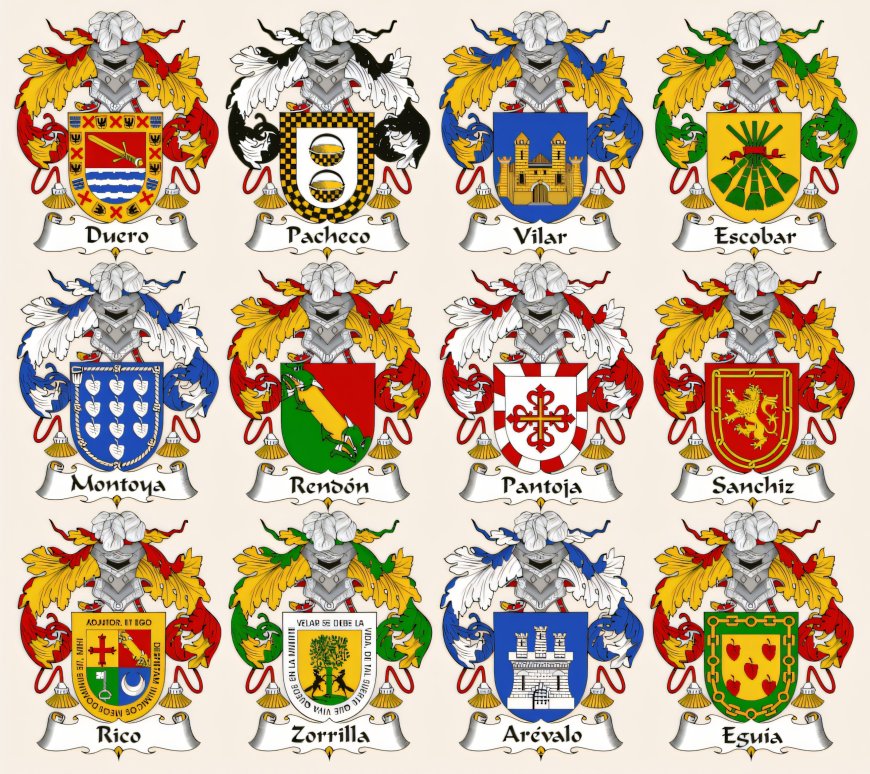
The “Surname Coat of Arms” Myth
Most people who search for a Spanish family crest are hoping to find the one coat of arms that belongs to their surname. There is no such thing, and saying so plainly is the most useful thing this page can do, because in Spanish heraldry arms belong to people and lineages, never to surnames.
Not every Garcia, Martinez or Nieto carried the same shield, and most carried none at all. A single surname can be linked to dozens of completely different arms, granted to dozens of unrelated families over the centuries, while another surname has not a single historic coat of arms to its name. The right to bear a particular shield passes down a documented bloodline, usually the direct male line from the person to whom it was first granted, not down a shared spelling.
This is why the surname plaques, mugs and scrolls sold online are, in the blunt verdict of Spanish genealogists, a timo, a swindle. If you have bought a “coat of arms for your surname”, it carries no legal or genealogical authority, and there is a very high chance it is not the shield your own ancestors would have been entitled to use, if they were entitled to any at all.
The Spanish Royal Coat of Arms
The current Spanish royal coat of arms was standardised by royal decree in 1981 after the restoration of the constitutional monarchy under Juan Carlos I. The shield is quartered and holds the historical devices of the medieval kingdoms that joined to form the Spanish state. Each quarter carries a separate charge drawn from the heraldry of the kingdom it represents:
- First quarter: gold castle of Castile on a red field
- Second quarter: purple or red lion of Leon on a silver field
- Third quarter: four red vertical bars of the Crown of Aragon on a gold field
- Fourth quarter: gold chains of Navarre on a red field
- Base: pomegranate of the Kingdom of Granada
- Inescutcheon: fleurs de lis of the Bourbon dynasty
- Supporters: Pillars of Hercules with Plus Ultra scroll
The first quarter (upper left from the viewer’s perspective) holds the gold castle of Castile on a red field. The second quarter (upper right) holds the purple or red lion of Leon on a silver field. The third quarter (lower left) holds the four red vertical bars of the Crown of Aragon on a gold field. The fourth quarter (lower right) holds the gold chains of Navarre on a red field, and a small inescutcheon holds the fleurs de lis of the Bourbon dynasty. A pomegranate is added at the base of the shield to represent the Kingdom of Granada, reconquered in 1492.
The shield is ensigned with the Spanish royal crown and flanked by the two Pillars of Hercules, each topped by an imperial crown and wrapped in a red scroll carrying the Latin motto Plus Ultra, meaning further beyond. The motto was adopted under Charles V in the sixteenth century and refers to the Spanish overseas empire that pushed beyond the Strait of Gibraltar, which classical tradition had treated as the western edge of the known world.
The Castilian and Leonese Tradition
The kingdoms of Castile and Leon developed the dominant heraldic tradition that later became the Spanish royal arms. The castle on a red field that gives Castile its name was used as a royal device by the eleventh century and appears in stone carvings and manuscript illuminations from the period of Alfonso VIII in the late twelfth century.
The lion of Leon, a purple or red rampant lion on a silver field, served as the device of the kingdom of Leon and was joined to the Castilian castle when the two crowns were united under Ferdinand III in 1230. The quartered shield with the castle and the lion became the recognised arms of the unified Crown of Castile and runs through the imperial Spanish heraldry of the sixteenth and seventeenth centuries down to the modern Spanish royal arms.
The same charges appear on the Spanish national flag, where the royal coat of arms occupies the central stripe. Castilian noble families adopted similar charges and developed personal arms that combined regional symbols with charges representing personal feats. The Castilian chronicles of the late medieval period record the arms of the major houses with descriptions of charges, tinctures, and supporters.
Aragonese and Catalan Bars
The Crown of Aragon developed a different visual tradition built around the four red bars on a gold field, sometimes called the Senyera in Catalan. The arms have been documented from the twelfth century in seals of the counts of Barcelona and the kings of Aragon.
The same charge survives today on the modern flag of Catalonia, the flag of Aragon, the flag of the Valencian Community, and the flag of the Balearic Islands. The four red bars on gold also appear on the modern Spanish royal arms in the quarter representing the Crown of Aragon, as documented in the evolution of the Spanish empire flag across centuries.
Catalan urban heraldry developed a tradition of municipal arms across the medieval period that often combined the bars with a local charge such as a saint, a tower, or a tool of the dominant local trade. Catalan family heraldry across the late medieval and early modern periods developed independently of the Castilian register, with its own vocabulary and conventions, although the two traditions overlap on many points.
Basque, Navarrese, and Galician Variations
The Basque Country and Navarre developed their own heraldic registers that intersect with both the Castilian and the French traditions through their position between the two larger kingdoms. The Navarrese chains, a red field with a chain of gold links radiating from a central jewel, are documented from the period of Sancho VII at the start of the thirteenth century and have been linked by chronicle tradition to the Battle of Las Navas de Tolosa in 1212.
The chains appear today on the flag of Navarre and on the regional coat of arms. The Basque provinces, including Alava, Vizcaya, and Guipuzcoa, each developed regional arms with their own charges, including the oak of Guernica that ties to the historic Basque assembly tradition.
Galician heraldry in the north-west developed under different historical circumstances and incorporated charges drawn from the pilgrimage to Santiago de Compostela, the cult of Saint James, and the maritime tradition of the Galician coast. The chalice and host charge of the Galician arms ties to a medieval Eucharistic miracle tradition.
Spanish Heraldic Charges and Their Meanings
The vocabulary of charges used across Spanish family heraldry overlaps with the wider European tradition but includes a number of regionally specific elements. Castles appear on Castilian arms and on arms of families connected to defensive military service during the Reconquista, the centuries-long campaign to reclaim Iberian territory from Moorish rule.
Lions appear on Leonese and broader Crown of Castile arms. Wolves and bears appear on northern Spanish family arms tied to the Cantabrian and Asturian regions. Eagles, fleurs de lis, and crosses appear across all regional traditions through both indigenous and imported influences.
The Cross of Santiago, with its scallop-shell elements and red sword shape, marks families and individuals connected to the medieval military Order of Santiago. The Cross of Calatrava and the Cross of Alcantara mark connections to the other Spanish military orders of the reconquista period.
Tinctures follow the standard heraldic palette of gold, silver, red, blue, green, black, and purple, with the rule of tincture that prevents metal on metal or colour on colour applied with the usual exceptions. Castilian heraldry uses the punning canting arms tradition more sparingly than English or French heraldry but does include cases where the family name is referenced directly by the charges.
Two Surnames, Two Lineages on One Shield
Spanish naming shapes Spanish heraldry in a way that surprises outsiders. Because every Spaniard carries two surnames, the father’s followed by the mother’s, a person’s full arms traditionally combine the arms of both lines on a single divided shield, a practice called cuartelado, or quartering.
A properly composed personal shield in the Spanish tradition can therefore read like a family tree, the paternal arms in one quarter and the maternal arms in another, with grander shields adding the arms of grandparents and earlier ancestors. A plain surname crest showing a single design ignores all of this, which is another reason the off-the-shelf version rarely matches a real family’s heraldry.
The Cronista de Armas and Modern Status
Spain regulates the official certification of personal and family arms through a state-appointed officer called the Cronista de Armas. The current office in the Kingdom of Spain is the Cronista Rey de Armas, an honorary position with a long historical lineage that goes back to the medieval royal heralds.
The Cronista issues certifications of arms for individuals and corporate bodies that meet the genealogical and historical criteria, although Spanish family arms have no legal protection as personal property in the way that some other European countries protect coats of arms. Several regional governments in Spain, including Catalonia and the Basque Country, have established their own genealogical and heraldic offices to certify regional arms.
Outside the formal state system, a substantial commercial market for family crest products operates in Spain and across the Spanish-speaking world that sells generic surname-based heraldry without certification. Anyone interested in researching genuine family arms should work with the official Cronista Rey de Armas or with a regional heraldic office rather than buying off-the-shelf surname plaques.
Frequently Asked Questions
What does the Spanish coat of arms look like?
The Spanish coat of arms is a quartered royal shield with the gold castle of Castile on a red field, the purple lion of Leon on a silver field, the four red bars of the Crown of Aragon on a gold field, and the gold chains of Navarre on a red field. A pomegranate at the base represents the Kingdom of Granada, and a small inescutcheon holds the fleurs de lis of the Bourbon dynasty. The shield is crowned with the royal crown and flanked by the Pillars of Hercules wrapped in the Plus Ultra motto scroll.
What is on the Spanish flag coat of arms?
The coat of arms on the centre of the Spanish national flag is the same royal shield used by the Spanish state since 1981. It carries the five historical charges for Castile, Leon, Aragon, Navarre, and Granada, plus the Bourbon inescutcheon and the Pillars of Hercules with the Plus Ultra scroll. The motto Plus Ultra, meaning further beyond, was adopted under Charles V in the sixteenth century and refers to the Spanish overseas empire.
Does my Spanish surname have a coat of arms?
A surname by itself does not give a person a coat of arms under Spanish heraldic tradition. Personal arms are tied to individuals and to documented family lines rather than to surnames. Many commercial sites sell generic surname-based plaques that have no genealogical authority. A genuine certification of arms requires research through the Cronista Rey de Armas or a regional heraldic office.
How can I find out if my family really had a coat of arms?
Start with genealogy, not with a surname search. Trace your direct ancestry as far back as the records allow, then look for a specific ancestor who was granted or recognised in arms, checking parish and notarial records and the Spanish heraldic archives. The Cronista Rey de Armas and the regional heraldic offices can then certify the arms you are actually entitled to, if any.
What is the Cronista Rey de Armas?
The Cronista Rey de Armas is the state-appointed officer in Spain who certifies personal and corporate coats of arms. The position has a historical lineage that goes back to the medieval royal heralds and is currently administered through the Ministry of Justice.
Why are Spanish heraldic traditions regional?
Spain emerged from the union of several medieval kingdoms, each with its own legal and cultural traditions, including Castile, Leon, Aragon, Navarre, the Crown of Aragon territories, and the Basque provinces. Heraldry developed inside each of those traditions before they were brought under a single crown, and the regional differences are still visible in modern Spanish municipal and regional arms.
What are the Senyera bars?
The Senyera is the four red bars on a gold field that served as the device of the Crown of Aragon from the twelfth century onwards. The same charge appears on the modern flags of Catalonia, Aragon, the Valencian Community, and the Balearic Islands.
How did the Reconquista shape Spanish heraldry?
The centuries-long Reconquista campaign against Moorish rule produced much of the military imagery in Spanish family arms. Castles, swords, crosses, and references to specific battles became heraldic charges awarded to families for their role in the territorial conquest. The military orders of Santiago, Calatrava, and Alcantara developed their own cross designs that marked membership and service during this period. Many Spanish noble families trace their heraldic origins to grants made during the Reconquista by Castilian, Aragonese, or Navarrese kings.
Sources and Further Reading
- Cronista Rey de Armas, Ministerio de Justicia – the state office that certifies personal and corporate coats of arms in Spain
- Real Academia Matritense de Heraldica y Genealogia – Spanish academy for heraldic and genealogical study
- Faustino Menendez Pidal de Navascues, Heraldica Medieval Espanola, multi-volume work on medieval Spanish heraldry
- Archivo General de Simancas – royal archive holding heraldic certifications from the imperial Spanish period
- Pere Maria Catedra, Las Heraldicas Reales y Nobiliarias del Renacimiento, academic study on Renaissance Spanish heraldry