Spain’s built environment records over two thousand years of settlement, conquest, religious change, and artistic ambition in stone, brick, tile, glass, and titanium. Roman engineers left aqueducts and theaters that still stand. Moorish rulers raised palaces and mosques that redefined what Islamic architecture could achieve in Europe. Gothic cathedrals pushed stone vaulting to its structural limits. Antoni Gaudi broke every classical rule in Barcelona. And 21st-century architects continue adding to the record with structures that have reshaped entire cities. This chronological survey traces the major periods and the buildings that define them.
Roman Foundations: Aqueducts, Theaters, and Roads
Rome controlled the Iberian Peninsula for over 600 years, from the late 3rd century BC until the Visigothic invasions of the 5th century AD. The engineering infrastructure they left behind remains some of the most visible ancient construction in Western Europe.
Merida (Roman Emerita Augusta), the capital of the province of Lusitania, holds the densest concentration of Roman ruins in Spain. The Roman Theater, built in 16-15 BC under the consul Marcus Agrippa, seated 6,000 spectators and still hosts live performances during the annual Merida Classical Theatre Festival each summer. The scaenae frons (stage backdrop) was rebuilt during the reign of Trajan in the early 2nd century and stands two stories high, lined with Corinthian columns and marble statues. Nearby, the Acueducto de los Milagros stretches 830 meters on granite-and-brick pillars reaching 25 meters high, carrying water from the Proserpina reservoir into the city.
The Aqueduct of Segovia, likely completed around 112 AD, is the most recognized Roman structure in Spain. It runs 813 meters through the city center on 128 pillars arranged in double-tiered arches, reaching a maximum height of 28.5 meters. The 24,000 granite blocks that form the structure hold together without mortar – the weight and precision of the stone cutting alone maintain the joints. UNESCO designated it a World Heritage Site along with the old town of Segovia.
Other significant Roman remains include:
- The walls of Lugo in Galicia – a complete 2-kilometer Roman wall circuit, the only fully intact Roman wall perimeter in the world
- Tarragona (Tarraco) in Catalonia – amphitheater, circus, forum ruins, and a section of aqueduct
- The Roman bridge at Alcantara in Extremadura – a 194-meter granite bridge over the Tagus River, completed in 106 AD
Moorish and Islamic Architecture: 711-1492
The Moorish conquest of 711 introduced Islamic architectural traditions to the Iberian Peninsula, and over the next eight centuries, Muslim rulers produced buildings that rank among the finest examples of Islamic art anywhere in the world. The style evolved through several phases – the Caliphate period centered on Cordoba, the Taifa kingdoms, the Almoravid and Almohad dynasties, and the final Nasrid period in Granada – each adding new decorative and structural techniques.
The Mezquita of Cordoba began as a mosque in 785 AD under Abd al-Rahman I, built on the site of a Visigothic church. Successive rulers expanded it four times over the next two centuries, eventually creating a prayer hall supported by over 850 columns of jasper, onyx, marble, and granite. The double-tiered horseshoe arches – red brick alternating with white stone – create the forest-like interior that has become among the most reproduced images in architectural history. After the Christian reconquest in 1236, a Gothic and Renaissance cathedral was inserted into the center of the mosque, producing a hybrid building that provoked controversy even in its own time (Charles V reportedly told the builders, “You have destroyed something unique to build something commonplace”).
The Alhambra in Granada, built primarily during the 14th century under the Nasrid sultans Yusuf I and Muhammad V, represents the final and most refined phase of Moorish architecture in Spain. The complex sits on a hilltop above the city, with the Nasrid Palaces – Mexuar, Comares, and the Palace of the Lions – arranged around interior courtyards. The Court of the Lions, with its marble fountain supported by twelve carved lions, demonstrates a level of decorative detail in stucco, ceramic tile (zellij), and carved wood that later European architecture rarely attempted. The Alhambra receives over 2.7 million visitors per year, making it Spain’s most-visited monument.
The Giralda tower in Seville, originally the minaret of the Great Mosque built between 1184 and 1198 under the Almohad dynasty, rises 104.5 meters. Its interior uses 35 ramps rather than stairs – wide enough for horses to climb. The tower’s proportions and decorative brickwork patterns influenced minaret design across North Africa and were modeled on the Koutoubia Mosque in Marrakesh.
Gothic Cathedrals: The 13th Through 16th Centuries
As the Christian kingdoms pushed southward during the Reconquista, they marked their territorial gains with cathedrals that drew on the French Gothic tradition while developing distinctly Spanish characteristics – broader naves, heavier walls, and elaborate choir enclosures (coros) placed in the center of the nave rather than near the altar.
Burgos Cathedral, begun in 1221 and completed in phases through 1567, was the first major French-influenced Gothic cathedral in Spain. Its openwork spires, added in the 15th century by the German architect Juan de Colonia, gave the building a silhouette that set it apart from earlier Spanish churches. UNESCO inscribed it individually in 1984 – one of very few cathedrals granted World Heritage status on its own rather than as part of a city listing. The interior holds the tomb of Rodrigo Diaz de Vivar (El Cid) and an elaborate Golden Staircase by Diego de Siloe.
Leon Cathedral, built between the mid-13th and late 14th centuries, took the Gothic emphasis on light to an extreme. Its walls contain 737 stained glass windows covering 1,765 square meters – more glass area than any medieval cathedral except Chartres, despite Leon’s smaller overall footprint. The structural consequence of so much glass and so little stone wall is visible: the building required extensive restoration in the 19th century to stabilize walls that had been pushed to their engineering limits. Locals call it the Pulchra Leonina (the Beauty of Leon) or the House of Light.
Seville Cathedral, built between 1402 and 1506 on the footprint of the former Almohad mosque, is the largest Gothic cathedral in the world by volume. The building committee reportedly declared at the outset that they would build something “so great that those who see it finished will think we were mad.” The cathedral retained the mosque’s courtyard (now the Patio de los Naranjos) and the Giralda minaret, converting the latter into a bell tower. Inside, the main altarpiece (retablo mayor) contains 45 carved scenes from the life of Christ covered in gold leaf – the largest altarpiece in Christendom.
Renaissance and Baroque: The 16th Through 18th Centuries
Spanish Renaissance architecture arrived through Italian influence in the early 16th century and developed a local variant called Plateresque – named for its resemblance to the intricate work of silversmiths (plateros). The facade of the University of Salamanca, carved around 1529, is the most cited example: a flat stone surface covered in dense ornamental relief that includes medallions, coats of arms, and a hidden frog that students traditionally search for before exams.
The Escorial, built between 1563 and 1584 under Philip II northwest of Madrid, marked a deliberate turn away from ornamental excess toward severe, geometric classicism. The complex – simultaneously a monastery, palace, library, and royal tomb – covers 33,000 square meters and contains over 2,600 windows, 1,200 doors, and 86 staircases. Its architect, Juan de Herrera, gave his name to the Herreran style, characterized by granite facades, minimal decoration, and massive scale. The Escorial influenced Spanish institutional architecture for the next two centuries.
Baroque architecture arrived in the 17th century and produced its most dramatic Spanish expressions in church interiors and facades. The Churrigueresque style – named after the Churriguera family of architects – pushed Baroque ornamentation to extremes, with every surface carved, gilded, or painted. The Plaza Mayor of Salamanca, designed by Alberto Churriguera and completed in 1755, applies Baroque principles to urban planning: a unified enclosed square with continuous arcades, decorative medallions, and a central pavilion.
The Royal Palace in Madrid, built between 1738 and 1764, represents the more restrained Italian-influenced Baroque that the Bourbon dynasty brought to Spain. Its 3,418 rooms, ceiling frescoes by Tiepolo, and formal gardens made it the largest royal palace in Western Europe.
Gaudi and Catalan Modernisme: The Late 19th and Early 20th Centuries
Barcelona’s Modernisme movement, running roughly from the 1880s through the 1920s, produced some of the most formally inventive architecture in European history. The movement included several architects – Lluis Domenech i Montaner, Josep Puig i Cadafalch, and others – but Antoni Gaudi dominated the period and continues to define Barcelona’s architectural identity.
Gaudi rejected straight lines and right angles in favor of forms derived from nature: hyperboloid surfaces, catenary arches, helicoid columns, and organic curves that resemble bone, shell, and plant structures. His major Barcelona works include:
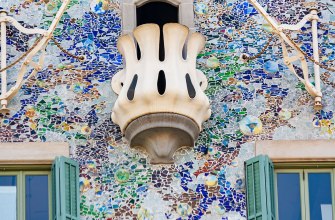
- Casa Batllo (remodeled 1904-1906) – a residential building on Passeig de Gracia with a facade of broken ceramic tile (trencadis), bone-shaped balcony railings, and a roof ridge resembling a dragon’s spine
- Casa Mila / La Pedrera (1906-1912) – a seven-story apartment building with an undulating stone facade and a rooftop populated by chimneys shaped like helmeted warriors
- Park Guell (1900-1914) – a hillside park originally planned as a garden city, with mosaic-covered benches, tilted columns, and gingerbread-style gatehouses
- The Sagrada Familia – Gaudi’s unfinished basilica, under construction since 1882
The Sagrada Familia deserves separate attention. Gaudi took over the project in 1883 and spent the last 12 years of his life working on it exclusively. The building combines Gothic structural principles with Gaudi’s own system of branching columns designed to distribute weight like tree trunks. The central Tower of Jesus Christ reached its final height of 172.5 meters in February 2026, making it the tallest church structure in the world. While the main architecture is now complete, finishing work on decorative elements is projected to continue through 2034 or 2035.
Domenech i Montaner’s Palau de la Musica Catalana (completed in 1908) and Hospital de Sant Pau (1902-1930) both hold UNESCO World Heritage status and represent the broader Modernisme movement beyond Gaudi. The Palau’s concert hall, with its stained glass skylight and sculptural proscenium, remains among the most densely decorated performance spaces in Europe.
20th and 21st Century Architecture
Spain’s architectural ambitions did not pause after Modernisme. The second half of the 20th century and the early decades of the 21st produced buildings that transformed entire urban economies.
The Guggenheim Museum Bilbao, designed by Frank Gehry and opened in October 1997, is the clearest example. The building’s curving titanium-clad forms – made possible through aerospace design software (CATIA) – sit on a former industrial wharf along the Nervion River. Its construction cost roughly 89 million dollars, but the economic return has been enormous: Bilbao went from a declining industrial city to a major cultural tourism destination within a few years of the museum’s opening. Architect Philip Johnson called it “the greatest building of our time.” The exterior uses approximately 33,000 titanium panels, each paper-thin, whose surfaces shift color with changing light and weather.
The Ciudad de las Artes y las Ciencias in Valencia, designed by Santiago Calatrava and Felix Candela, occupies a 35-hectare section of the former Turia riverbed. The complex opened in stages between 1998 and 2005 and includes L’Hemisferic (an IMAX cinema shaped like a giant eye), the Principe Felipe Science Museum (a skeleton-like structure of white steel and glass), L’Oceanografic (the largest aquarium in Europe), and the Palau de les Arts Reina Sofia (an opera house with a feathered-helmet profile). Calatrava’s white, bone-like forms extend the organic vocabulary that Gaudi pioneered a century earlier, though the engineering language is entirely different.
Other significant modern works include the Kursaal Congress Centre in San Sebastian by Rafael Moneo – two translucent glass cubes on the beach, completed in 1999 – the MUSAC contemporary art museum in Leon by Mansilla and Tunon, finished in 2004, and the Metropol Parasol in Seville by Jurgen Mayer, completed in 2011 – a wooden lattice structure covering the Plaza de la Encarnacion that ranks as the largest timber-frame structure in the world.
Frequently Asked Questions
Which Spanish city has the most diverse architectural history?
Seville and Cordoba offer the widest range within a compact area, with Roman, Moorish, Gothic, Renaissance, Baroque, and modern layers all within walking distance. Barcelona covers Romanesque, Gothic, Modernisme, and contemporary architecture in similar density. Toledo compresses Roman, Visigothic, Islamic, Jewish, and Christian buildings into a single hilltop.
Can I see Gaudi buildings without visiting Barcelona?
Gaudi’s work outside Barcelona is limited but exists. The Casa Botines in Leon and the Episcopal Palace in Astorga are both Gaudi-designed buildings in Castile and Leon. He also worked on the crypt of the Colonia Guell church in Santa Coloma de Cervello, near Barcelona. The concentration in Barcelona itself, however, is irreplaceable.
How did Moorish architecture survive the Reconquista?
Practical reuse played the largest role. Christian rulers often converted mosques into churches and palaces into residences rather than demolishing them, preserving the structures while altering their function. The Mudejar style – Moorish decorative techniques applied to Christian buildings by Muslim craftsmen living under Christian rule – also sustained Islamic artistic traditions well into the 16th century. Mudejar architecture is recognized by UNESCO as a distinct category, with sites across Aragon, Castile, and Andalusia.
What is the “Bilbao effect” in architecture?
The term refers to the economic transformation that a single high-profile building can trigger in a city. After the Guggenheim Bilbao opened in 1997, the city saw dramatic increases in tourism revenue, hotel construction, and international recognition. Other cities – including Valencia with the Ciudad de las Artes – attempted to replicate the formula, with varying degrees of success. The term is now used broadly in urban planning to describe the strategy of commissioning a landmark building to revitalize a struggling city.
Sources and Further Reading
- Aqueduct of Segovia – Wikipedia
- Roman Theatre, Merida – Wikipedia
- Mosque-Cathedral of Cordoba – Wikipedia
- Sagrada Familia – Wikipedia
- Guggenheim Museum Bilbao – Wikipedia
- City of Arts and Sciences – Wikipedia
- Burgos Cathedral – UNESCO World Heritage Centre
- Leon Cathedral – Wikipedia