Native American music across the United States covers an enormous range across more than 500 federally and state recognised tribal nations. Plains-style high falsetto vocals, Pueblo katsina dance songs, Pacific Northwest potlatch songcycles, Iroquois water-drum rituals, and Inuit throat singing all fall under the broad heading – but each is its own distinct tradition with specific protocols. The pages below walk through the most public-facing forms (powwow, flute, contemporary recording artists) while keeping in view that many ceremonial songs are restricted from public performance and recording. The hub fits within broader culture and traditions coverage and within the music category.
Vocal traditions
Plains-style singing is the most widely-recognised Native American vocal sound. The style centres on a high falsetto register, vocables (non-lexical syllables that carry musical rather than semantic meaning – “way-ya-hey-ya”), and unison drum accompaniment. The vocables sit in patterned sequences that vary by song genre: round-dance songs, intertribal songs, war-dance songs, and ceremonial songs each have distinct vocable structures.
Pueblo singing – Hopi, Zuni, Acoma, San Ildefonso, Santa Clara – uses a lower register and structured choral form. Hopi katsina dance songs accompany ceremonial cycles and are not typically performed outside the village context, though some adapted versions appear at intertribal events. The vocal style runs in measured rhythm rather than the more flexible Plains style.
Pacific Northwest Coast vocal traditions – Tlingit, Haida, Tsimshian, Coast Salish – feature extended songcycles with complex polyphony and formal staged performance at potlatches. Songs belong to specific clans and houses; ownership is taken seriously, and inappropriate use of another clan’s songs would be a violation of cultural protocol.
Iroquois (Haudenosaunee) and Algonquian Eastern Woodlands vocal traditions feature water drum-based rituals. The Longhouse ceremony cycle includes specific song sequences that are largely restricted to community participation. Smaller social-dance songs appear at public events.
Inuit and Yupik throat singing (katajjaq in Inuktitut) is a guttural duet vocal tradition practised primarily by women. Two singers face each other and produce alternating voiced and breathed sounds, often imitating natural sounds – wind, water, animal calls. The tradition is competitive in form, with the first singer to laugh or stop ending the round. Tanya Tagaq is the best-known contemporary throat singer, working in fusion with electronic and rock collaborators.
Powwow and drum traditions
The powwow (sometimes spelled pau wau, from an Algonquian word meaning “spiritual leader” or “medicine man”) emerged in the late 19th and early 20th centuries as a cross-tribal celebration. The contemporary powwow circuit covers hundreds of events annually across North America, drawing competitive dancers, drummers, and singers from many tribes.
The big drum (powwow drum) is the central instrument. Five to ten men sit around a large drum (typically 24-36 inches diameter, made from buffalo or cow hide stretched over a wooden frame), strike the drum simultaneously, and sing together. Some drum groups have women singers who sit behind or to the side of the drum.
Major drum groups include Northern Cree (multiple Juno and Native American Music Awards), Black Lodge (from White Swan, Washington), Cozad (Kiowa), Sweetgrass Cree, and Eyabay (Anishinaabe). Recording labels Canyon Records (Phoenix, since 1951) and Sound of America Records have documented the powwow drum tradition continuously for decades.
Two main powwow styles operate parallel: Northern style features high falsetto vocals, faster tempo, and is associated with Anishinaabe, Lakota, Cree, and other northern Plains tribes. Southern style uses a medium register, drum-line emphasis, and slower tempo, associated with Kiowa, Comanche, Cheyenne, and other southern Plains tribes. Many drum groups can sing both styles.
Powwow protocol structures the event. Grand Entry opens the powwow with all dancers entering the circle in a specific order led by veterans carrying tribal flags. The Veterans Song honours military service across all tribes; Native Americans serve in the US Armed Forces at higher rates per capita than most demographic groups. The Flag Song functions as a Native national anthem. Photographs and recording during ceremonial portions (Grand Entry, Veterans Song, Flag Song, retiring of flags) are typically prohibited; the MC will announce when photos are permitted.
Major powwows include Gathering of Nations (Albuquerque, the last weekend of April – largest in North America with 700+ tribes represented), Crow Fair (mid-August in Crow Agency, Montana), Stanford Powwow (Mother’s Day weekend in Palo Alto), Schemitzun (Mashantucket Pequot in Connecticut, August), and dozens of others. Tribal college powwows, university powwows, and reservation powwows fill the calendar year-round.
Native American flute
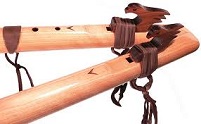
The Native American flute (sometimes called Plains flute, courting flute, or love flute) is a distinctive instrument with a two-chamber design that separates it from world flute traditions. The flute is typically made from cedar, pine, or redwood with five or six finger holes and a pentatonic or six-note diatonic tuning.
The two-chamber design – the heart of “double bore” construction – separates the breath chamber (where the player blows) from the sound chamber (where the air column vibrates). A small block (often called the saddle, bird, or fetish) sits between the two chambers and directs air across a sound hole called the true sound hole. This makes the Native American flute easier to play than transverse or recorder flutes – the player blows into the end without needing to shape the embouchure.
Plains traditional use centred on courtship. A young man would play the flute outside the lodge of a woman he wished to marry; her response (or her family’s response) would indicate whether the suit was welcome. Specific Plains tribes including Lakota, Dakota, Blackfeet, and Cheyenne carried the courtship-flute tradition. The instrument was largely forgotten between the late 1800s reservation period and the 1960s-1970s revival.
Modern revival came primarily through R. Carlos Nakai (Diné/Ute, born 1946 in Flagstaff, Arizona). Nakai trained classically as a trumpeter, learned the flute as an adult, and brought the instrument to mainstream concert stages starting in the 1980s. His Canyon Trilogy album released by Canyon Records in 1989 became among the most-purchased Native American flute recordings of all time and is widely credited with launching the contemporary Native flute genre.
Notable contemporary Native flute players include Mary Youngblood (Aleut/Seminole, the first woman to win a Grammy for Best Native American Music Album, in 2002 and again in 2006), Cody Blackbird (Eastern Band Cherokee), Joseph FireCrow (Northern Cheyenne), Robert Mirabal (Taos Pueblo, who works in flute-and-classical fusion), and Kevin Locke (Lakota, also a hoop dancer). Brent Michael Davids (Stockbridge-Munsee Band of Mohican Indians) extends the flute into contemporary classical composition.
Genre fusion has produced significant work. Coyote Oldman (a non-Native flutemaker and player who works closely with Native musicians) blends Native flute with New Age electronic. Robert Mirabal has performed his flute work with the Phoenix Symphony Orchestra. The genre crosses easily into ambient, world music, and concert classical contexts.
Drums beyond powwow
The hand drum is a smaller single-headed frame drum struck with a single beater. The instrument carries social-dance songs, round dance songs, and women’s songs in many traditions. Hand drums are easier to transport than the big powwow drum and appear at smaller community gatherings.
Water drums are used by Iroquois (Haudenosaunee) and Anishinaabe traditions. The drum is small (often a wooden or ceramic cylinder, six to eight inches across) with stretched hide laced over the top. Water inside the drum changes the pitch as the drum is played – tilting the drum shifts the water and produces tonal variation. Water drum songs are largely restricted to community ceremonial use.
Foot drums appear in California Maidu and other tribal traditions. A covered hole in the floor of a roundhouse or earthlodge is stamped on by dancers, producing a deep bass tone. The foot drum sits at the centre of specific California ceremonial cycles.
The Northwest Coast box drum is a cedar plank box struck with a stick. The box drum produces a deep, hollow tone that carries across longhouse interiors during potlatch ceremonies. Specific clan ownership of song-and-drum patterns continues in Tlingit, Haida, and Kwakwaka’wakw traditions.
Apache and Pueblo percussion traditions use rasping sticks, wooden rattles, and gourd rattles alongside drums. The Pueblo katsina dances incorporate these auxiliary percussion instruments in specific patterns.
Ceremonial and sacred music
Many ceremonial songs are restricted – not for public performance or recording. Sun Dance songs (Lakota, Plains Cree, and other Plains tribes) are sacred and recorded only with explicit tribal permission for very specific purposes. Sweat lodge songs are contextual, sung within the sweat ceremony rather than performed publicly. Healing and doctoring songs belong to specific medicine practitioners and are passed only through proper channels of teaching.
The cultural sensitivity issue around recording sacred music is well-documented. The Beach Boys recording of a Hopi song fragment in their 1969 album Sunflower drew criticism; the Hopi Tribe has consistently objected to recording or commercialisation of katsina songs. More recent cases involving non-Native New Age recordings claiming “authentic Native American sacred music” have prompted public statements from tribal cultural offices.
Public-shared categories include powwow circle songs, social dance songs, contemporary fusion work, and recordings released by tribal members themselves (with the explicit permission and intention to share). The distinction matters – non-Native consumers should not assume that anything labelled “Native American music” was recorded with appropriate consent.
Contemporary Native musicians and genre crossover
The contemporary Native musical landscape spans every popular genre and several classical and avant-garde forms.
Pop and rock: Robbie Robertson (Mohawk, founding member of The Band, died 2023), Buffy Sainte-Marie (Cree, “Universal Soldier” 1964 – note that her claimed heritage was disputed in 2023 reporting; the Indigenous Music Awards rescinded her award following), Litefoot, Yvonne St. Germaine, and the band Redbone (whose 1974 hit “Come and Get Your Love” reached number five on the Billboard Hot 100).
Hip-hop: Frank Waln (Sicangu Lakota), Snotty Nose Rez Kids (Haisla, two members from Kitamaat Village BC), Tall Paul (Ojibwe-Oneida from Minneapolis), Hellnback, Litefoot (Cherokee, who released the first major-label Native American hip-hop album), and Drezus (Plains Cree). The genre has grown substantially since the early 2000s.
Country: Crystal Shawanda (Anishinaabe from Wikwemikong, Manitoulin Island), Tommy Wildcat (Cherokee), and Chris Wall (whose songwriting work crossed Native and country music audiences).
Heavy metal and rock: Blackfoot (an early 1970s Southern rock band whose guitarist Rickey Medlocke is Lakota), XIT (a 1970s rock band whose work made Native American protest themes audible to non-Native rock audiences), and contemporary metal acts in regional scenes.
Classical and opera: Brent Michael Davids (Mohican composer with significant orchestral commissions including a string quartet for the Kronos Quartet), Jerod Impichchaachaaha’ Tate (Chickasaw composer with works performed by the National Symphony Orchestra), and Nathan Felix (Tlingit-Haida classical composer).
Jazz and improv: Mildred Bailey (Coeur d’Alene, a major 1930s-40s big-band singer often called “the rocking chair lady”), Jim Pepper (Kaw/Muscogee, whose 1969 jazz adaptation “Witchi-Tai-To” combined Native American chant with jazz instrumentation), and Russell Means (better known as a political activist, who also recorded jazz and rock work).
Powwow Step and electronic: A Tribe Called Red, an Ottawa-based DJ trio that fused powwow drum samples with electronic dance music, achieving significant mainstream attention in the 2010s. The trio rebranded as The Halluci Nation around 2020-2021. Their work has been featured in films and on major festival stages.
Notable albums: R. Carlos Nakai’s Canyon Trilogy, released by Canyon Records in 1989, remains the most-cited Native flute recording. Robbie Robertson’s Music for the Native Americans, released in 1994, brought traditional and contemporary Native music to a mainstream rock audience. A Tribe Called Red’s self-titled debut from 2012 introduced powwow-electronic fusion to a global audience.
Powwow and concert venues
Annual major powwows for music focus include Gathering of Nations (Albuquerque, last week of April; the Miss Indian World pageant runs alongside), Crow Fair (mid-August, Crow Agency, Montana), Standing Arrow Pow-Wow (Bozeman, July), Schemitzun (Connecticut, August), and Indigenous People’s Day powwows (October, growing each year as more cities recognise the holiday).
Native music festivals and awards: Indigenous Music Awards (Canada-based, annual), Native American Music Awards (US-based, annual), and the Hand Drum World Championships at Six Nations of the Grand River (Ontario). The First Peoples’ Festival in Montreal and the imagineNATIVE Film + Media Arts Festival in Toronto include music programming alongside film.
Concerts and performances: NMAI in Washington DC and NYC programs Native musicians regularly. The Heard Museum in Phoenix hosts concerts. University campuses with Native American studies programs (Stanford, UCLA, Arizona State, University of New Mexico, Dartmouth) regularly invite Native artists for performances.
Streaming has substantially expanded access. Spotify, Apple Music, and Bandcamp carry most contemporary Native artists. Specialty platforms like the Indigenous Music Countdown and Native America Calling (a daily public radio program) provide curated programming.
Acquiring and learning Native music respectfully
Buying from Native artists and tribal-owned labels supports the artists directly. Canyon Records in Phoenix has been the primary Native American label since 1951; SOAR Records (Sound of America Records) and individual tribal labels also exist. Buying physical CDs at powwow marketplaces or directly from artist websites bypasses the streaming-platform revenue split.
Attending live powwows requires respect for protocols. Photographs during ceremonial portions (Grand Entry, Veterans Song, Flag Song) are generally not allowed – the MC will announce when photos are permitted. Standing during the Grand Entry and removing hats is expected. Some songs and dances are intertribal (open to all participants); other dances (women’s traditional, men’s grass dance) have specific protocol about who may participate.
Learning the Native flute through a qualified teacher is appropriate. Native and non-Native flutemakers and players teach the instrument across many regions. The instrument itself has a complicated history – it was largely lost between 1880 and 1960, and the current revival is partly a reconstruction effort. Learning the instrument is acceptable; representing oneself as carrying restricted ceremonial knowledge is not.
What to avoid: recording sacred ceremonial music; “tribal beats” stock music marketed as Native (often non-Native creators); attending closed ceremonies (sweat lodge, Sun Dance, Native American Church meetings) without invitation and proper preparation; commercial use of Native musical samples without licensing from the original artists.
For broader context on the artistic traditions that frame Native music, see the reference on Native American art history and the Lakota tribal symbols deep-dive.
Frequently Asked Questions
What is the most famous Native American musical instrument?
The Native American flute (also called Plains flute or courting flute) holds the strongest international recognition, partly through R. Carlos Nakai’s recordings since the 1980s. The big drum at powwows carries equal cultural weight within Native communities, with major drum groups such as Northern Cree and Black Lodge widely recognised in Indian Country.
Can non-Native people learn the Native American flute?
Yes. The flute itself is a publicly shared instrument, with Native and non-Native flutemakers and teachers operating across many regions. The instrument was largely lost between the 1880s and the 1960s, and the current revival is in part a reconstruction effort. Learning the instrument is appropriate; representing oneself as carrying restricted ceremonial knowledge is not.
What is a powwow drum?
The powwow drum, or big drum, is a large frame drum (typically 24 to 36 inches in diameter) made from buffalo or cow hide stretched over a wooden frame. Five to ten singers sit around the drum, strike it simultaneously, and sing together. Major contemporary drum groups include Northern Cree, Black Lodge, Cozad, Sweetgrass Cree, and Eyabay.
What is throat singing?
Inuit and Yupik throat singing (katajjaq in Inuktitut) is a guttural duet vocal tradition practised primarily by women. Two singers face each other and produce alternating voiced and breathed sounds, often imitating natural sounds such as wind, water, or animal calls. The tradition is competitive in form, with the first singer to laugh or stop ending the round. Tanya Tagaq is the best-known contemporary throat singer.
Where is the largest powwow in North America?
The Gathering of Nations, held in Albuquerque, New Mexico during the last weekend of April, is the largest powwow in North America. The event draws more than 700 tribes and includes the Miss Indian World pageant alongside the dance competition. Crow Fair in Crow Agency, Montana, in mid-August is the second-largest gathering and the largest tipi encampment.
Sources and Further Reading
- Canyon Records archives, Phoenix, Arizona (Native American label since 1951)
- UNESCO documentation on Inuit throat singing as intangible cultural heritage
- National Museum of the American Indian, Smithsonian, music collections and exhibitions
- Tara Browner, Heartbeat of the People: Music and Dance of the Northern Pow-wow (University of Illinois Press)
- Beverley Diamond and Anna Hoefnagels, Aboriginal Music in Contemporary Canada (McGill-Queen’s University Press)