The medieval castles of Ireland are some of the finest examples of Anglo-Norman stonework and earthwork in Europe. After the Anglo-Norman invasion of 1169, the new lords of Ireland built castles across the island at a furious pace, first as simple wooden forts and earthworks, later as massive stone fortresses that came to dominate the landscape. The native Irish chieftains responded by constructing their own fortifications, and the long centuries of conflict that followed left Ireland with one of the densest concentrations of medieval castles anywhere in Europe. This 2026 guide walks through the main types of medieval Irish castles, the most famous surviving examples and the practical details for planning a castle tour.
A Short History of Medieval Castles in Ireland
Castle building in Ireland began in earnest after the Anglo-Norman invasion of 1169, when forces led by Strongbow (Richard de Clare) and later King Henry II of England arrived from Wales to support the deposed king of Leinster. The newcomers introduced European castle-building techniques to Ireland and used them to defend the territory they conquered. The Irish quickly adopted the same techniques, and over the next three centuries thousands of castles were built across the island.
The castles served primarily defensive purposes and acted as strongholds for the reigning kings and the opportunistic conquerors who fought over them through the centuries. Many battles have been fought over these castles, and some changed hands dozens of times during the long medieval period. Today, an estimated 3,000 castles, tower houses and fortified sites survive across Ireland, making it one of the most castle-dense countries in the world.
Types of Medieval Castles in Ireland
Medieval Irish castles vary widely in type and size and were built from different materials according to the local resources, the period of construction and the wealth of the lord who commissioned them.
Mottes and Bailey Castles
Among the earliest and most popular medieval castle structures are the motte and bailey fortifications. Mottes were castles built on top of artificial mounds of earth, typically with a wooden tower (the keep) at the summit. Some mottes featured a courtyard inside an adjoining lower enclosure known as a bailey, surrounded by a wooden palisade and a defensive ditch. Mottes were quick to build and gave the early Anglo-Norman lords a way to establish a stronghold within days of arriving in new territory.
The eastern part of Ireland holds the largest concentration of motte castles. Approximately 340 mottes survive across the island, with around 275 located in the province of Leinster. Some of the most important motte sites include those at Callan in County Kilkenny, Shanid in County Limerick and several locations across County Kildare. Although the wooden structures that once stood on top have long since vanished, the earth mounds themselves still rise above the Irish landscape as a striking reminder of the early Norman period.
Ringwork Castles
Ringwork castles are another early type of fortification, built without a central mound but instead surrounded by a circular bank and ditch. Ringworks were often used in places where the soil was too rocky or boggy to build a motte. These castles are difficult to find today, since the wooden defences have decayed and only the earthworks survive. Notable ringwork sites include County Cavan and Castlerahan.
Stone Castles
The most popular medieval castles in Ireland are the imposing stone fortresses that began to replace the earlier wooden structures from around 1175 onwards. The bulk of stone castle construction took place between 1175 and 1310, when the Anglo-Norman lords were at their most powerful and wealthy. Stone castles offered far better protection than earth and timber structures and gave the kings of England the strongholds they needed to consolidate their control over the conquered land.
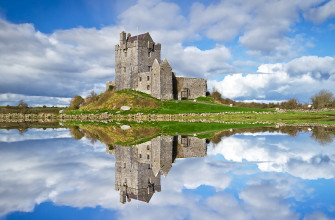
The strategic locations of these stone castles, often on river crossings, coastal headlands or at the entrance to mountain passes, show how important they were to the rulers of the time. Particularly notable are the medieval stone castles built along the major rivers of Ireland, where they controlled trade and communication.
Tower Houses
From around 1400 onwards, a new type of stone castle appeared in Ireland: the tower house. These were tall, narrow rectangular keeps four or five storeys high, usually built by Anglo-Irish or Gaelic Irish lords as fortified residences. The Irish government of the time even offered a £10 subsidy to anyone who built a tower house of standard dimensions, which led to thousands of them being constructed across the country. Today, tower houses are the most common surviving type of medieval castle in Ireland, with iconic examples including the famous Blarney Castle in County Cork and Bunratty Castle in County Clare.
The Most Famous Medieval Castles in Ireland
Dublin Castle
One of the most popular medieval stone castles in Ireland is Dublin Castle, originally built between 1204 and 1230 on the orders of King John of England. Dublin Castle is widely considered to be the only true “King John’s castle” in Ireland and served as the seat of British rule in Ireland for more than 700 years. The castle originally featured the trademark medieval Norman design with twin towers, a drawbridge and a moat fed by the now-underground River Poddle.
The medieval castle was largely destroyed by fire in 1684 and rebuilt as a Georgian palace, although the original 13th-century Record Tower still stands and remains the most complete surviving piece of medieval Dublin. Today the complex hosts state functions and is open to visitors for guided tours of the State Apartments, the medieval undercroft and the Chapel Royal.
Kilkenny Castle
Another important medieval castle is the magnificent Kilkenny Castle, originally built in 1195 by William Marshal, the famous Earl of Pembroke and one of the greatest knights of the medieval age. The castle was built in a quadrangular layout with one large round tower at each of its four corners. Three of the original four towers still stand today, and the castle bears some structural resemblance to Dublin Castle from the same period.
Kilkenny Castle was held by the powerful Butler family, the Earls and later Dukes of Ormonde, for nearly 600 years until they sold it to the local people of Kilkenny in 1967 for the symbolic price of £50. The castle has gone through a series of modifications and restorations over the centuries and now serves as one of the finest medieval-themed visitor attractions in Ireland, set in beautiful gardens at the heart of the historic city of Kilkenny.
Maynooth Castle
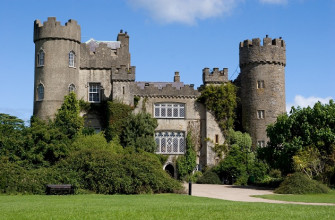
Maynooth Castle in County Kildare was originally built around 1203 as the principal stronghold of the powerful Fitzgerald family, the Earls of Kildare. The castle features the same classic Norman design with twin towers, a drawbridge and a moat that you find at Dublin Castle, and at its peak in the 15th century it was one of the largest and richest fortresses in Ireland. Today the well-preserved gatehouse and great keep are open to visitors and managed by the Office of Public Works.
Trim Castle
Trim Castle, on the banks of the River Boyne in County Meath, is the largest Anglo-Norman castle in Ireland and one of the most important medieval sites in the country. Construction was started by Hugh de Lacy in 1174 and completed by his son Walter de Lacy in 1206. The massive central keep, with its unusual cruciform plan, dominates the surrounding countryside, and the curtain walls and gatehouses still rise to nearly their full medieval height. Trim Castle famously appeared in Mel Gibson’s 1995 film Braveheart, which brought a new generation of visitors to the site.
Cahir Castle
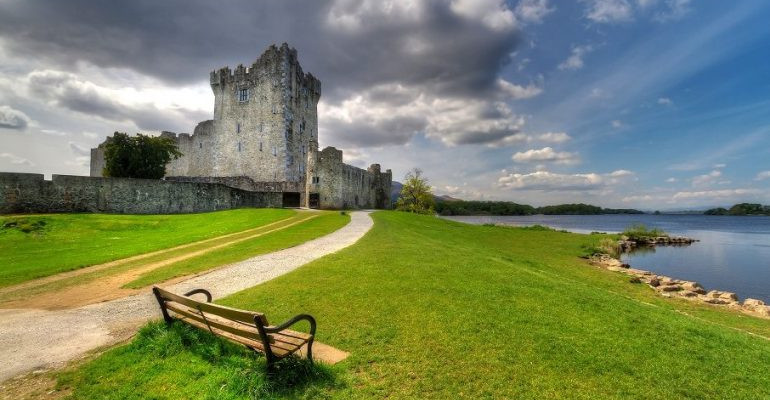
Cahir Castle in County Tipperary is one of the largest and best-preserved castles in Ireland. Built on a rocky island in the River Suir, the castle was the stronghold of the Butler family from the 13th century onwards and successfully repelled most attackers thanks to its formidable defences. Cahir has been used as a film location for productions such as Excalibur, The Tudors and the recent BBC adaptation of The Green Knight.
Adare Castle (Desmond Castle)
Adare Castle, also known as Desmond Castle, in County Limerick, is another medieval structure worth visiting. The 13th-century stone castle sits on the banks of the River Maigue and held an important role in the wars of medieval Munster. The ruins are now managed as a heritage site and can be visited by guided tour during the summer months.
Carrickfergus Castle
Built by John de Courcy in 1177 on the shores of Belfast Lough in County Antrim (Northern Ireland), Carrickfergus Castle is one of the best-preserved Norman castles in Ireland and one of the most impressive medieval fortifications on the entire island. The castle has played a role in Irish history for more than 800 years and is open to visitors year-round.
Other Important Medieval Castles
- Castleroche, County Louth. A spectacular 13th-century castle on a rocky outcrop near the border with Northern Ireland, built by Lady Rohesia de Verdon.
- Ferns Castle, County Wexford. The 13th-century stronghold of the William Marshal family in southeast Ireland.
- Dunluce Castle, County Antrim. The dramatic clifftop ruin on the Causeway Coast, made famous by The Chronicles of Narnia and Game of Thrones.
- Roscommon Castle, County Roscommon. A large 13th-century royal castle built by Robert de Ufford, with massive twin-towered gatehouses.
- Carlow Castle, County Carlow. A 13th-century four-towered keep, two of whose towers still stand today.
- Athenry Castle, County Galway. One of the best-preserved 13th-century keeps in Ireland, set inside a walled medieval town.
- Athlone Castle, County Westmeath. An imposing royal castle on the banks of the Shannon, founded in 1210.
Castles You Can Stay In
Ireland is one of the few countries in Europe where you can spend the night inside a real medieval castle. Several have been converted into hotels and resorts where tourists can experience what it was like to live in such structures:
- Ashford Castle, County Mayo. A 13th-century castle on the shore of Lough Corrib, now one of the most famous luxury hotels in the world.
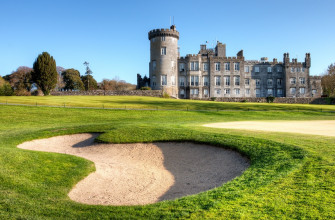
- Dromoland Castle, County Clare. A 16th-century stronghold turned five-star country resort.
- Kilkea Castle, County Kildare. Built in 1180, the oldest continuously inhabited castle in Ireland.
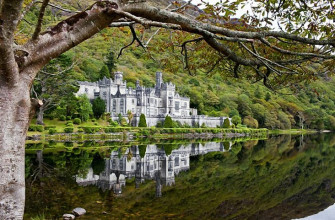
- Ballynahinch Castle, Connemara. A romantic riverside castle in the wilds of County Galway.
- Cabra Castle, County Cavan. A historic castle hotel set in 100 acres of parkland.
- Waterford Castle, County Waterford. A medieval castle on its own private island in the River Suir.
Practical Tips for Visiting Medieval Irish Castles
- Best time to visit. Late spring (April to June) and early autumn (September to early October) offer the best balance of mild weather, long daylight and lower crowds.
- Heritage Card. The Office of Public Works (OPW) sells an annual Heritage Card that gives free entry to most state-managed medieval sites, including Trim Castle, Cahir Castle, Maynooth Castle, the Rock of Cashel and Dublin Castle.
- Northern Ireland. Several of the most spectacular castles, including Dunluce, Carrickfergus and Belfast Castle, sit in Northern Ireland and use pounds sterling rather than euros.
- Driving. A rental car gives the most freedom for exploring castles in rural areas. Watch out for narrow country roads and remember that traffic drives on the left.
- Photography. The best light for castle photography comes in the early morning or late afternoon, especially on the Atlantic coast.
- Guided tours. Many of the major castles run guided tours that bring the medieval history alive and explain the architectural details that you would otherwise miss.
- Wear sturdy footwear. Castle floors and stairways are uneven and often slippery in wet weather.
- Combine with the local town. Many of the most famous castles sit in beautiful medieval towns such as Kilkenny, Trim and Cashel, which deserve a half-day visit in their own right.
Final Thoughts
Visitors to Ireland have the chance to explore some of the most impressive medieval structures in Europe, buildings that are not only architecturally brilliant but of enormous historical significance to the country. From the towering keep of Trim to the riverside walls of Cahir, from the royal seat of Dublin Castle to the fairy-tale ruins of Dunluce on the Atlantic cliffs, the medieval castles of Ireland tell the story of conquest, resistance, ambition and survival across nearly a thousand years of history. Whether you tour the famous OPW heritage sites by day or sleep inside a luxury castle hotel by night, the experience leaves you with a deep sense of how the stones of medieval Ireland still shape the landscape and the imagination of the modern country.