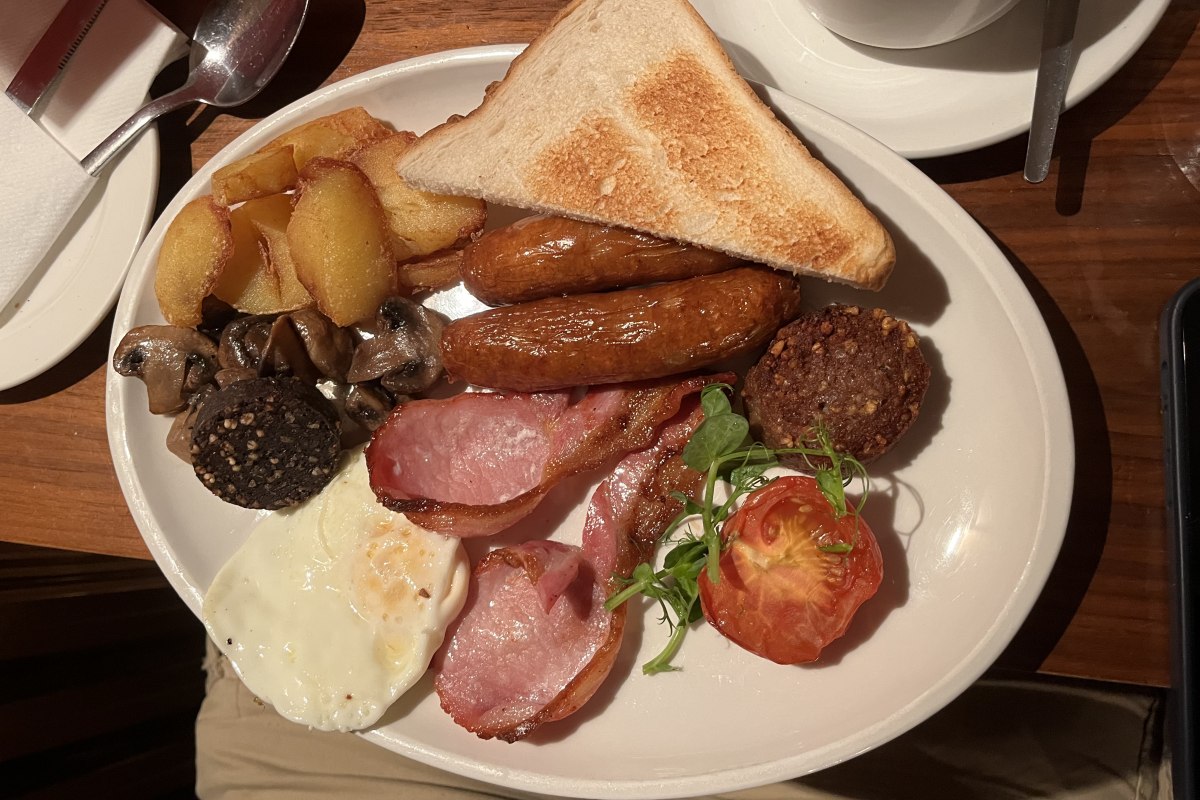
The full Irish breakfast is a plate built to fuel a day of hard work: rashers, sausages, eggs, black and white pudding, grilled tomato and mushrooms, with bread to mop it all up. Cross the border into Northern Ireland and the same plate becomes the Ulster fry, with one defining difference, the fried soda farl and potato bread that southern breakfasts leave off. This guide covers what goes on the plate, the north-south divide, the heritage cafes that serve it, and how to cook a proper one.
What is on the plate
A full Irish, also called a fry, is a cooked breakfast of fried and grilled components served together. The core is fixed even if the extras vary.
- Rashers, Irish back bacon cut from the loin, meatier and leaner than streaky bacon.
- Sausages, plain pork bangers.
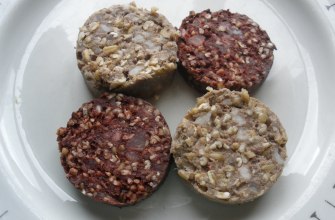
- Black and white pudding, sliced and fried, the oatmeal sausages covered in their own guide.
- Eggs, usually fried, sometimes scrambled or poached.
- Grilled tomato and fried mushrooms, the two vegetables on the plate.
- Baked beans, common though argued over by purists.
- Bread, fried or toasted, with tea or coffee alongside.
It is a weekend and holiday institution rather than an everyday meal, the breakfast of a Sunday morning, a hotel stay, or the morning after the night before, where it holds a near-medicinal reputation as the national hangover cure.
Full Irish or Ulster fry: the real difference
The breakfast splits along the border, and the dividing line is the bread. In the Republic you order an Irish breakfast and the bread is usually a slice of toast or soda bread. In Northern Ireland you order an Ulster fry, and the plate carries two griddle breads fried in the pan: the soda farl and the potato bread. That pair of fried breads is what makes a fry an Ulster fry. They sit in the bacon fat soaking up the flavour, and for many in the north they are the best thing on the plate. A southern fry without them is a perfectly good breakfast; it is just not an Ulster fry. The beans, often blamed for the difference, actually turn up on both sides; it is the soda farl and the potato bread that draw the real line.
The griddle breads
The two breads of the Ulster fry are worth knowing in their own right, both cooked flat on a griddle and cut into quarters, which is what farl means, an old word for a fourth.
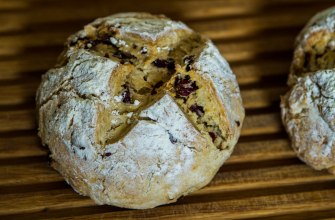
- Soda farl is soda bread dough patted flat and cooked on the griddle rather than baked, then split into four. It has a soft, doughy crumb that crisps beautifully in the pan. It belongs to the same family as the soda scone.
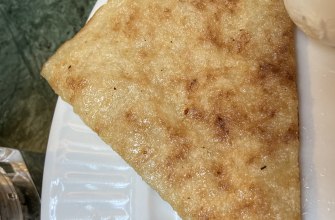
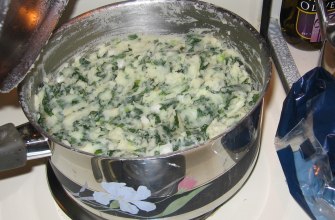
- Potato bread, or potato farl, is a dense flatbread of mashed potato, flour and buttermilk, close cousin to boxty and to the fadge of the north. Fried golden, it is rich and filling.
Both are sold ready-made in every northern shop and bakery, but a homemade farl, hot off the griddle and fried in the morning’s bacon fat, is on another level.
Where to eat it
The fry is served everywhere from roadside cafes to grand hotels, but a few houses carry real heritage. In Dublin, Bewley’s, the tea and coffee company founded in 1840 when Samuel Bewley landed over two thousand chests of tea from Canton, has poured breakfast on Grafton Street since its flagship cafe opened there in 1927, a Dublin institution under its famous stained glass. In Belfast, White’s Tavern claims the city’s first tavern licence, granted in 1630 on Winecellar Entry, making it the oldest in Belfast and a fitting place for an Ulster fry. Across the country the best fry is often found in a plain cafe or a farmhouse B and B rather than anywhere fancy, judged by the quality of the pudding and the bacon rather than the surroundings.
Where the fry came from
The big cooked breakfast is younger and more class-bound than it looks. For most of Irish history the morning meal of the poor was stirabout, a bowl of oatmeal porridge, or bread and tea, with no meat in sight. A plate of bacon, sausage, eggs and pudding was a Sunday or a special-occasion luxury, the meal of a farmhouse on a day that could spare the food, or of a landowner’s table any morning. As the country grew more prosperous through the twentieth century, the big fry spread down the social scale and became a weekend treat for everyone, and then, with tourism, a thing served to visitors as the taste of Ireland. Its components tell the story of the Irish larder: the pig that every cottage kept, in the bacon, sausage and pudding; the eggs from the yard hens; the oats in the pudding and the bread. The fry is the cottage smallholding turned into a single plate, which is why it feels so deeply Irish even though, as a daily breakfast, it is a fairly modern indulgence.
How to cook a full Irish breakfast
The skill is timing, getting everything hot and ready at once from a single pan or two. This serves four.
Ingredients
- 8 rashers of back bacon and 8 pork sausages
- 8 slices of black and white pudding
- 4 eggs
- 4 tomatoes, halved, and 200 g mushrooms
- Soda farls and potato bread, for an Ulster fry
- Baked beans, optional, and bread or toast to serve
Method
- Start the sausages first, since they take longest, cooking them gently until browned all over.
- Add the rashers and the pudding slices, frying until the bacon crisps and the pudding sets a crust.
- Cook the mushrooms and tomatoes in the same pan, soaking up the fat.
- For an Ulster fry, fry the soda farls and potato bread in the bacon fat until golden on both sides.
- Fry the eggs last, so they are hot and the yolks soft when you serve.
- Warm the beans if using, and bring everything to the plate together with tea or coffee.
The order matters: anything cooked too early goes cold or rubbery, so work backwards from the eggs.
Tips for a better fry
- Use good pudding and bacon. The fry is only as good as its parts. A named butcher’s pudding and proper back bacon lift the whole plate.
- Do not rush the sausages. Low and slow gives an even brown; high heat burns the skin and leaves the middle raw.
- Fry the bread in the bacon fat. The soda farl and potato bread soak up the rendered bacon fat, which is where half their flavour comes from.
- Keep a warm plate or oven. Hold cooked items in a low oven while you finish the rest, so everything reaches the table hot.
- Drain the grease. A brief rest on kitchen paper keeps the plate rich rather than greasy.
Modern variants
The fry has bent to modern tastes without losing its shape. A vegetarian Ulster fry swaps the meat for vegetarian sausages and a meat-free pudding, leaning harder on the soda farl, potato bread, eggs, mushrooms, tomato and beans, and makes a surprisingly complete plate. Lighter versions grill rather than fry and drop the pudding, though purists wince. Hotels now plate a smaller, neater fry beside fruit and pastries for guests who cannot face the full assault before noon. None of these has displaced the real thing, which remains a generous, unapologetic plate of fried food eaten slowly on a morning with nowhere to be.
Common questions
What is the difference between a full Irish breakfast and an Ulster fry?
The Ulster fry, from Northern Ireland, includes two fried griddle breads, the soda farl and the potato bread, that a southern full Irish does not. Both share rashers, sausages, pudding, eggs, tomato and mushrooms.
What is on a full Irish breakfast?
Back bacon rashers, pork sausages, black and white pudding, fried eggs, grilled tomato, fried mushrooms, often baked beans, and bread or toast, with tea or coffee. The Ulster fry adds soda farl and potato bread.
What is a soda farl?
Soda bread dough cooked flat on a griddle rather than baked, then cut into quarters. Farl means a fourth. It is fried in the pan as part of the Ulster fry.
Why is the Irish breakfast called a hangover cure?
The combination of fat, protein, salt and carbohydrate, eaten slowly with strong tea, has long been the Irish remedy for the morning after. It is as much ritual as cure, a slow, restorative weekend plate.
Related recipes
For the components, see black and white pudding, soda bread and the griddle boxty. For the wider tradition, see traditional Irish food.
Sources
- Bord Bia, the Irish Food Board
- RTE Lifestyle Food, Irish breakfast traditions
- Tourism Ireland, food and drink
- Dúchas, the National Folklore Collection of Ireland
- Fáilte Ireland, National Tourism Development Authority
- Good Food Ireland
- Slamforeman, full Irish breakfast photograph, Wikimedia Commons, CC BY 4.0