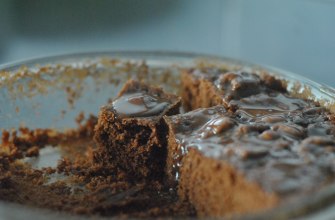
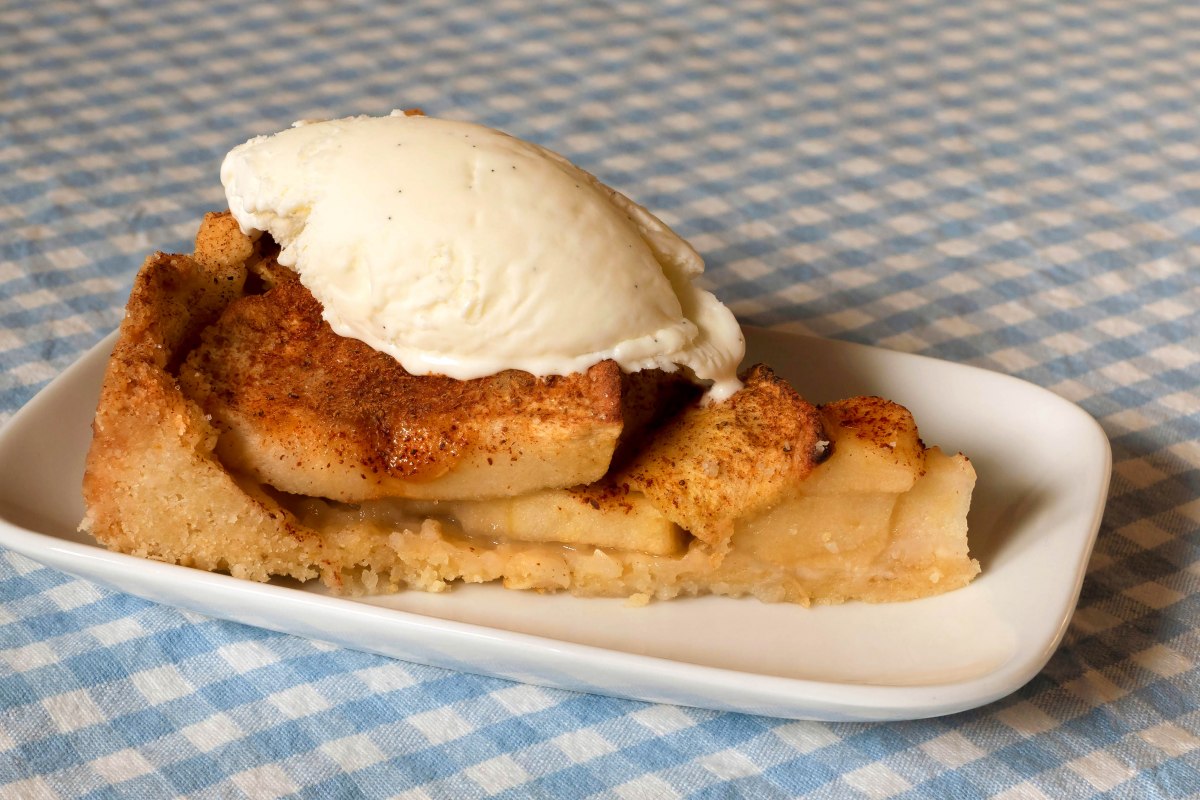
Irish apple cake is a farmhouse dessert: a plain, buttery sponge packed with chunks of tart cooking apple, baked with a crunchy sugar top and served warm with a jug of custard poured over. In the southwest it is known as Kerry apple cake, and it belongs to the simple, subtly sweet baking that came out of Irish kitchens when sugar was a luxury. Made well, with proper Bramley apples and a good custard, it is one of the finest plain cakes there is. This guide gives the recipe, the custard, and the apple that makes it work.
Cake, not tart
Two Irish puddings get muddled. Apple tart is a double-crust pastry pie of sliced apple, the Sunday-dinner standard. Apple cake is different: a soft sponge or a rubbed-in cake batter with chunks of apple folded through and baked into a single round, more cake than pastry. This guide is about the cake. In County Kerry and the southwest it is called Kerry apple cake, and the same dish is simply Irish apple cake elsewhere; the cookery schools of the region keep the recipe as a point of local pride. The Dingle Cookery School teaches the Kerry version as a signature of the peninsula, and its chef Mark Murphy has demonstrated it on RTÉ’s daytime television as the southwest’s own, a sponge spiked with cooking apple and finished with sugar on top, proof that the dish is taught and defended locally rather than just remembered. Wherever it is made, it is rustic and homely, meant to be cut in thick wedges rather than fussed over, and it was the kind of cake a farmhouse turned out on a baking day with apples from the garden.
Bramley, the Irish baking apple
The apple matters more than anything. The Irish baking apple is the Bramley, a large, tart, firm cooking apple that holds its shape and keeps a sharp edge when baked, so the cake is not sickly sweet. Eating apples turn to mush and add nothing but sweetness; the Bramley brings the tartness that balances the sugar and gives the cake its character. Armagh, the orchard county in the north, built its name on the Bramley, growing it in such quantity and quality that the Armagh Bramley carries protected geographical status. If you cannot find Bramleys, any tart, firm cooking apple, such as a Granny Smith at a push, is closer to the mark than a sweet eating apple, which would turn the cake bland and wet. Irish bakers are firm on this above all else: it must be a cooking apple, and the most common reason a home apple cake disappoints is that someone reached for a sweet eating apple instead. Peel and core them and cut them into good chunks, not thin slices, so they keep some bite in the finished cake.
Served warm with custard
An Irish apple cake is built for custard. The traditional way to serve it is warm, in thick wedges, with a proper homemade custard sauce poured generously over the top, the warm cake and cool custard meeting on the plate. The custard is a simple crème anglaise of egg yolks, sugar, milk or cream and vanilla, cooked gently until it coats the back of a spoon. Cream or a scoop of vanilla ice cream stand in well, but custard is the classic. The cake is also good cold the next day with a cup of tea, but warm with custard is how it earns its place at the Irish table. The historical restraint shows here too: the cake itself is only lightly sweet, because sugar was once dear, so the custard adds the richness.
Apples in the Irish kitchen
Apples have grown in Ireland for well over a thousand years, brought and tended by monks who planted orchards beside their monasteries, and the fruit settled into the cooler, wetter parts of the country where it thrived. The north and the southeast became the orchard regions, Armagh above all, where the Bramley took hold so firmly that the county is still called the Orchard County. For ordinary households an apple tree or two in the haggard meant a free supply of fruit every autumn, and the glut had to be used: stewed for sauce, baked into tarts, dried for winter and folded into cakes. Apple cake was one of the simplest and most reliable ways to turn that harvest into a pudding, asking only for flour, butter, a little sugar and the apples themselves. It is a dish shaped by what the land gave, which is why it tastes of restraint rather than indulgence, and why it has lasted on Irish tables for generations.
An Irish apple cake recipe
This makes one round cake to serve eight, with a custard sauce.
Ingredients
- 225 g plain flour and 1 teaspoon baking powder
- 110 g cold butter, cubed
- 110 g sugar, plus extra for the top
- 2 large Bramley or cooking apples, peeled, cored and chopped
- 1 egg, beaten, and about 75 ml milk
- A pinch of ground cloves or cinnamon, optional
Custard sauce
- 3 egg yolks, 50 g sugar, 300 ml milk or cream, a little vanilla
Method
- Heat the oven to 180C and line a round cake tin.
- Rub the cold butter into the flour and baking powder until it looks like breadcrumbs, then stir in the sugar and the spice if using.
- Fold in the chopped apples, then add the beaten egg and enough milk to make a stiff, dropping batter.
- Spread into the tin, scatter the top with a little extra sugar for crunch, and bake for about 45 minutes until golden and firm.
- For the custard, whisk the yolks and sugar, heat the milk, pour it over the yolks, then return to the pan and stir over low heat until it thickens enough to coat a spoon. Do not boil it.
- Serve the cake warm in wedges with the custard poured over.
The cake keeps for three or four days in a tin and is good cold, but a quick warm in the oven and a fresh jug of custard brings it back to its best.
Tips for a better apple cake
- Use cooking apples. Bramleys or another tart, firm apple keep the cake from being too sweet and hold their shape. Eating apples collapse.
- Chop, do not slice. Chunks of apple give the cake its rustic texture and pockets of tartness. Thin slices disappear into the crumb.
- Keep the butter cold. For the rubbed-in method, cold butter gives a lighter, shorter crumb.
- Sugar the top. A scatter of sugar before baking gives the crunchy top that is part of the cake’s charm.
- Do not boil the custard. Gentle heat and constant stirring keep it smooth. A boil scrambles the eggs.
Other ways with Irish apples
The apple cake is the best known, but the same autumn glut went into a handful of other Irish puddings worth knowing.
- Apple tart, the double-crust pastry pie of sliced Bramleys and a few cloves, the Sunday-dinner standard served with cream.
- Apple fool, stewed apple folded through whipped cream and custard for a soft, cold pudding.
- Apple sauce, the sharp purée served with roast pork and goose, a savoury use of the same fruit.
- Apple and blackberry, the wild hedgerow berries of September cooked with apple into crumbles and pies.
All of them lean on the tart cooking apple, and all belong to the same thrifty, seasonal tradition as the cake. Together they are the heart of the Irish autumn kitchen, when the orchards and hedgerows give more than a household can eat fresh. For more sweet baking, see the full guide to traditional Irish food.
Common questions
What is the difference between Irish apple cake and apple tart?
Apple cake is a sponge or rubbed-in cake batter with chunks of apple baked through it. Apple tart is a double-crust pastry pie of sliced apple. The cake is softer and more homely; the tart is pastry-based.
What apples are best for Irish apple cake?
Bramley cooking apples, which are tart and firm and hold their shape when baked. They balance the sugar and keep the cake from being too sweet. Any tart cooking apple is a fair substitute.
What is Kerry apple cake?
It is the same dish as Irish apple cake, named after County Kerry in the southwest where it is a local tradition. The recipe is the rustic apple sponge served warm with custard.
How do you serve Irish apple cake?
Warm, in thick wedges, with a homemade custard sauce poured over. Cream or vanilla ice cream also work, but warm custard is the traditional pairing, the cool sauce running into the warm crumb.
Can you freeze Irish apple cake?
Yes, it freezes well for up to three months, wrapped once it is fully cold. Thaw it at room temperature and warm it briefly in the oven before serving with fresh custard.
Related recipes
For the wider sweet table, see the guide to Irish desserts and the other Irish cakes. For the festive fruit loaf, see the barmbrack.
Sources
- Bord Bia, the Irish Food Board
- RTE Lifestyle Food, Irish baking
- Teagasc, Agriculture and Food Development Authority
- Dúchas, the National Folklore Collection of Ireland
- Fáilte Ireland, National Tourism Development Authority
- The Irish Times, food and drink
- W.carter, apple cake photograph, Wikimedia Commons, CC0 public domain