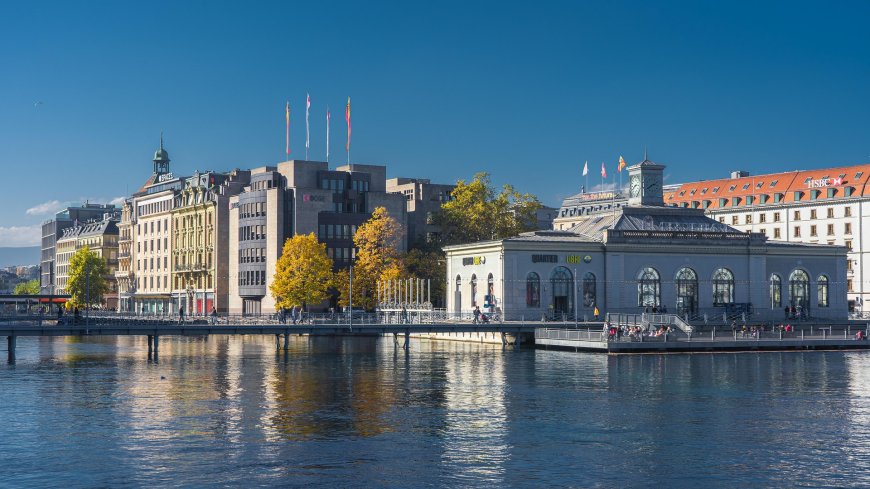
Geneva sits at the very western edge of Switzerland, where the Rhone River flows out of Lake Geneva and slips across the French border just a few kilometres downstream. The city looks at first glance like an enclave: on a map of Switzerland, the cantonal boundary forms a small bulge surrounded almost entirely by France. Around 200,000 people live inside the city itself, with another 600,000 in the wider metropolitan area that spills into neighbouring Vaud and the French department of Haute-Savoie. For its size, Geneva carries enormous international weight as the European headquarters of the United Nations, the home of the Red Cross, the seat of dozens of UN agencies and one of the most important banking and financial centres on the continent. Some of the wealthiest people in the world keep their money here, and many of them spend a fair bit of it here too.
A Quick Sense of the City
Geneva splits naturally into two halves divided by the Rhone and the lake. The smaller and older Vieille Ville (Old Town) climbs the hill on the south bank, with cobbled lanes, the cathedral, antique shops and quiet squares that feel almost untouched by the modern world. The flatter Rive Droite on the north side holds the main railway station, the international district with its UN buildings and embassies, the famous lakeside gardens and many of the larger hotels.
The city has been a centre of European intellectual life for centuries. Jean Calvin made it the capital of the Protestant Reformation in the 16th century, Jean-Jacques Rousseau was born here in 1712, Mary Shelley wrote much of Frankenstein at a villa nearby in 1816, and the Geneva Conventions on the rules of war were drafted here from 1864 onwards. That heritage still shapes the place, from the museums and the university to the international diplomats who fill the cafes around the Place des Nations.
Tours and Walking Routes
The Geneva Tourist Office, located inside the main railway station and on the Rue du Mont-Blanc, runs guided walking tours of the historic centre with English-speaking guides. A typical city walk lasts around two hours and covers the highlights of the Old Town, including St. Peter’s Cathedral, the Place du Bourg-de-Four, the Reformation Wall and the Town Hall. If you prefer to wander on your own, the same office hands out free maps marked with several suggested self-guided routes, and many of the route stops have QR codes that link to audio commentary in English, French, German, Italian and Spanish on the official Geneva audio guide app.
For an even broader overview, the city’s hop-on hop-off open-top bus runs a circular route that takes in both banks, the international district and the lakefront. Day passes are valid for unlimited rides and include a recorded commentary in several languages.
Boat Tours on Lake Geneva
One of the great pleasures of any visit to Geneva is a boat trip on the famously clear waters of Lake Geneva (known to the French as the Lac Leman). The historic Compagnie Generale de Navigation (CGN) operates a fleet of paddle steamers and modern ferries from the central piers at Quai du Mont-Blanc, with options that range from short one-hour cruises around the inner bay to half-day trips along the Swiss riviera as far as Lausanne, Vevey, Montreux and the Chateau de Chillon. Several boats include onboard restaurants serving full lunches and dinners with panoramic views, and themed sunset and fondue cruises run during the summer months. The CGN paddle steamers themselves are historic monuments, with the oldest, the Montreux, in service since 1904.
The famous Jet d’Eau, the iconic 140-metre-high water fountain in the harbour, is best appreciated from a boat. The fountain shoots 500 litres of water per second into the air, the droplets reach the equivalent of 200 metres in height before falling back, and the column has become the unofficial symbol of the city since the late 19th century.
The Old Town and Cathedral of St. Pierre
The cobbled lanes of the Vieille Ville form the historic heart of Geneva and reward an unhurried morning of wandering. The dominant landmark is the Cathedrale Saint-Pierre, a 12th-century Romanesque and Gothic church that became the main pulpit of John Calvin during the Reformation. The interior is famously austere by Catholic standards, since the Reformers stripped it of most of its statues and altarpieces. Climb the 157 steps of the north tower for one of the best views over the rooftops of the Old Town, the lake, the Jura mountains in the distance and (on a clear day) Mont Blanc itself.
Beneath the cathedral lies an impressive archaeological site with the remains of 4th-century Roman and early Christian buildings, including baptismal fonts, mosaic floors and the foundations of earlier churches. The site forms one of the best preserved early Christian archaeological zones in Switzerland.
Other Old Town highlights include the elegant Place du Bourg-de-Four (the oldest square in Geneva, built on the site of a Roman forum), the Maison Tavel (the oldest private house in Geneva, now a small but excellent museum of urban history), the Town Hall where the first Geneva Convention was signed in 1864, and the long Reformation Wall in the nearby Parc des Bastions, with monumental statues of Calvin, Theodore Beza, William Farel and John Knox carved into the city ramparts.
The International District
The northern part of Geneva, around the Place des Nations, holds one of the most concentrated diplomatic districts in the world. The unmissable highlights:
- Palais des Nations. The European headquarters of the United Nations, originally built in the 1930s as the home of the League of Nations and now used by the UN as its largest office complex outside New York. Public guided tours run several times a day in multiple languages and walk visitors through the historic Council Chamber and the famous Human Rights and Alliance of Civilizations Room with its dripping ceiling sculpture by Spanish artist Miquel Barcelo.
- Broken Chair. The 12-metre-tall sculpture of a giant wooden chair with one broken leg stands directly opposite the UN entrance and was installed in 1997 as a protest against landmines and cluster bombs.
- International Red Cross and Red Crescent Museum. A modern, deeply moving museum that tells the story of the Red Cross movement founded in Geneva in 1863 by Henry Dunant. Three permanent exhibitions cover the defence of human dignity, the reconstruction of family links and the reduction of natural risks.
- WTO, WHO, WIPO, ILO and other UN agencies. Most of the major international organisations have their European headquarters in this district, and several offer guided tours by appointment.
The Lakefront and the Jet d’Eau
The Geneva lakefront stretches for several kilometres around the inner bay and offers some of the most relaxing walks in the city. The promenades on both banks lead through formal gardens, sculpture parks, public swimming areas and the famous Jardin Anglais with its iconic Flower Clock (L’Horloge Fleurie), a working clock made entirely from thousands of seasonal flowers and an enduring symbol of the Swiss watchmaking tradition.
The Bains des Paquis, a free public bathing complex built on a long pier just off the north bank, is the favourite summer hangout of Genevans. Visitors can swim straight in the lake, sunbathe on the wooden decks, eat at the famous fondue restaurant or join a sunrise yoga class. In winter, the same complex runs one of the best Turkish bath and sauna circuits in the city.
Museums Worth Visiting
Geneva has a museum culture that punches well above its size. Beyond the Red Cross Museum already mentioned, the standouts are:
- Patek Philippe Museum. One of the finest watchmaking museums in the world, with more than 2,500 timepieces tracing 500 years of horological history.
- Museum of Art and History (MAH). The largest art museum in Switzerland, with collections that span ancient Egypt and Rome through Byzantine icons to Hodler, Vallotton and modern Swiss painting.
- Museum of Natural History. The largest natural history museum in Switzerland, free to enter and very popular with families.
- Ariana Museum. A specialist museum of ceramics and glass located in the international district.
- Museum of the Reformation. A small but excellent museum dedicated to the history of Calvinism and the Protestant Reformation.
- CERN. A short tram ride from the city centre, the European Organization for Nuclear Research runs the largest particle physics laboratory in the world. The Globe of Science and Innovation visitor centre and the new Science Gateway exhibition opened by Italian architect Renzo Piano in 2023 offer free public access and the chance to see real components from the Large Hadron Collider.
Entertainment and Nightlife
A large share of visitors to Geneva are international business travellers, and the city’s nightlife reflects that. Many younger Genevans cross the border into France on weekends for cheaper drinks and bigger venues, but plenty of choices remain inside the city itself. Regular classical concerts take place at the historic Victoria Hall, home of the famous Orchestre de la Suisse Romande, and the Grand Theatre de Geneve on the Place de Neuve hosts opera, ballet and classical productions throughout the autumn and winter season. The Grand Theatre, recently renovated, holds about 1,500 spectators and ranks among the most important opera houses in Switzerland.
Geneva also holds a number of mainstream cinemas showing the latest international releases, plus arthouse venues that lean towards European films, documentaries and independent productions. Always check whether the film is being shown in its original language with subtitles (look for v.o. or VOST in the listings) or whether it has been dubbed into French, since Geneva is in the French-speaking part of Switzerland.
Theatre in Geneva
Theatre is very popular in Geneva, and there is always plenty of choice. The city plays host to several productions at any given time, from classics to more experimental work staged by local companies. The major venues include the Comedie de Geneve, the Theatre du Grutli, the Theatre de Carouge just south of the city, and the Theatre Pitoeff. The language of most productions is French, often in the slightly distinctive Geneva variant of the language, although touring international productions in English, German and Italian also appear regularly. The summer brings open-air performances in the courtyards of the Old Town and the Parc La Grange.
Food and Drink
Geneva is one of the most cosmopolitan food cities in Switzerland, with hundreds of restaurants representing every cuisine in the world thanks to its diplomatic and banking populations. Local Swiss specialities to try include cheese fondue (best in winter at the historic Bains des Paquis or Cafe du Soleil), raclette, the iconic filets de perche (small lake perch fillets pan-fried in butter and served with frites), longeole sausage, the original Geneva-style pork sausage, and the famous Geneva chocolate makers Auer, Stettler and Du Rhone Chocolatier, whose flagship shops are scattered around the central streets.
For something more casual, head to the Carouge district just south of the centre, often described as “Geneva’s Greenwich Village” thanks to its Italianate streets, artisan shops, weekend markets and lively bistros.
Day Trips from Geneva
Geneva is the perfect base for some of the most rewarding day trips in western Europe. The best options:
- Chamonix and Mont Blanc. The highest mountain in the Alps sits less than 90 minutes away across the French border, with the famous Aiguille du Midi cable car climbing to 3,842 metres for one of the most spectacular high-altitude experiences in Europe.
- Annecy. The picture-perfect French alpine town with its turquoise lake and canal-laced Old Town, just 40 minutes south.
- Lausanne. The Olympic capital and home of the IOC headquarters, reachable in 35 to 50 minutes by train along the lake.
- Montreux and the Chateau de Chillon. The famous medieval lakeside castle that inspired Lord Byron’s poem The Prisoner of Chillon, about an hour east by train.
- Yvoire. A perfectly preserved medieval village on the French shore of Lake Geneva, easily reached by ferry from the centre of Geneva.
- Gruyeres. The hilltop village famous for its cheese, dairy demonstrations and the H. R. Giger Museum dedicated to the Swiss artist who designed the creature from the film Alien.
How to Get to Geneva
Geneva Airport (GVA) sits just 4 km from the city centre and is one of the most convenient airports in Europe. Trains run from the airport station to the central Cornavin railway station in just six minutes, and visitors holding a same-day flight ticket can claim a free public transport ticket from the special machine in the baggage hall, valid for 80 minutes of travel into the city.
Geneva is also a major hub on the Swiss railway network. Direct trains run to Lausanne in 35 minutes, to Zurich in around 2 hours 45 minutes, to Bern in less than 2 hours, to Milan in around 4 hours and to Paris on the high-speed TGV Lyria service in 3 hours 10 minutes.
Getting Around
Geneva has an excellent public transport network of trams, trolleybuses, buses and lake ferries (called Mouettes), all run under a unified ticketing system. Anyone staying in a registered hotel, hostel or campsite receives a free Geneva Transport Card at check-in, valid for unlimited public transport for the entire duration of the stay. The same card unlocks discounted entry to many museums and attractions.
The compact size of the city centre means that walking is often the fastest option, especially in the Old Town where many streets are pedestrian-only. The Geneva Card city pass, sold for 24, 48 or 72 hours, includes free public transport plus free or discounted entry to dozens of museums and attractions.
Best Time to Visit Geneva
- May to September. The most pleasant months for visiting, with mild to warm weather, long daylight hours, lake swimming and the major outdoor festivals such as the famous Fetes de Geneve in early August (with fireworks over the lake) and the August jazz festival.
- December. The Christmas markets and the historic Escalade festival on 11 December, when locals dress in 17th-century costumes and run through the Old Town with torches to commemorate the failed 1602 attack on the city by the Duke of Savoy.
- January to March. Cold but excellent for combining city visits with winter skiing in the nearby French and Swiss Alps. Geneva Airport handles enormous winter traffic from skiers heading to Chamonix, Verbier and Megeve.
- October and November. Quieter shoulder months, with autumn colours along the lake and a more reflective atmosphere in the Old Town.
Practical Tips
- Currency. Swiss franc (CHF). See our full money in Switzerland guide for banknote denominations, ATM tips, and card acceptance. Most prices are listed in francs, although many shops in central Geneva also display euro prices and accept euro cash. Cards work everywhere.
- Language. French is the official language, and signs, menus and street names are almost always in French. English is widely spoken in hotels, restaurants and major attractions.
- Cost of living. Geneva is one of the most expensive cities in the world. Restaurant meals, transport and accommodation can come as a shock to first-time visitors. Self-catering at the Migros and Coop supermarkets is the best way to save money.
- Tap water. Geneva’s tap water comes straight from the Alps and is among the cleanest in the world. The historic public fountains scattered around the city are all safe to drink from, so carry a refillable bottle.
- Tipping. Service is included in restaurant prices, but rounding up the bill or adding 5 percent for excellent service is appreciated.
- Cross-border travel. The French border runs right through the suburbs of Geneva, and many visitors cross daily for cheaper meals and shopping. Bring a passport even for short trips, since border checks have become more frequent in recent years.
- Safety. Geneva is one of the safest major cities in Europe. Petty theft can occur around the railway station and in busy tourist areas, but violent crime against visitors is extremely rare.
Final Thoughts
Geneva rewards visitors who give it a little time to reveal itself. Climb the cathedral tower for the view of Mont Blanc on a clear morning, walk the Old Town lanes where Calvin once preached and Rousseau was born, ride a paddle steamer past the Jet d’Eau as the sun sets behind the Jura, take the bus to CERN to stand inside one of the great scientific projects of the modern world, eat lake perch on a wooden pier at the Bains des Paquis and finish the day with a glass of local wine in a bistro in Carouge. Few cities of this size combine so much history, international weight and natural beauty in such a small footprint, and few make it so easy to step from a serious diplomatic meeting straight onto an alpine ski slope or a quiet medieval village by the lake.