Interested in the two headed German Eagle symbol? Learn more about the German Eagle two headed symbol and its use in heraldry…
The two headed German eagle symbol has been used in different forms in European vexillology and heraldry. It was initially associated with the Byzantine Empire, Vijayanagara Empire and the Holy Roman Empire. When it came to the heraldry in Byzantine the double eagle heads represented the dual sovereignty of the Emperor. This was dominant in religious and secular terms as well as the Byzantine era Emperors. There were many Eastern European countries that adopted this symbol as heraldry from the Byzantine Empire. To this day it is used as a symbol to depict their national emblems. It is in fact the most prominent in German and Russian Confederation issues.
Two Headed Germany Eagle Symbol in Asia
Prior to being adopted by the West, the two headed German eagle is noted prominently in the East. This was centuries before the Byzantines started using it as an adopted symbol of different historical states. In Asia the medieval areas of the Seljuk Sultanate of Rûm and Armenia were already using the double headed eagle symbol. In mythology, the double headed eagle is featured in Hinduism with the name of Gandaberunda.
Use of German Two Headed Eagle in Germany
The two headed eagle is used in the heraldry of The German Confederation, also known as the Deutscher Bund in German. This was associated as a group of Central European states that were established by the Congress of Vienna.
The confederation was established in 1815 in order to serve as the successors of the Holy Roman Empire for the German Nation that had been dissolved in 1806. By 1848 there were many revolutions by nationalists and liberals in order to create a unified German state. The talks failed between Germany and the different states in 1848. Following this the confederation was actually dissolved and then reinstituted in 1850. There was constant rivalry between the two dominant states of Prussia and Austria. The constant tussle focused on trying to prove which state had the right to rule the German lands and consequently led to the Austro-Prussian War of 1866.
As a result the confederation had collapsed and the new North German Confederation was established. Under this structure there were many south German states that were independent. Initially they did ally with Austria but by 1867 they forged an alliance with Prussia that lasted until 1871. Following, the southern states amalgamated with the new nation known as Germany. In fact the five years of independence of the southern states is the only time in their history when they were not under any higher political control since the 10th century and the creation of the Holy Roman Empire.
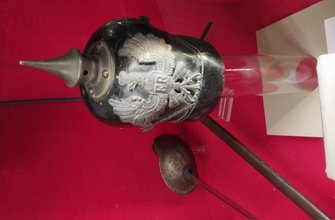
Subsequently the two-headed eagle German symbol was followed on the coat of arms of the German confederation. It is a black eagle with two heads, two red beaks and red claws. It is printed on a gold base and is in the shape of a shield in a rectangle box. The eagle does not have the swastika underneath it as that came much later.
Masonry Symbols
In fact that double headed eagle is also seen in masonry symbols. It can be found on the cover of Morals and Dogma issued by the Scottish Rite of Freemasonry. There are different meanings attached to its use and in the confederation it shows a union between the states. However in masonry it depicts the Sumerian pantheon of gods and the effort of the Freemasons to remain the gatekeepers for all the knowledge related to the origins and destiny of mankind.