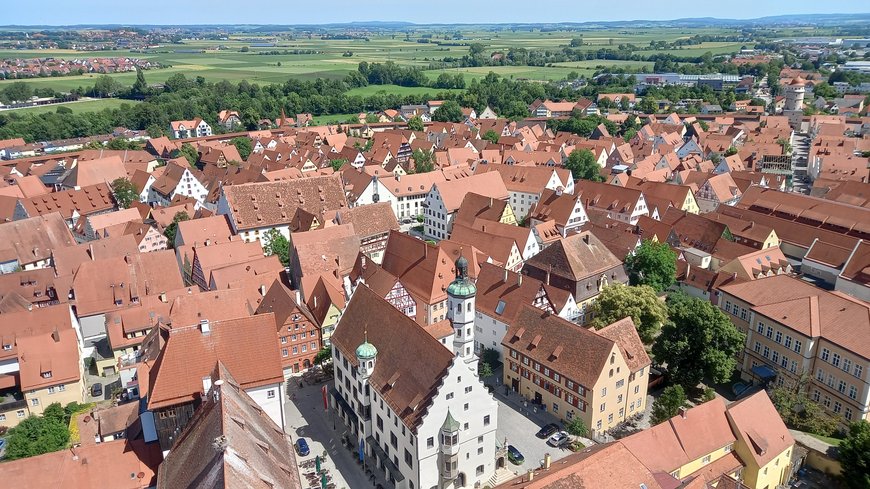
Nördlingen is the only inhabited town in the world built entirely inside a meteor impact crater, the 24-kilometre-wide Nördlinger Ries formed roughly 14.8 million years ago when an asteroid around a kilometre across struck what is now Bavaria. The town’s circular medieval wall, still walkable as a complete 2.7-kilometre loop, traces the rim of the crater’s inner basin and survives with all 16 original watchtowers intact. Forty kilometres southeast, Dinkelsbühl preserves its 400 half-timbered houses and complete city wall with the same rare completeness, spared from destruction during both the Thirty Years War and the Second World War. Both towns lie on the Romantic Road, the 350-kilometre themed route from Würzburg to Füssen established in 1950. This guide covers the meteor crater geology, the Willy Wonka and Attack on Titan film connections, the walkable walls, festival calendar, and practical travel logistics.
The Ries Meteor Crater
The Nördlinger Ries formed when a stony asteroid approximately one kilometre in diameter struck the Franconian Jura at an estimated 20 kilometres per second. The impact released energy equivalent to 1.8 million Hiroshima bombs, vaporised the asteroid and surrounding bedrock, and excavated a crater originally 12 kilometres across. Subsequent erosion and sediment infill expanded the visible rim to the current 24 kilometres.
Geologists misidentified the feature as a volcanic caldera through the 19th and early 20th centuries. The impact origin was confirmed in 1960 when Eugene Shoemaker and Edward Chao identified shocked quartz and coesite in samples from the Ries, proving that only hypervelocity impact could produce these minerals. The Ries became the type locality for impact crater research and remains one of the best-preserved mid-size craters on Earth.
NASA Apollo astronauts including Harrison Schmitt trained at the Ries in 1970 to study impact geology before lunar missions. The shatter cones, suevite breccia, and shocked minerals visible in local quarries provided ground-truth examples for what the astronauts would collect on the Moon.
Nördlingen: Circular Walls Around a Crater Basin
The town of Nördlingen grew inside the crater’s inner basin, first documented in 898 as Nordilinga. The circular shape of the walled settlement reflects the crater topography: a natural defensive advantage that medieval builders incorporated as stone ramparts and gatehouses through successive centuries of fortification.
The 2.7-kilometre complete wall circuit, constructed primarily between the 14th and 16th centuries, survives entirely walkable. Visitors can traverse the full loop along the covered wall-walk (Wehrgang) in about 90 minutes, passing through 16 towers and gate structures:
- Reimlinger Tor: south gate, oldest surviving gate structure
- Löpsinger Tor: north gate, houses the town museum
- Deininger Tor: west gate
- Berger Tor: east gate
Between the gates the wall includes numbered round and square towers with archery slits, crenellations, and external gate-bridge approaches. A small entrance fee admits visitors to the covered sections, and the walk continues in short free sections between paid towers.
Daniel Tower and St. George’s Church
St. Georgskirche dominates the old town from the Marktplatz. The Late Gothic hall church, constructed from 1427 to 1505, houses the Daniel tower (Daniel-Turm), the 90-metre spire that local night watchmen have climbed to call the hour across the town for over 500 years. The practice continues today with scheduled calls, though mainly as a tourist tradition rather than actual time-keeping.
The Daniel tower offers the best aerial view of the Ries crater. The 350-step climb reveals the full circular outline of the crater rim in clear weather, with the town clearly at the centre and the raised rim visible as forested hills in the distance. The climb takes 10 to 15 minutes of steady walking, with several rest landings. Admission runs a few euros for adults.
Inside the church, the late-Gothic stone vaulting reaches 27 metres with the original painted decoration visible in sections. The high altar from 1462 by the Master of the Nördlingen Altar is one of the finest Late Gothic altarpieces in southern Germany. The organ dates from 1797 and received restoration in 1988 using period techniques.
Willy Wonka Aerial Scenes From 1971
The opening credits sequence of Willy Wonka and the Chocolate Factory, released in 1971, includes aerial footage of Nördlingen’s circular walled town. Director Mel Stuart used the town as a visual reference for the film’s European setting. The shots appear during the opening title sequence and establish the storybook character of the fictional town where the film’s events unfold.
The film’s production team scouted several European towns before settling on Nördlingen for the aerial footage, citing the unique circular shape visible from altitude. Gene Wilder as Willy Wonka and the main cast never filmed in the town itself, but the aerial silhouette remains permanently associated with one of the best-known musical films of the early 1970s.
A separate aerial sequence in the film uses Munich for industrial-looking scenes, and the factory interiors were shot at the Bavaria Film Studios also near Munich. The Nördlingen aerial footage is therefore an authentic location appearance rather than a full production base.
Attack on Titan Film Connection
The 2015 live-action Japanese adaptation of Attack on Titan used Nördlingen’s circular walls as the visual model for the concentric-ring defensive walls of Wall Maria, Wall Rose, and Wall Sina in the source manga and anime. The manga creator Hajime Isayama has acknowledged Nördlingen as direct inspiration for the walled-town setting of the series.
The live-action film production did not shoot in Nördlingen itself, filming instead at Hashima Island in Nagasaki Prefecture for the ruined environment and in Japanese studios for most scenes. The Nördlingen connection is aesthetic and conceptual rather than a filming location for the live-action adaptation, though the town has become a pilgrimage destination for Attack on Titan fans from East Asia.
Nördlingen’s tourism office now runs specific walking tours oriented toward manga and anime fans, highlighting the wall sections that most closely match the series’ visual design. These tours run primarily in English and Japanese during peak season.
Ries Crater Museum
The Rieskrater Museum in the old town houses the world’s most comprehensive exhibition on the Ries impact and impact cratering generally. Founded in 1990 and extensively expanded in 2005, the museum covers the formation physics, the subsequent geology, and comparative material from other terrestrial and lunar impact sites.
Key exhibits include:
- Genuine lunar sample: a small basalt fragment on long-term loan from NASA
- Suevite and impact breccia: the characteristic rock types formed during the impact
- Impact simulation models: visualisations of the impact sequence at geological timescales
- Apollo astronaut training artefacts: photographs and equipment from the 1970 training visits
- Comparative crater geology: Meteor Crater Arizona, Chicxulub in Mexico, lunar craters
A visit takes about 90 minutes for general visitors and up to three hours for those interested in detailed geology. Admission runs around 5 euros for adults with reductions for students and families.
Dinkelsbühl: 400 Half-Timbered Houses
Dinkelsbühl, 40 kilometres southeast of Nördlingen, preserves among the most complete medieval old towns in Germany. The Old Town retains over 400 half-timbered buildings within its intact city walls, a completeness that reflects the town’s avoidance of both the Thirty Years War destruction and Second World War bombing.
The city walls run 2.5 kilometres around the town core with 16 gate towers and numerous smaller defensive structures. Visitors can walk the walls externally and enter several of the preserved gate complexes. The Rothenburger Tor (Rothenburg Gate) and the Nördlinger Tor (Nördlingen Gate) are the most impressive surviving gatehouses, both dating from the 13th and 14th centuries.
The central Marktplatz features the Münster St. Georg, the largest Gothic hall church in Germany south of the Danube. Construction ran from 1448 to 1499 under master builder Nikolaus Eseler. The building’s 76-metre tower opens for climbs during summer season, offering wide views across the Franconian plain.
The Kinderzeche Festival
Dinkelsbühl holds the Kinderzeche festival during the third weekend of July each year, a reenactment of a 1632 event during the Thirty Years War. According to local tradition, Dinkelsbühl’s children intervened when Swedish troops under colonel Claus Dietrich von Sperreuth threatened to sack the town, with the children’s appeal reportedly persuading the colonel to spare the town from destruction.
The historical basis of the event is debated among historians, but the festival tradition dates from 1897 and has run continuously through most of the 20th century. The ten-day festival features children in period costume reenacting the historical scene, a Knabenkapelle (boys’ band) performing pieces from the 1600s, and historical markets with period craft demonstrations.
The festival draws substantial crowds and hotels fill months ahead during the event. Visitors planning to attend should book accommodation by March or April of the festival year. Off-festival visits during July avoid the crowds but miss the central spectacle of the town’s tradition.
The Romantic Road Context
The Romantische Strasse runs 350 kilometres from Würzburg in Franconia to Füssen at the Austrian border, established in 1950 as one of the first themed driving routes in West Germany. The route connects medieval and Renaissance towns including Rothenburg ob der Tauber, Dinkelsbühl, Nördlingen, Augsburg, and Landsberg am Lech, ending at Neuschwanstein and Hohenschwangau castles in the Bavarian Alps.
Three route sections offer distinct character:
- Northern section (Würzburg to Rothenburg): Franconian wine country, Tauber Valley landscapes
- Central section (Rothenburg to Augsburg): walled medieval towns including Dinkelsbühl and Nördlingen
- Southern section (Augsburg to Füssen): alpine foothills and the Bavarian castles finale
Full-length drives take four to seven days with substantial town stops. Shorter trips focus on one section, with the central section (Rothenburg through Nördlingen) offering the densest concentration of medieval walled towns.
Rothenburg Versus Nördlingen/Dinkelsbühl
Rothenburg ob der Tauber draws the largest tourist crowds of the Romantic Road, with peak summer days producing significant visitor density in the small old town. Nördlingen and Dinkelsbühl offer similar preserved medieval character with substantially fewer crowds, making them preferred destinations for visitors seeking the walled-town experience without the tour-bus volumes.
Architectural character differs across the three towns. Rothenburg leans heavily Gothic with pronounced half-timbered accents. Dinkelsbühl leans slightly later with Renaissance-influenced facades alongside the half-timbered core. Nördlingen carries Late Gothic and Renaissance stone construction reflecting the town’s wealth from medieval trade.
A visitor with two days should consider pairing Nördlingen and Dinkelsbühl rather than including Rothenburg. The pair offers deeper immersion in medieval urban preservation without the crowd management issues that dominate Rothenburg visits during peak season.
Getting There and Where to Stay
Nördlingen connects to the national rail network via a branch line from Donauwörth. Regional trains from Munich take about 90 minutes with a single change. Dinkelsbühl lacks direct rail service and requires a bus connection from Ansbach (90 minutes from Nuremberg by express train). Most visitors rent a car for the combined trip, which suits the Romantic Road logic generally.
Accommodation options in both towns centre on small hotels and traditional guesthouses inside the medieval cores. Room rates run 80 to 160 euros per night during peak summer and drop significantly off-season. Booking ahead by two to three months for summer weekends is advised, particularly around the Kinderzeche festival weekend in Dinkelsbühl.
A typical itinerary allocates two days: Day 1 in Nördlingen with wall walk, Daniel tower climb, and Ries Crater Museum. Day 2 drives to Dinkelsbühl for the old town, city walls, and Münster St. Georg, overnight in Dinkelsbühl. A third day adds Rothenburg or continues toward Würzburg or Augsburg.
Best Season
May through September offers the best combination of weather and operating hours. July brings the Kinderzeche festival in Dinkelsbühl and peak summer atmosphere in Nördlingen. June and August combine warm weather with somewhat lower crowds than the festival weeks.
Autumn (September and October) produces the best photographic conditions for the half-timbered facades with softer light and occasional early colour in the Franconian landscape. December brings Christmas markets in both towns, with Dinkelsbühl’s market particularly atmospheric in the walled old core.
Winter (January through March) offers lowest hotel rates and near-empty streets, suitable for architectural photographers and visitors prioritising quiet historical atmosphere. Several restaurants and smaller museums reduce hours through the winter months.
Frequently Asked Questions
Can I really see the meteor crater from the ground?
Yes, from elevated viewpoints. The Daniel tower in Nördlingen offers the best view of the full crater rim on clear days. The crater floor is so wide that from within the town itself the impact origin is invisible: it looks simply like a shallow plain surrounded by low hills.
Is Dinkelsbühl just like Rothenburg?
Similar medieval walled-town character, but without Rothenburg’s crowd volume and with slightly later Renaissance influence on the architecture. Visitors comparing the two often prefer Dinkelsbühl for atmosphere and Rothenburg for volume of individual landmark buildings.
How long do you need for both towns?
Two full days minimum, three days for comfortable depth. Day trips from Munich or Stuttgart cover one town well, so splitting a weekend across Nördlingen and Dinkelsbühl with an overnight in one or the other makes sense.
Are the walls actually walkable completely?
Yes. Nördlingen’s 2.7-kilometre circuit is fully walkable along covered wall-walks. Dinkelsbühl’s 2.5-kilometre wall circuit is walkable externally with several accessible gate towers. Both towns provide the rare complete medieval wall experience found in only a handful of German towns.
Do you need to book the Daniel tower climb?
No reservations required for the Daniel tower climb. Open during church opening hours, typically 9:00 to 18:00 in summer with reductions in shoulder seasons and winter. A small admission fee applies.
What Attack on Titan locations should I see?
The circular wall sections facing the outer country view best match the concentric-wall aesthetic of the series. Walking the full wall circuit covers all the primary sight lines that the manga’s visual design drew from. English-language fan tours operated by local guides highlight specific wall sections and gate structures.
Are the towns suitable for wheelchairs?
The old town streets are cobbled and often narrow, creating accessibility challenges. The wall walks have stairs. Major museums (Ries Crater Museum, Nördlingen town museum) have accessible routes. Visitors with mobility needs should contact the tourist offices ahead to confirm specific route accessibility.
For other themed German drives that pair with the Romantic Road, see our Fairy Tale Road guide covering the Brothers Grimm literary route through Hesse and Lower Saxony. For a completely different wetland landscape near Berlin, our Spreewald travel guide describes Sorbian culture and canal country.
Sources and Further Reading
- Rieskrater Museum Nördlingen, permanent collection catalogue
- Shoemaker, E. M. and Chao, E. C. T., New Evidence for the Impact Origin of the Ries Basin, Journal of Geophysical Research, 1961
- Romantische Strasse Tourismusverband, official route documentation
- Stadtarchiv Dinkelsbühl, Kinderzeche festival historical records
- Deutsche Zentrale für Tourismus, Romantic Road materials
- Hero photograph: Nördlingen mit Nördlinger Ries by Markus Schäfer, Wikimedia Commons, CC BY-SA 4.0