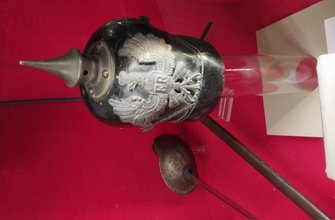

German military cap insignia from the 1933 to 1945 period carries a complex academic and legal status that reflects the distinct branches of the Wehrmacht and their organisational symbology. The standard national emblem (Hoheitszeichen) carried the eagle-and-swastika combination now prohibited under Section 86a of the German criminal code, while pre-1933 Reichswehr and post-1945 Bundeswehr insignia follow different legal frameworks. This article reviews the development of German military cap insignia across the branches of the Wehrmacht, manufacturing contexts, the denazification disposition of surviving items, museum and academic study frameworks, authentication challenges in the modern collector market, and the legal restrictions that shape international trade in these items.
Historical Development of German Military Insignia
German military headgear carried rank, branch, and national identification markings continuously from the unification of the German Empire in 1871 through the present day. The Reichswehr period (1919-1933) used restrained insignia reflecting Weimar-era limits on military ostentation. The 1933 reorganisation under the Third Reich introduced expanded insignia schemes across the three Wehrmacht branches plus the political and paramilitary organisations of the regime.
Cap insignia typically consisted of two distinct elements on each headgear type. The upper badge carried the Hoheitszeichen national emblem, showing the eagle with spread wings holding a wreathed swastika. The lower badge carried a cockade in the national colours (black, white, red in silk or metal) or branch-specific colouring, often surrounded by a wreath of oak leaves.
Manufacturing of insignia ran primarily through Solingen and Berlin-based firms under Reichszeugmeisterei oversight. RZM codes assigned to approved manufacturers appear stamped on metal components, allowing contemporary researchers to trace production to specific factories. Main manufacturers included Assmann, Overhoff, Deumer, and several smaller firms producing for specific organisational contracts.
Heer (Army) Cap Insignia
Heer cap insignia used a stylised eagle pattern with straighter wings than the Luftwaffe variant. Officer peaked caps (Schirmmutze) carried metal or bullion-wire embroidered insignia, while enlisted field caps (Feldmutze) used woven insignia on fabric backing.
Specific patterns included the M1936 officer Schirmmutze eagle in polished aluminium, the M1943 Einheitsfeldmutze woven insignia that combined eagle and cockade on a single T-shaped badge, and the machine-embroidered variants produced for overseas theatres where metal production became scarce.
Variation across production years reflected wartime resource constraints. Early-war insignia used higher-grade aluminium or silver alloy, while late-war production shifted to cheaper zinc castings and machine embroidery. These material differences provide authentication markers for researchers examining surviving items today.
Luftwaffe Cap Insignia
Luftwaffe cap insignia used a distinctive Spreizflugel eagle with more dramatically spread wings than the Heer pattern. The design reflected the Luftwaffe’s desire for a distinct visual identity when the branch was formally established in 1935, separate from the aviation corps that had existed within the Reichswehr.
Officer peaked caps typically carried bullion-wire embroidered eagles in silver or gold thread, with a wreathed cockade in Luftwaffe blue. Enlisted caps used woven insignia or stamped metal badges. Senior officer patterns sometimes included additional oak leaf clusters on the cap visor, a feature that distinguishes general-rank items in academic catalogues.
Manufacturing concentration for Luftwaffe insignia ran through Assmann and Deumer with smaller contracts to Friedrich Linden in Berlin and Gebruder Trenschel in Rathenow. Archive records at the Bundesarchiv-Militararchiv document production runs and distribution to specific units, which researchers use to verify provenance claims for surviving items.
Kriegsmarine Cap Insignia
Kriegsmarine cap insignia retained more continuity with Imperial German Navy traditions than the army or air force insignia did. Officer peaked caps (Schirmmutze) used bullion-wire embroidered eagles in gold thread on black fabric, and the wreath surrounding the cockade followed patterns established under the Kaiserliche Marine before 1918.
The 1938 modification to the eagle pattern introduced the Hoheitszeichen with wreathed swastika, replacing the Imperial crown used in pre-1918 and interwar patterns. This 1938 cutoff is significant for collector and academic purposes because insignia produced before the change follows different legal frameworks than post-1938 patterns under Section 86a.
Production volumes for Kriegsmarine insignia were substantially lower than Heer or Luftwaffe patterns, reflecting the smaller size of the naval officer corps. Manufacturing concentrated on Friedrich Linden and Assmann, with some dockyard-produced variants showing local craftsmanship specific to particular naval bases.
Denazification and Post-War Transition
Allied Control Council Directive 23 of 1945 ordered the destruction or confiscation of Nazi-era military insignia alongside other organisational militaria. Implementation varied across the four occupation zones, with US zone policy generally permitting personal soldier-trophy retention while Soviet zone policy enforced fuller collection.
The post-war Bundeswehr established in 1955 developed new insignia patterns entirely removed from Third Reich symbology. The current Bundeswehr Schirmmutze carries a federal eagle (Bundesadler) on a stylised wreath, with no continuity to the 1933-1945 Hoheitszeichen patterns. The East German Nationale Volksarmee similarly adopted entirely new insignia during its formation in 1956.
The 1949 Federal Republic constitutional framework under Section 86a of the criminal code prohibited possession and display of symbols of unconstitutional organisations, which includes the Wehrmacht Hoheitszeichen in most contexts. Paragraph 86 Absatz 3 provides specific exceptions for museum display, academic research, and civic education, which frame contemporary museum and research use.
Authentication and Research Access
Authentication of surviving cap insignia draws on several technical indicators.
- Manufacturer stamps and RZM codes on metal components
- Bullion wire analysis for thread composition anachronisms
- Backing fabric examination to identify period materials
- Casting or stamping technique examination on metal badges
- Patination patterns consistent with long-term storage and handling
- Provenance documentation back to pre-1945 possession
A significant portion of international market items consist of post-war reproductions produced in various workshops since the 1950s. Modern reproduction quality has improved substantially, and distinguishing period originals from recent productions often requires specialist examination. Authentication services typically cost 100 to 300 US dollars per item.
Museum research access for insignia studies operates through institutional requests to holding institutions. The Militarhistorisches Museum Dresden, the Imperial War Museum, and the Deutsches Historisches Museum in Berlin maintain research collections accessible to credentialed researchers with documented academic programmes.
Legal Considerations for Private Buyers
Private possession and display of Wehrmacht cap insignia carrying the Hoheitszeichen falls within Section 86a restrictions in Germany. Import to Germany, Austria, Israel, and several other jurisdictions requires specific documentation under academic or museum exceptions, or may be prohibited entirely for private buyers.
In the United States federal law does not restrict possession of most period items, though some state statutes and local ordinances around symbols of hate or discriminatory display may apply to public display regardless of possession legality. Private collectors should consult legal counsel in their jurisdiction before acquiring or publicly displaying items carrying prohibited symbology.
Insurance coverage for collector objects carrying restricted symbology typically excludes items that cannot be legally imported or displayed in the owner’s jurisdiction. This means private buyers often cannot insure these items against theft, fire, or damage, which removes the standard protection that collectors of other artefact categories normally maintain.
Online marketplaces including eBay, Etsy, and major auction platforms have tightened restrictions on listings carrying Nazi-era symbology over the past decade. Listings are regularly removed, seller accounts suspended, and in some cases information forwarded to law enforcement under cross-border cooperation frameworks. This enforcement continues to reshape the collector market away from public platforms toward closed specialist channels.
Frequently Asked Questions
What does the Hoheitszeichen represent?
Hoheitszeichen literally translates as sovereignty symbol. In the Third Reich period it combined the traditional German eagle with a wreathed swastika, serving as the national emblem. This combination is the specific symbol restricted under Section 86a.
Are pre-1933 Reichswehr items restricted?
Generally no. Reichswehr insignia from 1919 to 1933 does not carry the Nazi-era symbology and is not restricted under Section 86a. The period-specific cutoff begins with the 1933 reorganisation under the new regime.
How do I identify a reproduction?
Through professional authentication by specialists with access to manufacturer records, material analysis tools, and documented reference collections. Home identification from online guides is unreliable because reproduction quality has improved significantly since the 1990s.
Can I display these items in the United States?
Federal law does not restrict private display of most period items, though state and local ordinances around symbols of hate may apply to public display contexts. Employers, landlords, and insurance providers may also impose private restrictions that go beyond statutory requirements.
Why do museums continue to display these items?
Museums display these objects under documented educational exemptions for historical teaching about the period and its crimes. Proper museum presentation includes explicit contextualisation of the violence the regime carried out, with display text naming the victims alongside the objects themselves.
For other military history topics, see our German army helmet overview, our WWII German helmets, and our Imperial German army uniforms. For dagger history, see German dagger overview.
Sources and Further Reading
- Brian L. Davis, German Army Uniforms and Insignia 1933-1945
- Jill Halcomb, Uniforms and Traditions of the German Army 1933-1945
- Militarhistorisches Museum der Bundeswehr, Dresden, research collection documentation
- Bundesarchiv-Militararchiv, Freiburg, production and distribution archives
- Bundesministerium der Justiz, Strafgesetzbuch Sections 86 and 86a