The German Fairy Tale Road (Deutsche Marchenstrasse) runs 600 kilometres from Hanau in Hesse to Bremen on the North Sea coast, linking the towns where Jacob and Wilhelm Grimm collected, wrote, and published the Kinder- und Hausmarchen (Children’s and Household Tales) that shaped world literature from 1812 onward. Regional tourism boards established the route in 1975 to connect over 60 towns, castles, and landscapes tied to Grimm biography or fairy-tale locations. A complete drive takes five to ten days depending on depth, passing through Kassel where the first edition was printed, Sababurg where local lore placed Sleeping Beauty, Hamelin of Pied Piper fame, and Bremen with its Musicians statue. This guide covers the Grimm brothers’ biography, the 14 anchor towns of the route, practical driving and rail logistics, the best season, and nearby excursions.
Who the Brothers Grimm Were
Jacob Grimm was born in Hanau on 4 January 1785, Wilhelm on 24 February 1786. Their father Philipp was a lawyer who died in 1796 when Jacob was 11, leaving the family in reduced circumstances. The older brothers continued their education thanks to support from relatives, first at the Lyzeum in Kassel and then at the University of Marburg starting in 1802.
The brothers began collecting folk tales around 1806, initially at the suggestion of the Romantic poet Clemens Brentano who wanted material for a literary anthology. Instead of giving their collection to Brentano, the Grimms published the first volume of Kinder- und Hausmarchen in December 1812 under their own names. A second volume followed in 1815, and the collection expanded through seven editions during Wilhelm’s lifetime, reaching over 200 tales.
Beyond the fairy tales, the brothers produced foundational work in German linguistics. Jacob’s Deutsche Grammatik (1819 onward) established modern comparative Germanic philology, and the Deutsches Worterbuch dictionary project they began in 1838 continued past their deaths and finished in 1961, over a century later. Wilhelm died in Berlin on 16 December 1859, Jacob on 20 September 1863, both buried in the Matthauskirchhof cemetery in Berlin-Schoneberg.
Hanau: Birthplace and Route Start
Hanau, just east of Frankfurt on the Main, opens the Fairy Tale Road at its southern end. The town centres on a bronze monument to the brothers unveiled in 1896, showing Jacob seated and Wilhelm standing, set on the Neustadter Markt square in front of the town hall. The house where the brothers were born no longer stands, but a marker plaque notes the location.
The town hosts the Bruder Grimm Marchenfestspiele, an annual fairy-tale festival running from mid-May through late July on an open-air stage in the Amphitheater am Schloss Philippsruhe. The festival combines drama, puppetry, and music productions aimed at family audiences. Schloss Philippsruhe, a Baroque residence built between 1701 and 1725, houses the Hanauer Historisches Museum.
Hanau lies 20 minutes east of Frankfurt by S-Bahn train, making it an easy day trip. Many visitors spend a half day here before continuing north.
Steinau and Marburg: Early Life of the Grimms
Steinau an der Strasse, 60 kilometres northeast of Hanau, holds the Grimm-Haus Steinau where the family lived from 1791 to 1796 in the half-timbered Amtshaus where Philipp Grimm served as district magistrate. The brothers spent their formative childhood years here before their father’s death forced the move to Kassel. The building opens as a museum with rooms reconstructed to the late 18th-century period.
Marburg an der Lahn, 100 kilometres further north, draws visitors for its hilltop castle (Landgrafenschloss) and the oldest Protestant university in the world, founded in 1527. Jacob enrolled here in 1802, followed by Wilhelm in 1803, both studying law under the respected jurist Friedrich Carl von Savigny. The brothers lived on Wendelgasse in the old town, still a narrow lane winding up toward the castle.
Marburg itself carries fairy-tale atmosphere independent of the Grimm connection. The medieval core terraces up the hillside, with covered staircases (Stufen) linking upper and lower town. Elisabethkirche, one of the earliest Gothic hall churches in Germany, dates from 1235 and holds the tomb of Saint Elisabeth of Hungary.
Kassel: Where the First Edition Was Printed
Kassel anchors the central Fairy Tale Road and claims the strongest Grimm heritage. The brothers worked in the city from 1805 to 1829 as librarians for King Jerome Bonaparte (during French occupation) and later for the Elector of Hesse. The first edition of Kinder- und Hausmarchen was printed here in 1812 by the publisher Georg Andreas Reimer.
GRIMMWELT Kassel opened in 2015 as the world’s most comprehensive Grimm museum, built into the hillside above the Aue-park. Exhibits cover the brothers’ linguistics work alongside the fairy tales, with interactive installations exploring the Deutsches Worterbuch alphabet. The building design itself maps the letters A through Z across separate architectural zones.
Kassel also hosts documenta, the contemporary art exhibition staged every five years since 1955. The exhibition dates make Kassel a useful stop even for visitors with limited Grimm interest. Wilhelmshohe Park (UNESCO World Heritage 2013) with its water features, Hercules monument, and Lowenburg folly sits five kilometres west of the centre.
Alsfeld and Bad Wildungen: Red Riding Hood and Snow White
Alsfeld in Vogelsberg county claims Little Red Riding Hood territory. Local folklore links the tale to the red cap worn as traditional dress in the Schwalm region, which survives in festival costume today. The Rotkappchen-Land tourism initiative runs events during summer, and the Alsfeld town hall from 1512 and half-timbered houses on Marktplatz rank among the most photographed town cores on the route.
Bad Wildungen, further northwest, claims Snow White (Schneewittchen). Local historian Eckhard Sander argued in a 1994 study that the tale traces to Margarethe von Waldeck, who lived in the town in the 16th century, with the seven dwarfs representing child miners at nearby copper workings. The Bergfreiheit district has reconstructed a historical dwarf village for visitors, and the Schneewittchen-Haus museum covers the theory and the counterarguments.
Both towns fit well into a day of driving between Marburg and Kassel, making them practical stops rather than overnight destinations for most visitors.
Sababurg and Trendelburg: Castles of Legend
Sababurg in the Reinhardswald forest (40 minutes north of Kassel) holds the strongest claim to Sleeping Beauty (Dornroschen) territory. The castle dates to 1334, fell into ruin during the Thirty Years War, and was rebuilt in the late 19th century. A dense thorn hedge reputedly surrounded the castle for centuries, matching the hundred-year sleep of the tale. The ruins operate today as a hotel with themed Dornroschen rooms, restaurant, and guided tours.
The surrounding Reinhardswald (Reinhard’s Forest) covers 200 square kilometres of beech woodland, one of the largest contiguous forests in central Germany. Walking trails connect Sababurg with the Wildtierpark Sababurg, one of Europe’s oldest wildlife parks dating from 1571, where visitors see European bison, fallow deer, and Pozwolski wild horses in near-natural settings.
Trendelburg Castle, 25 minutes further north, claims Rapunzel territory through a tall cylindrical tower that stands apart from the main keep. The castle also operates as a hotel, and the Rapunzel theming extends to rooms named after fairy-tale characters. The combination of Sababurg and Trendelburg makes a natural overnight pair for visitors willing to sleep in castle hotels.
Gottingen: University and the Gottingen Seven
Gottingen, 50 kilometres north of Kassel, drew the Grimm brothers in 1830 as professors at the Georg-August-Universitat. They taught and researched here until 1837, when the new King Ernst August of Hannover revoked the liberal constitution. The two Grimm brothers were among seven university professors (the Gottinger Sieben) who signed a formal protest and were dismissed and in some cases expelled from the kingdom.
The Gottinger Sieben became a landmark moment in German intellectual history, standing for academic principle against royal absolutism. A memorial on the Platz der Gottinger Sieben outside the state parliament in Hannover commemorates the event with bronze statues of the seven.
The university itself, founded in 1737, produced 45 Nobel laureates over three centuries. The historic core preserves the Alte Mensa, the Gansemannchen fountain (a traditional kissing spot for newly doctoral graduates), and the Aula auf dem Wilhelmsplatz assembly hall.
Hamelin: Pied Piper Territory
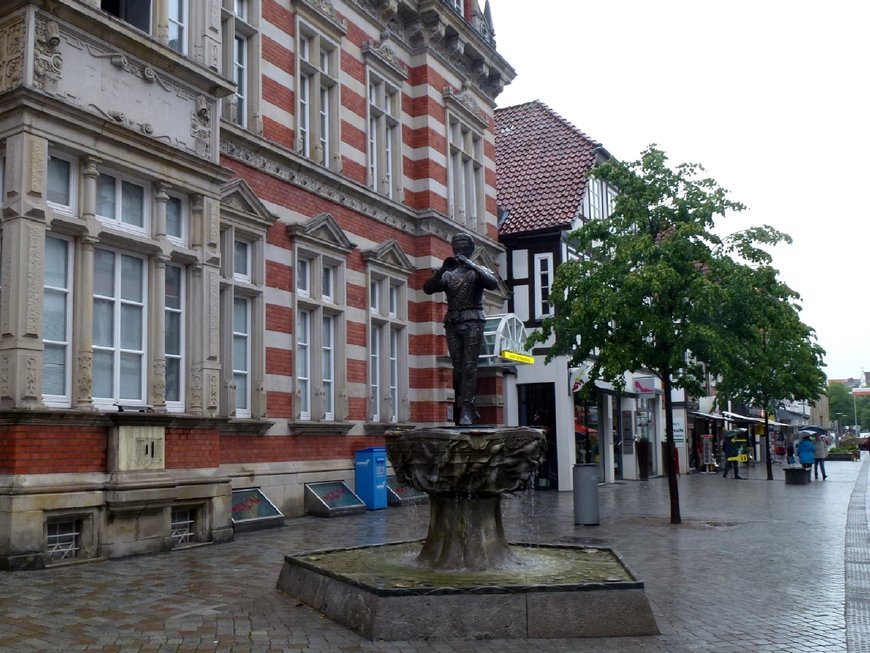
Hamelin (Hameln in German) on the Weser River hosts the darkest of the Grimm-collected tales. The Pied Piper legend traces to a documented 1284 event where 130 children vanished from the town, though the rat-plague version of the story developed in later retellings. The town lean into the legend with multiple daily reenactments during summer, running from mid-May through mid-September on the terrace at the Hochzeitshaus (Marriage House).
The Rattenfangerhaus (Piper’s House), a 1603 Weser Renaissance building, carries a frieze retelling the 1284 event. The inscription describes 130 children led out of town, a number and date that historians take seriously. Several explanations have been proposed including plague, the Children’s Crusade, or emigration to Eastern Europe during the Ostsiedlung colonisation period.
Hamelin also anchors the upper Weser valley, a scenic stretch of river running north toward Minden and Bremen. Riverboat cruises run during the summer months between Hamelin and Hannoversch Munden.
Bodenwerder and the Weser Valley Towns
Between Hamelin and Bremen the route winds along the Weser River through smaller towns tied loosely to Grimm tales. Bodenwerder, the birthplace of Baron von Munchhausen (Karl Friedrich Hieronymus), stands slightly apart from pure Grimm territory but fits the route’s broader theme of German folk narrative. The Munchhausen Museum covers the tall-tale tradition that the baron inspired, and the annual Munchhausen festival in June reenacts his fabulous stories.
Hann. Munden sits at the confluence of the Werra and Fulda rivers where they merge to form the Weser. The town preserves one of Germany’s best-maintained half-timbered old towns with over 700 historic buildings. Dr Eisenbarth, a travelling 18th-century physician remembered in the rhyme Ich bin der Doktor Eisenbarth, practised here. Open-air performances reenact his life during summer weekends.
Polle and Hofgeismar continue the Weser route with their own minor connections to tales and smaller-scale historical centres. Visitors with tight schedules pass through these towns on a single day, while slower travellers dedicate overnights to one or two.
Bremen: Route End and the Town Musicians
Bremen, a Hanseatic port city on the North Sea coast, closes the Fairy Tale Road with its Stadtmusikanten (Town Musicians) statue. The bronze sculpture by Gerhard Marcks, installed in 1953 on the western side of the Rathaus, shows the four animals (donkey, dog, cat, rooster) stacked in their traditional pose. Rubbing the donkey’s legs is said to bring good luck, and the lower brass shines from over seventy years of visitor contact.
The Bremen Marktplatz, inscribed as UNESCO World Heritage in 2004, features the Rathaus and the Roland statue from 1404, a symbol of civic liberty. The Bottcherstrasse, a narrow expressionist lane from 1926 to 1931, offers an unusual architectural contrast to the medieval core. Schnoor, the historic fisherman’s quarter, preserves narrow half-timbered houses now filled with craft shops and cafes.
Bremerhaven, 60 kilometres north at the mouth of the Weser, serves as the official route terminus for some itineraries. The Deutsches Auswandererhaus (German Emigration Center) covers the 7 million emigrants who left through Bremerhaven to the Americas between 1830 and 1974.
Driving and Rail Logistics
Most travellers cover the Fairy Tale Road by car over five to ten days. A minimum comfortable schedule allocates:
- Day 1: Frankfurt or Hanau base, Hanau half-day, drive to Steinau, overnight Marburg
- Day 2: Marburg morning, drive to Bad Wildungen and Alsfeld, overnight Kassel
- Day 3: Kassel full day (GRIMMWELT, Wilhelmshohe), overnight Kassel
- Day 4: Sababurg morning, Trendelburg afternoon, overnight at Sababurg or Trendelburg castle hotel
- Day 5: Drive to Gottingen morning, Hamelin afternoon, overnight Hamelin
- Day 6: Weser valley drive to Bodenwerder and Hann. Munden, overnight Minden
- Day 7: Drive to Bremen, explore old town and Schnoor, overnight Bremen
Extensions for deeper visits add days at GRIMMWELT (Kassel), Wilhelmshohe Park, and a half-day at Bremerhaven. A shorter five-day version skips Bodenwerder, Hann. Munden, and Minden.
Rail travel works but limits routing flexibility. Regional trains serve Hanau, Marburg, Kassel, Gottingen, Hamelin (change at Hannover), and Bremen. Intermediate towns such as Sababurg, Trendelburg, Alsfeld, and Bad Wildungen require bus connections or taxi hops from nearby rail stations. Renting a car from Frankfurt or Kassel for two to five days makes intermediate destinations accessible without the full road trip commitment.
Best Season and Festival Calendar
May through September offers the most reliable weather and the full festival season. The Brothers Grimm Festival in Hanau runs mid-May through late July. The Pied Piper open-air performances in Hamelin run mid-May through mid-September on Sunday summer days. The Munchhausen festival in Bodenwerder falls in June, and Kassel’s documenta (when the five-year cycle aligns) runs from June through September.
October brings autumn colour to the Reinhardswald beech forest around Sababurg, worth timing for visitors more interested in landscape than festival content. December adds Christmas markets in Bremen, Kassel, and Marburg, though the route’s smaller towns wind down for winter.
January and February are quiet months across the route. Some smaller museums close for winter maintenance, and festivals suspend entirely. Travellers seeking pure fairy-tale atmosphere without crowds might still find the Reinhardswald forest and Sababurg castle hotel atmospheric in winter snow, though the museum experience contracts sharply.
Combining the Route With Other Themed Drives
The Fairy Tale Road pairs well with two other German themed routes. The Romantic Road (Romantische Strasse) runs from Wurzburg to Fussen through Rothenburg and Nordlingen, offering a contrasting Bavarian medieval focus. Our Nordlingen and Dinkelsbuhl guide covers two highlights of that route.
The Wadden Sea coast sits 90 minutes north of Bremen, making an extension practical for travellers who want to add coastal walking to the literary itinerary. Our Wadden Sea mudflat walking guide covers the guided walks and the East Frisian Islands.
Berlin and the Spreewald lie further east, accessible via a four-hour drive from Bremen along the A2. The Spreewald canals guide describes the Sorbian-culture landscape 90 minutes southeast of Berlin.
Frequently Asked Questions
How long does driving the Fairy Tale Road take?
The official 600-kilometre route can be driven in two days as pure transit, but five to seven days delivers the museum visits and town exploration that make the trip worthwhile. Dedicated Grimm enthusiasts spend ten days or more including multiple Kassel days.
Do any of the towns require English-speaking guides?
Major museums (GRIMMWELT Kassel, Grimm-Haus Steinau, Bruder-Grimm-Haus Hanau) provide English labelling or audio guides. Smaller town museums often operate in German only, though staff usually handle basic English questions. A translation app handles most situations in the smaller stops.
Can you stay overnight in a fairy-tale castle?
Yes. Sababurg castle (Sleeping Beauty territory) and Trendelburg castle (Rapunzel tower) both operate as hotels, with themed rooms priced at premium rates during summer season. Book at least three months ahead for summer weekends, since both hotels are small and popular with themed-wedding bookings.
Which town is best for a single-day visit?
Kassel offers the deepest Grimm content in a walkable centre, with GRIMMWELT as the anchor and Wilhelmshohe Park as a scenic extension. Hamelin comes second for visitors prioritising the Pied Piper reenactments during summer.
Are the fairy-tale connections historically verified?
The Grimm biography connections (Hanau birthplace, Steinau childhood home, Marburg and Gottingen university work) are documented. The fairy-tale site connections (Sababurg as Sleeping Beauty castle, Bad Wildungen as Snow White origin) are folk associations and modern tourism marketing, not verified by historical sources. Enjoyment does not require taking the associations literally.
Is the route suitable for children?
Yes, especially for children aged six to twelve who already know some Grimm tales. The museums include interactive content, and the reenactments in Hamelin and Hanau draw family audiences. Castle hotels appeal to children though parents should confirm room types and rates.
How does the route compare to the Romantic Road?
The Fairy Tale Road focuses on literary heritage and fairy-tale themed attractions spread through northern Hesse and Lower Saxony. The Romantic Road runs through Bavaria and Baden-Wurttemberg with emphasis on medieval towns, castles, and alpine scenery. Each suits different travel priorities, and many travellers visit both across separate trips.
Sources and Further Reading
- Deutsche Marchenstrasse tourism association, official route documentation
- Deutsche Zentrale fur Tourismus, themed route materials
- GRIMMWELT Kassel, permanent collection catalogue
- Jack Zipes, The Brothers Grimm: From Enchanted Forests to the Modern World
- Valdimar Hafstein, The Making of Intangible Cultural Heritage (UNESCO context)
- Hero photograph: Rattenfaenger Osterstrasse Hameln by Hiroki Ogawa, Wikimedia Commons, CC BY 3.0