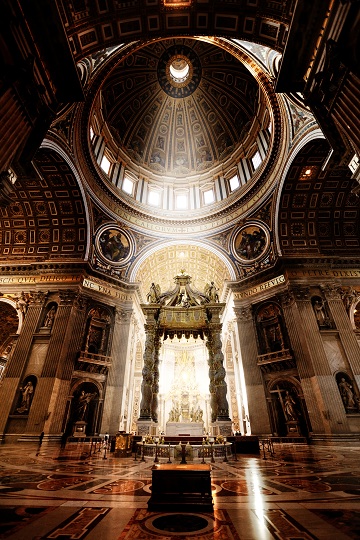
Brass lines set into the marble floor of St Peter’s mark where the world’s other great cathedrals would reach if they stood inside it, and not one of them touches the far wall. This is the largest church ever built, raised over more than a century above the grave of the apostle Peter, and the work of Bramante, Michelangelo and Bernini in turn. Entry is free, but the basilica rewards a visitor who knows where to look, so this guide walks through what makes it extraordinary and how to see it without wasting the queue. It is the centrepiece of any trip to the Vatican.
The Largest Church in the World
St Peter’s holds the title of the largest church on earth, and the building knows it. Down the centre of the nave, brass markers in the floor show the lengths of other famous cathedrals, from St Paul’s in London to Florence’s Duomo, each falling short of St Peter’s own 186-metre interior.
It was built between 1506 and 1626, and the scale only registers once you are inside, where cherubs holding holy-water basins turn out to be the size of grown adults and the basilica can hold tens of thousands of worshippers at once. Entry is free, though airport-style security funnels everyone through one queue that can run long by mid-morning, so come early.
Built Over a Tomb
The basilica exists because of a grave. The first church here was raised by the emperor Constantine in the 4th century over a spot long venerated as the burial place of Saint Peter, the apostle the Catholic Church counts as its first pope.
By 1506 that thousand-year-old building was crumbling, and Pope Julius II took the radical step of demolishing it to start again. A line of the greatest architects of the age followed, Bramante, Raphael, Antonio da Sangallo, Michelangelo and finally Carlo Maderno, who added the long nave and the façade. The high altar stands directly above what is held to be Peter’s tomb, reachable on the separate Scavi tour described in our Vatican guide.
The Facade and the Papal Balcony
The wide front you cross the square to reach was built by Carlo Maderno and topped with a row of giant statues of Christ and the apostles. Its central balcony, the Loggia of the Blessings, is among the most watched places in the Catholic world, the point every camera turns to when something happens at the Vatican.
From this balcony a cardinal announces “Habemus Papam”, “we have a pope”, when a new one is elected, and from here the pope gives his Urbi et Orbi blessing at Christmas and Easter. Below it, the Swiss Guards in striped uniform stand watch at the edge of Vatican territory, and Bernini’s colonnade sweeps out into the square; both have their own story in our guides to the Swiss Guard and to things to do in Rome.
Michelangelo’s Dome
The dome that crowns the basilica was designed by Michelangelo in his seventies and finished after his death. Rising about 136 metres, it remains one of the tallest domes in the world and the model for capitol buildings across the globe.
You can climb it, and you should. A lift carries you to the roof terrace, from where 320 steps spiral up between the dome’s double shell, the walls leaning in as you go, to the lantern and a sweeping view down Bernini’s square and across Rome. Around the inner base of the dome runs a Latin inscription in letters nearly two metres tall, naming Peter as the rock on which the church is built.
Bernini’s Baldachin and the Altar
Under the dome stands the baldachin, the 29-metre bronze canopy of twisting columns that Gian Lorenzo Bernini raised over the papal altar in the 1620s and 1630s. It marks the tomb below and gives the vast space a human focus.
The bronze for it was famously stripped from the portico of the ancient Pantheon, prompting the Roman jibe “what the barbarians did not do, the Barberini did”, a dig at the Barberini pope who ordered it. Beyond the altar, Bernini also designed the golden Cathedra Petri, the throne reliquary lit by a window of the dove of the Holy Spirit.
The Pieta
Just inside the entrance, on the right, is Michelangelo’s Pieta, the marble of the Virgin Mary holding the dead Christ that he carved around 1499, still in his early twenties. It is the only work he ever signed: he cut his name into the sash across Mary’s chest after overhearing it credited to another sculptor.
It has stood behind bulletproof glass since 1972, when a man with a hammer climbed over the rail and struck it more than a dozen times before being pulled away, damaging the face and arm. The careful repair is invisible from the rail today.
The Bronze St Peter and the Holy Door
Two more details reward a closer look near the entrance.
- The bronze St Peter: a seated 13th-century statue whose right foot has been worn smooth and shiny by the touch and kisses of pilgrims over seven centuries.
- The Holy Door: the rightmost of the basilica’s doors, sealed with brick on the inside and opened only for a Jubilee every 25 years; the cycle and the latest opening are covered in our Vatican guide.
Below the Floor: the Grottoes
Beneath the basilica lie the Vatican Grottoes, a low crypt of chapels holding the tombs of dozens of popes, from medieval figures to recent ones such as John Paul II, whose grave draws a quiet, constant line of visitors paying their respects. Entry to the grottoes is free and usually lies on the route out of the basilica.
Deeper still, below the grottoes, runs the Roman necropolis that the Scavi tour visits, ending at the bones the Church identifies as Peter’s. That tour is booked separately and well in advance through the Vatican’s Excavations Office.
Climbing the Dome and Visiting
A little planning makes the visit smooth.
- Free entry: the basilica itself costs nothing; you pay only to climb the dome and for the audio guide.
- Dress code: shoulders and knees must be covered for everyone, and the guards turn away shorts and bare shoulders at the door.
- Dome ticket: choose the lift plus 320 steps, or all 551 steps on foot for less money; the last stretch is narrow and steep either way.
- Timing: arrive at opening or in the late afternoon, and remember the Sistine Chapel’s group shortcut can drop you straight in from the Vatican Museums.
Frequently Asked Questions
Is it free to enter St Peter’s Basilica?
Yes. Entry to the basilica and the grottoes below is free. You pay only to climb the dome, hire an audio guide, or join the separate Scavi tour of the necropolis. Expect a security queue, which is longest in the middle of the day.
How do you climb the dome of St Peter’s?
Buy a dome ticket near the entrance. The cheaper option is 551 steps on foot; for a little more, a lift takes you to the roof terrace and you climb the final 320 steps between the dome’s shells. Both end at the lantern with a view over Rome.
Where is the Pieta in St Peter’s?
In the first chapel on the right as you enter, behind protective glass since the 1972 attack on it. It is busy, so move to the side rail rather than straight in front for a clearer view.
What is the dress code?
Shoulders and knees must be covered for both men and women. Sleeveless tops, shorts and short skirts are refused at the entrance, so carry a scarf or light layer in summer.
Is St Peter actually buried under the basilica?
The Church holds that the apostle Peter is buried directly beneath the high altar, where Roman excavations found an ancient grave and bones. You can see the necropolis on the booked Scavi tour, and the high altar and baldachin mark the spot above it.
How long do you need at St Peter’s?
About an hour to an hour and a half for the basilica and the grottoes at a steady pace. Add an hour for the dome climb, and more if you are also doing the square, the treasury or the Scavi tour, which together make it a half-day.
Sources and Further Reading
- Fabbrica di San Pietro – the office that runs and maintains the basilica
- Vatican City State, St Peter’s Basilica – official visitor information
- The Holy See – the Vatican’s portal and the basilica’s history
- UNESCO, Vatican City – the World Heritage listing