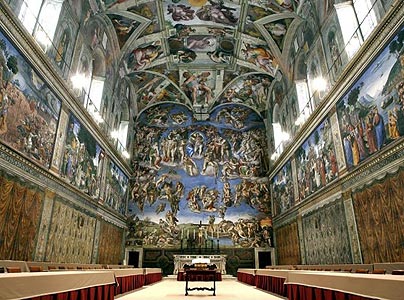
 Hundreds of visitors at a time crane their necks under Michelangelo’s ceiling while guards hiss for quiet, but the Sistine Chapel is far more than its frescoes. It is the room where popes are elected, built to the proportions the Bible gives for the Temple of Solomon, and painted by the greatest hands of the Renaissance over half a century. Knowing what you are looking at, and how the room is used, turns ten rushed minutes into the highlight of a trip to the Vatican.
A Chapel Built to Solomon’s Measure
The chapel takes its name from Pope Sixtus IV, who had it rebuilt between 1473 and 1481, “Sistine” coming from the Italian Sisto. It is the Pope’s own chapel, the setting for the most solemn services of the church year.
Its plain brick outside hides a deliberate design. The room measures about 40.9 metres long by 13.4 metres wide, the proportions the Old Testament gives for the Temple of Solomon, a link the builders intended to be read as the new church succeeding the old.
It is still a working chapel, and its music is as old as its art. The Sistine Chapel Choir, the Pope’s own choir, traces its roots back centuries and for generations was famous for its castrato singers, the last of whom recorded his voice in the early 1900s.
The Walls Came Before Michelangelo
Visitors look up so fast they miss that the side walls are masterpieces in their own right, painted a generation before the ceiling. In 1481 and 1482 Sixtus IV brought the finest painters in Italy to Rome to fresco them with parallel lives of Moses and Christ.
- Botticelli: three scenes including the Trials of Moses.
- Perugino: the Delivery of the Keys to St Peter, the theological heart of the room.
- Ghirlandaio, Rosselli and Signorelli: the remaining panels, a roll-call of the early Renaissance.
The two cycles were designed to answer each other across the room, the life of Moses on one wall set against the life of Christ on the other, the old law fulfilled by the new. When Michelangelo later painted the Last Judgment, he had to destroy two of these early frescoes and an altarpiece of the Assumption to clear the wall, a loss the church accepted for his sake.
Michelangelo’s Ceiling
In 1508 Pope Julius II pressed Michelangelo, who thought of himself as a sculptor and resisted the job, to paint the vault. He worked for four years, standing on a scaffold of his own design rather than lying on his back as legend claims, and finished in 1512.
He did not paint on a blank vault. The earlier ceiling was a simple blue sky scattered with golden stars, and Michelangelo covered it entirely. In its place came nine scenes from Genesis, running from the Separation of Light to the drunkenness of Noah, framed by prophets, classical sibyls and the muscular nude youths known as the ignudi.
The most famous panel, the Creation of Adam, shows God and the first man reaching toward each other with fingers a hair apart; some scholars argue the cloak billowing around God is shaped like a cross-section of the human brain. Over the altar looms the prophet Jonah, leaning back as if the whole vault curves around him. Stand near the altar end and look back to read the scenes in their proper order.
The Last Judgment
Decades later, between 1536 and 1541, Michelangelo returned under Pope Paul III to cover the altar wall with the Last Judgment, a storm of more than 300 figures swirling around Christ as judge.
It carries two famous quarrels in paint. Michelangelo painted the papal master of ceremonies, Biagio da Cesena, who had called the nudes obscene, as Minos in hell with donkey ears and a serpent. After the Council of Trent objected to the nakedness, the painter Daniele da Volterra was hired to add loincloths and drapery, earning him the lasting nickname “il Braghettone”, the breeches-maker.
The artist hid himself in it too. The flayed human skin held by Saint Bartholomew, just below and right of Christ, carries a sagging, distorted self-portrait of Michelangelo, a bleak signature buried in his own masterpiece.
The Restoration That Changed Everything
Between 1980 and 1994 the frescoes were cleaned in a project funded by a Japanese television company in exchange for filming rights. Centuries of soot and candle smoke came off to reveal colours so bright that many were stunned, and a long argument followed over whether the restorers had also stripped away shadows Michelangelo added by hand. The vivid palette you see today is the result.
The cleaning also exposed his method, the seams of each day’s fresh plaster showing how quickly he worked, and it recast a man long thought of as a sculptor who happened to paint into one of the boldest colourists of the age.
Where Popes Are Made: the Conclave
The chapel’s other role is political. When a pope dies or resigns, the cardinals process in, the master of ceremonies calls “extra omnes”, everyone out, and the doors are sealed for the conclave that elects the next pope. The word itself means “with a key”, from the medieval practice of locking the cardinals away until they decided, a rule imposed in the 13th century after one election dragged on for almost three years.
A stove is set up inside to burn the ballots after each vote, and the smoke from a chimney tells the crowd in the square the result: black smoke for no decision, white smoke for a new pope, with chemicals now added to make the colour unmistakable. The cardinals sleep nearby in the Casa Santa Marta guesthouse and the room is swept for listening devices. The most recent conclave met here in 2025.
Seeing the Sistine Chapel
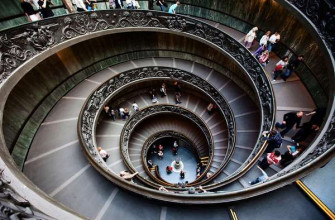
The chapel is not a separate ticket. It is the climax of the one-way route through the Vatican Museums, so you reach it only after walking the galleries, which take three to four hours if you linger.
- No photos: photography and video are forbidden inside, and guards enforce it.
- Silenzio: talking is discouraged out of respect; the guards call for quiet when the noise rises.
- Book ahead: timed museum tickets sell out in high season, and the chapel is busiest late morning.
- The shortcut: a side door at the front, usually reserved for guided groups, leads straight into St Peter’s Basilica, saving the long walk back.
- Bring a small pair of binoculars: the ceiling is high, and a little magnification, or a phone’s zoom used without flash, brings its detail within reach from the floor.
Frequently Asked Questions
Can you take photos in the Sistine Chapel?
No. Photography and video are banned inside, partly out of reverence and partly a legacy of the restoration’s filming rights, and guards stop anyone who tries. You can photograph freely in the rest of the Vatican Museums.
Is the Sistine Chapel a separate visit from the museums?
No, it is the final room of the Vatican Museums and is included in that ticket. You cannot visit it on its own, and you reach it only after the one-way gallery route.
Why does the Last Judgment have painted loincloths?
After the Council of Trent condemned the nudity in the 1560s, the painter Daniele da Volterra was commissioned to add drapery over the most exposed figures, which earned him the nickname “il Braghettone”, the breeches-maker. Some were removed in the later restoration.
How long do you need in the chapel?
Most people spend 15 to 20 minutes, though it deserves longer. Stand to one side, look at the altar wall and the ceiling in turn, and let the first wave of a tour group pass to get a clearer view.
What happens during a conclave?
The cardinals are sealed inside to elect a new pope, voting in secret and burning the ballots after each round. Black smoke from the chimney means no decision, white smoke means a pope has been chosen. The chapel is closed to visitors during the process.
Who painted the Sistine Chapel?
Several hands. The side walls were frescoed in the 1480s by Botticelli, Perugino, Ghirlandaio and others, while Michelangelo painted the ceiling between 1508 and 1512 and the Last Judgment on the altar wall from 1536 to 1541. The chapel is named not after any painter but after Pope Sixtus IV, who had it built.
Sources and Further Reading
- Vatican Museums, the Sistine Chapel – the official account of the frescoes and access
- The Holy See – the Vatican’s portal, including the chapel’s liturgical role
- UNESCO, Vatican City – the World Heritage listing covering the chapel
- Vatican Museums restoration – the cleaning of the frescoes and its findings