
Bali at a glance: how the regions actually fit together
Bali is small (roughly 95 km west to east, 75 km north to south) but the roads do not match the map. A 35 km hop from Ubud down to Seminyak takes 90 minutes on a quiet day and two and a half hours on a Saturday. Picking the right area is less about scenery and more about how much time you want to spend in a car.
The seven areas in this guide cover 95% of first-visit demand: Ubud (inland, jungle, culture), Seminyak (beach, dining, mid-luxe), Canggu (surf, hipster cafes, digital-nomad density), Kuta and Legian (cheap, party, airport-close), Nusa Dua (gated resort), Uluwatu (clifftop, surf, retreats), and Sanur (calmer beach, ferry to Lombok and the Nusa islands). The single rule that explains most of Bali: the south-west coast (Canggu through Uluwatu) gets dry-season swell from April to October, while the south-east (Sanur, Nusa Dua, Keramas) gets wet-season swell from November to March. Where you should stay depends in part on which season you booked.
For an inland-Bali primer before you book, see Ubud: a different side of Bali.
Ubud (inland, jungle, yoga, culture)
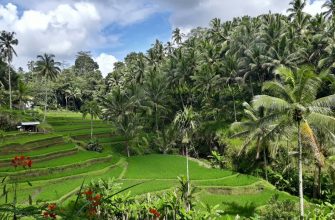
Ubud sits 25 km inland from the south coast, in the foothills, surrounded by rice terraces and small villages. The town has been the cultural capital of Bali for a hundred years and the wellness capital for the last twenty. If you want jungle mornings, temple ceremonies, and yoga rather than sand, this is the area.
What works in Ubud: the Tegalalang and Jatiluwih rice terraces (open 8 a.m. to 6 p.m., entry IDR 25,000 to 50,000), the Sacred Monkey Forest Sanctuary (entry IDR 80,000), the Ubud Royal Palace and night dance performances at IDR 150,000, and serious yoga and ayurveda centres clustered around Penestanan and Nyuh Kuning. The Campuhan Ridge walk at sunrise is free and the kind of thing people remember twenty years later.
What does not work: the centre of Ubud has bad traffic from 9 a.m. to 7 p.m. and worse parking. Stay 1 to 3 km out (Penestanan, Nyuh Kuning, Sayan) for the same character with quieter mornings. Thai-style yoga bodywork shops are common; pure Balinese bodywork is the local equivalent and runs IDR 150,000 to 350,000 per hour.
Pick Ubud if: you have at least 5 days in Bali and want a 3-night inland leg in the middle of the trip; you came for yoga retreats, hiking, or temples rather than beach.
Seminyak (beach club, dining, mid-luxe)
Seminyak runs along the south-west coast about 15 minutes north of Kuta and 10 minutes south of Canggu. The strip from Petitenget to Oberoi is the densest cluster of upmarket restaurants, beach clubs (Potato Head, Ku De Ta, Mrs Sippy), and four-star hotels on the island. Walking is realistic for the central blocks; for anything beyond two intersections you call a Grab or Gojek.
What works: dinner culture is the strongest in Bali (a similar register to Bangkok‘s Thonglor and Sukhumvit dining streets), beach sunset is the most accessible (the sand drops straight from the road), and hotels in the mid-luxe band (USD 90 to 220 per night) cluster here in greater density than anywhere else. The dry-season surf at Seminyak Beach itself is gentle enough for first-time surfers, with several lesson schools at the Petitenget end.
What does not work: prices are 30-50% higher than Canggu for similar quality, traffic on Jalan Kayu Aya at dinner time is genuinely bad, and the area has lost its edge to Canggu in the last five years.
Pick Seminyak if: this is your first or only beach leg, you want to walk to dinner from your hotel, and you value reliable Western-style food alongside Indonesian.
Canggu (surf, cafes, digital nomad density)
Canggu is what Seminyak was a decade ago, with much more digital-nomad infrastructure. The main zones are Berawa (newest, most polished), Batu Bolong (surf-school core), and Pererenan (the next wave, quieter, lower density). All three sit on a 4 km coastal strip with the same beach.
What works: Echo Beach and Batu Bolong have beginner-friendly waves through dry season (April to October), broadly comparable to the Atlantic beach-break season covered in our surfing in Spain guide. The cafe culture is the densest on the island (Crate, Milk and Madu, Penny Lane), co-working spaces (Outpost, Tropical Nomad, BWork) charge USD 150 to 250 per month for hot desks, and prices for accommodation run 25-40% below Seminyak.
What does not work: the road network was built for a fishing village. Pererenan to Berawa is 3 km but the only routes are single-lane shortcuts that turn into 30-minute crawls between 5 p.m. and 8 p.m. The beaches face direct ocean current; rip tides are real and lifeguards are not present on every section.
Pick Canggu if: you want surf lessons or daily surfing, you plan to stay 7+ days and need the WiFi and cafe infrastructure for remote work, or you have done Bali before and want a different register from Seminyak.
Kuta and Legian (budget, party, airport-close)
Kuta sits two minutes from Ngurah Rai International Airport (DPS) and was Bali’s first mass-tourism beach in the 1970s. The reputation is mixed for good reasons: cheap eats, hostels under USD 12 a night, beginner surf schools at Kuta Beach, and a heavy late-night bar strip that polarises travellers. Legian, the next area north, runs slightly quieter and family-friendlier with the same beach access.
What works: the only sensible airport-side overnight if your flight lands after 9 p.m. and the next morning you transfer onward, plus the cheapest tier of accommodation on the south coast. Beginner surf is genuinely good; the schools are organised.
What does not work: noise after midnight in central Kuta, hawking pressure on Kuta Beach Road, and a tourist-trap density that will not feel like the Bali you saw in photographs.
Pick Kuta or Legian if: you arrive late, leave early, and need one cheap night near DPS; or you are 19-23 and the bar district is the trip. Travellers comparing it with the South-East Asian party circuit will recognise the register from Thailand’s party beaches; Kuta is the Bali equivalent of Haad Rin or Patong, with the same trade-offs.
Nusa Dua (resort, family, gated)
Nusa Dua is a 25-minute drive south of the airport on a peninsula that the Indonesian government zoned as a high-end resort enclave in the 1970s. It is gated, manicured, and contains some of the largest five-star resorts on the island (St Regis, Mulia, Ritz-Carlton, Grand Hyatt). The beaches inside the enclave are calm with reef breaks far offshore, which makes the swimming safe for children.
What works: families with kids under 10 (kids’ clubs, calm sea, gated security), travellers who want the resort to be the destination rather than the base, and people in shoulder season looking at 30-50% promotional rates on names that hold their value.
What does not work: leaving the enclave is a 30-45 minute round trip even for short errands, the food inside the resort is priced two to three times the open Bali rate, and you will not see much of what makes Bali distinctive without a daily car.
Pick Nusa Dua if: this is a one-week beach holiday with kids and you do not plan to leave the resort more than once.
Uluwatu (cliffs, surf, retreats)
Uluwatu sits at the southern tip of Bali on the Bukit peninsula, 30 minutes south of the airport. The coast is cliff rather than beach, with steep paths down to small surf-break coves at Padang Padang, Bingin, Dreamland, and Suluban. The famous Uluwatu Temple (Pura Luhur Uluwatu, entry IDR 50,000) sits on a 70-metre cliff with a sunset Kecak fire dance at 6 p.m. that earns its reputation; for comparison, Thailand’s Buddhist temples mostly sit inland and run a different cultural register.
What works: the most dramatic landscape on the island, the densest yoga and surf retreats in any one zone (Single Fin, Suka Espresso, Drifter), and clifftop hotels with infinity pools that deliver the postcard. Surf is consistent during dry season but is reef-break and not for novices.
What does not work: walking is mostly impossible (one cliffside road and steep beach paths), prices for clifftop hotels run USD 220 to 800 per night, and the area has limited groceries or pharmacies.
Pick Uluwatu if: you surf at intermediate level or higher, you want a yoga retreat with cliff views, or you are willing to spend more for the visual register.
Sanur (quieter family beach, ferry to Lombok and the Nusas)
Sanur sits on the south-east coast and works as the calm counterpart to Seminyak. The 6 km beach promenade runs north to south with a boardwalk you can actually walk for an hour without traffic. Sanur is the main port for fast boats to the adjacent island chains, including Nusa Lembongan, Nusa Penida, and Lombok via the new Sanur Port terminal opened in 2022. Travellers extending the trip to Vietnam or other South-East Asian neighbours will often start the wider regional leg from here.
What works: families with older parents who do not want to fight traffic, travellers who want a beach base for day trips to Ubud (45 minutes inland) and Nusa Penida (35 minutes by fast boat), and an older crowd that finds Seminyak loud. Reef-protected swimming, which is rare on the south-west.
What does not work: the dining scene is conservative compared with Seminyak or Canggu and the nightlife is essentially absent past 11 p.m.
Pick Sanur if: you want a calmer beach with multi-generational appeal, or you plan to add Nusa Lembongan or Lombok to the trip.
Hotel tiers and what each price band buys
Approximate per-night rates in 2026 high season (July-August, December-January) for two adults, breakfast included where standard:
- Hostel and homestay (USD 12 to 35): private rooms in Kuta, Canggu, Ubud Penestanan; shared kitchen, scooter parking, family-run feel.
- Mid (USD 60 to 140): three-star boutiques in Seminyak, Canggu Berawa, Ubud Nyuh Kuning; pool, breakfast, walkable.
- Mid-luxe (USD 160 to 320): four-star resort or boutique villa in Seminyak, Sanur, central Ubud, Uluwatu mid-tier (Drifter, Suarga, Mu).
- Luxury (USD 380 to 900+): Four Seasons (Sayan and Jimbaran), Capella Ubud, Mandapa, Bulgari Uluwatu, Alila Manggis, St Regis Nusa Dua, COMO Uma Ubud.
Off-season (April-May, October-November) rates drop 25-45% across all tiers. Booking 3 to 5 months out for high season is normal; 8+ months for villa-style luxury. The same booking-window logic applies in other capital-grade destinations covered in our where to stay in Paris guide.
Getting around: scooter, Grab, or hired car?
Three modes, each with a use case.
Scooters are the fastest way to move around within an area. Daily rental runs USD 5 to 15, monthly USD 60 to 180 depending on model and area (Canggu, Seminyak, and Uluwatu price 20-30% above Ubud). Helmets are legally required for both rider and passenger, and police checkpoints in 2025-2026 routinely fine tourists IDR 250,000 to 500,000 for missing helmets, no licence, or no International Driving Permit. Yes, you need an IDP. The “I rented and nobody asked” stories are 2017 stories. Bring an IDP from your home country before you fly.
The roads that punish novices: the Uluwatu clifftop loop (sharp hairpins and limited shoulder), the Canggu shortcuts north of Berawa (broken pavement, blind corners), and the central-Ubud market streets at any time of day. If you have ridden a scooter for fewer than ten total hours in your life, do not start in any of these three zones.
Grab and Gojek are the local Uber-equivalents and run reliably across the south coast. A Grab car from Seminyak to Ubud costs IDR 220,000 to 320,000; from DPS airport to Canggu IDR 180,000 to 240,000. Driver wait times are 3-8 minutes in dense areas. Some Ubud zones still have a “no Grab driver” tradition enforced by the local taxi co-op; in those zones you walk to a main road or use a hotel transfer.
Hired car with driver runs USD 45 to 65 per day (8 hours, fuel included) and is the right choice for any day with three or more stops outside your home area. Most hotels arrange this through a partner driver; rates are similar to direct hire and you get accountability if a stop runs long.
Bali Tourist Levy: every foreign visitor pays IDR 150,000 (about USD 10) once per entry. Pay online before flying at lovebali.baliprov.go.id (the only government-authorised domain, ending in .go.id) for a QR voucher, or at the dedicated counters at DPS airport on arrival. The fee is per person, regardless of age. The standard Phuket-style water-sports fees do not exist in Bali; the levy is the only mandatory tourist charge.
Common questions
Where should I stay if I only have one base for a week?
Seminyak for first-timers who want a beach, dining, and walking convenience; Ubud for inland, yoga, and culture; Canggu for surf and remote work. If you do not know which fits, Seminyak is the safest first choice.
Is the Bali Tourist Levy mandatory?
Yes. Every foreign visitor pays IDR 150,000 once per entry. The only official payment portal is lovebali.baliprov.go.id (.go.id is the Indonesian government domain). Counters also exist at DPS airport on arrival.
Do I need a Visa on Arrival in advance?
No. The 30-day VoA can be paid on landing for USD 35 with card or cash. It can be extended once for another 30 days at the immigration office in Jimbaran or Denpasar for around IDR 500,000.
Can I rent a scooter without a licence?
Legally, no. The IDP and a valid motorcycle licence from your home country are both required. Police checkpoints in 2025-2026 enforce this; fines run IDR 250,000 to 500,000 plus possible bike confiscation. SNI helmets are mandatory for rider and passenger.
Is Ubud worth it on a 5-day trip?
Yes if you want any inland register (yoga, jungle, temples). 2 to 3 nights is enough; pair with 2 to 3 nights at a south-coast beach base (Seminyak or Canggu).
Should I split my stay or pick one base?
Split if you have 7+ nights. The most common split: 3 nights Ubud + 4 nights Seminyak or Canggu. Single base only works for short trips of 4 nights or fewer.
Sources
Operational facts cross-checked against the agencies and operators below. Prices and entry rules change; the live links carry the current numbers.
- LoveBali (Provincial Government of Bali) – the only official portal for the IDR 150,000 Tourist Levy and current 2026 payment process.
- Wonderful Indonesia (Ministry of Tourism) – official destination authority, current visa-on-arrival rules, and entry requirements.
- Indonesian Immigration (Direktorat Jenderal Imigrasi) – VoA fee structure, B211A visit visa rules, extension procedures and overstay penalties.
- Ngurah Rai International Airport (DPS) – airport transfer logistics, Tourist Levy counter location, and arrivals flow guidance.
- Ubud Tourism Information – Tegalalang, Jatiluwih, Monkey Forest entry fees and ceremony dates.
- Bali (Wikipedia) – geographic and demographic overview, region boundaries, and historical context for the resort enclave designations.
- Lonely Planet Bali – independent destination overview and area-by-area framing for cross-reference.