The biggest argument in biryani is settled before a single grain is cooked. It is the choice between kacchi and pakki, raw meat or cooked, and Hyderabad sits firmly on the kacchi side. Raw marinated mutton or chicken goes into the pot under a layer of half-cooked rice, the lid is sealed with dough, and the whole thing is trusted to slow steam until both are done together. This Hyderabadi biryani recipe follows that kacchi dum method, the harder and older way, and explains the parts that decide success: the marinade, the rice cooked to exactly the right point, and a seal you never break. The dish carries a Nizam legend, a lost legal case, and three regional rivals worth knowing before you cook.
Kacchi and pakki: the two architectures of biryani
Every dum biryani is built one of two ways, and the difference runs deeper than technique.
- Kacchi biryani, the Hyderabadi way. Raw meat is marinated overnight in yogurt and spice, layered raw under parboiled rice, and the sealed pot is set on low heat so the meat juices cook up into the rice. Everything finishes together. Timing is unforgiving: too little and the meat is raw, too much and the rice is mush.
- Pakki biryani, the Lucknow way. The meat is cooked in its gravy first, then layered with parboiled rice for a short final dum. Safer and more controlled, with each part cooked to its own doneness.
Hyderabadi biryani is kacchi by definition. That single choice explains why it is harder to get right at home and why a Hyderabadi cook judges a biryani on whether the rice stayed separate while the raw meat cooked through. Get the kacchi balance and you have the real thing. Reach for pre-cooked meat and you have made a different, Lucknowi-style dish.
From the Nizam’s kitchen, and the tag it never got
Local legend hands the dish to the kitchen of the first Nizam, Asaf Jah I, in the mid-1700s, supposedly invented for an army on a hunt. The cleaner history is that biryani grew from the pilaf the Arab traders and Mughal courts brought to the subcontinent, and that Hyderabad blended that Persian-Mughlai inheritance with its own Deccani spicing. The result became the symbol of the city.
What it did not become is a protected name. In 2009 the Deccani Biryani Makers’ Association applied for a Geographical Indication tag for Hyderabadi kacchi gosht biryani. After a nine-year fight, the GI registry refused it, ruling that the applicants could not prove the dish’s historic origin with documents. So Hyderabadi biryani, for all its fame, holds no GI, even though Hyderabadi Haleem won one back in 2010. The lesson for a cook is quiet but real: there is no single official recipe to defend, which is exactly why the method, not a certificate, is what carries the tradition.
The sealed-pot technique itself has a famous story attached, from Awadh rather than Hyderabad. When a long famine struck Lucknow in the 1780s, the Nawab Asaf-ud-Daula put thousands to work building the great Bara Imambara, and to feed them around the clock cooks kept enormous pots of rice and meat sealed and simmering on low fires. The tale runs that the aroma escaping those pots was so good the nobles asked for the same dish, and dum pukht, cooking in trapped steam, passed from relief kitchen to royal table. Whether or not the story is exact, it captures what dum does: long, slow, sealed cooking that concentrates flavour with almost no liquid lost.
The four great biryanis of India
Hyderabadi is one of four regional schools, and treating them as one dish is the mistake that flattens the whole subject.
| Biryani | Method and rice | What sets it apart |
|---|---|---|
| Hyderabadi | Kacchi, aged basmati | Spicy, raw-meat dum, served with mirchi ka salan |
| Lucknowi (Awadhi) | Pakki, basmati | Subtle, Nawabi, gentle saffron and cardamom over heat |
| Kolkata | Pakki, basmati | Potato and boiled egg, mild, lightly sweet |
| Malabar (Thalassery) | Short-grain kaima rice | Coconut, fennel, curry leaf, coastal Kerala |
The Kolkata version hides a small history lesson. When the British exiled the Nawab of Awadh, Wajid Ali Shah, to Metiabruz near Calcutta in the 1850s, his kitchen came with him. Cooking on a reduced budget, the cooks stretched the meat with potato, and the potato stayed, so a Kolkata biryani still arrives with a soft potato and a boiled egg that no Hyderabadi pot would contain. Malabar goes further from the template, dropping basmati altogether for the short, aromatic kaima rice of Kerala and leaning on coconut and the spice-trade coast. Four kitchens, four answers, one word.
Ingredients for Hyderabadi kacchi biryani
This serves four to six. The rice is not a place to economise: aged basmati is the difference between separate grains and a sticky mass.
| Ingredient | Amount | Why it matters |
|---|---|---|
| Aged basmati rice (1121 if you can) | 500 g | Long grains that stay separate |
| Chicken or mutton, bone-in | 750 g | Bone adds flavour to the steam |
| Thick yogurt | 1 cup | Tenderises the raw meat overnight |
| Fried onions (birista) | 1.5 cups | The backbone, sweet and deep |
| Saffron in warm milk | a pinch in 3 tbsp | Colour and aroma in patches |
| Kewra and rose water | a few drops each | The signature Hyderabadi perfume |
| Ghee, mint, coriander, whole spices | to layer | Aroma between the layers |
Birista is worth making yourself. Thinly sliced onions fried slow to a deep brown, drained crisp, carry a sweetness that store-bought fried onions rarely match, and they are the flavour most home cooks underrate. Fry a large batch when you cook, since they keep for a week and go into the marinade, between the layers and over the top.
How to make Hyderabadi dum biryani
Marinate the meat
Mix the meat with thick yogurt, ginger-garlic paste, red chili, garam masala, half the birista, mint, coriander, a squeeze of lemon and salt. Leave it at least six hours, overnight for mutton. This long marinade is what lets raw meat cook tender in the sealed pot, so it is not a step to shorten.
Parboil the rice, and stop at 70 percent
Soak the basmati thirty minutes, then boil it in well-salted water with whole spices until it is only 70 to 75 percent done, around five to seven minutes. A grain should bend and still snap at the core. There is a quiet divide here over which rice to buy: aged raw basmati gives the best aroma and the longest grain but breaks easily if you misjudge the boil, while many commercial biryani kitchens reach for sella, parboiled basmati, which is far more forgiving and stays separate even when slightly overcooked, at some cost to fragrance. A nervous home cook is often better served by sella; a confident one chasing the finest aroma uses aged raw basmati. Either way the parboil is the hinge of the whole dish. Rice cooked fully now turns to mush under the dum; rice left too hard never softens. Drain it the moment it reaches that half-done point.
Layer and seal the dum
- Spread the marinated raw meat across the base of a heavy pot with a little ghee.
- Pile the drained rice over it. Scatter the rest of the birista, mint and coriander, and drizzle the saffron milk, kewra and rose water in patches, not all over.
- Make a stiff dough rope from flour and water, press it around the rim, and clamp the lid down to seal the steam in.
- Cook on high for the first few minutes to build steam, then set the pot on a flat tawa over the lowest heat for forty to forty-five minutes.
- Rest it ten minutes off the heat before you break the seal. Open it only once, at the table.
The sealed pot is the entire principle of dum. The trapped steam cooks the raw meat and finishes the rice at once, and every time you lift the lid to check, you let that steam escape and lose the thing you are cooking with.
The trick that lets raw meat cook in rice
The obvious worry with kacchi biryani is timing: how does raw meat cook through in the same minutes that finish delicate rice without one ruining the other. The traditional answer is a tenderiser worked into the marinade. Hyderabadi kitchens use a spoon of raw papaya paste, whose enzymes break down the meat fibres overnight so the flesh turns tender in the sealed pot. Tougher mutton sometimes gets kachri, a dried wild melon powder with the same effect. Without one of these, only young chicken cooks reliably by the kacchi route, which is why home cooks who skip the tenderiser and use mutton often pull out a pot of perfect rice over chewy meat.
The aroma has its own trick. Many cooks tie the whole spices into a small muslin potli, a spice bag, and steep it in the rice water rather than scattering loose spices that get stuck between the teeth. Restaurants go a step further with a drop of edible ittar, a traditional perfume, sealed in at the end of the dum. A little goes a long way, and too much is the line between fragrant and soapy.
The mistakes that ruin a home biryani
- Mushy rice. The top complaint, and always the same cause: rice boiled past 70 percent before the dum. Stop it early and let the steam finish it.
- Fresh rice instead of aged. New-crop basmati holds more moisture, breaks and clumps. Aged rice, a year or two old, stays long and separate.
- Opening the lid. Every peek vents the steam that is doing the cooking. Seal it and trust it.
- Store-bought fried onions. Thin, often stale, and missing the slow-fried sweetness. Make birista fresh.
- Skipping the kewra. The pandanus and rose perfume is what makes a biryani smell Hyderabadi. A few drops, no more, or it turns soapy.
- Wrong meat-to-rice balance. Too much rice and the pot tastes bland, too much meat and it stews. Aim for roughly three parts rice to two of meat by volume.
- Under-salted rice water. A complaint that runs through reader reports on the big recipe sites is a biryani that tastes bland on top and seasoned only at the bottom. The fix the authors give is blunt: the water you parboil the rice in must taste properly salty, since that is the only salt the rice itself gets.
- Greek yogurt and a thin pot. The other recurring reader failure is a scorched base. The causes named are using thick Greek yogurt in place of regular whisked curd, a thin-bottomed pan, and too long on a high flame. A heavy pot or a tawa set under it as a heat diffuser, with more time on low and less on high, stops the burn.
Paradise and the biryani houses of Hyderabad
The commercial template most people picture comes from Paradise, which started in 1953 as a small canteen in Secunderabad under Ghulam Hussain and grew, under the Hemmati family, into a chain of dozens of outlets. Its consistent kacchi biryani set the bar that other houses are judged against. Locals will send you instead to Bawarchi for a heavier, spicier plate, to Shadab near the Charminar for old-city flavour, or to Pista House, better known for its GI-tagged haleem in Ramadan but a serious biryani kitchen too. Across these names the same arguments repeat, which raita, how much salan, kacchi or not, and that argument is half the pleasure of the dish.
What to serve with Hyderabadi biryani
A Hyderabadi plate is a set, not a single dish, and the sides are not optional decoration.
- Mirchi ka salan, a peanut, sesame and tamarind gravy with green chilies, the classic Hyderabadi partner.
- Raita, cooling yogurt with onion, cucumber and a little cumin, to balance the spice.
- Salad and lemon, raw onion, cucumber and a wedge of lemon to cut the richness.
Biryani is a one-pot meal, so it rarely needs a gravy beside it the way naan needs dal makhani or butter chicken. The salan and raita are there to season and cool, not to fill the plate.
For how the dish sits among the wider Mughlai table, alongside tandoori chicken and the makhani gravies, the guide to Indian cuisine and spices maps the spread.
Frequently asked questions
What is the difference between kacchi and pakki biryani?
In kacchi biryani the meat is layered raw and cooks in the sealed pot with the rice. In pakki biryani the meat is cooked first, then layered for a short final steam. Hyderabadi biryani is kacchi; Lucknowi is pakki.
Does Hyderabadi biryani have a GI tag?
No. An application was filed in 2009 but the Geographical Indication registry refused it, ruling the historic origin was not proven. Hyderabadi Haleem holds a GI from 2010, but the biryani does not.
Why does my biryani rice turn mushy?
Almost always because the rice was boiled too far before layering. Parboil only to 70 to 75 percent, when the grain bends but still snaps, then let the dum finish it. Using fresh rather than aged basmati makes it worse.
Can I make Hyderabadi biryani without a sealed pot?
You need to trap the steam somehow. A tight lid weighed down, or foil under the lid, stands in for the dough seal. What you cannot do is leave it loose or keep opening it, since the steam is what cooks the dish.
What rice is best for Hyderabadi biryani?
Aged long-grain basmati, the 1121 variety if you can find it, soaked briefly and parboiled. Aged rice has less moisture and stays separate. Short-grain rice belongs to other biryanis, like the Malabar style, not to Hyderabadi.
Can I make a vegetable or egg biryani the same way?
Yes, with one change. Vegetables and boiled eggs cook fast, so the long raw-meat dum is unnecessary. Lightly cook or fry them first, then layer with the parboiled rice for a shorter sealed steam, which is closer to the pakki method than the true kacchi style.
Sources
- Hyderabadi biryani, history and method
- The Week, on the failed GI application
- Swasthi’s Recipes, Hyderabadi biryani technique reference
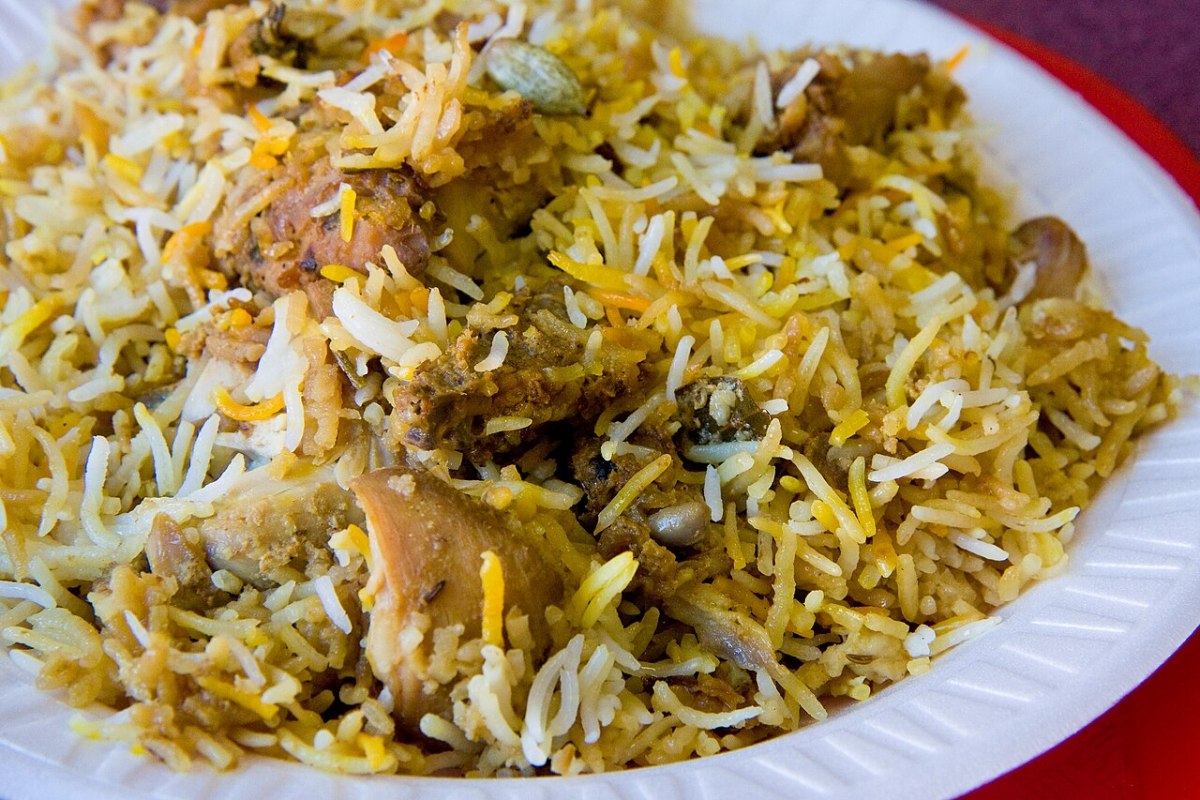
- Image: Hyderabadi chicken biryani, Wikimedia Commons, CC BY 2.0, by Garrett Ziegler