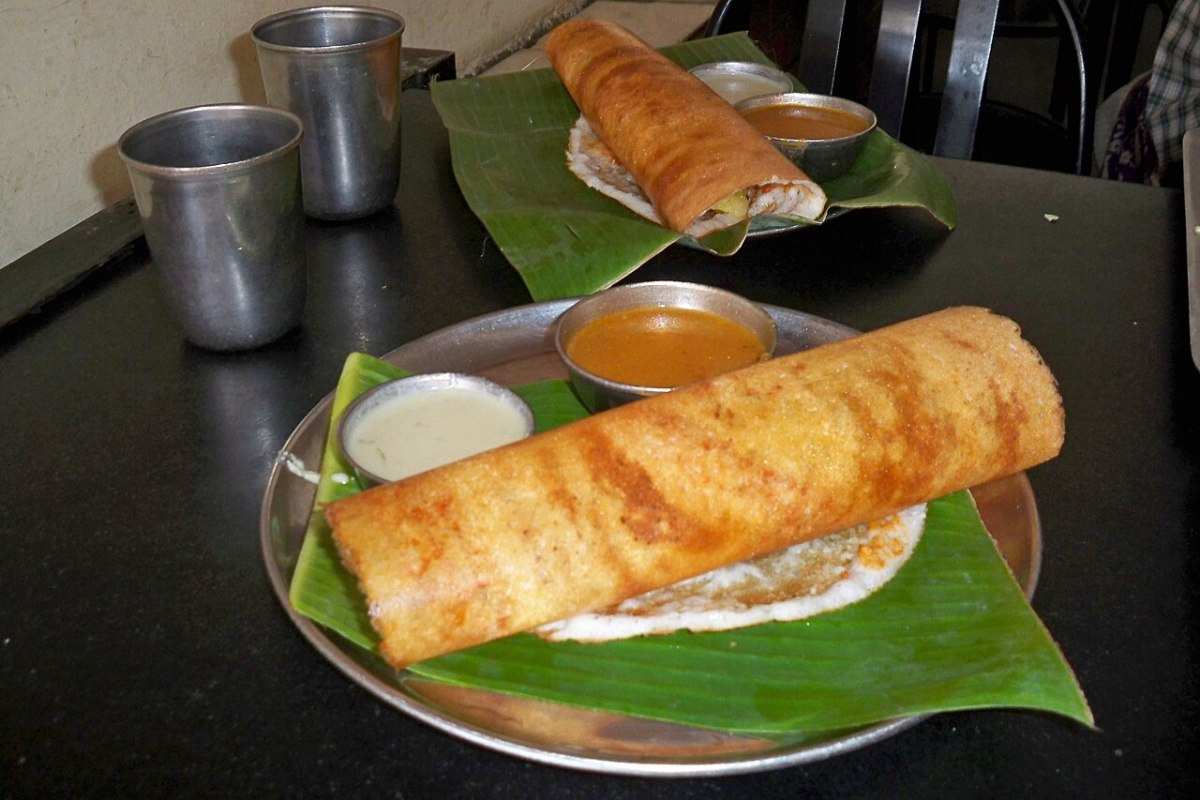
The masala dosa you order in a restaurant was shaped in a few Bangalore tiffin rooms within living memory, even though the dosa itself is more than a thousand years old. The crisp golden crepe folded over spiced potato is South India’s most exported breakfast, and getting it right at home turns on one thing the recipe sites tend to rush: the batter, and the slow fermentation that makes it sour, light and able to crisp. This masala dosa recipe covers the rice-and-lentil batter, the potato filling that gives the dish its name, and the technique that the famous Udupi cooks of Bangalore turned into a standard.
Dosa, dose, dosai: one crepe, many names
The English word dosa flattens a row of South Indian names, and the spelling changes with the language. None of them has anything to do with the British word curry; this is a dish that named itself, locally, long before that.
| Language | Name |
|---|---|
| Tamil | dosai |
| Kannada | dose |
| Telugu | dosa / attu |
| Malayalam | dosha |
| Tulu | dosae |
| Odia | chakuli pitha, a close cousin |
The food historian K.T. Achaya traced the dosa to the ancient Tamil country, where a version appears in early literature. Karnataka claims an Udupi origin, and the argument over which southern state invented it has never fully settled. What is clear is that the dish is southern, ancient and fermented, three facts the modern restaurant version sometimes hides under a layer of butter.
The Udupi cooks who made it famous
The masala dosa became a standard through a handful of Bangalore institutions, most of them founded by cooks from Udupi, the coastal Karnataka town whose Brahmin hotel tradition spread vegetarian tiffin across South India.
- Mavalli Tiffin Room (MTR), opened in 1924 as the Brahmin Coffee Club by Parampalli Yagnanarayana Maiya and his brothers, who came from near Udupi. Maiya studied European restaurant practice on a tour abroad and brought that discipline home. MTR set the benchmark for the masala dosa, and during the rice shortages of the Second World War it invented rava idli, swapping semolina for scarce rice.
- Vidyarthi Bhavan, opened in 1943 by Venkatramana Ural, another Udupi native, to feed the students of the local colleges. Its benne masala dose, a butter-soaked dosa, is the dish people queue for, and the kitchen is known for laying butter on the hot griddle before the batter rather than after.
These rooms did not invent the dosa. They industrialised its consistency, turning a home ferment into a dish you could rely on getting the same way every morning, and in doing so they made the masala dosa a national breakfast rather than a regional one.
The Udupi hotel, an early restaurant chain
The reason so many dosa institutions trace to one small town is worth a paragraph of its own. Udupi, on the Karnataka coast, is home to the Krishna temple whose kitchen fed pilgrims for centuries, and the Brahmin cooks of that tradition carried their vegetarian tiffin out into the cities. From the early twentieth century, Udupi men opened clean, cheap, vegetarian restaurants across South India and then Bombay, all working to a similar template of dosa, idli, sambar and filter coffee. The Udupi hotel became a recognised category, arguably India’s first restaurant chain idea, decades before the word franchise reached the country. When you eat a masala dosa in Mumbai or New Jersey, you are eating the end of a line that runs back to a temple kitchen on the Karnataka coast.
The batter is the dish
A masala dosa lives or dies by its batter, and the batter is two things ground separately and fermented together: rice and urad dal, the skinned black gram. The ratio shifts by region, which is the first sign that there is no single recipe.
- Karnataka tends to a 3 to 1 rice-to-urad batter.
- Tamil Nadu and Kerala lean to 4 to 1.
- Andhra runs richer in dal, closer to 2 to 1.
A spoon of fenugreek seeds soaked with the dal helps the batter ferment and browns the dosa golden. A handful of poha, flattened rice, or a little chana dal adds the crisp. The dal is ground smooth and fluffy, the rice slightly coarse, and the two are combined with salt and left to ferment for eight to twelve hours, longer in a cold kitchen. Wild lactic-acid bacteria do the work, doubling the batter in volume, souring it gently and filling it with tiny bubbles. That fermentation is also why the dish is easy to digest: it breaks down the phytates in the grain and lifts the B-vitamin content. Under-ferment the batter and the dosa turns gummy and pale; over-ferment it and it smells too sour to eat.
Two small things decide whether the ferment works. The salt should go in before fermenting in most southern kitchens, and it should be plain salt, since iodised salt can slow the wild bacteria the batter depends on. And the urad dal must be fresh and ground with enough water to trap air, because it is the dal, not the rice, that gives the batter its lift. The mucilage in urad gram holds the gas the bacteria produce, which is why a batter heavy on rice and light on dal never rises well. Cooks who fail at dosa usually blame the rice when the dal was the problem.
For crispness, two home tricks recur in the Indian kitchen press. Use old, aged rice rather than new-crop, which holds less moisture and crisps better, and grind the rice slightly coarse rather than smooth. The trick worth stealing is to blend a couple of tablespoons of cooked rice, or a handful of poha, into the batter: the extra gelatinised starch is what turns out a dosa that shatters rather than bends.
Ingredients for masala dosa
| For the batter | Amount |
|---|---|
| Raw rice (sona masuri or dosa rice) | 3 cups |
| Urad dal (skinned black gram) | 1 cup |
| Fenugreek (methi) seeds | 1 teaspoon |
| Poha (flattened rice) | a handful |
| Salt | to taste, added before fermenting |
| For the potato palya | Amount |
|---|---|
| Boiled potatoes, roughly mashed | 4 |
| Onion, sliced | 1 large |
| Mustard seeds, chana dal, urad dal | to temper |
| Curry leaves, green chili, ginger | to taste |
| Turmeric | half a teaspoon |
Note what is not in the potato filling: no garam masala. The southern potato palya is built on a mustard-seed and curry-leaf tempering with turmeric, not the warm northern spice blend. Adding garam masala is the most common way a home cook makes a southern dish taste northern by accident. A pinch of asafoetida and a few cashews fried in the tempering are the traditional richeners instead.
How to make masala dosa step by step
Grind and ferment the batter
Soak the rice, and the dal with the fenugreek, separately for four to six hours. Grind the dal first to a smooth, airy paste, then the rice to a slightly grainy one, and the poha with it. Combine with salt, cover, and leave somewhere warm to ferment until it doubles and smells mildly sour, eight to twelve hours.
Make the potato palya
Temper mustard seeds, chana dal and urad dal in oil until they pop, add curry leaves, green chili and ginger, then the sliced onion cooked soft. Stir in turmeric and the mashed potato with a splash of water, and finish with coriander. It should be soft and savoury, not dry.
Spread, crisp and fill
- Heat a cast iron tava until a sprinkle of water skitters and vanishes in a second or two.
- Pour a ladle of batter at the center and spread it outward in a quick spiral with the back of the ladle, as thin as you can.
- Drizzle ghee or oil around the edge. When the underside turns golden and the dosa lifts at the rim, it is done; a masala dosa is cooked on one side only.
- Spread a line of potato palya down the middle and fold the dosa over it.
The tava temperature is the make-or-break. Too cool and the batter sticks and steams; too hot and it seizes before it spreads. The water test, a droplet that dances and evaporates fast, is how every dosa cook reads the griddle.
The mistakes that ruin a home dosa
- The wrong rice entirely. The hidden failure that runs through reader reports is buying parboiled rice by mistake instead of raw rice. Parboiled rice barely ferments and gives a pale, paper-thin dosa that stays uncooked. Labels vary by region, so check the packet actually says raw rice before you blame the weather.
- Under-fermented batter. The top cause of pale, gummy dosas. Give it the full rise; in a cold kitchen, leave it in the oven with the light on.
- Batter that will not spread. Almost always one of two things: the batter is too thick, or the tava is too hot to let you spiral it. Thin it with a little water and drop the heat to medium before you pour.
- Wrong tava heat. Use the water test before every dosa, and lower the heat slightly just before you pour, then raise it to crisp.
- Batter too thick or too thin. It should pour and spread but not run. Adjust with a little water after fermenting, never before.
- A new or dry griddle. A well-seasoned cast iron tava, lightly wiped with oil and a cut onion, releases the dosa cleanly. A bare new pan grabs it.
- Garam masala in the potato. It turns a Karnataka palya into something northern. Keep to mustard, curry leaf and turmeric.
The butter trick, and why people queue for it
The single most copied home upgrade comes from Vidyarthi Bhavan and the benne dose tradition: butter on the griddle before the batter, not after. A knob of butter laid on the hot tava and spread thin, then the batter poured straight onto it, browns into a nutty, almost burnt-butter crust that finishing butter cannot reproduce. Reviews of the Bangalore institution repeat the same line across years, that the smell of the dosa reaches the table before the plate does, and that the queue outside is part of the ritual. The restaurant is said to go through huge quantities of butter a day in dosa-making alone. You cannot match its century of seasoned griddles at home, but the butter-first habit gets you closer than any amount of extra ghee at the end.
The dosa family
Masala dosa is one of a large family, and the names mark real differences.
| Dosa | What changes |
|---|---|
| Plain dosa | No filling, the everyday version |
| Paper dosa | Spread huge and thin, crisp as a sheet |
| Benne dose | Cooked in butter, the Bangalore signature |
| Mysore masala | A layer of red garlic-chili chutney inside |
| Rava dosa | A batter of semolina, no fermentation, lacy and instant |
| Set dosa | Small, thick and soft, served in stacks |
The rava dosa is the exception that proves the rule: because it skips fermentation, it can be made on the spot, but it trades the sour depth and the gut-friendly chemistry of the real fermented batter for speed.
What to serve with masala dosa
A dosa never arrives alone. The southern accompaniments are part of the dish, not extras.
- Sambar, the tamarind-and-lentil stew that a dosa is dipped into, made with its own roasted sambar powder rather than any all-purpose blend.
- Coconut chutney, ground fresh with green chili and tempered with mustard and curry leaf.
- Filter coffee, the strong, milky South Indian coffee that completes a tiffin breakfast.
For where the dosa sits against the wheat-and-tandoor cooking of the north, and why a rice ferment belongs to the south, the guide to Indian cuisine and spices draws the line. It is the southern answer to the northern naan, grain for grain, the way a biryani is the rice belt’s festive plate against the north’s tandoor.
Frequently asked questions
Why will my dosa batter not ferment?
Usually the kitchen is too cold. Fermentation needs warmth, around 25 to 30 degrees. In cool weather, leave the batter in an oven with only the light on, or in any warm spot, and give it longer, up to sixteen hours.
Which rice is best for dosa?
Raw sona masuri or a dedicated dosa rice gives the most reliable crisp. Idli rice or parboiled rice works but makes a softer dosa. Avoid basmati, which belongs to the north and will not ferment the same way.
Why is my dosa not crisp?
Either the batter was under-fermented, the tava was not hot enough, or the batter was too thick. A little poha or chana dal in the grind also helps the crisp.
Is masala dosa healthy?
The fermented rice-and-lentil batter is nutritious and easy to digest, rich in B vitamins and probiotics. The potato filling and the ghee add calories, so it is wholesome rather than light.
What is the difference between a dosa and a masala dosa?
A plain dosa is the crepe on its own. A masala dosa is the same crepe folded over a spiced potato filling, the palya, which is where it gets its name.
How long does dosa batter keep?
Fermented batter keeps in the fridge for four to five days, and many cooks think the dosas improve over the first two as the flavour deepens. Take it out to warm slightly before using, and if it has risen and fallen, stir it gently. Once it smells sharply sour or turns watery on top, it is past its best.
Can I make masala dosa without a cast iron tava?
A heavy non-stick pan works and is more forgiving for a beginner, though it rarely gives the same crisp. Cast iron, once seasoned, releases the dosa cleanly and browns it better. Wipe either with a halved onion and a little oil between dosas.
Sources
- Dosa, regional names and history
- Mavalli Tiffin Room, history of MTR Bangalore
- Vidyarthi Bhavan, Bangalore
- Image: Masala Dosa, Bengaluru, Wikimedia Commons, CC BY-SA 4.0, by Sumitbanti