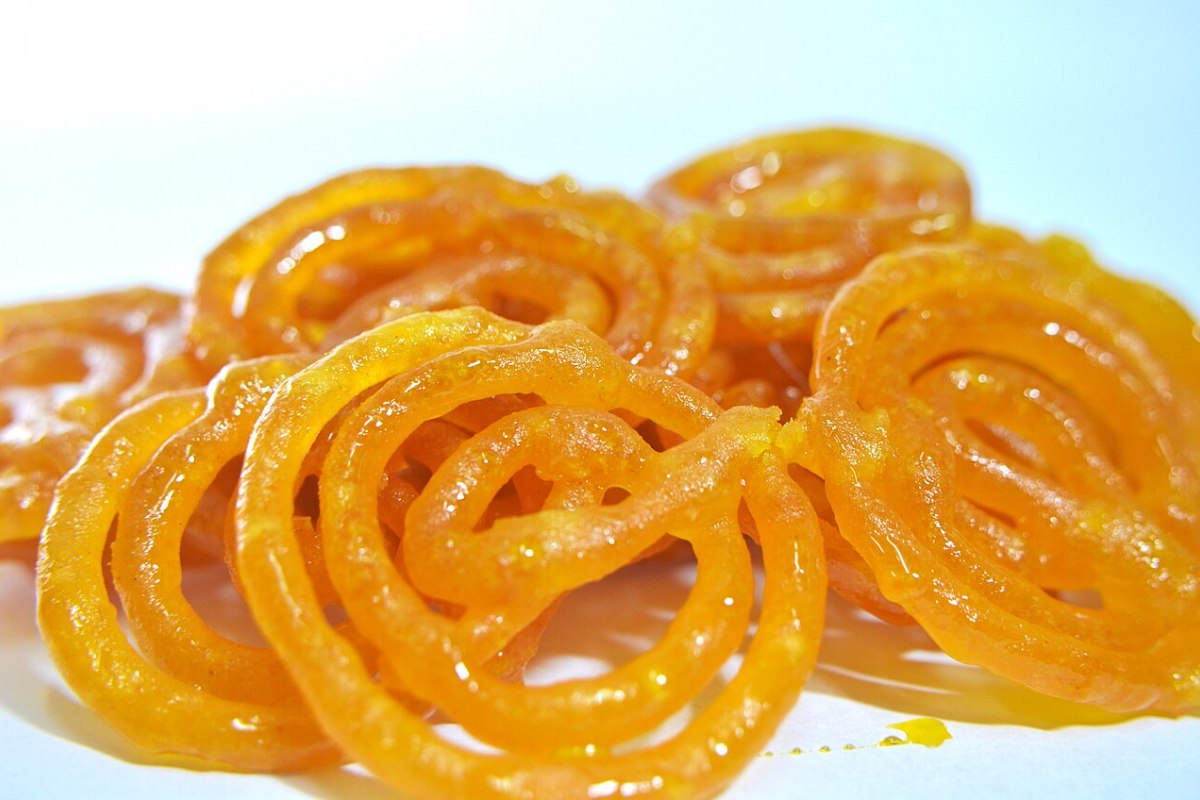
Jalebi is a thousand-year-old sweet that India borrowed and made its own. The orange spiral fried crisp and soaked in syrup, sold hot at every fair and festival morning, began as the Arabic zalabiya and reached the subcontinent through Persia centuries ago. This jalebi recipe makes the proper fermented-batter version, and it is honest about the two things that defeat most home cooks: a batter left long enough to sour, and a syrup at exactly the right stage so the jalebi soaks through and still stays crisp.
From zalabiya to jalebi
The trail is unusually well documented for a sweet. The earliest known recipe appears in a tenth-century Arabic cookbook, the Kitab al-Tabikh of Ibn Sayyar al-Warraq, for a fried-dough sweet soaked in syrup. In Iran the same sweet, zolbiya, was traditionally handed to the poor during Ramadan. The name jalebi descends directly from that Arabic zalabiya and the Persian zolbiya, carried east with traders and cooks.
It put down Indian roots early. The first Indian text to name it is the Priyamkarnrpakatha, a Jain work composed by Jinasura around 1450, where jalebi appears on the dinner menu a wealthy merchant lays on. From court and merchant tables it spread to the street, and one of its most famous homes still stands: the Old Famous Jalebi Wala in Chandni Chowk, Old Delhi, frying its thick, ghee-rich spirals since Lala Nem Chand Jain opened the shop in 1884. A jalebi, in other words, links a medieval Baghdad kitchen to a Delhi street corner in one bite.
For all its foreign roots, jalebi has become so woven into Indian life that some half-jokingly call it the national sweet. It turns up at temple festivals and political rallies, at weddings and on ordinary winter mornings, and it carries a particular association with the monsoon and the cold months, when a hot, dripping jalebi against the chill is one of the small fixed joys of the season. Few sweets are sold across such a span, from a roadside cart frying them for a few rupees to a wedding caterer piping them by the kilo.
The global family of the fried spiral
Because the sweet travelled with the medieval Islamic world, versions of it ring the map, and they are all relatives of the jalebi.
- Zlabia across the Maghreb, in Tunisia, Algeria and Morocco, a darker, looser tangle eaten especially in Ramadan.
- Zoolbia in Iran, often paired with the small fried bamieh, both handed out during the fasting month.
- Jalebi across the rest of the subcontinent, a fixture in Pakistan, Bangladesh and Nepal under the same name.
- Mushabak and similar fried-syrup sweets through the Levant and Turkey, branches of the same medieval recipe.
The thread that ties them is the technique: a thin batter piped into hot oil in loops and soaked in sugar or honey syrup. India took that idea, added the overnight ferment and the spiral discipline, and produced the bright, crisp jalebi that now feels wholly Indian despite a passport stamped in Baghdad and Isfahan.
Jalebi or imarti? The pair people confuse
Half the jalebis sold are not jalebis at all, but imartis, and the two are genuinely different sweets that share a coil shape.
| Jalebi | Imarti (jangiri) | |
|---|---|---|
| Batter | Refined flour (maida), fermented | Ground urad dal (black gram) |
| Texture | Thin, crisp, juicy | Thicker, chewy |
| Shape | Random, free-form spiral | Neat, flower-like rings |
| Colour | Yellow to orange | Deep orange |
| Eaten | Best hot, an everyday treat | Often cold, more festive |
The imarti, called jangiri in the south, is the richer, special-occasion cousin, built on lentil batter rather than flour. A jalebi is the everyday morning sweet. If the coil is a tidy flower and chewy, it is an imarti; if it is a crisp, messy scrawl, it is a jalebi. The urad-dal batter of the imarti also means it carries more protein and a denser bite, which is part of why it reads as the more substantial, festive sweet of the two.
The batter and the ferment
What makes a real jalebi is fermentation. The batter is refined flour, maida, loosened with a little gram flour or cornflour and curd, mixed to a smooth, pourable thickness and then left to sour. Six to eight hours gives a light tang; a full overnight ferment, twelve to twenty-four hours in a warm kitchen, gives the best flavour and the airy crispness that defines the sweet. Wild fermentation lifts the batter and gives the fried spiral its delicate, shattering crunch.
Instant jalebis skip this with a pinch of eno or baking soda for quick bubbles, and they are passable, but they trade away the faint sour depth that a real ferment gives. The Hindi halwai guides push for a full twenty-four-hour ferment for the crispest result, and they are insistent on one syrup detail: keep it at exactly one string, because a hair thicker and the syrup crystallises on the jalebi instead of soaking in, leaving it sugary rather than juicy. A few drops of lemon stirred into the cooled syrup keep it from graining. The difference between a stale, heavy jalebi and a light, glassy one is almost always the ferment. The same chemistry that lifts a dosa batter works here, wild bacteria and yeast filling the batter with gas, except that a jalebi cook wants only a short, light ferment for crispness rather than the full sour rise of a dosa. A batter left too long turns too sour and the jalebi loses its clean sweetness, so the overnight window matters in both directions.
Ingredients for jalebi
| For the batter | Amount |
|---|---|
| Refined flour (maida) | 1 cup |
| Gram flour (besan) or cornflour | 2 tablespoons |
| Plain curd (yogurt) | 2 tablespoons |
| Water | to a pourable batter |
| A pinch of saffron or turmeric | for colour |
| For the syrup | Amount |
|---|---|
| Sugar | 1.5 cups |
| Water | 1 cup |
| Cardamom and saffron | a few |
| Lemon juice | a few drops |
How to make jalebi step by step
Ferment the batter
Whisk the flour, gram flour and curd with enough water to make a smooth, thick but pourable batter, free of lumps. Cover and leave it in a warm spot to ferment, overnight for the best result. By morning it should look a little bubbly and smell faintly sour. Stir it gently before using.
The syrup, the pipe and the fry
- Boil the sugar and water with cardamom, saffron and a little lemon to a one-string syrup, then keep it warm, not hot.
- Pour the batter into a piping bag, a squeeze bottle or a cloth with a small hole.
- Heat ghee or oil to a steady medium. Pipe spirals straight into the oil, working from the centre outward in three or four loose loops.
- Fry until crisp and golden on both sides, then lift them straight from the oil into the warm syrup.
- Soak only twenty to thirty seconds a side, then lift out. A brief dip sweetens the jalebi while keeping it crisp; a long soak turns it soggy.
Serve them at once, hot. Jalebi is a sweet with a short window: it is at its best within minutes of leaving the syrup, which is why the halwai fries it to order in front of you. The same batter, piped thicker and fried longer, gives the chewier jalebi some prefer, while a thin, fast-fried stream gives the lacy, glassy kind, so a single bowl of batter can please two camps.
The art of the spiral
Watching a halwai pipe jalebi is half the appeal, and the skill is real. The traditional tool is not a fancy nozzle but a thick cotton cloth folded into a cone with a small hole at the tip, or in many shops a simple steel jug or a recycled squeeze bottle. The batter is pressed out in a single continuous stream while the hand moves in fast, looping circles directly over the hot oil, three or four overlapping rings laid down in a second or two. The wrist does the work; the spiral is muscle memory built over years.
At home a piping bag or a squeeze bottle with a small opening stands in well, and the first few jalebis will look like accidents before the motion settles. Size is a regional choice. Old Delhi favours a thick, substantial jalebi heavy with ghee, while much of the country prefers a thinner, lacier, crisper coil. Neither is more correct; they are different sweets from the same batter, and a cook can pipe either from the same bowl by changing the thickness of the stream and the size of the loops.
Why the crisp is so hard to get at home
- Batter wrong thickness. Too thin and the spirals break apart; too thick and they fry dense. It should ribbon off the whisk and hold a piped line.
- Skipping the ferment. Without it the jalebi is heavy and bland. Give it the overnight rise for the airy crunch.
- Oil too hot or too cold. Too hot browns before it crisps; too cool and the jalebi drinks oil and goes limp. Hold a steady medium.
- Syrup too hot or too thick. Hot syrup makes the jalebi soggy; a thick, over-cooked syrup crystallises on it. Keep it warm and at one string.
- Soaking too long. The crispness lives in a quick dip. Past a minute, the jalebi softens and loses its snap.
How India eats jalebi
Jalebi is rarely eaten alone, and the pairings are regional and often surprising to outsiders who think of it only as a dessert.
- Fafda-jalebi in Gujarat, a savoury crisp gram-flour fafda eaten with sweet jalebi for breakfast, the fixed order on Dussehra morning.
- Jalebi with rabri across North India, the crisp spiral drowned in thick, cardamom-scented reduced milk.
- Jalebi with milk or curd, a common breakfast in the north, dipped into a glass of warm milk or a bowl of yogurt.
- Poha-jalebi in Madhya Pradesh, especially Indore, where flattened-rice poha and jalebi share a breakfast plate.
- Jalebi with dahi, the crisp spiral broken into a bowl of cool yogurt, a common northern way to soften both the sweetness and the crunch.
The Gujarati fafda-jalebi pairing is the clearest sign that jalebi is more than a dessert in India: it is a breakfast, a festival food and a street snack as much as a sweet, eaten hot off the pan at any hour, often with a glass of masala chai beside it.
Where to eat the best jalebi
For all that it can be made at home, jalebi is at heart a halwai’s sweet, fried fresh and eaten on the spot. The Old Famous Jalebi Wala in Chandni Chowk has drawn crowds for its thick, ghee-fried spirals since 1884, and most Indian towns have a morning jalebi stall whose first batch sells out fast. At a fair, a festival or a wedding, a jalebi handed over warm and dripping is one of the simplest pleasures Indian street food offers. It belongs to the syrup-sweet shelf of the mithai guide, beside the soft gulab jamun, the two of them the most beloved fried-and-soaked sweets in the country.
Frequently asked questions
Where did jalebi originate?
It descends from the Arabic and Persian zalabiya or zolbiya, a fried sweet soaked in syrup recorded as early as the tenth century. It reached India through Persia and appears in an Indian text by 1450, becoming a national favourite over the centuries.
What is the difference between jalebi and imarti?
Jalebi is made from fermented refined-flour batter, fried thin and crisp in a free-form spiral. Imarti, or jangiri, is made from urad dal batter, thicker and chewier, piped in neat flower shapes, and is more of a festive sweet.
Why is my jalebi not crisp?
Usually the batter was not fermented, the oil was the wrong temperature, or the jalebi soaked too long in syrup. A fermented batter, steady medium oil and a quick dip in warm one-string syrup give the crisp.
Can I make jalebi without fermenting the batter?
Yes, an instant version uses eno or baking soda for quick bubbles. It works, but it lacks the light tang and airy crunch of a properly fermented batter, which is what makes a great jalebi.
What is fafda-jalebi?
It is a Gujarati pairing of savoury crisp gram-flour fafda with sweet jalebi, eaten together at breakfast and especially on the festival of Dussehra. It shows how jalebi in India is as much a breakfast and festival food as a dessert.
What sugar-syrup stage does jalebi need?
A one-string syrup, cooked just to the point where a drop pulls a single thread between finger and thumb, then kept warm rather than boiling hot. A thinner syrup will not coat; a thicker one crystallises on the jalebi and dulls the crisp.
Can I store jalebi, or is it only good fresh?
It is at its best within minutes of frying, while still warm and crisp. It keeps a day or two at room temperature but softens, so a quick reheat in a low oven brings back some crispness. Jalebi is one of the sweets most worth eating fresh from the pan rather than saving.
Sources
- Jalebi, history and etymology
- The Better India, the journey of jalebi from Persia
- Imarti, the urad dal cousin of jalebi
- Image: Jalebi, Wikimedia Commons, CC BY-SA 4.0, by Lion.harvinder