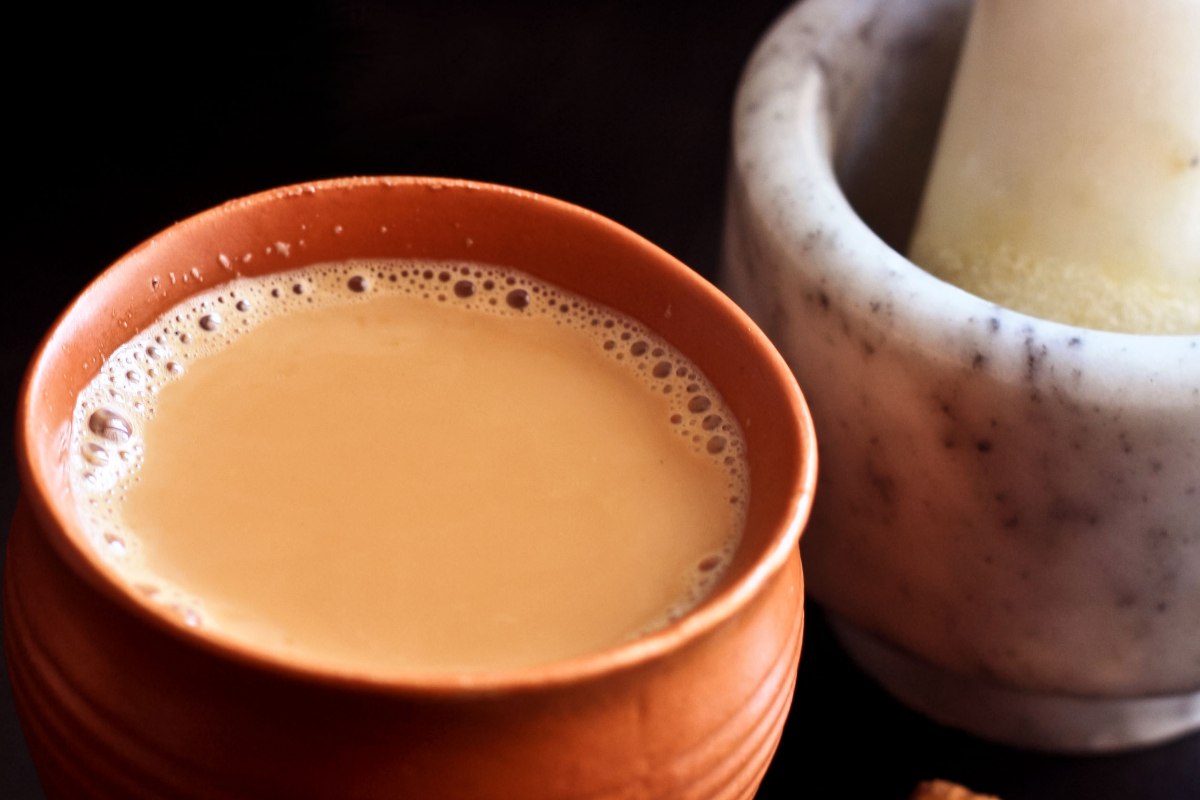
Ordering a “chai tea” is asking for a tea tea. Chai is simply the word for tea across much of Asia, so the spiced, milky drink most of the West means by chai is properly masala chai, spiced tea. It is also younger than people think: the sweet, milky, spice-laced tea boiled on every Indian street corner is largely a creation of the last century, born when British tea-selling met Indian spice. This masala chai recipe makes it the way a roadside stall does, and the order in which things go into the pan is the part that matters most.
Chai means tea, so “chai tea” says it twice
The word carries its own history. Chai descends from the Chinese cha, which travelled overland through Persia and into Hindi and Russian, while the English word tea comes from te, the same Chinese character in the Min dialect of the coast, which travelled by sea with Dutch traders. Two words, two trade routes, one leaf. So in Hindi, chai already means tea, and “chai tea” repeats itself. The spiced version Indians drink is masala chai, where masala is the spice mix. Calling it that is not pedantry; it is the difference between naming a drink and naming it twice.
A colonial drink that became national
Masala chai feels ancient and is not. Tea is native to the hills of Assam, where the plant grew wild, but South Asians long treated it as a medicine, not a drink to enjoy by the cup. The recreational habit was built deliberately, and recently.
In the 1830s the British East India Company, anxious to break China’s monopoly on the tea its home market drank by the pound, found that tea grew in Assam and turned the region into plantations. Almost all of it was shipped to Britain. To create a home market, the British-owned Indian Tea Association began, in the early 1900s, to push tea-drinking on Indians, handing out cups at railway stations and factories. Indians took the cheap tea and did what their kitchens always did: they boiled it with milk and sugar and threw in the warming spices of the household masala box, some of them straight out of Ayurvedic texts. The drink that resulted, masala chai, was a marriage of a colonial cash crop and a local spice tradition, and it became so completely Indian that its imported, recent origins vanished from memory.
The tea, the spices and the method
Three choices separate real masala chai from a weak imitation.
- The tea must be strong. Use Assam CTC, the granular crush-tear-curl black tea that stands up to milk and spice. Delicate Darjeeling is wasted here; its subtlety disappears under the masala. The mass-market Indian brands built for this are the right tool, not a fine single-estate leaf. CTC tea is rolled into hard granules rather than left as whole leaves, which makes it brew fast, dark and strong, exactly the qualities a milky, spiced, quickly made street tea needs and the opposite of what you would want in a delicate afternoon cup.
- The spices go in whole. Green cardamom, cloves, black peppercorns, fresh ginger and cinnamon are the core, with the option of fennel, star anise or nutmeg. Crush them fresh rather than using a stale ground blend.
- The order is fixed. Spices and ginger first, simmered in water to draw out their oils, then the tea, then the milk and sugar last. Get the order wrong and the chai tastes thin.
The technique that gives street chai its body is the repeated boil: let the pan rise to a boil and pull it back two or three times before straining. Each surge concentrates the brew and pulls the colour and strength out of the CTC.
Ingredients for masala chai
| Ingredient | Amount (for 2 cups) |
|---|---|
| Water | 1 cup |
| Whole milk | 1 cup |
| Assam CTC black tea | 2 teaspoons |
| Fresh ginger, crushed | a small piece |
| Green cardamom, crushed | 3 to 4 pods |
| Cloves and black peppercorns | 2 each |
| Cinnamon | a small piece |
| Sugar or jaggery | to taste |
The water-to-milk ratio is a matter of taste and region. Equal parts is a good middle. More milk gives a richer, creamier cup; more water a lighter, more tea-forward one.
How to make masala chai step by step
- Bring the water to a boil with the crushed ginger, cardamom, cloves, peppercorns and cinnamon, and let it simmer five minutes so the spices steep.
- Add the CTC tea and boil two to three minutes until the water turns dark.
- Pour in the milk and the sugar, and bring it back to a boil.
- Let it rise and settle two or three times, watching it so it does not boil over, which deepens the colour and body.
- Strain into cups through a fine sieve and serve at once, hot.
The whole thing takes about six minutes. Chai is made fresh, by the small pot, every time; it does not keep and it does not reheat well, which is why a stall brews it to order all day long.
One flourish is worth copying from the stall: the pull. A practised chaiwala pours the finished chai from a height between two pots, again and again, stretching a long ribbon of tea through the air. It looks like showmanship, and it is, but it also aerates the chai, cools it to drinking temperature and builds a light froth on top. At home you can pour it once or twice between a pan and a jug to the same effect. It is the same idea behind the pulled teh tarik of Malaysia, which Indian migrants carried there, another branch of the same milky-tea family.
The tapri secrets the recipe sites miss
The chai at a roadside tapri tastes of more than the sum of its parts, and named Indian chefs writing in the Hindi food press keep returning to a few timing tricks that home recipes gloss over.
- Cardamom goes in late. The most repeated secret is to hold the green cardamom back. Boil the pods’ shells early for body, but crush the fragrant seeds and add them only in the last two or three minutes before the pan comes off the heat. Cardamom is delicate and its aroma boils away over a long simmer, so the dhaba smell people chase comes from late cardamom, not more of it.
- Do not boil the spices too long. Past a few minutes, the warming spices turn bitter rather than fragrant. Build the base, then add the most aromatic spices near the end.
- Bruise the ginger, do not chop it. Crushing or pounding the ginger, rather than slicing it, releases far more of its oils into the boil, which is why a tapri chai bites with ginger in a way a chopped-ginger home version does not.
- Boil it hard, then pull it. A weak simmer makes weak chai. The strong, repeated rolling boil is what gives kadak chai its body, and the pour from a height aerates it and lifts the foam.
These are small adjustments of timing, not new ingredients, and they are exactly what separates a flat home cup from the one handed over at a railway platform.
The regional styles of chai
There is no single Indian chai. Every region, and many families, brew it their own way.
| Style | Where | What changes |
|---|---|---|
| Kadak chai | Maharashtra and the west | Strong, more tea, longer boil, less milk |
| Doodh patti | Punjab and Pakistan | No water at all, tea simmered straight in milk |
| Lebu cha | Bengal | Black tea with lemon and no milk |
| Jaggery chai | Punjab, Bihar, rural north | Sweetened with jaggery for a caramel depth |
The jaggery version is a small home trick worth borrowing: a teaspoon of jaggery boiled with the spices, in place of sugar, rounds out the bite of the ginger and pepper with a caramel note. It does not dissolve cleanly into hot milk, so it goes in early, with the spices, not at the end. Bihar and eastern Uttar Pradesh take this furthest, with a winter jaggery chai thick enough to feel like a meal.
Cutting chai and the chaiwala
Chai is less a drink than a punctuation mark in the Indian day, and the man who makes it, the chaiwala, is an institution. In Mumbai the standard order is a cutting chai, half a glass, strong and sweet, designed to be downed fast in a break and to cost almost nothing, so two people can split a full glass and each get a cutting. The roadside stall, the tapri, is where colleagues argue, deals are struck and strangers stand shoulder to shoulder over a three-rupee glass. Offering chai is the basic gesture of Indian hospitality; refusing it can read as a snub. None of this is incidental to the recipe. The drink is built to be cheap, quick and shared, which is why it is brewed strong and small rather than steeped gently in a pot.
The same drink has been repackaged abroad almost beyond recognition. The “chai latte” of Western coffee chains is usually a sweet syrup or a powder steamed into milk, a long way from spices boiled in a pan. It is not wrong as a drink, but it is to masala chai what instant coffee is to a fresh brew, and tasting the real thing on an Indian street is the quickest way to see the gap.
Make your own chai masala blend
A house chai masala saves crushing whole spices every morning, and a home blend beats any jar. The proportions are a matter of taste, but a reliable base, ground together and kept airtight, runs roughly like this: a heaped tablespoon of green cardamom, which should dominate, with a teaspoon each of cloves, black peppercorns and dried ginger, a couple of cinnamon sticks, and a small pinch of nutmeg and fennel. Cardamom leads, ginger and pepper give the warmth, and the rest fills in behind. Half a teaspoon of the ground blend per two cups, simmered in the water, gives a consistent chai without the morning grind. Make it in small batches, since ground spice fades within a month or two.
The kulhad and the railway cup
The most romantic chai comes in a kulhad, an unglazed terracotta cup thrown on a potter’s wheel, used once and thrown away. The raw clay lends the tea a faint earthy aroma that drinkers prize, and the disposable cup needs no washing. It is the cup of the railway platform and the roadside stall. Indian Railways has tried more than once to bring the kulhad back in place of plastic, first in the 2000s and again in recent years, on grounds of hygiene, the environment and rural pottery jobs, though plastic and paper keep winning on cost and weight. A kulhad chai on a station platform, drunk as the train pulls in, remains one of the small fixed pleasures of Indian travel.
The mistakes that ruin a cup of chai
- Weak tea. Fine Darjeeling or a couple of teabags cannot carry the milk and spice. Use strong Assam CTC.
- Spices added to the milk. Their oils draw out in water, not milk. Simmer them in water first, before the tea and milk.
- Boiling the tea too long. Past a few minutes the tannins turn bitter. Boil the leaves briefly, then move on to the milk.
- Too much milk, too soon. Adding milk at the start mutes the brew. Build the tea in water first, then enrich it.
- A stale ground masala. Pre-ground blends fade fast. Crush whole spices fresh for each pot, or grind a small batch often.
What to drink chai with
Chai is a social and a punctuating drink, taken at breaks through the day, and it has its standard companions.
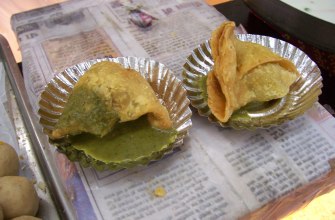
- A samosa or a pakora, the classic evening tea-stall pairing.
- Rusks or Parle-G biscuits, dunked, the everyday office and home accompaniment.
- Mathri or namkeen, savoury fried snacks that suit the sweet, spiced tea.
Chai sits in the drinks corner of the guide to Indian cuisine and spices, where the same word for tea splits along the trade routes that carried the leaf out of China. It is the north’s everyday drink the way South Indian filter coffee, the partner to a masala dosa, rules the morning below the Deccan.
Frequently asked questions
Is it wrong to say “chai tea”?
It is redundant. Chai already means tea, so “chai tea” literally says tea tea. The spiced milky drink is more correctly called masala chai, or just chai.
What tea is best for masala chai?
Strong Assam CTC, the granular black tea made for milk tea. It holds its own against the milk, sugar and spices. Darjeeling and delicate teas are overwhelmed and wasted in chai.
Why do you boil the spices before adding the tea?
The flavour and aroma of whole spices draw out in simmering water. Adding them later, or to the milk, gives a weaker result. Five minutes in boiling water first builds the masala base.
What is doodh patti chai?
Doodh patti means milk leaf. It is chai made with no water at all, the tea and spices simmered straight in whole milk for a thick, rich cup, common in Punjab and Pakistan.
Can I use jaggery instead of sugar in chai?
Yes, and it adds a caramel depth. Boil it in with the spices rather than stirring it into hot milk at the end, since it dissolves better in water and can curdle milk if added late.
Does masala chai have caffeine?
Yes. It is made with strong black tea, so a cup carries real caffeine, though less than a coffee of the same size. The spices add no caffeine of their own; the kick is all from the Assam leaf.
Can I make a big batch of chai ahead of time?
It is best fresh and does not hold well, since reboiling turns the tannins bitter and the milk catches. If you must, brew the spiced tea base without milk and keep it, then heat it with fresh milk by the cup as you go. A jar of dry chai masala, ready to simmer, is the better way to save time.
Sources
- Masala chai, history and preparation
- Britannica, on the words chai and tea and their trade routes
- Kulhar, the terracotta cup and the railway revivals
- Image: Kullad chai, Wikimedia Commons, CC BY-SA 4.0, by Thecuriouseye