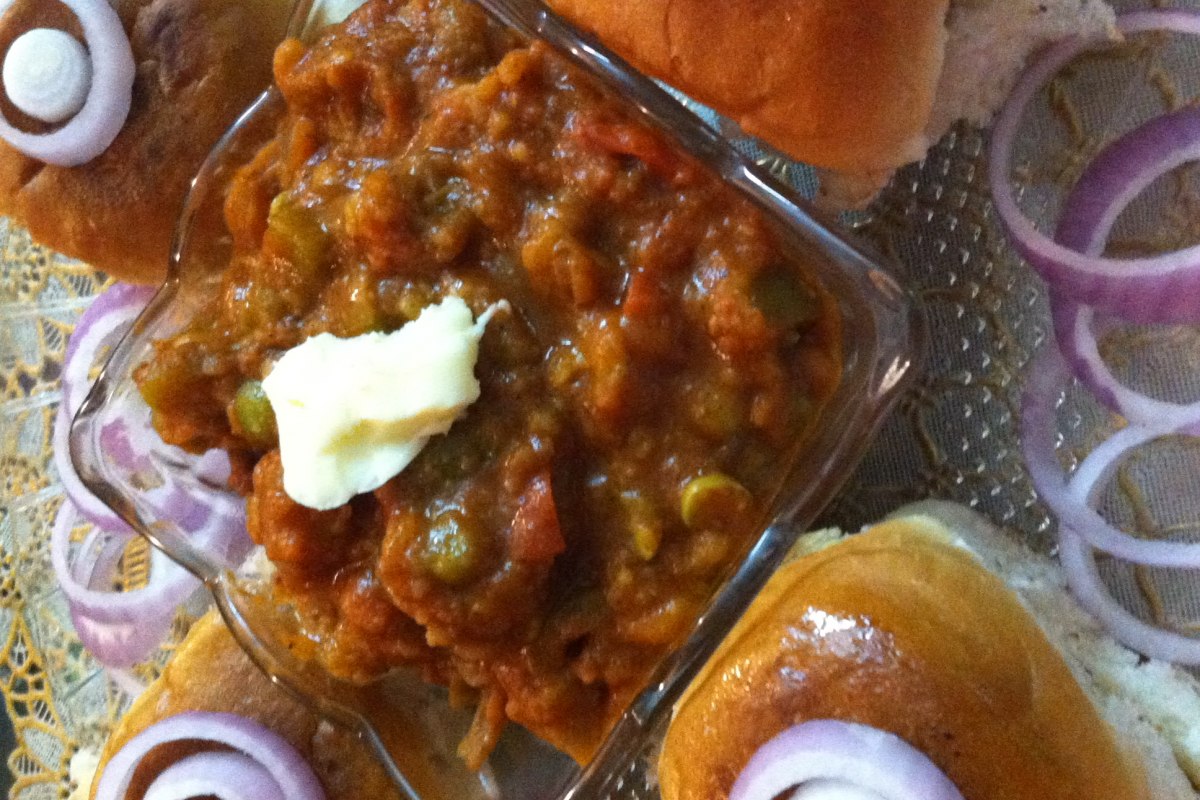
Pav bhaji was invented to be eaten fast, with one hand, on a short break. It began as a mill-worker’s lunch in the textile boom of mid-1800s Bombay, a pile of vegetables mashed and spiced on a hot griddle and scooped up with a soft buttered roll, and it climbed from the factory gate to the beach to become one of Mumbai’s defining street foods. This pav bhaji recipe makes the proper griddle version, butter and all, and explains the two halves of its name: the Portuguese bread it is eaten with, and the spiced vegetable mash that gives it its colour and its kick.
A mill-worker’s lunch that conquered Mumbai
The dish is a child of industrial Bombay. In the booming textile mills of the 1850s and 1860s, thousands of workers needed a meal they could eat in a short break, cheap and filling, with no time for a sit-down thali. Street vendors near the mills and the city’s markets answered with a fast plate: a medley of vegetables mashed together with spices on a large iron griddle, served with bread rolls so no plate or cutlery was needed. It was hot, it was quick, and it cost very little.
From the mill gates the dish drifted toward leisure. Mumbai’s seafront, above all Chowpatty Beach, filled with pav bhaji stalls, and the worker’s lunch became an evening treat eaten in the sea air. That journey, from functional fuel to a night out by the water, is the whole social history of the city in one dish, and it is why pav bhaji still carries a holiday feeling even when eaten at a roadside cart at noon.
The pav: Portuguese bread in a Mumbai dish
Half the dish is the bread, and the bread is a colonial inheritance. Pav comes from the Portuguese pão, bread, and the soft, square white rolls it names entered western India through Portuguese rule, the same Portuguese presence that left vindaloo and its pork down the coast in Goa. The pav is a yeasted, pull-apart roll, pillowy and plain, and its blandness is the point: it is a vehicle for the spiced bhaji, not a flavour competing with it.
The treatment of the pav is half the pleasure. It is split, laid on the hot griddle in a pool of butter dusted with a little pav bhaji masala, and toasted until the cut sides are crisp and golden and faintly spiced. A pav bhaji served with untoasted bread has skipped the step that ties the two halves together.
The bhaji and the masala
The bhaji is a mash, not a chunky curry. Potatoes give the body, with cauliflower, green peas, capsicum, carrot, onion and tomato cooked down and crushed on the griddle until they blur into a thick, almost smooth red-brown mass. The colour and the flavour both come from pav bhaji masala, a dedicated spice blend built on coriander, cumin, red chili, black pepper, cinnamon, clove, fennel and amchur, with Kashmiri chili for the signature red. Generous butter melts through it, and the bhaji is finished with lemon, raw onion and coriander at the table.
The technique is as important as the ingredients. Everything is cooked and mashed together on a wide, flat tawa over high heat, the cook working the mixture with the back of a masher, building layers as more butter and masala go in. That open-griddle mashing, rather than a closed pot, is what gives street pav bhaji its particular depth and its slightly smoky edge.
The pav bhaji masala, the dish’s signature
One ingredient separates pav bhaji from any other mashed-vegetable dish, and it is the masala. Pav bhaji masala is a purpose-built blend, distinct from garam masala, and getting it right is most of the recipe. A typical mix grinds together coriander and cumin seeds, dried red chili, black pepper, cinnamon, cloves, black and green cardamom, fennel, dry ginger, amchur for sourness and a little turmeric, with Kashmiri chili for the red. The balance leans on the coriander and the souring amchur in a way garam masala does not, which is why a garam masala substitute always tastes slightly wrong here.
Good packaged versions exist and are what most home cooks use, but a freshly ground batch, dry-roasted before grinding, lifts the dish noticeably. The masala also does double duty: a pinch is melted into the butter for toasting the pav, tying the bread to the bhaji. Whatever you use, it should be fresh, since the blend’s many volatile spices fade within a few months and a stale masala gives a dull, flat bhaji.
Ingredients for pav bhaji
| Ingredient | Amount | Role |
|---|---|---|
| Potatoes, boiled | 3 to 4 | The body of the mash |
| Cauliflower, peas, carrot, capsicum | 2 cups, mixed | The vegetable medley |
| Onion and tomato | 2 each, chopped fine | The base |
| Butter | generous, 4 tablespoons or more | The defining richness |
| Pav bhaji masala | 2 tablespoons | The signature flavour |
| Kashmiri chili and ginger-garlic paste | to taste | Colour and base aroma |
| Pav rolls | 8 | Toasted in butter to serve |
How to make pav bhaji step by step
Build and mash the bhaji
- Boil and roughly mash the potatoes and the mixed vegetables, keeping the water.
- Melt butter on a wide tawa or pan, cook the ginger-garlic paste, then the onion, then the tomato and capsicum until soft.
- Add Kashmiri chili and the pav bhaji masala and cook a minute until the raw smell goes.
- Tip in the mashed vegetables with a little of their water and mash everything together on the heat, working it with a masher until thick and smooth.
- Simmer, adding water to loosen and butter to enrich, and finish with chopped coriander and a squeeze of lemon.
Toast the pav
Split the rolls. Heat butter on the griddle, sprinkle a little masala into it, and press the cut sides of the pav into the butter until golden and crisp. Serve the bhaji topped with a pat of butter, raw chopped onion, coriander and a lemon wedge, with the hot pav alongside.
The theatre of the tawa
Half the appeal of pav bhaji is watching it made. The street version is cooked on a tawa the size of a small table, a vast flat iron griddle kept hot all evening, with a mound of part-cooked bhaji pushed to one side and individual portions worked up to order at the front. The cook mashes and folds with a heavy masher in one hand and a slab of butter in the other, scraping the spiced, reddened paste across the iron, toasting rows of pav in the melted butter, the whole thing clanging and steaming under the stall lights. It is fast food as performance.
That giant, well-seasoned griddle is also why street pav bhaji tastes better than most home versions. The huge hot surface lets the bhaji catch and caramelise at the edges as it is mashed, building a faint char a small home pan cannot reproduce. The home cook compensates with the two things the stall never skimps on, time and butter, mashing patiently and being generous with the fat, which closes most of the gap.
The variants worth knowing
The basic dish has spawned a row of versions, and a Mumbai stall menu lists them as a matter of course.
| Variant | What changes |
|---|---|
| Cheese pav bhaji | Grated cheese melted over the hot bhaji |
| Jain pav bhaji | No onion, garlic or potato; raw banana or plantain for body |
| Khada pav bhaji | Vegetables left chunky rather than mashed |
| Kolhapuri pav bhaji | Hotter, in the fiery style of Kolhapur |
| Mushroom or paneer pav bhaji | Modern add-ins for extra body |
The Jain version is the most ingenious, rebuilding the whole dish without the onion, garlic and potato that Jain practice avoids, leaning on raw banana for the starchy body instead. That a street dish bends so far to a dietary code, and still tastes like itself, says something about how central pav bhaji is to Mumbai eating.
Where Mumbai eats its pav bhaji
Pav bhaji is a stall dish first, and a few names are pilgrimage sites for it. Sardar in Tardeo is famous for a pav bhaji so heavy with butter that the bhaji arrives gleaming, and its menu of Amul, cheese, Jain and khada versions is a tour of the whole family. Cannon, near the CST railway station, has fed commuters and tourists for decades. And the Chowpatty and Juhu beach stalls remain the place to eat it as it was meant to be eaten, off a paper plate with the sea in front of you. For a sense of where this Maharashtrian street food sits among India’s regional kitchens, the guide to Indian cuisine and spices places it on the wider map, alongside the chaat and the samosa of the street.
How a plate of pav bhaji comes together
The finished plate is a small assembly, and each part has a job. Served right, it arrives as a hot bhaji crowned and ringed with garnishes and a stack of glistening pav.
- The bhaji, thick and red, with a melting pat of butter dropped on top at the last second.
- Raw onion, finely chopped, for crunch and bite against the soft mash.
- Lemon, a wedge squeezed over to cut the butter and lift the spice.
- Coriander, scattered fresh for colour and aroma.
- The pav, split, butter-toasted and warm, for scooping.
You eat it by tearing a piece of pav, loading it with bhaji and a little onion, and going back for more until both run out. There is no cutlery and no ceremony, which is exactly as the hungry mill workers who first ate it would have intended.
The stall secrets home cooks borrow
The Mumbai food press and home cooks share a handful of tricks for closing the gap to a stall plate, and they go beyond simply adding more butter.
- Beetroot for the natural red. The home trick the Hindi food columns push for that deep restaurant red, without bottled colour, is to boil and mash a small piece of beetroot into the bhaji. It lends colour and a faint sweetness and disappears into the spice. This is the answer to the “how do they get it so red” question that the recipe sites dodge with food dye.
- A garlic and Kashmiri-chili paste. Many stalls and home cooks stir in a separate wet paste of crushed garlic, Kashmiri chili and a little water near the start. It gives both a deeper red and the punchy, garlicky aroma that marks a good bhaji.
- Caramelise the onions properly. The single most repeated restaurant tip is to cook the onion down to a deep golden brown over ten to twelve minutes rather than only softening it. That long caramelisation is the sweet base under all the spice.
- A short blitz for the right texture. For the smooth-yet-textured stall consistency, mash by hand and then give the bhaji a five to ten second blitz with a hand blender, no more. Over-blend it and it turns to baby food; leave it raw and it stays chunky.
None of these replace the butter and the masala. They are the difference between a home bhaji that tastes home-made and one a Mumbai stall regular would nod at.
The mistakes that flatten a home pav bhaji
- Too little butter. Pav bhaji is a buttery dish by nature. Cutting the butter to feel virtuous gives a flat, dry bhaji that tastes nothing like the stall version.
- Under-mashing. The bhaji should be thick and almost smooth, not a chunky vegetable curry. Mash it hard on the heat.
- Weak masala. A good pav bhaji masala is the whole flavour. A generic garam masala will not give the same taste, and stale masala gives a dull bhaji.
- Skipping the toasted pav. Untoasted bread breaks the dish. Toast the split rolls in buttered, lightly spiced griddle heat.
- Chasing colour with extra red chili. The red comes from Kashmiri chili and the masala, not from piling on heat. Overdoing the hot chili burns the dish without deepening the colour.
Frequently asked questions
What does pav mean in pav bhaji?
Pav is the soft white bread roll, and the word comes from the Portuguese pão, bread, brought to western India under Portuguese rule. Bhaji is the spiced mashed-vegetable curry. Together they are bread and mash.
Where did pav bhaji originate?
In Mumbai, as a quick lunch for textile mill workers during the city’s industrial boom in the mid-nineteenth century. Vendors mashed vegetables on a griddle and served them with bread so workers could eat fast on a short break.
Can I make pav bhaji without a special masala?
You can approximate it, but the dedicated pav bhaji masala is what gives the dish its distinctive taste. A generic garam masala produces a different, lesser result. A good packaged or homemade pav bhaji masala is worth it.
What is Jain pav bhaji?
A version made without onion, garlic or potato, which Jain dietary practice avoids, using raw banana or plantain for the starchy body instead. It keeps the buttery, spiced character of the original without those ingredients.
Why is restaurant pav bhaji so red and buttery?
The red is Kashmiri chili and pav bhaji masala, not artificial colour, and the richness is simply a great deal of butter worked into the bhaji and the toasted pav. Both are central to the dish rather than excess.
What vegetables go into the bhaji?
Potato is the base, with cauliflower, green peas, capsicum and often carrot, plus onion and tomato. The exact mix is flexible; the constants are potato for body and a generous amount of it. Many cooks add whatever firm vegetables need using up, which suits the dish’s leftover-mash origins.
Can I make pav bhaji ahead?
Yes, and it reheats well, since the flavours deepen as it sits. Make the bhaji ahead, then loosen it with a little water and fresh butter when you reheat, and toast the pav fresh just before serving so it stays crisp.
What is the bread made of, and can I use burger buns?
Pav is a soft, yeasted white roll, mildly sweet and pull-apart. Soft dinner rolls or unsweetened burger buns are a reasonable substitute when pav is unavailable, toasted the same way in buttered, lightly spiced griddle heat.
Sources
- Pav bhaji, origin and varieties
- Curly Tales, on pav bhaji and the mill workers
- Swasthi’s Recipes, Mumbai pav bhaji technique reference
- Image: Pav bhaji, Wikimedia Commons, CC BY-SA 4.0, by Deboli Dutta