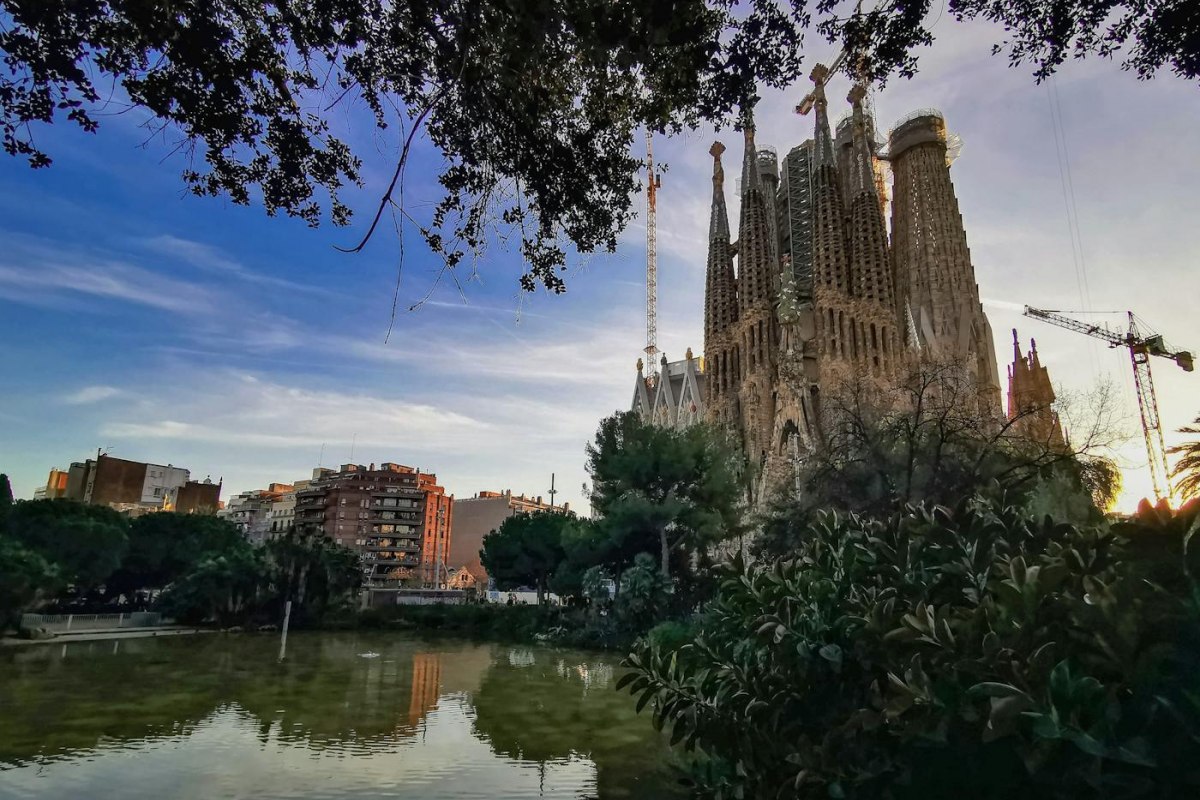
The Sagrada Família is the only building to become the tallest church on earth while still wrapped in scaffolding. Antoni Gaudí’s basilica has been under construction in Barcelona since 1882, outliving its architect by a century, and the central tower that now crowns it stands taller than any cathedral ever finished. This guide covers the parts the ticket sites skip: how a project with no money and no building permit kept going for 140 years, how Gaudí worked out a structure no one could draw, who actually carved each facade, and exactly which ticket to buy so you see it at its best.
The basilica is the centrepiece of the wider Gaudí in Barcelona story, and it anchors any trip planned through the things to do in Barcelona guide.
A 140-year building site
The first stone was laid in 1882 under the architect Francisco de Paula del Villar, who planned a conventional neo-Gothic church. He resigned within a year, and in 1883 the commission passed to a 31-year-old Antoni Gaudí, who tore up the plan and spent the rest of his life rebuilding it from the ground up.
- Gaudí’s obsession: he gave the final twelve years of his life to the basilica alone, living in a workshop on the site as he refined its forms. He knew he would never see it finished.
- His death: in 1926 Gaudí was struck by a tram on the Gran Via. Taken for a beggar because of his shabby clothes, he died days later and was buried in the basilica’s crypt, where his tomb remains.
- The lost years: during the Spanish Civil War, anarchists burned the workshop and smashed many of Gaudí’s plaster models, leaving later architects to reconstruct his intentions from fragments and photographs.
- The acceleration: work crept along for decades, then sped up sharply once computer modelling and robotic stone-cutting removed the slow hand-carving that had bottlenecked every generation before.
Pope Benedict XVI consecrated the building as a minor basilica in 2010, which means it now functions as a working church even as cranes still swing overhead.
Funded by no one but its visitors
The Sagrada Família is a temple expiatori, an expiatory temple, and that label is the key to its whole strange economics. From the start it was meant to be paid for entirely by ordinary people, as an act of devotion, with no money from the state and none from the institutional Church.
That model still runs the project. The construction is funded by donations and, above all, by the tickets the millions of annual visitors buy. Your entry fee is not a museum charge; it is a brick. This is why the basilica was poor and slow for its first century, when it depended on alms alone, and why it has surged ahead in the tourism era, when paying visitors finally gave it a budget. It is the rare monument where buying a ticket is the point rather than the price of admission.
The permit it never had
For most of its life the most famous building in Barcelona was, on paper, illegal. The basilica went up for 137 years without a valid municipal works permit. A licence was requested as far back as 1885 and simply never granted, and generation after generation kept building anyway.
- The reckoning: the city and the foundation finally settled the matter after long negotiation, with the foundation agreeing to pay around 4.6 million euros for the licence itself.
- The bigger bill: on top of that it agreed to pay 36 million euros to the city over a decade, to cover the public costs that a century of construction had dumped on the neighbourhood.
- Where it went: the bulk was earmarked for transport, with roughly 22 million for the city’s public transport network and 7 million to improve access to the nearby metro, plus several million more for the streets around the basilica.
It is a detail almost no visitor knows, and it explains the cranes, the fences and the constant works around a building that has been a permanent fixture of the city for longer than any living resident.
How it actually stands up
Gaudí’s great problem was that his soaring, leaning forms could not be calculated with the engineering of his day. His solution is the most ingenious thing about the building, and you will not find it explained on a ticket page.
He built upside-down hanging models. By suspending strings weighted with small bags of lead shot, he let gravity pull each cord into a perfect catenary curve, the exact line a structure should follow to carry pure compression with no sideways thrust. Photographed and flipped, those hanging chains became the leaning columns and branching vaults of the basilica. The result is a building that holds itself up without the flying buttresses every Gothic cathedral needs, supports Gaudí once dismissed as crutches.
Inside, that logic produces columns that split into branches as they rise, spreading the roof load like a canopy of trees, and vaults built from hyperboloid and paraboloid shapes that let in light through their openings. Gaudí spent about a decade from the late 1890s perfecting the method on a small chapel outside the city, the crypt at Colònia Güell, hanging a model from the ceiling and reading the curves off photographs, before he trusted it to the basilica.
Three facades, three hands
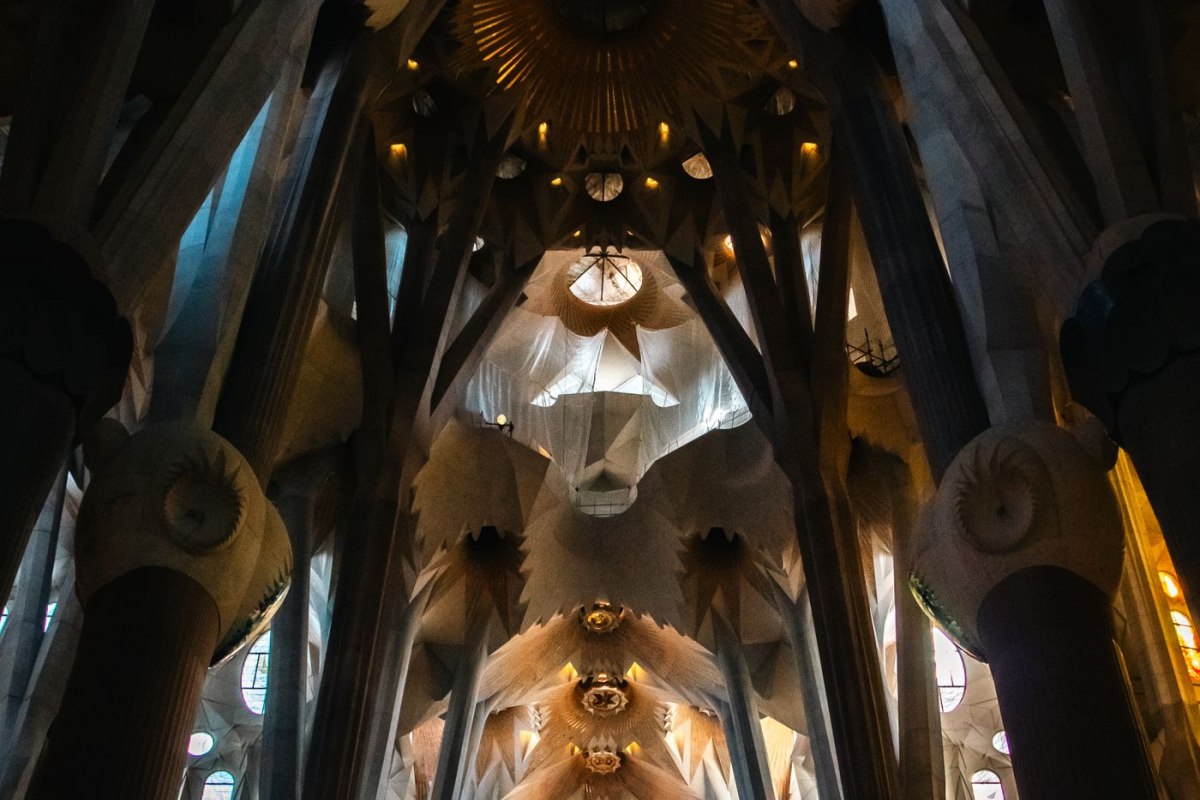
The basilica’s three great fronts were carved generations apart by different sculptors, and telling them apart is the key to reading the building.
- The Nativity facade faces the sunrise and is the only one Gaudí saw largely built in his lifetime. It is dense, soft and overgrown, encrusted with sculpted plants, animals and the story of Christ’s birth until the stone seems to be melting or growing.
- The Passion facade faces the sunset and is its deliberate opposite. Carved from the 1980s by the Catalan sculptor Josep Maria Subirachs, it is gaunt, angular and stripped bare, with skeletal figures that split opinion sharply. Many visitors find it cold; that severity is the point, matching the agony it depicts.
- The Glory facade is the main entrance and is still being built. When finished it will be the largest of the three, opening onto a planned grand stairway that would require demolishing a block of flats, a controversy the city has yet to resolve.
Inside: the stone forest and the light
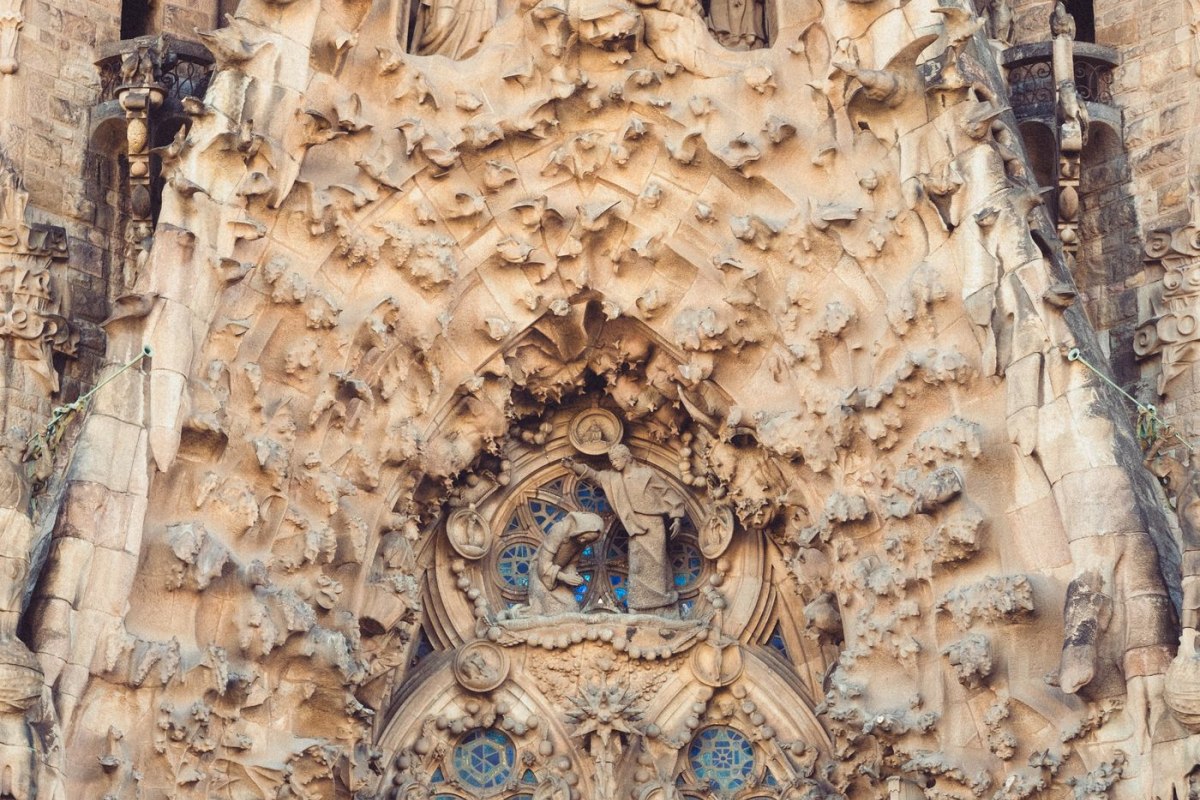
The interior is the part that surprises visitors who expected a building site. Gaudí designed the nave as a forest, and it reads exactly that way: tall columns rise and branch overhead into a canopy, drawing the eye up rather than along.
The light is engineered as carefully as the stone. Gaudí planned the windows so that the side facing the morning sun glows in cool blues and greens, while the opposite side burns in warm reds and oranges as the day turns. Stand in the centre on a bright afternoon and the whole nave fills with shifting coloured light from the stained glass, an effect worth timing your visit around.
The towers and the tallest church on earth
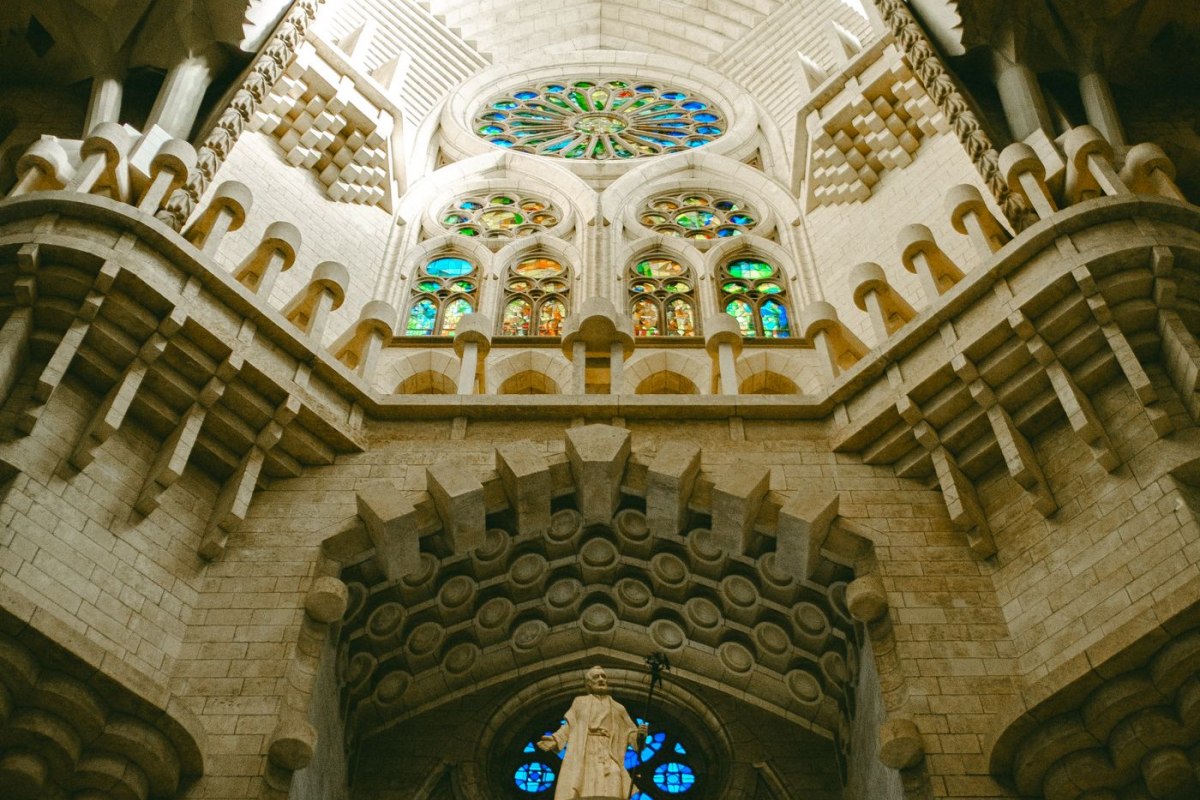
Gaudí planned eighteen towers in all, a deliberate hierarchy in stone: twelve for the apostles, four for the evangelists, one for the Virgin Mary, and the tallest at the centre for Jesus Christ.
That central Tower of Jesus Christ now tops the building at 172.5 metres, which makes the Sagrada Família the tallest church in the world, passing the previous record held by Ulm Minster in Germany. Gaudí set the height deliberately just below the hill of Montjuïc, on the principle that his work should never rise higher than God’s. A giant illuminated cross crowns the tower, visible across much of the city after dark.
Two of the facade towers are open to visitors by lift, and the climb is the closest you can get to the carved detail and the view over Barcelona, though the narrow spiral stair back down is not for anyone uneasy with heights or tight spaces.
Details the crowds walk past
A few features reward the visitor who knows to look for them, and they sit largely unremarked in the rush between the facades.
- Gaudí’s little school: in a corner of the site stands a small building with a rippling, wave-like roof, the Escoles, which Gaudí built as a free school for the workers’ and neighbourhood children. Its undulating brickwork so impressed Le Corbusier that he sketched it on a visit, and it now serves as an exhibition space.
- The city in the stone: the crypt and the Nativity side were built from Montjuïc sandstone quarried from the city’s own hill, the same grey stone used across old Barcelona, which ties the basilica physically to the ground it stands on.
- Bells played by the wind: Gaudí designed the towers to hold tubular bells sounded by the wind blowing through the spires, alongside an electronic carillon, so the finished building is meant to be an instrument as much as a church.
- What UNESCO actually listed: only the parts built in Gaudí’s own lifetime, the Nativity facade and the crypt, carry the World Heritage inscription, a reminder that most of what towers over you was raised by the architects who came after him.
How to visit the Sagrada Família
This is the most visited monument in Spain, and a careless booking can mean queues, a missed tower or flat light. A little planning changes the whole experience.
- Buy online, always. There is no longer any ticket office at the basilica. Every ticket is sold in advance on the official site, and timed slots sell out days ahead in busy periods.
- Choose your tier. Basic entry starts at around 34 euros. Adding a tower lift costs roughly 20 euros more, and a guided visit or audio guide sits in between. Tower access is a separate add-on, never included in the basic ticket.
- Pick the right tower. The Nativity tower lift gives the older, denser carving and the morning view; the Passion tower gives the harbour side. You cannot do both on one ticket.
- Time the light. Go mid-morning to catch the cool blue glass lit, or mid-to-late afternoon for the warm reds. Overcast days mute the whole effect.
- Watch your bag. The basilica is safe inside, but the metro and the plaza outside are heavy pickpocket ground. Keep valuables zipped and close.
- Getting there: the Sagrada Família metro stop on lines two and five lets out at the foot of the Nativity facade and its reflecting pond, the best first view.
For the wider Gaudí route and the combined tickets that bundle the basilica with Park Güell and the houses, see the Gaudí in Barcelona guide. The other unmissable Gaudí stop, his Park Güell, pairs naturally on the same trip.
Frequently asked questions
Is the Sagrada Família finished?
The main structure is now complete, with the central tower topped out and the basilica standing at its full height. Decorative work and the Glory facade continue, so cranes and scaffolding are still part of the picture, but the building is fully open and functioning as a church.
Is the Sagrada Família really the tallest church in the world?
Yes. The central Tower of Jesus Christ reaches 172.5 metres, passing the long-standing record of Ulm Minster in Germany. Gaudí set that height just under the Montjuïc hill so his work would not rise above nature.
Do you need to book Sagrada Família tickets in advance?
Yes, and there is no other option. Tickets are sold only online, with no ticket office at the door, and timed slots sell out days ahead in peak season. Book as early as you can, especially if you want tower access.
Should you pay for tower access?
If you are steady with heights, yes. The lift takes you up among the carved towers for close detail and a high view over the city. The descent is by a tight spiral staircase, which is the main reason to skip it if confined spaces bother you.
How long do you need at the Sagrada Família?
Allow at least ninety minutes for the interior and the two facades, and closer to two and a half hours if you add a tower and an audio guide. The interior light rewards lingering rather than rushing.
Which facade is by Gaudí?
The Nativity facade is largely Gaudí’s own and the only one well advanced in his lifetime. The Passion facade is the later work of Josep Maria Subirachs, in a stark style that divides visitors, and the Glory facade is still under construction.
Why has it taken so long to build?
For its first century the basilica relied on donations alone, which kept it poor and slow, and its forms were too complex for the engineering of the day. Modern computer design, robotic stone-cutting and ticket revenue from millions of visitors have allowed the recent surge that brought it to its full height.
Sources
- Basílica de la Sagrada Família – history, construction, tickets and visiting information
- Ajuntament de Barcelona – the works licence agreement and city investment
- Cripta Gaudí, Colònia Güell – the hanging-model method Gaudí tested before the basilica