Park Güell began as a property failure. Antoni Gaudí and his patron Eusebi Güell set out to build an exclusive hillside estate for rich families, sold almost none of the plots, and abandoned the scheme half-built. What was left, a fantasy of mosaic terraces, leaning colonnades and a tiled dragon, became the most photographed park in Barcelona. This guide explains what you are actually walking through, including the hidden water system under your feet, and tells you precisely what costs money, what is free, and how to climb up without exhausting yourself.
The park is one of the two great Gaudí landmarks, alongside the Sagrada Família, and it fits into the full Gaudí in Barcelona route.
The luxury estate that nobody bought
Around 1900, Eusebi Güell, the industrialist who bankrolled much of Gaudí’s career, set out to build a gated garden suburb on a bare hill north of the city, modelled on the English garden cities he admired. The English spelling in the park’s signs, Park rather than Parc, is a deliberate nod to that inspiration.
- The plan: sixty plots for wealthy Barcelona families, each a private villa among landscaped grounds, with Gaudí designing the shared infrastructure of roads, walls, market and terrace.
- The failure: the hill was remote, the access poor and the old-style land contracts off-putting. Of the sixty plots, only two ever sold. Just three families settled the estate: Güell himself, the lawyer Martí Trias, and Gaudí, who moved into a show house built to tempt buyers who never came. Work stopped in 1914.
- The afterlife: Güell died in 1918, and in 1922 the city council bought the site and opened it as a public park. Gaudí’s show house is now the Gaudí House Museum.
The whole place is a wealthy dream that went bankrupt, which is why its grandest features, the sweeping bench and the columned hall, were built for a market and a community that never arrived.
What costs money and what is free
The single most useful thing to understand before you go is that Park Güell is split in two, and most of it is free.
- The Monumental Zone is the ticketed core: the dragon stairway, the columned hall, the great terrace and bench, and the gatehouse pavilions. General admission is 18 euros, with children aged 7 to 12 and visitors over 65 at 13.50 euros and under-7s free, all booked online for a timed slot.
- The surrounding park, the wooded hillside with its viaducts, palm-columned paths and viewpoints, is open and free to walk. Many of the best city views are out here, outside the paid area.
- Residents enter free. Anyone registered as living in Barcelona can book a free Monumental Zone slot through the Passi Verd system. The park also opens free to everyone in two early and late daily windows, the Bon Dia Barcelona slot before opening and the Bon Vespre Barcelona slot in the evening.
El Drac and the mosaic stairway
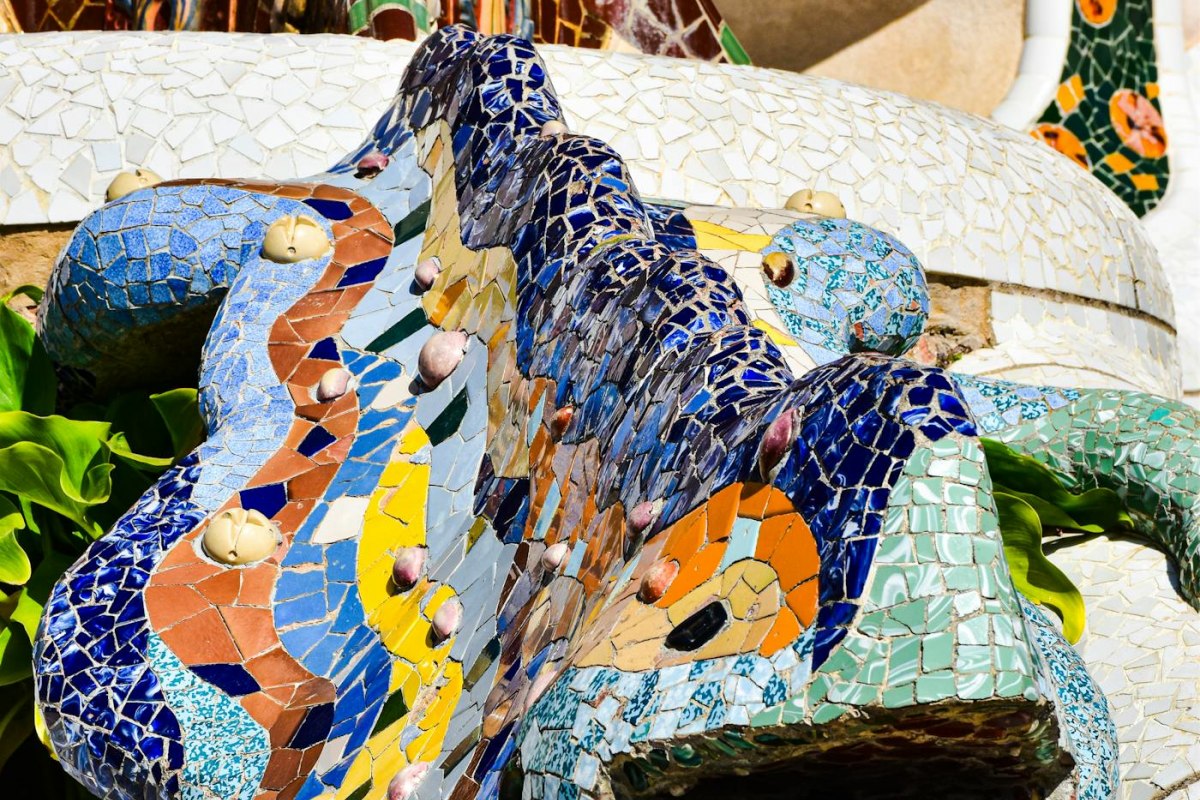
The image every visitor comes for sits on the main stairway at the entrance: El Drac, the mosaic lizard. Locals call it the dragon, though it is most often read as a salamander, and it is clad head to tail in the broken-tile mosaic that defines the park.
It is also doing a job. The creature sits at the outlet of the park’s water system, and water once flowed from its mouth. Above it on the staircase sits a second emblem, a stone serpent’s head against the red and yellow bars of the Catalan flag, turning the grand entrance into a quiet statement of Catalan identity as much as decoration.
The hall that is secretly a cistern
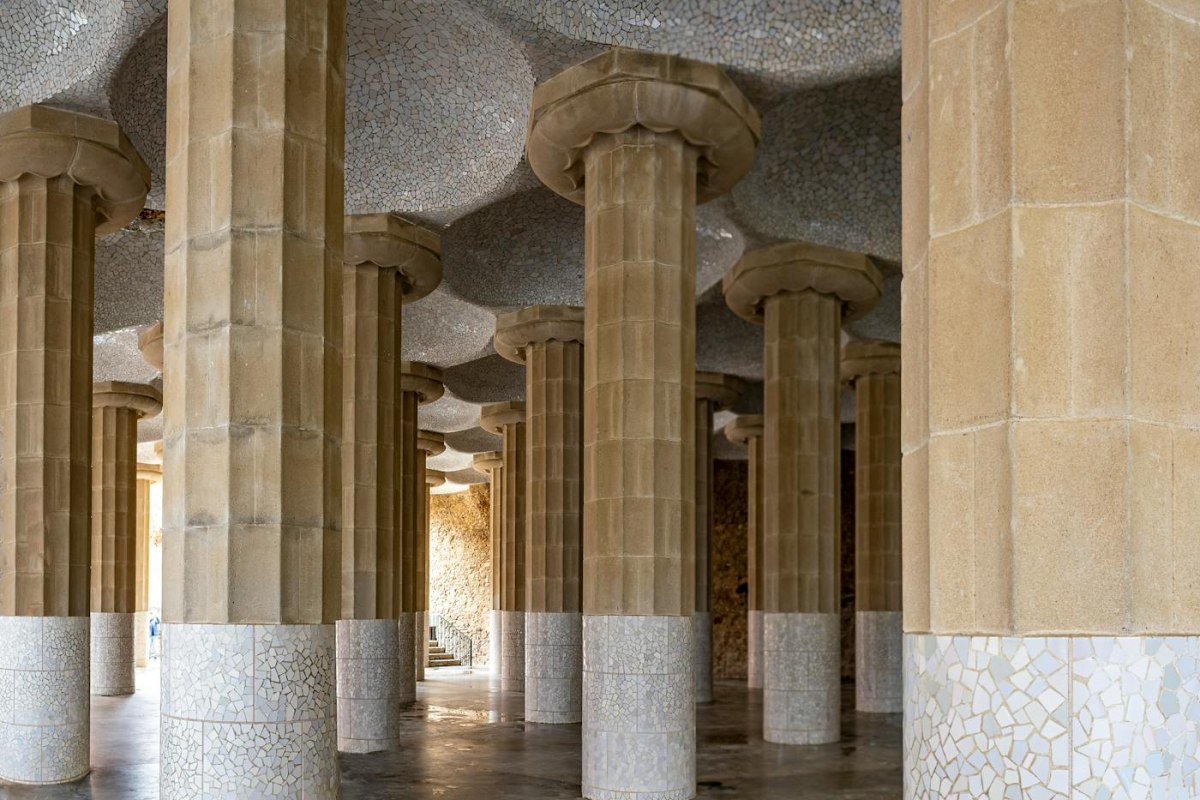
Climb past the dragon and you reach the Hypostyle Hall, a forest of stout columns that was meant to be the estate’s covered market. It is the cleverest piece of engineering in the park, and almost no one realises what it does.
- The columns: eighty-six Doric pillars hold up the great terrace above. Gaudí left the outer ring of columns leaning inward, tilted to carry the sideways load like a series of buttresses.
- The hidden tank: the columns are hollow. Rain that falls on the terrace above drains down through them into a large cistern built into the hall, which once supplied water to the estate.
- The overflow: when the tank is full, the excess runs out through the dragon fountain on the stairway below. The famous lizard is the visible end of an invisible plumbing system.
- The ceiling: between the columns, the roof is studded with circular mosaic medallions of suns and swirls, the work of Gaudí’s collaborator Josep Maria Jujol.
The terrace, the columns and the cistern are a single machine for collecting and storing water on a dry hill, dressed up as a Greek temple.
The serpentine bench and the art of broken tile
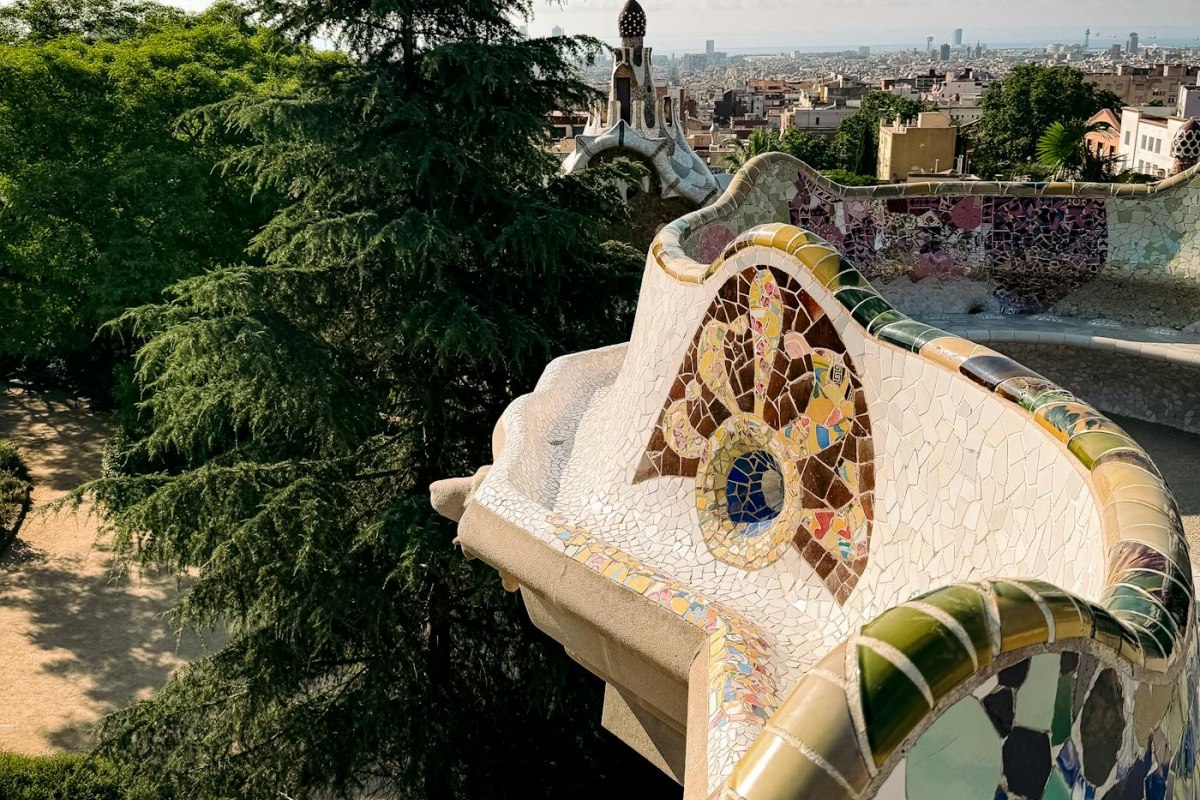
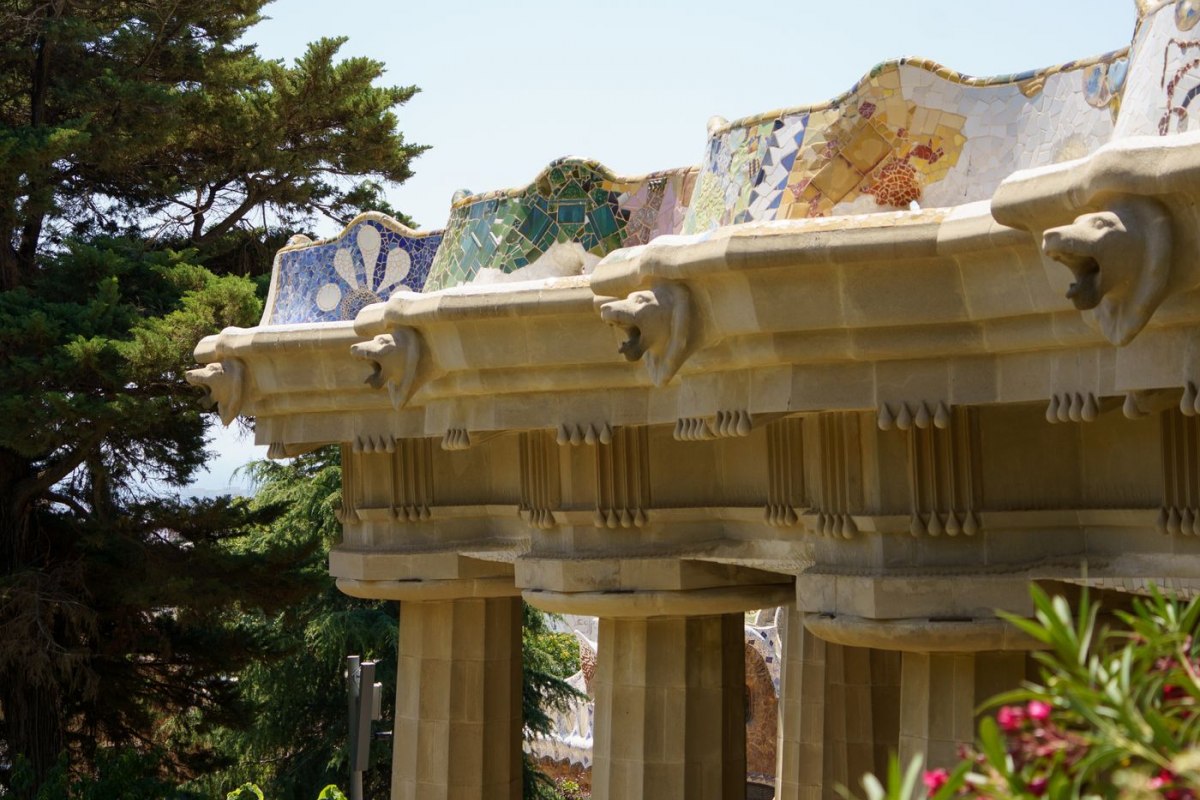
On top of the hall runs the great terrace, known as the Plaça de la Natura or Greek Theatre, edged by a long undulating bench that snakes around its rim. The market hall below was meant to support an open-air theatre up here for the estate’s residents. It is the park’s masterwork of decoration and, like much of the colour, largely the invention of Jujol rather than Gaudí.
The bench is clad in trencadís, the mosaic of broken ceramic that Gaudí made his signature. Much of it was assembled from factory rejects and smashed tiles, waste material turned into shimmering collage, an early act of recycling raised to art. Jujol worked fast and freely, even pressing in broken bottles and the odd printed plate, so the surface rewards close looking for the fragments hidden in the pattern. The bench also curves in and out in a series of bays, which is not only decorative: the shape gives sitting visitors pockets of privacy and follows the body more comfortably than a straight seat would.
Beyond the bench: viaducts, pavilions and the free viewpoint
Most visitors photograph the dragon and the terrace and leave, missing that the wider free park holds some of Gaudí’s most inventive structures and the best views of all.
- The viaducts: to carry paths across the steep slope, Gaudí built three stone viaducts whose columns lean outward and twist like tree trunks or breaking waves. Each quietly borrows a different historic style, one Gothic, one Baroque, one Romanesque, and all three cost nothing to walk through.
- The washerwoman’s portico: one walkway, the Pòrtic de la Bugadera, rears up into a stone wave on slanting columns, and one of its buttresses is carved as a woman carrying a laundry basket on her head. Local lore says a workman building the park fell for a washerwoman who passed each day, and asked Gaudí to set her in stone.
- The gatehouse pavilions: the two buildings flanking the main entrance, with their wavy roofs and trencadís spires, look like gingerbread houses. One was the porter’s lodge and now serves as an information point and shop; their fairy-tale forms set the tone for the whole estate.
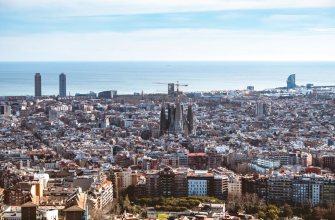
- The Three Crosses hill: the highest point in the park, the Turó de les Tres Creus, is crowned by a simple stone monument and gives a sweeping free panorama over the terrace, the city and out to the sea, often far quieter than the crowded bench below.
Walking the free zone first, up to the Three Crosses, gives you the park’s best views without a ticket and a sense of the failed estate’s scale that the paid core alone does not.
The Gaudí House Museum
Among the pines stands a pink house where Gaudí lived for most of the years he worked on the Sagrada Família. It is now the Gaudí House Museum, holding furniture he designed and personal effects, and it sits in the free part of the park with its own separate ticket. For anyone following the architect’s life it is a quiet, low-crowd counterpoint to the busy terrace.
How to visit Park Güell
The park sits high on a hillside, so the practical questions are about tickets and the climb.
- Book the Monumental Zone ahead. Entry is by timed slot bought online, and the popular late-morning and sunset slots sell out days in advance. Arrive within your half-hour window.
- Choose your metro wisely. Lesseps on line three is the gentler walk; Vallcarca, one stop further, is steeper but has public outdoor escalators on the Baixada de la Glòria that carry you up the worst of the slope.
- Go early or late. The first slot of the day and the last hours before closing are cooler, quieter and better lit. Midday in summer is hot, crowded and harsh for photographs.
- Hours: the Monumental Zone runs timed entries from 9:30 to 19:30. Check the exact last slot when you book, as the closing band shifts a little by season.
- Free first, paid second. Walk the free wooded paths and viewpoints before or after your Monumental Zone slot to get the best views without spending more.
For the combined Gaudí tickets and the full architect’s route across the city, see the Gaudí in Barcelona guide, and place the park inside a wider trip with the things to do in Barcelona guide.
Frequently asked questions
Is Park Güell free to enter?
Partly. The wooded park around the monuments, with many of the best viewpoints, is free to walk. The Monumental Zone, which holds the dragon, the columned hall and the mosaic bench, needs a timed ticket of roughly 18 to 21.50 euros. Barcelona residents can book the zone free through the Passi Verd system.
Do you need to book Park Güell tickets in advance?
For the Monumental Zone, yes. Entry is by timed slot bought online, and slots sell out days ahead in peak season. The free outer park needs no ticket.
How do you get to Park Güell?
The nearest metro stops are Lesseps and Vallcarca on line three. Lesseps is a slightly flatter walk uphill; Vallcarca is shorter but steeper, eased by public escalators on the Baixada de la Glòria. Buses and a hop-on tourist bus also serve the park.
What is the dragon at Park Güell?
El Drac is the mosaic lizard on the entrance stairway, usually read as a salamander. It is covered in trencadís broken-tile mosaic and sits at the outlet of the park’s water system, where the overflow from the hidden cistern once poured out.
How long do you need at Park Güell?
Allow about ninety minutes to two hours to see the Monumental Zone and walk part of the free park. Add more if you climb to the upper viewpoints or visit the Gaudí House Museum.
Is Park Güell worth visiting?
Yes, for the mosaic terrace, the city views and the strange engineering hidden in the columned hall. To keep costs down, walk the free zone for the views and book a Monumental Zone slot only for the dragon, hall and bench.
Sources
- Park Güell official site – history, tickets, opening times and the resident free-access scheme
- Ajuntament de Barcelona – the municipal purchase and management of the park
- Basílica de la Sagrada Família – Gaudí’s wider work and the years he lived in the park