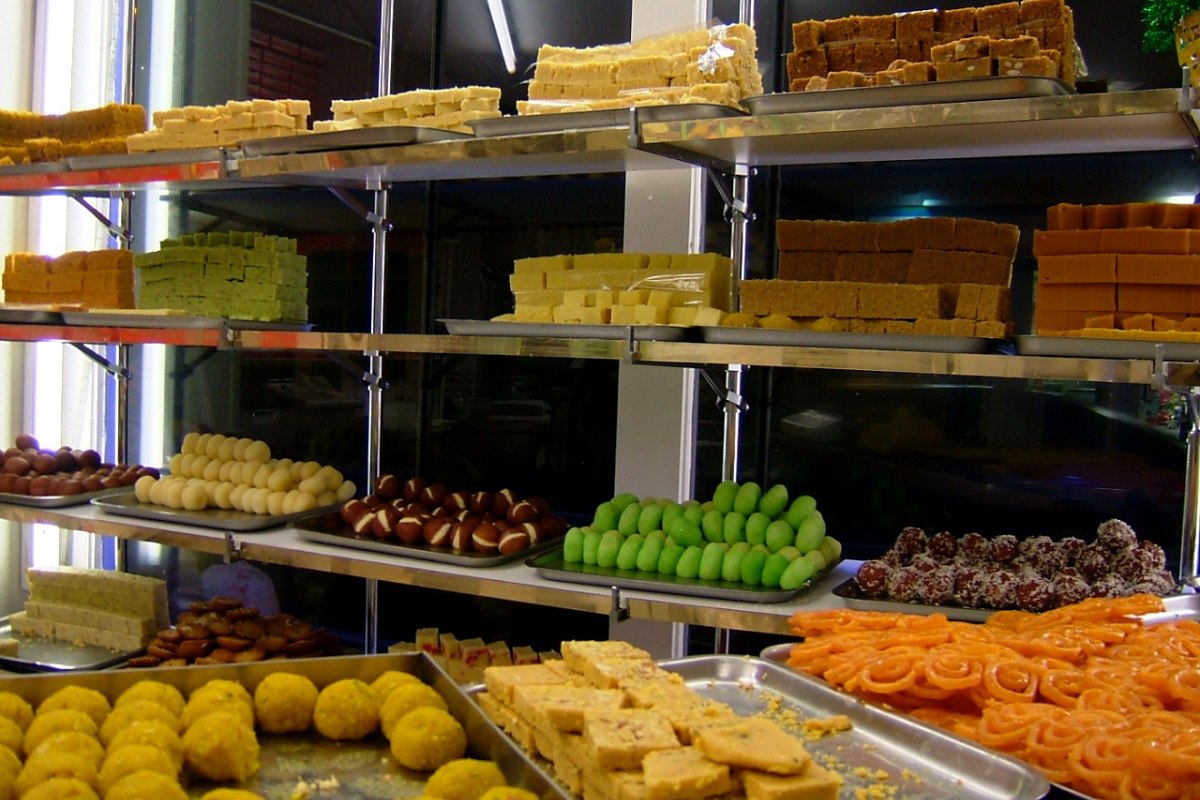
India invented sugar. The world’s word for the sweet itself, candy, comes from the Sanskrit khanda, and the technique of crystallising cane juice into solid sugar was worked out in India more than a thousand years ago. Out of that head start grew mithai, a universe of sweets so large that no single shop holds all of it. This guide is the map: the one ingredient that splits the whole tradition in two, the milk-solid family every sweet is built from, the protected regional treasures, the festival calendar that decides what gets made when, and the sweets worth learning to make yourself.
Khoya or chenna: the divide that splits Indian sweets
Almost every milk sweet in India sits on one side of a single line, and the line is what you do to the milk. Reduce it, or curdle it. That one choice separates the north from the east and explains why a Delhi sweet shop and a Kolkata one barely overlap.
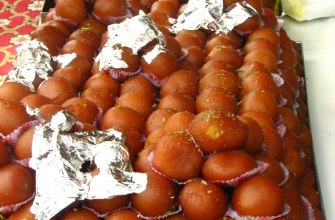
- Khoya, the reduced-milk tradition of the north and west. Whole milk is simmered for hours in a wide iron pan until the water cooks off and it collapses to a thick, fudgy solid, roughly a fifth of its starting volume. This khoya, also called mawa, is the base of barfi, peda, gulab jamun and most of the dense, rich sweets of Delhi, Punjab and Rajasthan.
- Chenna, the curdled-milk tradition of Bengal and Odisha. Milk is split with an acid, the curds drained and kneaded into a soft fresh cheese called chenna. This is the base of rasgulla, sandesh and the whole spongy, syrup-soaked world of eastern sweets.
The split is not an accident of taste. The eastern habit of curdling milk is often traced to Portuguese influence in Bengal, where cheese-making took hold, while orthodox Hindu practice elsewhere long frowned on deliberately splitting milk. So Bengal built its sweets on fresh cheese while the north built its on patiently reduced milk, and the two traditions still feel like different cuisines on a plate.
The milk-solid family every sweet starts from
Before the sugar and the shaping, an Indian sweet is usually one of a handful of milk preparations. Knowing them is knowing the grammar of the whole shop.
| Preparation | How it is made | Used in |
|---|---|---|
| Khoya / mawa | Milk reduced to a thick solid | Barfi, peda, gulab jamun |
| Chenna | Milk curdled, curds drained and kneaded soft | Rasgulla, sandesh, pantua |
| Paneer | The same curds, pressed firm | Savoury dishes, not sweets |
| Rabri | Milk simmered with layers of skin folded back in | A dessert in itself, and a topping |
| Malai | Clotted cream skimmed from boiled milk | Malai sweets, rabri, garnish |
Khoya itself comes in grades, and a good halwai chooses by the sweet. Daanedaar khoya is grainy and goes into kalakand; pindi, the driest, presses into barfi and peda; dhap, the softest and moistest, is rolled for gulab jamun and pantua. Chenna and paneer start identically, from the same curds, and part ways only at the last step: chenna is kept soft and moist for sweets, while paneer is pressed firm under a weight for curries. One pot of split milk becomes either a rasgulla or a saag paneer depending on a few minutes under a weight.
Beyond milk: the other sweet families
Milk sweets are only half the shop. A second world of mithai is built on flours, semolina, nuts, jaggery and seasonal vegetables, and sorting sweets by their base ingredient is the surest way to understand them.
| Base | Sweets |
|---|---|
| Gram flour (besan) | Besan laddu, Mysore pak, soan papdi |
| Semolina (sooji) | Sooji halwa, rava laddu, the South Indian kesari |
| Refined flour (maida) | Jalebi, imarti, balushahi, gujiya |
| Rice | Kheer, Bengali payesh, pithe, Joynagar moa |
| Nuts | Kaju katli, badam barfi, pista rolls |
| Jaggery and sesame | Til laddu, chikki, the winter Sankranti sweets |
| Vegetable and fruit | Gajar halwa, Agra petha from ash gourd, aamras |
This is why a vegetarian, even a vegan, can eat deep into Indian sweets: a besan laddu, a sesame chikki or an ash-gourd petha needs no dairy at all. The base ingredient also tracks the season. Carrot halwa is a winter sweet because that is when the red carrots come; sesame and jaggery sweets cluster around the January harvest festivals because they warm the body; mango sweets are a summer affair. A mithai shelf read closely tells you the time of year.
The syrup and the ghee
Two techniques underpin a huge share of the sweets, and getting them is most of the craft. The first is the sugar syrup, the chashni, and its consistency decides everything. Cooks judge it by threads: a one-thread syrup, which forms a single strand between finger and thumb, soaks into a gulab jamun; a two-thread syrup sets harder around a jalebi or a balushahi; a still thicker syrup at the soft-ball stage shapes a barfi or a laddu. Misjudge the chashni and the same ingredients give a soggy sweet or a rock-hard one.
The second is ghee, clarified butter, which is the fat almost all mithai is cooked in. It carries flavour, browns the milk and flour, and gives sweets their keeping quality and their richness. A halwa is defined by how much ghee it has drunk; a laddu is bound by it. The finishing touch on the finest sweets is vark, a gossamer leaf of edible silver beaten paper-thin and laid over barfi and kaju katli, a flourish that goes back to the Mughal table. Between a well-judged chashni and enough ghee, most of the sweet shop is within a home cook’s reach.
The country that invented sugar
The sweetness itself has an Indian pedigree. Sugarcane reached the subcontinent by around 1000 BC, and it was in India, during the Gupta era around the fourth century, that cooks first learned to boil cane juice down and crystallise it into solid sugar rather than leaving it as syrup. Before that, the world sweetened with honey and raw cane juice; India turned sugar into a storable, tradable solid.
The words still carry the history. The Sanskrit sharkara, meaning grit or gravel, described those first sugar crystals and travelled through Arabic and Latin to become the English sugar. And khanda, a Sanskrit word for a piece of crystallised sugar, is the root of the English candy. When the West names its sweets, it is speaking borrowed Sanskrit. That long sugar tradition is why India developed not one or two sweets but hundreds, and why a sweet shop is a fixture of every Indian neighbourhood rather than an occasional treat.
The halwai and the moira
Indian sweets are rarely made at home from scratch; they are bought from a specialist, and the specialist is an institution. In the north the sweet-maker is the halwai, whose shop, the mithai counter, anchors a market street, glass cases stacked with trays sold by weight. In Bengal the equivalent is the moira, the traditional confectioner whose families have kept their chenna recipes for generations.
Some of these houses are famous. K.C. Das in Kolkata, descended from the family credited with the modern rasgulla, turned a moira’s recipe into a brand that canned the sweet and sent it across the world. A wedding or a festival means an order placed with a known halwai weeks ahead; a visit to someone’s home means a box of mithai carried to the door. The sweet-maker is woven into the social fabric in a way the Western baker is not, because mithai is the currency of celebration, condolence and courtesy alike.
The Persian and Mughal layer
Not every Indian sweet grew from Indian milk and sugar alone. A whole stratum arrived with the Persian and Central Asian courts and settled into the repertoire. The very word halwa is Arabic, meaning sweet, and the dense, ghee-rich puddings it names, from semolina halwa to the famous Karachi and Bombay halwa, came west to east with Muslim cooks. Jalebi descends from the Persian and Arab zalabia, a fried syrup sweet documented in medieval cookbooks long before it reached India. The Mughal kitchens added their love of nuts, saffron, rose and silver leaf, refining sweets like shahi tukda, the royal bread pudding, and the nut barfis that still read as festive and grand.
Layered under that is the oldest tradition of all, the temple sweet. Many of India’s most revered mithai are prasadam, food first offered to a deity and then shared, from the Tirupati laddu to the Jagannath temple’s rasgulla to the panjiri and peda of countless shrines. A sweet in India is rarely only a sweet; it can be a court luxury, a religious offering and a street snack all at once, depending on which thread of this history you follow.
The protected sweets: India’s GI mithai
A growing number of Indian sweets carry a Geographical Indication, the legal protection that ties a name to a place, the same kind of tag that guards Champagne or Parmesan. For sweets, the GI is often the front line of a fierce regional pride.
| Sweet | Place | GI year |
|---|---|---|
| Tirupati Laddu | Tirupati, Andhra Pradesh | 2009 |
| Joynagar Moa | Joynagar, West Bengal | 2015 |
| Bardhaman Sitabhog | Bardhaman, West Bengal | 2017 |
| Banglar Rasogolla | West Bengal | 2017 |
| Odisha Rasagola | Odisha | 2019 |
The Tirupati Laddu is the most striking case: it is a temple offering, the prasadam handed to pilgrims at the Venkateswara temple, made only in the temple’s own kitchen by the Tirumala Tirupati Devasthanams, and the GI exists to stop anyone else selling a sweet under that sacred name. Joynagar Moa, made from date-palm jaggery and the puffed rice called khoi only in winter, and Bardhaman Sitabhog, a tangle of fine rice-flour and chenna strands that once impressed a visiting British viceroy, are both bound to a single town. The list keeps growing: Dharwad pedha from Karnataka, the Bardhaman companion sweet Mihidana, and others have joined it, each a town staking a legal claim to a recipe. The tag is less about quality control than about a place insisting that its sweet belongs to it.
The pattern says something about how seriously India takes its sweets. A GI fight is expensive and slow, the kind of effort a country usually reserves for wine, cheese or handicraft, and that towns will wage it over a laddu or a rasgulla shows that mithai is treated as heritage, not confectionery. Behind each tag is a guild of makers arguing that their version, in their place, with their water and their method, cannot be reproduced elsewhere. It is the same irreplaceability that a great regional dish claims, written into law.
The rasgulla war
No GI was fought harder than the rasgulla’s. The modern spongy white rasgulla is widely credited to Nobin Chandra Das, a Kolkata moira who in 1868 worked out how to boil chenna balls in light sugar syrup so they stayed soft and bouncy, and whose family later founded K.C. Das. Bengal treats him as the inventor and the sweet as a Bengali birthright.
Odisha disagreed. It argued that a softer, browner rasgulla had been offered for centuries at the Jagannath temple in Puri, where the Pahala rasgulla is a fixture, long before any Kolkata shop. The two states fought a public, years-long battle over who owned the name, and the resolution was a quiet acknowledgement that they are different sweets: West Bengal won a GI for the white, spongy Banglar Rasogolla in 2017, and Odisha won a separate GI for the browner, softer Odisha Rasagola in 2019. Both were right, which is the most Indian possible ending to a fight over a sweet.
A sweet map of India
Like the savoury food, the sweets change as you travel, and the famous ones are tied to towns the way a wine is tied to a vineyard.
- The north runs on khoya: Mathura’s peda, Agra’s ash-gourd petha, Bikaner and Jaipur’s syrup-drenched ghevar, the silver-leafed kaju katli of every Delhi shop.
- The west brings Maharashtra’s modak, the steamed rice-and-coconut dumpling offered to Ganesha, and puran poli, the lentil-stuffed sweet flatbread, alongside Goa’s Portuguese-rooted bebinca.
- The east is the chenna heartland: Bengal’s sandesh, rosogolla and the fermented mishti doi, Odisha’s temple sweets, Bihar’s flaky khaja and the milk-fudge of the region.
- The south answers with Mysore pak, the ghee-soaked gram-flour fudge from the Mysore palace kitchens, Dharwad pedha, the temple payasam and the Tirupati laddu.
Each of these belongs to its place as firmly as a regional dish does, and a traveller who asks for the local sweet rather than a generic box learns more about a town in one bite than a guidebook gives in a page. The famous houses guard their versions: a Mysore pak from the right Bengaluru shop and a supermarket copy are not the same sweet.
Sweets by festival
What a halwai makes depends on the calendar as much as the region, because mithai is tied to the festival cycle. Each celebration has its sweets, and they are not interchangeable.
- Diwali, the biggest sweet season, fills shops with laddu, barfi, kaju katli, soan papdi and boxes given by the dozen.
- Holi belongs to gujiya, the fried khoya-stuffed pastry, and to malpua, syrup-soaked pancakes.
- Eid centres on sheer khurma and sevaiyan, vermicelli simmered in milk with dates and nuts, and on shahi tukda.
- Durga Puja in Bengal means sandesh and the whole chenna repertoire, exchanged across the neighbourhood.
- Raksha Bandhan, Janmashtami and weddings each pull their own sweets from the same deep shelf.
The festival logic runs deep: many sweets exist because a particular ingredient is seasonal or a particular day demands an offering, so the mithai shop is also a calendar you can taste. Sankranti and Lohri in January bring sesame and jaggery; Ganesh Chaturthi calls for steamed modak; Janmashtami means milk sweets and butter; Karva Chauth and Navratri have their own fasting-friendly treats. A halwai plans the year around these dates, and a regular customer can tell the season from the trays in the window without checking a calendar.
Mithai in the rituals of life
To understand why India makes so many sweets, watch when they appear. Mithai marks almost every threshold in a life. A birth is announced by distributing sweets to neighbours. Good news, an exam passed, a job won, a deal closed, is met with muh meetha karo, an invitation to sweeten the mouth, and a piece of mithai pressed on you. A wedding runs on boxes of sweets exchanged between families. Even mourning has its sweets, served after the rites. Diwali turns the whole country into a circulation of mithai boxes carried from door to door.
This ritual weight is why the sweet shop matters more than its Western equivalent. A box of mithai is never just dessert; it is a message of celebration, respect or comfort, and the choice of shop and sweet carries meaning. To arrive at a festival or a family home empty-handed is a small failure of manners; to bring a box from a respected halwai is to do the thing properly. The sweetness is social before it is culinary.
The modern mithai shop
The trade has scaled without quite losing its roots. Old single-counter halwais now sit beside national chains like Haldiram’s and Bikanervala, which box and ship mithai across the country and abroad, and K.C. Das, which canned the rasgulla generations ago. Festival season, above all the weeks around Diwali, is when the business lives or dies, with shops running day and night to meet the demand for gift boxes.
That demand has a shadow side worth knowing. Around Diwali, when khoya runs short, adulteration spikes, and food inspectors regularly seize batches of fake or synthetic mawa made from starch and detergent rather than milk. The safe move is to buy from a busy, reputable shop that turns its stock fast. Modern tastes have also pushed the sweet shop to adapt, with sugar-free mithai for diabetics, lighter baked versions and fusion sweets like chocolate barfi and gulab jamun cheesecake, none of which have displaced the classics so much as crowded in beside them.
How to read a mithai shop
A first visit to an Indian sweet counter can overwhelm, but the trays sort into a few families, and knowing them turns a wall of colour into a menu.
- Barfi, dense milk-fudge squares, plain or flavoured with pistachio, coconut or the silver-leafed kaju katli.
- Laddu, round sweets of gram flour, semolina or boondi bound with syrup and ghee.
- Peda, soft khoya discs, often saffron-scented.
- Syrup sweets, the soaked ones: gulab jamun, jalebi, rasgulla, the wettest and most indulgent shelf.
- Halwa, the soft, ghee-rich puddings of semolina, carrot or lentil.
- Chenna sweets, the Bengali shelf of sandesh, rasgulla and their cousins.
Everything is sold by weight, ordered by the kilo or half, boxed and tied with string. A good shop turns its stock fast, so the busiest counter is usually the freshest, and the syrup sweets in particular are best eaten the day they are made.
The sweets worth learning to make
Most mithai is bought, but a handful reward the home cook, and they are the doorways into the wider tradition. Each earns its own page in this cluster.
- Gulab jamun, the khoya dumpling fried and soaked in rose syrup, the gateway sweet of the north and the easiest crowd-pleaser to master.
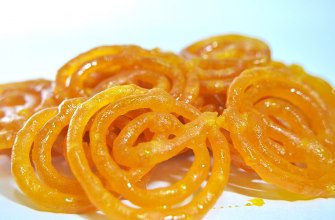
- Jalebi, the fermented-batter spiral fried crisp and soaked in syrup, the orange coil of every fair and festival.
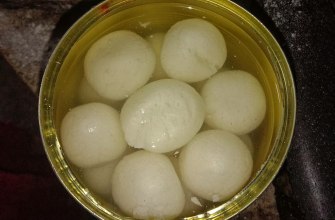
- Rasgulla, the Bengali chenna sphere whose whole identity is the spring in its bite.
- Gajar halwa, the winter carrot pudding cooked down in milk and ghee, the home sweet that needs no halwai and no special skill, only patience and good red carrots.
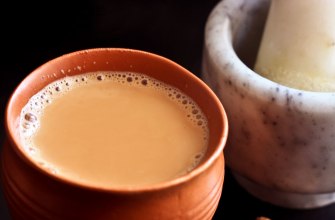
Between the reduced-milk sweets of the north and the curdled-milk sweets of the east, these four cover both halves of the divide this guide began with, plus the ghee-and-sugar craft that everything else shares. Start with one, learn its chashni and its timing, and the rest of the shop opens up. For where sweets sit in the wider meal, alongside a cup of masala chai and the savoury dishes of each region, the guide to Indian cuisine and spices sets out the whole table, and the older rasgulla tradition shows the chenna line at work.
Frequently asked questions
What is the difference between khoya and chenna?
Khoya is milk reduced by long simmering to a thick solid, the base of northern sweets like barfi and gulab jamun. Chenna is milk curdled into a soft fresh cheese, the base of Bengali sweets like rasgulla and sandesh. One is concentrated, the other curdled.
Why are Bengali sweets so different from North Indian ones?
Because they start from different milk. Bengal built its sweets on chenna, curdled fresh cheese, a tradition often linked to Portuguese cheese-making in the region, while the north built its on khoya, reduced milk. The two produce almost separate worlds of sweets.
Did India really invent sugar?
India was the first place to crystallise cane juice into solid sugar, around the Gupta era in the fourth century. The English words sugar and candy both descend from Sanskrit, from sharkara and khanda, a sign of where the technology and trade began.
Who invented the rasgulla, Bengal or Odisha?
Both have a claim. Bengal credits Nobin Chandra Das with the modern spongy white rasgulla in 1868; Odisha points to a centuries-old temple rasgulla at Puri. The dispute ended with separate GI tags, for Banglar Rasogolla in 2017 and Odisha Rasagola in 2019, recognising them as different sweets.
What sweets are made for Diwali?
Diwali is the great sweet festival, with laddu, barfi, kaju katli, soan papdi and gulab jamun the most common, bought in boxes and exchanged as gifts across the holiday.
Are there Indian sweets without milk?
Many. Besan laddu, sesame and jaggery chikki, soan papdi, Agra petha from ash gourd and most semolina and gram-flour sweets use no dairy, which makes a large part of the mithai world suitable for vegans and for those avoiding milk.
Why do home cooks buy khoya instead of making it?
Making khoya means standing over a wide pan stirring milk for an hour or more as it reduces to a fifth of its volume, which is slow and easy to scorch. Most home cooks buy ready khoya from the halwai and use it as a base, reserving the long reduction for those who want full control of the sweet.
What is vark, the silver on some sweets?
Vark is edible silver beaten into a leaf finer than paper and laid over barfi, kaju katli and other festive sweets. It is tasteless and purely decorative, a flourish inherited from the Mughal table, and it is safe to eat in the tiny quantities used.
Sources
- Sweets of the Indian subcontinent, an overview
- Khoa (khoya/mawa), the reduced-milk base
- History of sugar and the Sanskrit roots of sugar and candy
- SpicyIP, on the Banglar Rasogolla and Odisha Rasagola GI tags
- Image: Mithai for Diwali, Wikimedia Commons, CC BY-SA 2.0, by Laura