Döner means “it turns”, and that is the whole idea: a tall stack of marinated meat rotating beside a vertical flame, its crisping outer edge shaved off in thin ribbons. From a single innovation in a Bursa bazaar in 1867, döner grew into the meat in a shawarma, a gyro and a Mexican al pastor taco, and into the street food that now defines fast eating in Germany. This guide covers what döner is, where it began, how it took over Berlin, its many forms, and how to spot a good one.
What döner kebab is
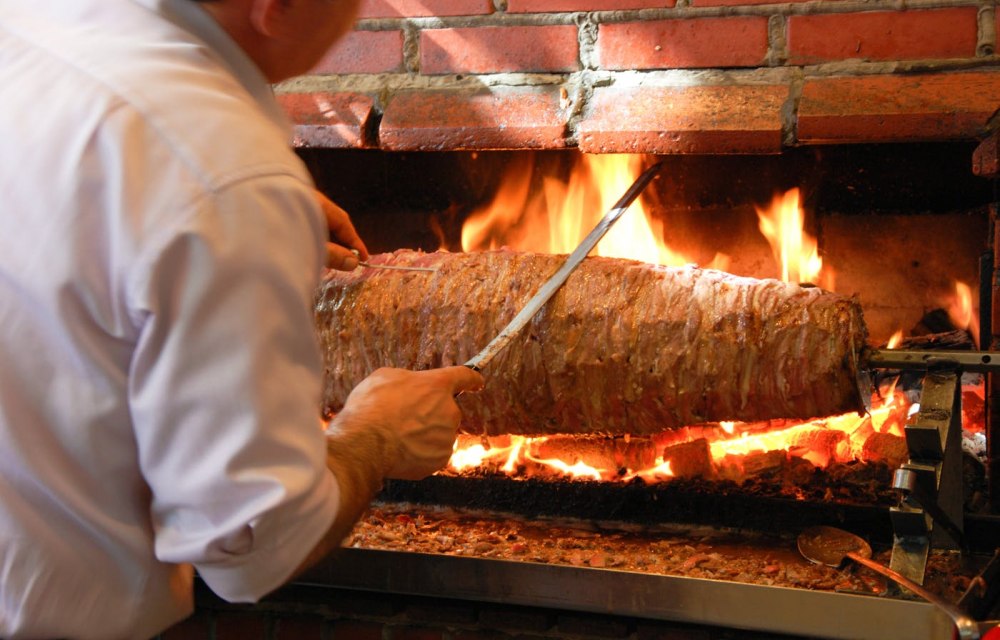
Döner is not a single cut but a built tower. Thin slices of seasoned lamb, beef or chicken are stacked onto a vertical skewer, sometimes layered with fat or minced meat to keep it moist, then set turning in front of a gas or charcoal grill.
- The shave. Only the outer layer cooks at any moment. The cook shaves off the browned, crisp edge with a long knife or electric blade, and the next layer browns behind it.
- Et or tavuk. Et döner is the red-meat version of lamb and beef; tavuk döner is chicken, lighter and cheaper. Many stalls run both spits side by side.
- Why vertical matters. Turning upright lets fat drip down and the surface crisp evenly, which is the texture that makes döner what it is.
İskender and the upright spit
For centuries Anatolian cooks grilled meat flat over coals. The turn to vertical is tied to one name in Bursa.
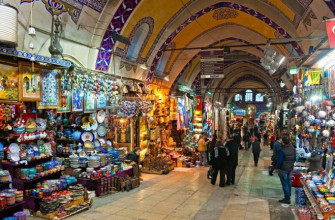
- The man. In 1867 a cook called İskender Efendi, from a family of meat cooks, opened a shop beside the Kayhan Mosque in Bursa’s Kayhan Bazaar and set out to improve the grilled-meat kebab.
- The idea. Until then a lamb was roasted whole and flat over the coals, so the prized cuts never reached every plate. He boned the meat, stacked it on a skewer stood upright before a charcoal fire, and shaved it to order, so it cooked from the side, basted in its own fat and crisped as it turned.
- The legacy. The dish and the family name became one. Kebapçı İskender still trades in Bursa under the İskenderoğlu family, who hold the trademark, and the sign reads since 1867.
The cağ kebabı, döner lying down
Eastern Turkey kept the older horizontal form alive in the cağ kebabı of Erzurum. Here the marinated lamb turns on a horizontal skewer over wood embers, and the cook slices portions onto smaller hand skewers to order. Many Turks regard cağ kebabı as the ancestor of döner, the same meat and method cooked on its side before İskender stood the idea upright. It is still a regional speciality worth seeking out in the northeast.
İskender kebap, the plated original
İskender did more than stand the spit up. He built a plated dish around the shaved meat that remains a destination in its own right.
A plate of İskender kebap is a bed of diced pide bread, covered with thin slices of döner, then dressed with a tomato sauce and a ladle of sizzling melted butter poured over at the table, with a scoop of strained yogurt on the side. The browned butter and the cool yogurt against the meat and soaked bread are the point. People travel to Bursa to eat it at the source, and a true İskender is measured by the quality of its butter and yogurt as much as its meat.
How döner conquered Berlin
The döner most Europeans know is not a plate but a sandwich, and that form was shaped by Turkish workers in Germany.
- The stall. In 1972 Kadir Nurman, a Turkish migrant, set up a stand near the Zoologischer Garten station in West Berlin and sold döner meat stuffed into flatbread with salad, food a worker could eat on the move.
- The spread. The format caught on across Germany and became the country’s defining fast food, with thousands of shops and a place in daily life that rivals the sausage.
- The honest record. Nurman is widely credited, though he never claimed to be the only one. As he put it, the kebab became well known through him.
Whose döner is the real one?
Döner has even become a matter of international paperwork. Turkey’s döner federation has applied to the European Union to have döner recognised as a protected traditional speciality, with rules on the type of meat, the cut and the method of cooking. Germany, where the sandwich is a daily staple prepared its own way, pushed back, since binding rules from Ankara would force German shops to change how they work. The argument is friendly but real, and it shows how far a Bursa idea has travelled when two countries can quarrel over who gets to define it.
One spit, many names
The vertical rotisserie spread far beyond Turkey, and most of the world’s spit-roasted street meats trace back to it.
- Shawarma – the Arab version across the Levant and beyond, often beef or chicken with garlic sauce and pickles.
- Gyros – the Greek take, sliced from a similar spit and wrapped in pita with tzatziki.
- Al pastor – the Mexican taco filling, brought by Lebanese migrants who adapted shawarma to pork and chilli.
- Donair – the Canadian version from Halifax, with a sweet condensed-milk sauce.
All of them descend from the same nineteenth-century Ottoman idea of cooking meat on a turning upright skewer.
The forms of döner in Turkey
In Turkey the shaved meat reaches the plate in several ways.
- Porsiyon – a plate of meat on its own or over rice, called pilav üstü döner.
- Dürüm – the meat rolled in thin lavaş or yufka flatbread with salad and sauce, the wrap form, the word meaning roll.
- Ekmek arası – stuffed into a quarter or half loaf of bread, the everyday street sandwich.
- İskender – the Bursa plated dish with butter and yogurt.
- Pide and lahmacun pairings – in many shops döner shares the counter with these baked breads, though it is its own dish.
How döner is made
Building a good spit is slow work. The cook layers marinated slices of meat, often alternating lean and fatty cuts, and caps the top with a block of fat or a tomato so the juices run down and baste the stack as it turns. The marinade leans on yogurt, onion, pepper and spices. The spit needs an hour or more to start cooking through, and the cook shaves only what has browned, never digging into the raw inner core. A processed, uniform cone of reformed meat is the cheap shortcut; a hand-stacked spit of real cuts is the mark of a serious shop.
How to eat it well
- Watch the spit. Look for a hand-stacked tower of real meat, not a smooth machine-made cone.
- Pick a busy stall. Fast turnover means the meat is freshly shaved, not steamed grey under a lamp.
- Mind the sauces. Garlic yogurt and a hot red sauce are the classics, with sumac-dusted onions and parsley to cut the richness.
- Choose your carb. A dürüm travels best, ekmek arası fills most, and a porsiyon lets the meat speak for itself.
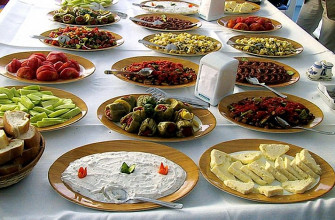
Döner is the most famous of the Turkish kebabs, which run far wider across the country. See the full guide to Turkish cuisine for the kebab family, read about the flatbreads that wrap and carry it, and the cold meze that share the table.
Frequently asked questions
What does döner mean?
It means turning, from the Turkish dönmek, to turn. The name describes the vertical skewer of meat that rotates in front of the fire while it cooks.
Is döner the same as shawarma or gyros?
They are close relatives. All come from the Ottoman vertical spit. Shawarma is the Arab version, gyros the Greek, and Mexican al pastor descends from the same idea by way of Lebanese migrants. Döner is the Turkish original of the family.
What meat is döner made from?
Lamb and beef for et döner, or chicken for tavuk döner. The meat is sliced thin, marinated, stacked on the skewer and often layered with fat to keep it juicy.
What is İskender kebab?
It is the Bursa plated dish of döner over diced pide bread, topped with tomato sauce and sizzling butter and served with yogurt. It dates to İskender Efendi in 1867 and is named after him.
Who invented the döner sandwich?
The döner-in-flatbread fast food is widely credited to Kadir Nurman in West Berlin in 1972, though he never claimed to be the only one selling it. The vertical-spit meat itself is far older.
What is cağ kebabı?
It is the horizontal, wood-fired döner of Erzurum in eastern Turkey, sliced onto small skewers to order. Many consider it the older ancestor of the upright döner.
Sources
- Doner kebab – history and lineage
- İskender kebap – Bursa origin
- Kadir Nurman – the Berlin döner sandwich
- National Geographic – what is Turkish döner kebab