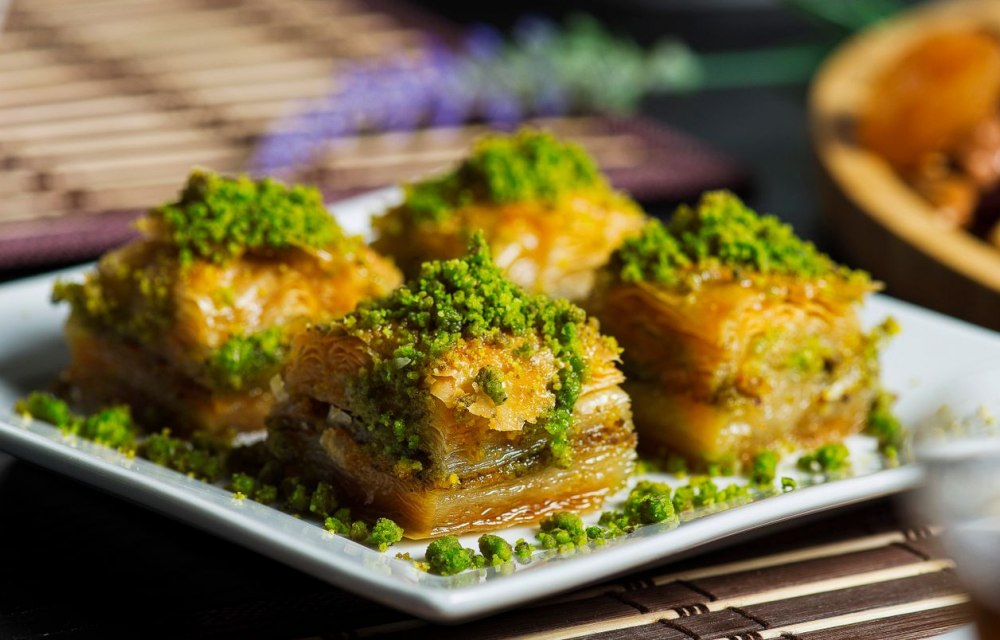
Baklava is the showpiece of the Turkish sweet table: dozens of sheets of paper-thin pastry, a layer of green pistachio, clarified butter and a sugar syrup, baked until it shatters at the fork. Behind that simple description sit a protected origin in Gaziantep, a centuries-old palace ceremony, and a craft that takes years to master. This guide covers where the best baklava comes from, how the forty layers are built, the syrup rule that makes or breaks it, the types worth knowing, and how to make a tray at home.
Antep baklava, the protected original
Not all baklava is equal, and one version carries a legal seal. Antep Baklavası, the baklava of Gaziantep in southeastern Turkey, became the first Turkish product to win a European Union geographical indication, registered in 2013. The protection ties the name to a recipe and a place.
- The pistachio. Real Antep baklava uses the small, intensely green Antep pistachio, itself a protected crop, which gives the colour and the flavour cheaper baklava cannot copy.
- The butter. It is made with local clarified butter, sadeyağ, churned almost to pure fat from goat milk and brushed between the layers in place of margarine.
- The dough. The pastry is hand-rolled yufka, stretched until you can read print through it.
Gaziantep treats baklava as civic pride. The city is a UNESCO City of Gastronomy, its baklava workshops pass down through families, and a tray from a Gaziantep master is the benchmark every other version is measured against. The Turkish register lists it as a mark of origin under number 95, and the rules hold that a true Antep baklava cannot be made outside Gaziantep. The registered recipe even fixes the kaymak, boiled with a little semolina to between 105 and 108 degrees.
Forty layers of yufka
The craft is in the pastry. A baklavacı, the baklava master, rolls dough into yufka sheets so thin they are nearly transparent, using a long thin pin called an oklava.
- The stack. A classic tray holds around forty sheets, brushed with clarified butter, with the nut layer set in the middle so the pastry is balanced above and below.
- The cut. The whole tray is sliced into its diamonds or squares before baking, never after, so the syrup can reach every layer.
- The bake. It bakes until deep golden and crisp, the butter carrying the heat evenly through the sheets.
Rolling yufka by hand to an even, tearless thinness is the skill that separates a master from an amateur, which is why the best workshops still roll by hand rather than by machine.
The syrup rule
Turkish baklava is finished with şerbet, a syrup of sugar, water and a little lemon juice. It is not soaked in honey, which is the Greek style; the lemon in a sugar syrup keeps the baklava from turning cloyingly sweet and stops the syrup crystallising.
The rule every baklava maker knows is about temperature. The syrup and the pastry must never be poured hot onto hot, or the baklava goes soggy. One must be hot and the other cool: most makers pour cooled syrup over a tray straight from the oven, so it hisses, soaks in, and still sets crisp. Get that contrast right and the baklava drinks the syrup yet keeps its crunch.
The Baklava Alayı, a sultan’s procession
Baklava was woven into the calendar of the Ottoman court through a ceremony called the Baklava Alayı, the baklava procession.
- The gift. On the fifteenth day of Ramadan, the Sultan handed out trays of baklava to the janissaries, his standing soldiers, one tray for every ten men.
- The parade. The soldiers carried the trays back to their barracks in a public procession through Istanbul, two men to a tray slung on a cloth, a spectacle the city waited for each year.
- The history. The custom took shape under Suleiman the Magnificent and ran for centuries, a yearly measure of the Sultan’s generosity, ending only when the janissary corps was abolished in 1826.
Types of baklava
Baklava is a family, not a single sweet.
- Fıstıklı – the pistachio baklava of Gaziantep, the gold standard.
- Cevizli – made with walnuts, common further north and west and cheaper than pistachio.
- Şöbiyet – a triangle with a pocket of kaymak, clotted cream, set among the nuts.
- Havuç dilimi – the carrot slice, a fat wedge with extra pistachio along the cut edge.
- Bülbül yuvası – the nightingale’s nest, rolled into a ring with nuts in the centre.
- Fıstık sarma – thin pastry wrapped tightly around a dense line of pistachio.
- Sütlü Nuriye – a lighter, milk-soaked version, paler and less sweet than syrup baklava.
How Turks eat baklava
Baklava is a treat for guests and holidays rather than an everyday dessert. It appears at the religious feast of Şeker Bayramı, at weddings and to honour visitors. It is usually eaten on its own or with tea rather than drowned in cream, though a scoop of kaymak alongside is welcome. Portions are small because it is intense, and a single perfect piece beats a plateful of the ordinary. The Gaziantep houses of Güllüoğlu and İmam Çağdaş are the names Turks trust, and a box of their fıstıklı baklava is a prized gift to carry from the city. Turkey even marks a World Baklava Day on the seventeenth of November each year.
Make it at home: pistachio baklava
Hand-rolling yufka is a craft, so a home cook can use ready-made phyllo and still get a fine tray.
Ingredients
- 1 packet of phyllo (yufka) pastry
- Clarified butter (sadeyağ), melted, for brushing
- Finely chopped pistachios
- 2 cups sugar
- 1.5 cups water
- A squeeze of lemon
- Make the syrup first so it can cool: simmer 2 cups sugar with 1.5 cups water and a squeeze of lemon for ten minutes, then leave it to go cold.
- Brush a tray with melted clarified butter and lay in half a packet of phyllo sheets, buttering every few sheets.
- Spread a thick layer of finely chopped pistachios across the pastry.
- Cover with the rest of the phyllo, buttering as you go, and brush the top.
- Cut all the way through into diamonds with a sharp knife before baking.
- Bake at 170 degrees Celsius for about 40 minutes until deep golden and crisp.
- Pour the cold syrup evenly over the hot baklava, then leave it for a few hours to drink it in before serving.
Is baklava Greek or Turkish?
Both countries claim it, and layered pastry sweets are ancient across the region, so the honest answer is that no one nation invented the idea. The baklava the world eats today, with its tissue-thin phyllo, clarified butter and nut filling, took its finished form in the kitchens of Topkapı Palace in Istanbul, and the earliest written mention sits in a fifteenth-century Turkish poem. The one version with a legal birthplace is Antep baklava, whose European protection ties it firmly to Gaziantep.
How to spot good baklava
A few signs separate a master’s tray from a factory box.
- Colour. The pistachio should be a soft, natural green, closer to olive than emerald. A loud, uniform green means the nuts were dyed.
- Crunch. A good piece shatters and flakes when you bite it. If it bends or feels wet, the syrup went on hot or it has sat too long.
- Layers. Study the cut edge. You should count many fine, separate sheets, not one thick doughy band.
- Butter, not oil. Real baklava is made with clarified butter and smells of it. A greasy, flavourless sheen points to cheap fat.
- Freshness. Baklava is at its peak within a day or two of baking, so buy from a busy maker whose trays turn over fast.
Baklava sits at the head of the wider family of Turkish desserts. Read about the Antep pistachio that fills the best trays, see how sugar and starch make Turkish delight, and place it all in the wider Turkish kitchen.
Frequently asked questions
Where is baklava originally from?
Layered pastry sweets are ancient across the eastern Mediterranean and Middle East, but the baklava eaten today was perfected in the Ottoman palace kitchens of Istanbul. The protected Antep baklava is tied specifically to Gaziantep in Turkey.
Why is Antep baklava special?
It holds a European Union geographical indication, granted in 2013, and must be made with Antep pistachios, local clarified butter and hand-rolled yufka. That combination gives it the colour, flavour and texture mass-made baklava lacks.
Is baklava made with honey or sugar syrup?
Turkish baklava uses a sugar syrup with lemon, called şerbet, not honey. Honey syrup is more typical of the Greek style.
How many layers does baklava have?
A traditional tray has around forty sheets of yufka, with the nut filling set in the middle so the pastry is balanced above and below.
How do you store baklava?
Keep it at room temperature under a loose cover, not in the fridge, which makes the pastry damp and hard. Good baklava keeps its crunch for several days.
Sources
- Protected food name – Antep Baklavası / Gaziantep Baklavası
- Baklava – history and varieties
- Smithsonian – the sticky history of baklava
- Daily Sabah – the Baklava Procession