
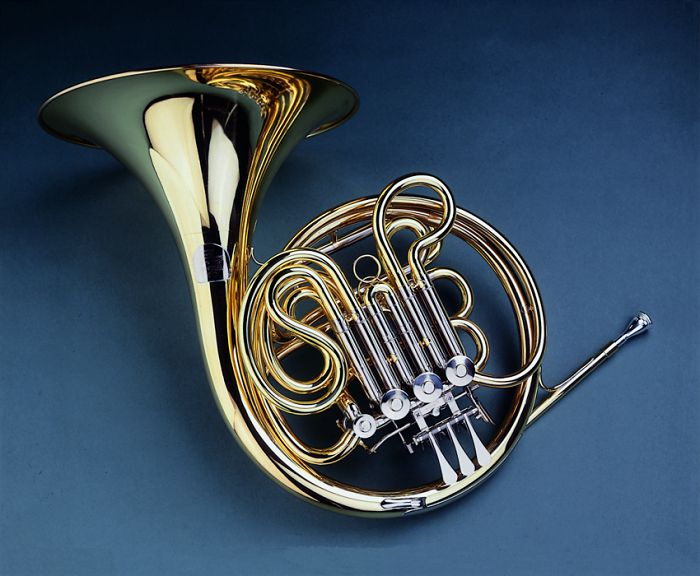
A double French horn holds about twelve feet of brass tubing, folded and coiled, with a thumb valve that switches the air between F and B-flat in a fraction of a second. Players cross between those two sides for low orchestral lines on the F horn and brighter high notes on the B-flat side. The story runs from 18th-century French hunting calls through Erfurt workshops in the 1890s to modern factories in Indiana and Germany, and those choices still shape what a hornist hears.
A short history of the French horn
The instrument descends from the cor de chasse, a French hunting horn used at royal hunts in 17th-century France. Early horns played a single overtone series and could not change key, so composers wrote for them as they wrote for natural trumpets, one tonality at a time. The horn appears in this form across French Baroque and Classical music, where Rameau and Gossec scored hunting calls into court ballets.
Anton Joseph Hampel, a horn player at the Dresden court, changed that around 1753 by attaching crooks to the body of the horn. A crook is a short coil of tubing that drops into the leadpipe and lengthens the air column, lowering the key. Hand-stopping, where the right hand closes the bell to flatten or sharpen pitch, joined the standard repertoire shortly after.
Valves replaced crooks during the 19th century. Heinrich Stölzel patented the first practical brass valve in 1814 and co-patented the box valve with Friedrich Blühmel four years later. Rotary valves followed, and the chromatic writing of Wagner, Mahler, and Strauss became playable on one instrument without manual switching.
Fritz Kruspe of Erfurt and Edmund Gumpert built the first compensating double horn at the close of the 1890s, combining F and B-flat tubing into one body. Kruspe refined the full double around 1900, and his layout still defines professional horns today. C.G. Conn Ltd., founded in Elkhart, Indiana in 1875, introduced the Conn 8D in 1937 on a Kruspe wrap, and the 8D became the standard American orchestral horn for the rest of the 20th century.
Single vs double French horn: the practical difference
Single horns come in either F or B-flat. The F horn has a longer, warmer tone that suits the middle and lower register; the B-flat horn responds with less effort up top and weighs less in the hand. Each version uses three rotary valves.
A double horn carries the F and B-flat tubing inside one body and adds a fourth valve, the thumb lever, that diverts air between them. The player keeps the same three left-hand fingerings and switches sides whenever the music asks for a different timbre or an easier high note. The double has been the orchestral default since the mid-20th century.
Beginners face a real choice. A single F horn is lighter and cheaper and forgives a student who is still building embouchure strength, while a double costs more and removes the awkward transition that students hit if they start on a single and switch later. Teachers split: some recommend a single F for the first year, others argue that a serious student should begin on a double to avoid relearning fingerings. Body size, lung capacity, and the type of music programme guide the choice.
Anatomy of the double horn
The mouthpiece is where the player’s lip vibration enters the instrument. A deeper cup darkens the sound and helps low-register work; a shallower cup brightens response in the high register. The leadpipe runs from the mouthpiece into the wrap, and its taper and material shape how the horn responds to the initial buzz.
Three rotary valves on the left hand reroute the air through extra tubing. Pressing each valve lengthens the air column by a fixed amount and lowers the pitch by one or two semitones. The valves work in combination, so a competent player produces every chromatic note across the horn’s range with the same three fingers.
A fourth rotary, operated by the left thumb, diverts the air between the F and B-flat sides. Most modern double horns route through B-flat by default and switch to F when the thumb lever is pressed, though some players reverse the linkage so F sits in the rest position.
Two slide sets sit on the bottom of the wrap, one per side, and each main slide pulls out a few millimetres for fine intonation. A water key drains condensation during long passages. The bell, around twelve inches across at the rim, is hand-hammered from sheet brass; the right hand sits inside it during play to adjust tone and intonation.
How the thumb valve works
Pressing the thumb lever rotates a fourth rotary valve that opens a different path for the air. On a full double horn, that path leads to a separate set of valve slides and a shorter total length of tubing, so the instrument behaves as a B-flat horn instead of an F horn, or the reverse, depending on linkage.
The shift between sides happens in roughly a quarter of a second. A player crosses to the B-flat side for high passages above the staff because the shorter tubing places the partials closer together and gives a more secure attack on each note. The F side stays in use for the warm, dark middle and low register where the longer tubing speaks with a fuller body.
Compensating doubles share part of the F tubing with the B-flat side rather than carrying two complete sets. A compensating horn weighs less and costs less, but the shared air column gives a different response on the B-flat side compared with a full double. Most professional players choose full doubles for the cleaner B-flat tone.
Conn modified the thumb-lever geometry several times to suit smaller hands, and most modern professional models from Conn, Yamaha, Holton, and Hoyer let the player adjust lever throw with a single screw.
Tubing and construction
A French horn is among the more labour-intensive brass instruments because each curved segment is bent, fitted, and soldered by hand. The F side carries about twelve feet of tubing in total; the B-flat side carries about nine. Wrap geometry follows either the Kruspe or the Knopf design.
The Kruspe wrap puts the change valve above the first valve and routes air through a wider bell throat. Kruspe-style horns are often built from nickel silver for the heavier, darker projection that suits American orchestral playing; the Conn 8D is the best-known example.
The Knopf wrap, often called the Geyer wrap after Chicago maker Carl Geyer, sits the change valve behind the third valve and uses a narrower throat. Yellow brass is the typical material, and the response is lighter and more flexible. Geyer-style horns are common in Boston, Chicago, and San Francisco, and across most of European orchestral practice.
Yellow brass gives the brightest tone; gold brass adds red copper for warmth; nickel silver darkens and stiffens the response. Lacquer and silver plating affect the sound to a smaller but audible degree.
Bell variants: fixed, detachable, and screw bells
A fixed bell joins the bell tail with a soldered seam. The single piece of brass from leadpipe to rim gives the most direct acoustic coupling and the most stable response. Fixed bells are common on student and intermediate horns and on professional models that never travel by air.
A detachable bell breaks at a ring near the throat. The flare unscrews from the lower bell branch, and the case shrinks by about a third, small enough to fit into an aircraft overhead bin or a car boot. The joint adds a touch of mass at the break point and damps the bell vibration by a fraction.
A screw bell is a particular type of detachable that threads off the first branch using a coarse thread cut into the metal itself, no flange ring. The Holton H278 Farkas and the Conn 8DS are the best-known American screw-bell models. Screw bells became common after the 1980s as orchestral players started flying to gigs and needed a case that fit airline rules.
Converting a fixed bell to a detachable type requires cutting the bell and soldering on a flange ring. The cut changes metal hardness around the seam and shifts how the horn responds, so most hornists who want a detachable bell buy a horn that came with one from the factory.
Sound and tonal range
The F side gives the warm, dark colour that defines the horn in symphonic writing: the long-held notes in Wagner’s Ring, the off-stage calls in Beethoven’s Sixth, the opening of Mahler’s First. Composers wrote those passages for a horn that would speak with the F-side weight and resonance.
The B-flat side gives a brighter, easier upper register. High partials sit closer together on the shorter air column, so a player can secure a top G or A with more confidence than on the F side. Strauss horn solos and Mahler high writing live on the B-flat side for that reason.
A competent player covers the range from F2, the F below the bass-clef staff, to F5 or higher above the treble staff. The first horn in a top orchestra plays above F5 in repertoire by Strauss, Bruckner, and Shostakovich.
Inspection points before you buy a used horn
Try the horn before you commit. Spend at least twenty minutes on scales, slow phrases, and passages from your current repertoire, listening for evenness across the registers and checking whether each valve speaks at the same dynamic level.
Before paying, run through the points below:
- Each rotor turns with no clicking, no rough edges, and no metal-on-metal scrape.
- The thumb-valve linkage moves with a smooth, even pull and returns without a snap.
- Main slides and tuning slides glide on a thin layer of grease, not stick or rattle.
- The bell branches and rim show no major dents and no heavy lacquer wear.
- The leadpipe interior shows no red rot, the brown discolouration that signals chemical breakdown of the brass.
- The case fits the bell type you want, fixed or detachable, and the lining holds the horn without play.
Worn ball joints or stretched valve strings slow the change between sides and make fast switching unreliable. Loose slides leak air and flatten attack; tight slides need professional cleaning, which a buyer can use as a price negotiation point. Patches of bare brass on the lacquer can be a warning or a feature depending on the asking price.
Decide on bell type before you sign anything. A fixed bell is cheapest and acoustically purest for a player who never travels far. A detachable or screw bell makes sense for anyone who flies more than once or twice a year.
Care and longevity
A horn lives a long life on a routine of daily, weekly, and yearly maintenance. After every session, empty the water key with the valves at rest, wipe down the leadpipe with a soft cloth, and store the horn in a cushioned case with the bell facing up.
Apply rotor oil to each valve once or twice a week. A few drops on the top bearing and on the linkage points keep the action smooth. Slide grease goes on the main and tuning slides every two to three months, more often in dry climates.
Once a year, take the horn to a qualified brass technician for a chemical clean. The technician dismantles the wrap, soaks each section, removes built-up residue, and reassembles with fresh grease and oil. A neglected horn can develop red rot in the leadpipe within five to seven years; a serviced horn lasts decades and holds resale value far better.
Frequently Asked Questions
Is a double French horn harder to learn than a single?
The fingerings for the three left-hand valves are the same on both. The extra learning load is the thumb valve and knowing when to cross to the B-flat side. A motivated student who has had a few months of brass instruction handles the double without much trouble.
Why does the player put a hand inside the bell?
The right hand inside the bell adjusts intonation and tone colour. Closing the hand further raises the pitch a few cents and darkens the sound; opening it lowers the pitch and brightens the response. The technique survives from the hand-horn era before valves.
What is the difference between Kruspe and Geyer wraps?
Kruspe wraps place the change valve above the first valve and use a wider bell throat, which gives a heavier sound suited to large American orchestras. Geyer wraps put the change valve behind the third valve and use a narrower throat, which gives a lighter, more flexible response common in European orchestral tradition.
How much does a quality double French horn cost?
Student doubles cost at the low end of the brass-instrument market. Intermediate models from Holton, Yamaha, and Hoyer sit in the middle. Professional horns from Engelbert Schmid, Paxman, and Yamaha custom shop run to prices comparable to a small used car. Try before you commit at every tier.
Sources and Further Reading
- International Horn Society, Brief History of Horn Evolution
- Galpin Society Journal articles on Anton Joseph Hampel and the chromatic horn
- Conn-Selmer company archives, Elkhart, Indiana
- Kruspe horn workshop, Erfurt, Germany – factory documentation
- Robin Gregory, The Horn (Faber and Faber, 1969)