Mexican food is a country of cuisines, not a single one. The Yucatán cooks with achiote and citrus on banana-leaf bundles. Oaxaca grinds chilies and chocolate into a sauce that takes three days to build. Northern ranchers grill flour tortillas the size of dinner plates. UNESCO put traditional Mexican cuisine on the Representative List of the Intangible Cultural Heritage of Humanity in 2010, the first national cuisine to receive that status alongside the Mediterranean diet and French gastronomy.
This guide walks the regions, the spice base, the taco taxonomy, the moles, the drinks, the modern fine-dining scene, and how to plan a first trip built around food. The plan is straightforward: read a Mexican menu without flinching, pick the right region for a first visit, and know what to drink with each course.
The foundations: corn, beans, chili, tomato
Four indigenous staples carry every regional plate: corn, beans, chili peppers, and tomatoes. UNESCO’s inscription points to the system around them, including milpa fields that rotate corn with beans and squash on the same plot, chinampa farming islets in Mexico City’s surviving lake areas, and nixtamalization, the lime-soaking of dried corn that transforms it into masa.
Nixtamalization is the most important process in Mexican cooking. Treating corn with calcium hydroxide, the lime called cal, releases niacin the body cannot otherwise absorb and softens the kernel for grinding. Without it, a maize-based diet causes pellagra. With it, the same kernel makes tortillas, tamales, atole, pozole, and every other dough that holds a Mexican meal together.
Native plants beyond the four staples include avocados, vanilla, cocoa, agave, and at least sixty cultivated chili varieties. Spanish colonization layered wheat, dairy, pork, and citrus on top of that base from 1521 onward, and the result is a cuisine that mixes pre-Hispanic technique with European ingredients dish by dish, region by region. Indigenous food traditions still survive in pockets such as Huichol communities, where peyote, tejuino, and ceremonial foods predate the colonial overlay.
Regional cuisines, north to south
The country breaks into roughly six culinary zones. The North runs cattle, wheat, and grilled meat: carne asada, machaca dried beef, cabrito roast goat in Monterrey, and flour tortillas instead of corn. Sonoran flour tortillas reach a metre across in some bakeries.
The Bajío and central plateau cook around Mexico City, mixing colonial and indigenous traditions. Carnitas, the slow-confit pork from Michoacán, came from this belt, as did chiles en nogada, the green-white-red dish built for Mexican independence colors and served around mid-September.
The Yucatán Peninsula tastes different from anything else in Mexico because of Maya base ingredients and Caribbean trade. Cochinita pibil, pork marinated in achiote paste and sour orange, then wrapped in banana leaves and pit-cooked, is the signature plate. Habanero chili shows up where elsewhere a milder pepper would, and ground squash seeds called sikil pak make a dip eaten with totopos.
Oaxaca is the centre of mole and mezcal production. The city’s seven moles, rojo, coloradito, amarillo, verde, negro, chichilo, and manchamantel, each use different chilies, herbs, and thickening agents. Tlayudas, the giant baked tortillas topped with bean paste, asiento, cheese, and cecina, stand in for pizza on Oaxacan streets.
Veracruz on the Gulf coast turned Spanish, Caribbean, and African ingredients into seafood-driven plates. Huachinango a la Veracruzana red snapper with olives, capers, and tomato is the textbook example. Veracruz also grows most of Mexico’s vanilla, a Totonac crop the Aztecs adopted before the Spanish carried it to Europe.
Puebla, between Mexico City and the Gulf, gave the country mole poblano, chiles en nogada, and chalupas. Puebla’s nuns are credited with the moles invented in colonial-era convents, and the city remains the place to eat that style of cooking from a fonda rather than a fine-dining room.
The taco family: a quick taxonomy
A Mexican taco is a soft corn tortilla wrapped around a filling and eaten with the hands, full stop. Hard-shell tacos are a Tex-Mex variant. Inside Mexico, the tortilla is almost always corn, made to order at the stand, and the difference between street tacos lies in the meat and the technique.
Tacos al pastor came to Mexico through Lebanese migrants who arrived in Mexico City in the early twentieth century. They brought shawarma, the vertical-spit lamb roast, and Mexican cooks swapped lamb for pork, marinated it in chili and pineapple, and stacked it on a trompo. A taco al pastor today carries shaved pork, raw onion, cilantro, and a slice of pineapple from the top of the spit.
Carnitas come from Michoacán and use pork shoulder slow-cooked in its own lard until the outside crisps and the inside falls apart. A Michoacán taquero hand-chops the mix from a copper pot at the stand, includes both meat and crackling, and finishes with salsa verde. Suadero, the thin-cut beef brisket cooked in a flat-bottom pan with rendered fat, is its central-Mexico cousin.
Barbacoa is the pre-Hispanic ancestor of the entire family. Lamb or goat wrapped in maguey leaves is buried in a stone-lined pit with hot coals and roasted overnight. The technique survives across central Mexico, with Hidalgo state holding the most respected version. Pescado tacos belong to Baja California, where battered fish, shredded cabbage, crema, and lime define the Ensenada style that travelled north into San Diego.
Tacos dorados are different again: corn tortillas filled with shredded chicken or beef, rolled, then fried until crisp, and served with cream, cheese, and a green sauce. The closest Tex-Mex equivalent is a flauta, though the Mexican original uses softer corn rather than the rigid stand-up shell sold abroad.
Beyond tacos: tamales, tlayudas, sopes, tlacoyos
Mexican corn-dough cookery extends far beyond the taco. Tamales steam masa parcels wrapped in corn husks, banana leaves, or hoja santa leaves depending on the region. Oaxacan tamales hide a tablespoon of mole inside the dough. Yucatecan tamales add achiote and pork. Mexico City sweet tamales come pink with strawberry, sold from street trolleys at dawn and dusk.
Sopes are thick, hand-formed corn discs with a pinched rim that holds a layer of refried beans, salsa, cheese, and a meat topping. Tlacoyos are oval, slightly larger, and stuffed with beans or fava paste before being griddled. Both belong to central Mexico and share a counter at the same stalls.
Tlayudas, the Oaxacan platter, are crisp 30-centimetre corn discs spread with bean paste and asiento (the pork lard left after carnitas), then folded around shredded cabbage, Oaxaca cheese, and grilled cecina beef. Ate them at a market stall after sundown is half the experience. Huaraches, the sandal-shaped masa pieces topped like sopes but in a longer footprint, round out the family.
Memelas, gorditas, panuchos, and salbutes complete the broader pantheon. Each is a regional masa staple with its own meal context, and most of them sit in the breakfast and supper hours rather than the lunchtime taco rush.
Salsas and moles: building blocks
Two salsas cover most everyday Mexican food: roja and verde. Salsa roja toasts dried red chilies, often guajillo or árbol, with garlic, onion, and tomato, then blends them with a touch of stock. Salsa verde uses tomatillos, the green husk-tomato relative, with serrano or jalapeño chili, garlic, cilantro, and lime. Salsa macha is a recent darling: chilies and seeds fried in oil and served as a chunky condiment, more like Italian olio piccante than a wet sauce.
Mole sits a tier above. The word covers any complex sauce ground from a long ingredient list, often more than twenty items. Mole poblano from Puebla blends ancho, mulato, and pasilla chilies with chocolate, almonds, plantains, sesame, anise, and cinnamon. Mole negro from Oaxaca darkens the same architecture with chilhuacle negro chilies and a deeper char.
The seven Oaxacan moles work as a grid. Negro and rojo are deep and complex. Coloradito is shorter and lighter. Amarillo skips the heavy ground spices and runs on annatto, hoja santa, and chilcostle. Verde uses fresh herbs and tomatillos. Chichilo is rare, smoky, and reserved for funerals in some villages. Manchamantel, “tablecloth-stainer,” carries fruit and chili together. Most cooks specialize in two or three; mastering all seven is a lifetime project.
Drinks: mezcal, tequila, pulque, atole, agua frescas
Agave runs through the Mexican drinks cabinet. Tequila uses only blue agave, grown around the town of Tequila in Jalisco, and is steam-cooked above ground in industrial ovens before fermentation. Mezcal accepts more than thirty agave species, with espadín dominant in Oaxaca, and pit-roasts the piñas underground for several days with oak or mesquite wood. The smoke that defines mezcal comes from that pit, not from the spirit itself.
Oaxaca holds about 570 of the country’s 625 mezcal production sites, which makes the state the obvious base for any mezcal trip. Beyond the standard espadín, mezcals from rare wild agaves such as tobalá and tepeztate sit at premium prices and rotate through small-batch palenques. The standard pour comes alongside orange slices and sal de gusano, the salt mixed with ground agave worm.
Pulque predates Spanish arrival. The fermented sap of the maguey, viscous and slightly sour, was sacred to the Aztec elite and then democratised into pulquerías across central Mexico in the colonial era. Sales collapsed in the twentieth century when bottled beer arrived, but a small revival is now visible in Mexico City pulquerías such as La Pirata and Las Duelistas.
Soft drinks have their own architecture. Atole is a hot masa-based drink, often flavored with chocolate (champurrado), vanilla, or pineapple, and pairs with tamales at breakfast. Aguas frescas, “fresh waters,” blend hibiscus (jamaica), tamarind, horchata rice-and-cinnamon, or chia-and-lime, and sit in glass barrels at every fonda. Mexican coffee from Veracruz and Chiapas is now respected internationally, and Mexico City’s third-wave roasters sit on par with anything in California.
Mexican sweets: tres leches, churros, capirotada
Mexican desserts mix Spanish convent recipes with indigenous bases. Tres leches cake, soaked in evaporated, condensed, and whole milk, is the most-exported version, though its origin sits between Nicaragua and Mexico in the early twentieth century. Churros at Mexican stands are thicker than the Spanish form and stuffed with cajeta, dulce de leche, or chocolate.
Capirotada, the bread pudding eaten during Lent, layers stale bolillo bread with piloncillo syrup, raisins, peanuts, and queso fresco. Each ingredient stands for a part of the Passion narrative, which makes it a religious dish rather than a routine sweet. Pan de muerto appears around Day of the Dead and stands in Mexican bakeries through October and early November, while bunelos, ponche, and tamales mark the December posadas covered in Christmas celebrations in Mexico and Mexican Christmas traditions.
Coyotas from Sonora, glorias from Monterrey, and dulces de tamarindo across the country fill out a sweets shelf that runs from refined to street-vendor. The general rule is that Mexican sweets favor caramel, milk reductions, and seed brittles over the layered cake-and-cream tradition Europeans associate with French or Viennese pastry.
Modern Mexican gastronomy and the Pujol generation
Mexico City’s fine-dining scene shifted in the 2000s. Pujol, opened by chef Enrique Olvera in 2000, started with Asian and American influence before pivoting to a Mexican-only kitchen and helping define what international observers now call Nueva Cocina Mexicana. The signature dish, Mole Madre, has been in continuous production for more than a decade, with new mole spooned over the older base every morning.
Quintonil, run by Jorge Vallejo and Alejandra Flores in the same Polanco district, sits as Pujol’s parallel. Both restaurants received two Michelin stars in 2024 when the guide first covered Mexico, and both work entirely with Mexican producers, ingredients, and technique vocabulary. The vegetable focus at Quintonil and the maize focus at Pujol differentiate the two without splitting the audience.
The wider scene includes Sud 777 and Rosetta in Mexico City, Alcalde in Guadalajara, Origen and Casa Oaxaca in Oaxaca, and a Yucatán cluster around Mérida. Reservations open thirty to sixty days ahead and book within hours. Pujol’s tasting menu sits at roughly USD 245 per head (4,400 Mexican pesos), with Quintonil priced similarly; lower-tier fine-dining venues run from USD 100 upwards. Tax of 16 percent and a 10 to 15 percent service charge add to the bill, and beverage pairings are extra.
How to eat in Mexico: markets, fondas, comedores
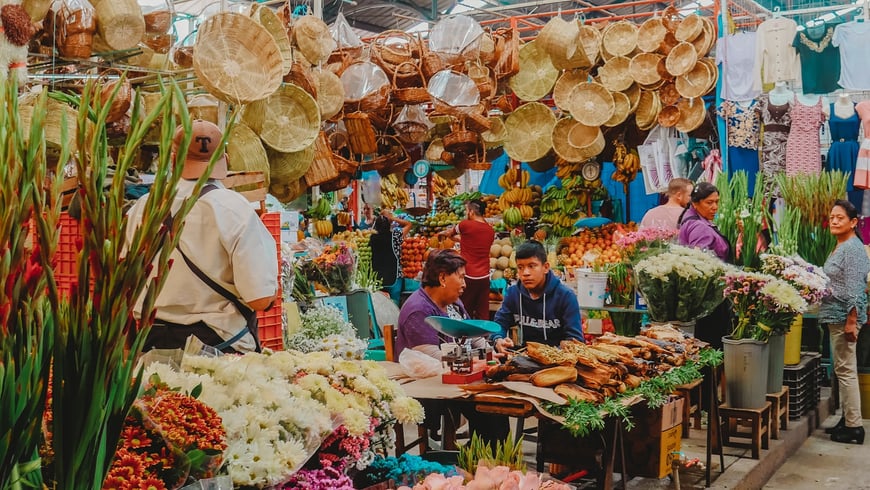
Three eating environments cover most of a visitor’s meals. Mercados, the covered municipal markets, run a horseshoe of cooked-food stalls around their produce sections. Mexico City’s Mercado Medellín, Mercado Roma, and Mercado de San Juan each cover different angles, and Oaxaca’s 20 de Noviembre and Mercado Sánchez Pascuas serve grilled-meat smoke-pit lunches that no white-tablecloth restaurant tries to imitate.
Fondas are family-run lunch counters with a fixed midday menu, the menú del día. A fonda lunch typically runs three courses for under USD 10, includes an aguafresca, and ends with a small dessert. Mexico City’s Roma and Condesa neighborhoods carry many. The Mexican family traditions piece covers the Sunday meal at home, which is its own institution alongside fonda culture.
Comedores sit between the two: family-style indoor canteens, slightly more formal than a fonda but still cheap and fast. Breakfast in Mexico is the meal foreigners overlook. Chilaquiles (tortilla chips simmered in salsa with cream and cheese), huevos rancheros, and tamales with atole at sunrise stalls outshine almost every brunch place a visitor knows from home. Dress codes at family lunches stay relaxed; market kitchens are entirely casual, but a Sunday comida in someone’s home often involves the traditional Mexican clothing the host’s grandmother still wears.
First-timer’s eating itinerary
A solid five-day food trail pairs Mexico City with Oaxaca. Land in Mexico City, give the city two and a half days for breakfast at El Cardenal, lunch at a Roma fonda, an afternoon market crawl through Medellín, and one fine-dining slot at Pujol or Quintonil if reservations cooperate. The Mexican celebrations calendar helps choose dates around festivals that intersect with food, especially Day of the Dead and Independence Day.
Fly Mexico City to Oaxaca for the next leg, ninety minutes in the air. Spend two and a half days walking the Centro Histórico, eating a tlayuda after dark in 20 de Noviembre, sitting through a seven-mole tasting at Casa Oaxaca or Origen, and visiting a palenque outside town for the mezcal trail. Traditional Mexican music at evening tables and the regional music styles piece pair with the food rhythm of each region.
For longer trips, add Yucatán for cochinita pibil and cenote lunches, the Sonoran coast and Kino Bay for seafood and Sonoran flour tortillas, or Puebla as a day trip from Mexico City for mole poblano at a colonial-era fonda. The Mexican clay pottery tradition shapes the cooking vessels that change how stews taste, and Talavera pottery is the dishware on which most of the food arrives. Wedding-table cooking is a separate world covered in Mexican wedding food traditions.
Frequently Asked Questions
Is Mexican food spicy?
Some of it, but not most. A street taco arrives plain; the diner adds heat from a salsa selection at the table. Mexican cooks favor chili variety over straight heat, with poblanos and anchos contributing flavor more than burn, and habaneros reserved for Yucatecan dishes where the diner expects it. Asking the cook for “no picante” works without offence.
What is the difference between a taco and a burrito?
A burrito uses a flour tortilla wrapped tightly around a substantial filling and is northern Mexican, especially Sonoran. A taco uses a smaller corn tortilla folded around a single meat and a couple of toppings. The Mission-style giant burrito with rice, beans, and cheese is a San Francisco invention, not a traditional Mexican format.
Is Tex-Mex Mexican food?
Tex-Mex grew along the border in Texas during the late nineteenth century, and uses some Mexican techniques with American ingredients, including yellow cheese, cumin-heavy chili powder, ground beef, and hard-shell tacos. It is its own cuisine and worth eating, but a Texas chili-cheese plate is closer to American comfort food than to anything cooked south of the Rio Grande.
Where should a first-time Mexican-food traveller go?
Mexico City covers the broadest range, with regional cuisines from across the country in one neighbourhood map. Oaxaca specializes in mole and mezcal and rewards a slower trip. The Yucatán is the most distinct regional cuisine and pairs well with beach time. A first trip with three or four cities over ten days will cover the broad strokes; deep regional specialization can wait for return visits.
Sources and Further Reading
- UNESCO Intangible Cultural Heritage list – “Traditional Mexican Cuisine: Ancestral, Ongoing Community Culture, the Michoacán Paradigm” (2010 inscription).
- Secretaría de Turismo de México (gob.mx/sectur) – regional gastronomic routes and tourism data.
- VisitMexico (visitmexico.com) – English-language regional cuisine portal.
- Larousse Cocina – Spanish-language food encyclopedia for ingredient and technique definitions.
- Mexico Desconocido (mexicodesconocido.com.mx) – regional food magazine with verified seasonal calendars.