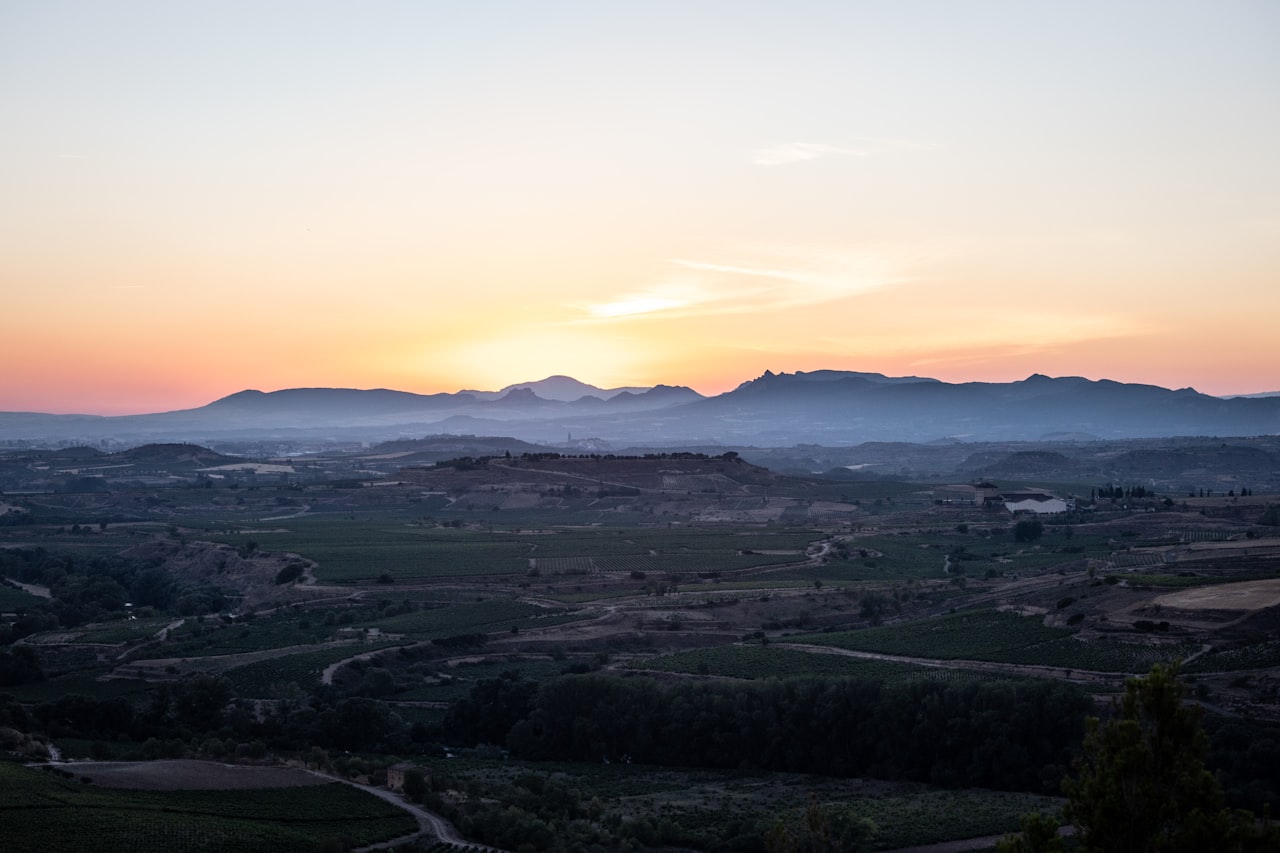
Spain plants more vines than any other country on earth, roughly 940,000 hectares stretching from the Atlantic coast of Galicia to the volcanic islands of the Canaries. Yet outside Rioja, most Spanish wine still moves quietly. The country has more than seventy DO zones, six classified grapes that grow nowhere else as well as they grow here, and a fortified-wine tradition older than the Spanish empire. This guide maps the country region by region, picks the grapes worth knowing, decodes the aging labels, and pairs the bottles with the food they were born next to.
Why Spanish wine deserves its own conversation
French regions get the headlines. Italian regions get the variety. Spanish wine sits between them and is often underpriced for what is in the bottle. The country produces close to 40 million hectolitres in a typical year, putting it third in global volume behind Italy and France, while exporting at lower average prices than either neighbour. That gap between quality and price is the practical reason to learn the regions.
The history matters too. Rioja was officially recognised as a denomination in 1925, the oldest in Spain, and was upgraded to the country’s highest tier, DOCa, in 1991. Priorat joined that top tier in 2000. Sherry production in Jerez goes back to Phoenician traders, with documentary references to wine shipments in the third century BCE. The vocabulary used elsewhere in the wine world to describe oxidative aging, fortified styles, and fractional blending was largely codified here.
Three regions that anchor everything
Rioja, Ribera del Duero, and Priorat are the three names that travel. They cover roughly 80,000 hectares between them, a small share of the national total but a heavy share of the prestige. Rioja makes the elegant, oak-influenced reds that define what Spanish wine has tasted like for a century. Ribera del Duero makes denser, higher-altitude reds from the same grape under a different climate. Priorat makes some of the most concentrated and expensive bottles in the country from steep slate hillsides in inland Catalonia.
Beyond those three, the map opens up. Galicia in the rainy northwest produces the best Atlantic whites in Spain. Catalonia gives the country its sparkling wine. Andalucía in the south runs the sherry triangle. Castilla-La Mancha contributes the volume. The rest of this guide takes each region on its own terms.
Rioja: the reference reds
Rioja covers about 66,000 hectares along the Ebro river in north-central Spain, split into three sub-zones. Rioja Alta is the cool, high-altitude western half on iron-rich clay, where the wines lean structured and built for aging. Rioja Alavesa, on the north bank in the Basque Country, sits on chalky limestone and gives wines that are softer in youth. Rioja Oriental, the lowland eastern stretch formerly called Rioja Baja, is hotter and produces fruit-forward bottles, often blended into the wines of the other two zones.
Tempranillo is the engine grape, planted on roughly 88 percent of the red-vine area. Garnacha, Graciano and Mazuelo (Carignan) round out the blends. Whites use Viura, Malvasía, and Garnacha Blanca, with a small but growing share of Tempranillo Blanco, a pale mutation discovered in 1988 that the regulatory council added to the approved list in 2007.
The traditional Rioja style was built around extended oak aging in American oak barrels, which give vanilla, coconut, and dill notes alongside the cherry and tobacco of mature Tempranillo. The modern style, pioneered in the 1990s, uses French oak for tighter grain and shorter aging windows, producing fresher, more concentrated wines. Both styles still sit on the shelf together, often from the same producer.
Logroño is the regional capital and a useful base. The Wine Train La Rioja runs day trips from Bilbao through Haro, the historic bodega district where seven of the most famous houses cluster within walking distance of each other.
Ribera del Duero, Toro, and Rueda
The Castilla highlands form a distinct red-wine geography around the Duero river. Ribera del Duero, founded as a DO in 1982, sits at 750 to 900 metres above sea level on the high plateau north of Madrid, covering parts of the provinces of Burgos, Valladolid, Soria and Segovia. Tempranillo here is called Tinto Fino, and the extreme continental climate of hot days and cold nights produces wines with darker fruit, denser tannins, and more obvious structure than Rioja. Vega Sicilia, founded in 1864, was the estate that built the region’s reputation long before it had a denomination at all.
Toro, west of Ribera, makes muscular reds from a local Tempranillo strain called Tinta de Toro, often unblended and at high alcohol levels. Rueda, just south, is the white-wine partner to those reds. Verdejo, an ancient grape revived in the 1970s by Marqués de Riscal, gives crisp, herbal whites that have become Spain’s most-exported still white. A small share of the planting is Sauvignon Blanc, allowed under the DO since 1980.
Cigales, between Ribera and Toro, is the region’s quiet third name and the historic source of the rosado tradition that still defines Spanish pink wine.
Catalonia: Priorat, Penedès, and Cava
Catalonia produces three distinct categories of wine in a small geography. Priorat, in the rugged inland of Tarragona province, was nearly abandoned in the mid-twentieth century before a small group of growers led by René Barbier rebuilt the region in the late 1980s. The slate-and-quartz soils, locally called llicorella, force vines to root deep for water, producing some of the most concentrated reds in Spain. Garnacha and Cariñena lead the blends, often with Cabernet Sauvignon and Syrah added to selected bottles.
Penedès, west of Barcelona, is more diverse. Still wines here use Macabeo, Xarel·lo and Parellada for whites and Tempranillo or international grapes for reds. The same three local white grapes are the basis of Cava, Spain’s traditional-method sparkling wine, which can legally be produced across several Spanish regions but has its centre in Penedès. Two large houses, Codorníu and Freixenet, dominate the export volume, while a separate quality tier called Corpinnat broke away in 2019 to mark estate-grown organic Cavas with longer aging.
The Costers del Segre, Empordà, and Montsant DOs round out the Catalan map and tend to offer better value than Priorat without sacrificing the regional character.
Galicia and the Atlantic whites
Galicia is rainy, cool, and Celtic in feel, with vineyards trained on granite pergolas to keep grapes off damp ground. The five DOs (Rías Baixas, Ribeiro, Ribeira Sacra, Valdeorras, and Monterrei) together cover about 11,000 hectares, mostly white.
Albariño, planted overwhelmingly in Rías Baixas, produces Spain’s signature white: salty, citric, low in alcohol, made for shellfish. The grape grows nowhere else in commercial volume, although small plantings exist in California and New Zealand. Godello, the inland counterpart from Valdeorras and Monterrei, gives a richer, mineral-driven white that ages longer than Albariño. Mencía, the principal red grape of Bierzo and Ribeira Sacra, has been compared in style to Pinot Noir, though it is genetically distinct.
Visiting Galicia rewards walkers and seafood travellers more than tasting tourists. The city of Vigo works as a base for the Rías Baixas coast, and the regional cuisine of pulpo, percebes and pimientos de Padrón is the natural pairing for almost any Galician white.
Sherry, Málaga, and Andalucía
Sherry, the fortified wine of the Marco de Jerez triangle in southwest Andalucía, sits in a category of its own. Three towns frame the production zone: Jerez de la Frontera, Sanlúcar de Barrameda, and El Puerto de Santa María. The albariza soils, white chalk that holds winter rainfall through the dry summer, are the foundation of the style. Palomino is the dominant grape, with Pedro Ximénez and Moscatel covering the sweet styles.
The aging system, called solera, blends barrels of different vintages in stacked rows, with the oldest row at the bottom and bottling drawn only from that bottom level. The result is a non-vintage wine of consistent character year after year. The styles run from bone-dry fino, aged under a yeast veil called flor, through amontillado that loses the flor mid-aging, to oxidative oloroso that never had flor, and finally to the molasses-thick PX dessert sherries.
Beyond Jerez, Málaga and Montilla-Moriles produce sweet and fortified wines using similar techniques, while modern Andalusian DOs such as Sierras de Málaga have shifted into still wines from international grapes. The seafood culture of Seville and the wider Andalusian coast remains one of the great food-and-wine pairings in Europe.
The aging classifications
Most Spanish red wine carries one of four aging labels, set by the regulatory council of each DO and tightened further by Rioja and a handful of others.
- Joven or sin crianza: little or no oak. Released early, intended for drinking young.
- Crianza: minimum 24 months total aging, with at least 12 in oak (6 in Rioja’s case).
- Reserva: minimum 36 months total, with at least 12 in oak.
- Gran Reserva: minimum 60 months total, with at least 18 in oak. In practice most Gran Reservas spend longer. Less than 9 percent of Spanish red wine reaches this level in any given year.
White and rosé wines have shorter required windows: Crianza needs 18 months total with 6 in oak, Reserva 24 months with 6 in oak, Gran Reserva 48 months with 6 in oak. Rioja and Ribera del Duero apply stricter rules than the national baseline, which is why a Rioja Reserva typically tastes more developed than a Reserva from a less prestigious DO.
Pairing Spanish wine with Spanish food
Spanish food was built around fortified wine, regional reds, and high-acid whites. The pairings still hold.
Tapas culture and a chilled fino sherry remain the canonical match: olives, almonds, salted anchovies, and a glass of bone-dry Tio Pepe. Jamón ibérico, the dry-cured ham from acorn-fed black pigs, calls for an aged Reserva from Rioja or a Crianza from Ribera. Paella, the rice dish from the Valencian coast, takes a young Garnacha-based rosé or a chilled Albariño better than a heavy red. The paella techniques worth learning at home work with the same wine logic.
Manchego cheese, aged for at least three months, was made for Tempranillo of any region. Galician octopus and Albariño are the classic seafood-and-wine combination. Churros and chocolate take a sweet Pedro Ximénez. The full traditional food of Spain guide covers what to order in each region, and the broader survey of regional Spanish foods matches each plate to its bottle. For a deeper dive into famous Spanish foods beyond the obvious, the same logic applies.
Visiting bodegas: how Spanish wine tourism works
The first thing to know is that Spanish bodegas mostly require an appointment, even small family operations. Walk-in tasting rooms exist but are the exception, particularly in Rioja and Priorat. Booking online a week or two ahead is the norm.
Rioja is the friendliest first region for travellers. Logroño and Haro have dense bodega clusters, English-language tours are standard, and tasting fees stay modest. Ribera del Duero requires a car, with the bodegas spread along a 100-kilometre stretch of the Duero. Priorat is the hardest to visit logistically, with steep mountain roads and a small handful of producers offering visits, but the scenery is worth the effort.
Penedès works easily as a day trip from Barcelona, particularly during Cava harvest in late August. The Jerez triangle is best done from Sanlúcar in the cooler season, with the bodegas of González Byass, Tío Pepe, Lustau and Hidalgo all running scheduled tours.
For broader trip planning, Madrid and Barcelona work as start and end points for almost any wine itinerary. The shopping guide for Madrid covers where to bring home bottles you cannot find elsewhere, and the Chocolate Museum in Barcelona sits next to several Penedès-focused wine shops worth a stop.
Frequently asked questions
Which Spanish wine region is best for first-time visitors?
Rioja, with little argument. The town of Haro packs seven major bodegas into walking distance, English-language tours run daily, and the Wine Train La Rioja makes Bilbao a practical entry point. Distances are short, tasting fees are reasonable, and the food is excellent.
What is the difference between Rioja and Ribera del Duero?
Both are Tempranillo-led, but Ribera del Duero sits at 750 to 900 metres elevation on the Castilian plateau and has a more extreme continental climate. The wines are denser, tannic, and structured for long aging. Rioja sits lower along the Ebro and produces a wider stylistic range, from elegant Crianza to powerful Gran Reserva, with both traditional American-oak and modern French-oak schools.
Is Cava the same as Champagne?
No. Cava is made by the same traditional method (second fermentation in the bottle) but uses different grapes and is produced in Spain, mostly in Catalonia. Macabeo, Xarel·lo and Parellada are the standard blend. Cava also costs a fraction of comparable Champagne, partly because labour and land are cheaper and partly because Cava has not built the same global luxury image, though the recent Corpinnat split is pushing some producers toward higher-tier positioning.
Why is sherry sold in so many styles?
The styles depend on whether the flor yeast veil survives during aging. Fino keeps flor and stays bone-dry. Amontillado loses flor and develops oxidative complexity. Oloroso never had flor and was aged purely under air. Pedro Ximénez is a separate sweet style from sun-dried grapes, and Cream sherry is a sweetened blend made for the export market.
What does DOCa mean on a Spanish wine label?
DOCa, Denominación de Origen Calificada, is the highest tier in the Spanish quality pyramid. Only two regions have qualified so far: Rioja since 1991 and Priorat since 2000. The label signals stricter rules on yields, grape varieties, and aging than the standard DO tier below it.
Sources and further reading
- Wines from Spain (winesfromspain.com), the trade body of the Spanish wine export agency ICEX, for production statistics and regional summaries.
- Consejo Regulador DOCa Rioja (riojawine.com) for sub-zone definitions, Tempranillo Blanco history, and the Wine Train La Rioja schedule.
- Consejo Regulador Ribera del Duero (riberadelduero.es) for elevation data and Tinto Fino synonym usage.
- Consejo Regulador del Vino de Jerez (sherry.wine) for solera technical detail and style definitions.
- Spain.info, the national tourism office, for visiting routes, harvest calendars, and bodega contact information.