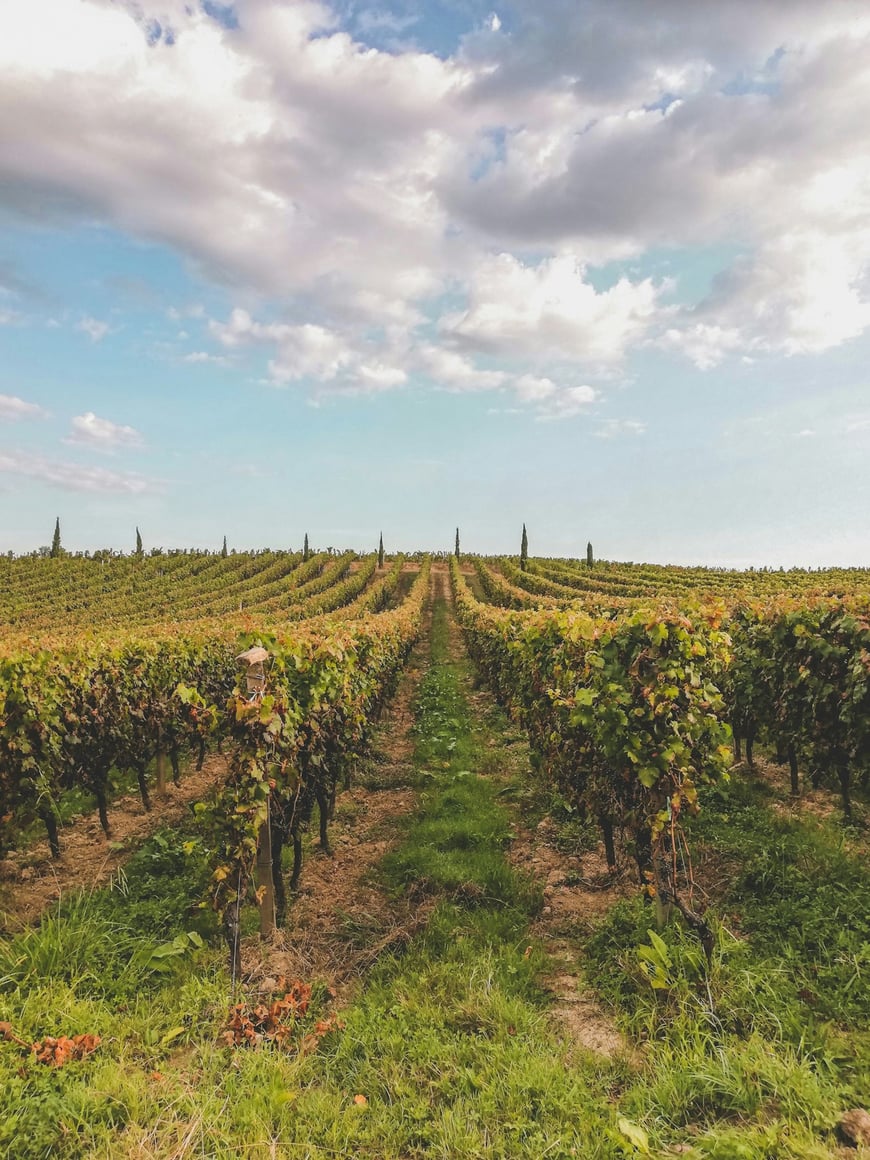
France maps eleven major wine regions across roughly 750,000 hectares of vineyard, each tied to a different grape, soil, and table. Cabernet thrives along the Gironde estuary in Bordeaux. Pinot Noir defines a few-kilometre strip of Burgundy. The chalk under Reims gives Champagne its tension. A bottle from Sancerre and a bottle from Châteauneuf-du-Pape come from the same country and share almost nothing else.
This guide covers Bordeaux, Burgundy, Champagne, the Rhône, the Loire, Alsace, Provence and Languedoc, then unpacks the AOC label system and how to plan a tasting trip. The aim is plain: read a French wine label, know what is in the glass, and pick the region worth visiting first.
France as a wine country
French growers farm about 750,000 hectares of vines, the second-largest vineyard area on earth after Spain. Eleven regions account for nearly all production: Bordeaux, Burgundy, Champagne, the Rhône, the Loire, Alsace, Provence, Languedoc-Roussillon, the South-West, the Jura and Savoie, and Corsica. More than 300 wine appellations sit inside those regions, each with its own rules on grape varieties, yields, and ageing.
Most of the vocabulary used to talk about wine outside France was borrowed from France: terroir, cru, vintage, brut, blanc de blancs, méthode traditionnelle. The country also gave the world the appellation idea itself, codified in 1935 to protect place names from imitation. Today that idea has spread to olive oil, cheese, and butter, but it began with wine.
The latitude spread is wide. Champagne sits near 49°N in cool, chalky country closer to Belgium than to the Mediterranean, while Provençal rosé ripens in dry heat about 1,000 kilometres south. Almost no other country covers that climatic range, which is the simplest reason French regions taste so different from one another.
Bordeaux: left bank, right bank, the styles
Bordeaux is France’s largest fine-wine region, with about 113,000 hectares under vine along the Atlantic coast. The Gironde estuary splits the vineyards into a Left Bank and a Right Bank, and that single geographical fact decides what grape leads the blend.
On the Left Bank, gravel soils drain fast and warm up early, conditions Cabernet Sauvignon needs to ripen. The famous communes here, Saint-Estèphe, Pauillac, Saint-Julien and Margaux, all sit inside the Médoc, with Pessac-Léognan and Sauternes to the south. Wines lean tannic and structured, built to age. The 1855 classification ranked five Médoc estates as First Growths: Châteaux Lafite Rothschild, Latour, Margaux, Mouton Rothschild, and Haut-Brion. That hierarchy has been amended once, in 1973, when Mouton was promoted.
The Right Bank flips the soil and the grape. Clay and limestone hold cooler water, suiting Merlot and Cabernet Franc. Saint-Émilion and Pomerol dominate the prestige tier, producing softer, plummier blends than the Médoc. Pomerol has no formal classification at all, yet Château Pétrus regularly outprices any First Growth. Saint-Émilion runs its own tiered system, revised roughly every ten years, which keeps quality competition active.
For travellers, the city of Bordeaux is the obvious base. The Bordeaux travel guide covers districts, harbour, and the wider Aquitaine region. Many châteaux on both banks accept visitors by appointment, with the Sauternes and Saint-Émilion routes friendliest to first-timers because the villages cluster tightly and tasting fees stay modest.
Burgundy: Pinot Noir, Chardonnay, climats
Burgundy is small. Roughly 29,000 hectares of vines, almost two grapes only, Pinot Noir for reds and Chardonnay for whites, and yet the region produces some of the most expensive wine on earth. The reason is a vineyard map drawn over eight centuries by Cistercian monks who recorded which exact plots gave better wine.
Those plots are called climats, and there are 1,247 of them in Burgundy, each with a separate name, a precise boundary, and its own AOC. UNESCO inscribed the climats of Burgundy on the World Heritage list in 2015. Of the 1,247, roughly 640 carry Premier Cru status and 33 are Grand Cru. Grand Cru output sits at about one percent of regional volume, which explains the prices.
The Côte d’Or, a thin escarpment running south from Dijon, holds the bulk of the Grand Crus. Its northern half, the Côte de Nuits, makes mostly red wine: Gevrey-Chambertin, Vosne-Romanée, Nuits-Saint-Georges. The southern half, the Côte de Beaune, leans white: Meursault, Puligny-Montrachet, Chassagne-Montrachet. Beaujolais sits south of Mâcon and uses Gamay rather than Pinot Noir, though for trade purposes it counts as part of Burgundy.
To plan a Burgundy trip with food in mind, the Burgundy and Périgord regional food guide covers the cuisine that grew up alongside the wine: boeuf bourguignon, escargots, époisses cheese, and the Lyonnais bouchons farther south.
Champagne: the sparkling method
Champagne occupies the northernmost vineyards in mainland France, with cool springs that often threaten the harvest and chalk subsoil that drains relentlessly. The two business capitals are Reims and Épernay. Beneath both cities run kilometres of chalk cellars dug originally as Roman quarries, where bottles age at a stable ten degrees year-round.
Three grapes do almost all the work: Chardonnay for finesse, Pinot Noir for body, and Pinot Meunier for fruit. Each grape has its territory. Chardonnay rules the Côte des Blancs south of Épernay. Pinot Noir takes the Montagne de Reims. Pinot Meunier dominates the cooler Vallée de la Marne. Four older varieties, Pinot Blanc, Pinot Gris, Arbane and Petit Meslier, survive in tiny acreage and appear on a few label-collector bottles.
The defining technique is the méthode champenoise, also called méthode traditionnelle outside the region. The base wine ferments first like any still wine, then receives a sugar-and-yeast dose and a crown cap before going horizontal in the cellar. A second fermentation locks carbon dioxide into the bottle. Riddling, disgorging, and dosage finish the process, sometimes years later. The houses worth knowing on a first visit include Krug, Bollinger, Pol Roger, Ruinart, Taittinger, and Veuve Clicquot, all of which run scheduled English-language tours.
Rhône Valley: Northern vs Southern
The Rhône splits in two halves so distinct that wine writers treat them as separate regions. The Northern Rhône, a 64-kilometre stretch from Vienne to Valence, accounts for only about four to five percent of total Rhône output, but it carries a heavy share of the prestige.
Northern reds come from Syrah, sometimes co-fermented with up to twenty percent of white grapes for aromatic lift. Côte-Rôtie produces silky, perfumed Syrah on terraced granite slopes. Hermitage, on a single hill above Tain, makes the most powerful and longest-lived reds in the valley. Whites here use Marsanne, Roussanne, and, in Condrieu, the floral Viognier grape, which was nearly extinct in the 1960s before a small group of growers replanted it.
The Southern Rhône is wider, hotter, and Mediterranean. Reds here are blends, not single-grape wines. The signature appellation, Châteauneuf-du-Pape, allows thirteen authorised grape varieties in the blend, though Grenache, Syrah, and Mourvèdre carry most bottles. The famous galets roulés, smooth river stones the size of fists, blanket many vineyards and re-radiate heat at night to push ripeness even further. Côtes-du-Rhône Villages and Gigondas sit a tier below Châteauneuf at far gentler prices and offer a fairer entry point for new drinkers.
Loire Valley: Sancerre, Vouvray, Muscadet
The Loire follows the river of the same name for about 1,000 kilometres from the Massif Central to the Atlantic, and the wine changes character at every bend. The valley is the most diverse single region in France, with whites, reds, rosés, sparklings, and sweet wines all in serious production.
Three sections matter for label reading. The Upper Loire, around Sancerre and Pouilly-Fumé, produces benchmark Sauvignon Blanc on flint and limestone soils. These wines smell of citrus, gooseberry, and gunsmoke. The Middle Loire, covering Touraine, Vouvray, Saumur, and Chinon, lives on Chenin Blanc and Cabernet Franc. Vouvray’s Chenin can be bone-dry, off-dry, sparkling, or sweet depending on the year. The Lower Loire, near Nantes on the Atlantic coast, is Muscadet country, where the Melon de Bourgogne grape gives lean, salty whites that pair with oysters better than almost any other wine in France.
The valley’s chateaux make the region a natural pairing of wine and history, and the Loire Valley golf and chateaux guide is useful if a tasting trip is part of a wider holiday.
Alsace and the German border style
Alsace runs along the Vosges mountains on the German border, and its wine reads more like a German bottle than a French one. The labels carry the grape variety, a habit borrowed from Germany during the period from 1871 to 1919 when the region was annexed. By French law, an Alsace wine sold under a varietal name must contain 100 percent of that grape.
Riesling leads the plantings and produces dry, structured whites with cut and minerality, drier in style than most German Rieslings of equivalent ripeness. Gewurztraminer comes second and gives perfumed, lychee-and-rose wines that work with strong cheeses and Asian food. Pinot Gris and Sylvaner round out the white core. The region also makes Crémant d’Alsace, a sparkling wine made by the same method as Champagne but at a fraction of the price, which has become one of France’s quiet export successes.
The fifty-one Grand Cru vineyards are designated by lieu-dit name rather than by chateau, and the wine route through villages such as Riquewihr, Ribeauvillé, and Eguisheim turns Alsace into a walkable wine route on a scale no other French region matches.
Provence and Languedoc: rosé and value
Provence makes more rosé than any other region on earth. Roughly nine out of ten bottles labelled Côtes de Provence are pink, and the style, pale, crisp, and Mediterranean, has become the default summer rosé reference for the rest of the wine world. The blends use Grenache, Cinsault, Syrah, and Mourvèdre. Bandol, a smaller appellation hugging the coast east of Marseille, makes serious tannic Mourvèdre reds that age fifteen years and longer.
The accommodation for a Provençal wine trip is dense and varied. Country houses among the vineyards work better than coastal hotels for tasting visits, and the Provence rentals guide covers the inland options, while the food of Provence rounds out what to eat with each bottle. The coast itself is a separate calculation, covered in the French Riviera beaches overview.
Languedoc-Roussillon, sweeping from the Rhône delta to the Spanish border, is the volume engine of French wine. It produces more bottles than any other French region and supplies most of what shows up as house wine on French restaurant lists. Picpoul de Pinet, Faugères, Saint-Chinian, and Maury are the appellations to track if you want value French reds with depth, and Banyuls makes a fortified red close in style to vintage port.
The AOC tier system explained
Three tiers cover almost every French wine. AOC stands for Appellation d’Origine Contrôlée and is the strictest, covering where the wine is made, which grapes are allowed, how vines are pruned, when grapes can be picked, the maximum yield per hectare, and minimum alcohol levels. Since 2009, AOC has carried the EU equivalent label AOP, Appellation d’Origine Protégée, which appears on some labels in place of AOC. Both terms cover the same wines.
Below AOC sits IGP, Indication Géographique Protégée, which replaced the older Vin de Pays category in 2009. IGP rules cover broader zones (a whole department, sometimes a whole region) and allow more grape varieties and higher yields. A Pays d’Oc IGP, for instance, can come from anywhere in Languedoc-Roussillon and use international grapes such as Chardonnay or Cabernet Sauvignon outside the strict regional varieties.
The bottom tier is Vin de France, the renamed table-wine category. These wines can blend grapes grown anywhere in France with no varietal or regional restriction, and a producer can list the vintage and grape variety on the label without naming a place. Vin de France looks low-status, but a small group of natural winemakers use it deliberately to escape AOC rules they consider outdated.
Visiting French wine country: planning a tour
The friendliest first regions for travellers are Alsace, Champagne, and parts of the Loire. All three have well-marked routes, English-speaking cellars, and short distances between estates. Burgundy is rewarding but compact and busy, with appointments often essential at the Grand Cru level. Bordeaux works best with a car and a half-day commitment per estate. The Rhône and Provence reward longer driving routes between villages.
Harvest runs from late August in Champagne and the south to mid-October in cooler northern blocks. Visiting during harvest looks romantic, but most producers cannot give tours that month and many tasting rooms close. Late spring and early autumn outside harvest are the best windows, with mild weather and full cellars to taste from.
For a Paris-based traveller, all major regions reach by train within four hours. The TGV runs to Reims in 45 minutes, Beaune in just over two hours, Bordeaux in two hours and five minutes, and Avignon in two and a half. The Eurostar breaks to Paris guide handles the London-to-Paris leg, and once in Paris, the Paris Museum Pass and Louvre tickets cover a couple of days in the city before heading out. Travellers who want a darker side trip can fold in the Catacombs of Paris before catching the train south.
A few practical points before booking:
- Most châteaux require advance reservation, often through their website rather than phone.
- Spitting at tastings is normal and expected at top estates, especially in Bordeaux.
- Tasting fees range from free at small Loire growers to over 100 euros at First Growth Bordeaux.
- Bring a coolbag if you plan to buy at the cellar; July afternoon heat can damage bottles in a parked car.
- Most regions have a Maison des Vins in the main town, useful as a single tasting stop covering many producers.
For a wine-and-food itinerary in Paris itself, the best cheese in Paris guide pairs naturally with anything brought home from the regions.
Frequently Asked Questions
Which French wine region is best for first-time visitors?
Alsace is often the easiest entry. Distances between villages are short, signage along the Route des Vins is consistent, most producers speak English or German, and tasting rooms accept walk-ins more readily than in Bordeaux or Burgundy. The food and lodging in towns such as Riquewihr also stay reasonably priced compared with the Champagne or Médoc circuits.
What is the difference between Bordeaux and Burgundy?
The two regions differ in grape, soil, and structure. Bordeaux uses blends, mostly of Cabernet Sauvignon and Merlot, on gravel and clay along an Atlantic estuary. Burgundy uses single grapes, Pinot Noir or Chardonnay, on limestone slopes far inland. Bordeaux estates are large and chateau-branded, while Burgundy producers are small and plot-focused, with the same grape from neighbouring vineyards tasting clearly different.
Can any sparkling wine be called Champagne?
No. The name is legally protected. Only sparkling wines made within the Champagne AOC zone, using the permitted grapes and the méthode champenoise, can carry the word Champagne. Sparkling wines made elsewhere in France by the same method are sold as Crémant, with regional suffixes such as Crémant d’Alsace, de Loire, or de Bourgogne.
What does AOP mean on a French wine label?
AOP, Appellation d’Origine Protégée, is the EU-wide version of the older French AOC. The two labels cover the same wines under the same rules. Some producers use AOC, others AOP, depending on when they redesigned their label after the 2009 European harmonisation.
How long does a French wine tour typically last?
For a single region, three to five nights is the realistic minimum. That covers around six to eight estate visits, two or three formal tastings, and time for non-wine elements such as cathedrals or local markets. A multi-region trip covering both Bordeaux and Burgundy in one week is possible by TGV but tight, and most travellers prefer to focus on one region per trip.
Sources and Further Reading
- Conseil Interprofessionnel du Vin de Bordeaux (vins-bordeaux.fr) – regional statistics, classification history, harvest reports.
- Bureau Interprofessionnel des Vins de Bourgogne (bourgogne-wines.com) – climat database and Premier and Grand Cru listings.
- Comité Champagne (champagne.fr) – méthode champenoise rules, permitted grape varieties, house registry.
- Institut National de l’Origine et de la Qualité (inao.gouv.fr) – the official French body governing AOC, AOP, and IGP categories.
- Atout France (atout-france.fr) – the national tourism office, useful for regional visiting routes and seasonal calendars.