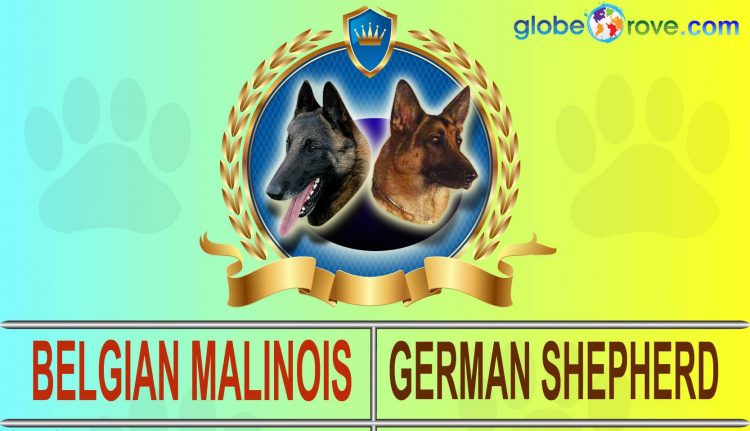
US Navy SEALs deploy Belgian Malinois on most high-altitude parachute operations while municipal police in the same country keep German Shepherds on most patrol rosters. Both choices are correct. The two breeds look similar from 20 paces and share working-dog heritage, but the differences in drive, size, coat, and handler temperament matter enough that selecting the wrong breed produces an unhappy dog regardless of training quality. This comparison covers breed history, physical differences, drive and trainability, health profiles, family compatibility, and the decision framework that matches the right breed to the handler.
Parallel Origins in the Late 1800s
Both breeds formed in the last decade of the nineteenth century when industrial change pushed rural herding dogs toward new roles. Max von Stephanitz founded the Verein fur Deutsche Schaferhunde in 1899 in Germany with a goal of standardising the working shepherd around Horand von Grafrath.
Professor Adolphe Reul and a committee of Belgian veterinary teachers formalised the four Belgian Shepherd varieties at the Cureghem veterinary school in 1891. The Malinois, short-coated and fawn-coloured with a black mask, took its name from the city of Mechelen (Malines in French), where the variety had the strongest working tradition.
Both breeds reached the US between the world wars. The shepherd arrived first on the backs of WWI veterans, gained civilian popularity through Rin Tin Tin films, and built police programmes through the 1930s. The Malinois arrived quietly and stayed specialised, working police and military roles until US Special Operations adopted the breed in large numbers through the 1990s and 2000s.
Physical Differences That Matter
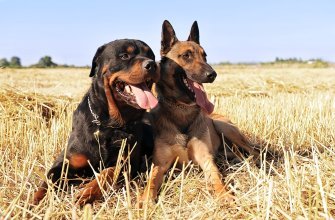
A side-by-side measurement shows the frame gap. Male German Shepherds stand 60 to 65 cm at the withers and weigh 30 to 40 kg. Male Malinois stand 61 to 66 cm but weigh 25 to 30 kg, a full 10 kg lighter at the same height. The Malinois is the middleweight, the shepherd the full size.
Coat differences are obvious. Shepherds carry a medium double coat that sheds heavily twice a year and needs weekly brushing. Malinois carry a short straight double coat that needs minimal grooming, shedding moderately year-round without dramatic blowouts. Families considering either breed should count shedding among the household logistics, since shepherd hair colonises upholstery in a way that Malinois hair does not.
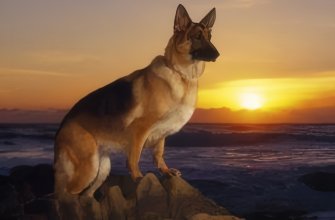
Colour standards differ too. Shepherds come in black and tan, sable, solid black, and bi-colour with regional variants including white. Malinois are fawn to mahogany with a black mask and black-tipped guard hairs, with very limited acceptable variation in the FCI standard.
Key physical comparisons:
- Weight (male): GSD 30-40 kg, Malinois 25-30 kg
- Height (male): GSD 60-65 cm, Malinois 61-66 cm
- Coat: GSD medium double, Malinois short double
- Lifespan: GSD 9-13 years, Malinois 12-14 years
- Skeletal maturity: GSD 18-24 months, Malinois 12-18 months
Drive, Energy, and Working Style
Both breeds score near the top of canine intelligence rankings, but intelligence expresses differently. A shepherd processes commands with deliberate thoughtfulness and often offers a considered response. A Malinois processes at higher speed and offers an immediate response, sometimes before the handler finishes the cue.
Drive levels run higher in the Malinois on average. The breed developed through police and military selection for maximum prey drive, ball drive, and bite commitment, with lower thresholds for engagement. A working-line Malinois often needs two to four hours of structured work daily, and an apartment kept Malinois without that outlet becomes destructive within weeks.
Working-line shepherds need 90 minutes to two hours of structured activity, with a wider range of satisfying outlets including slower-paced tracking, scent games, and nose work. Show-line shepherds settle easily with shorter daily exercise and often work well in lower-intensity therapy and service roles.
Off-switch behaviour separates the breeds clearly in the home. A satisfied adult shepherd sleeps for much of the day between sessions. A Malinois that has worked hard for two hours may still pace, gnaw on furniture, or invent games. Handlers sometimes describe the breed as having no off-switch, a phrase that is about 80 percent accurate.
Trainability and Handler Fit
Both breeds reward consistent training and punish inconsistency. The shepherd tolerates handler errors better than the Malinois does. A shepherd forgives a missed session, a badly-timed reward, or an emotional correction with minimal regression. The Malinois catalogues every handler error and brings them back during the next working session.
First-time working-dog owners usually do better with a shepherd. The response time is forgiving, the drive is contained, and the breed reads human emotion with enough sensitivity to defuse handler frustration. A Malinois picked up by a novice handler often develops reactivity, leash frustration, or redirected aggression within the first year.
Advanced handlers with sport or working ambitions sometimes prefer the Malinois because the speed of learning accelerates title timelines. A Malinois can reach IGP 1 in 18 months with daily training, while a shepherd on the same schedule usually needs 24 months. That speed comes with zero tolerance for sloppy handling during the training process.
Health Profiles Compared
Shepherds carry a higher rate of hip and elbow dysplasia than Malinois, around 19 percent and 7 percent respectively in OFA data. Shepherds also show higher prevalence of degenerative myelopathy, a progressive spinal condition now testable by DNA panel on both parents.
Malinois health profiles run cleaner overall, with average lifespans a year or two longer than shepherds. The breed does carry a specific risk of pannus, an autoimmune eye condition, and higher rates of anaesthesia sensitivity linked to the multi-drug resistance (MDR1) gene variant shared with collies and related breeds.
Bloat risk exists in both breeds due to deep chest conformation. Preventive gastropexy at the time of spay or neuter reduces the lifetime risk by over 90 percent and is now offered routinely by veterinary surgeons handling either breed.
Insurance and veterinary cost implications favour the Malinois modestly. Average annual veterinary spend across a US household runs around 1,400 US dollars for a shepherd and 1,100 for a Malinois, with the gap narrowing if the shepherd comes from health-tested working lines.
Family Life and Multi-Pet Households
Both breeds bond closely to their families and tolerate children when properly socialised. The shepherd’s calmer demeanour usually integrates better with small children and household chaos. A toddler can stumble over a napping shepherd without incident, while the same stumble into a Malinois may trigger a startled response even in a well-socialised dog.
Multi-dog households suit the shepherd more readily. Two shepherds of opposite sex or with age gap usually coexist without daily management. Two Malinois in the same house need active supervision around food, toys, and resting spots because the threshold for conflict sits lower.
Cats and small pets coexist with both breeds when the cross-species introduction happens during the puppy socialisation window before 16 weeks. Adult introductions work for shepherds with patience but rarely succeed with a high-drive adult Malinois without significant management.
Frequently Asked Questions
Which breed is stronger?
The shepherd has the heavier frame and slightly higher static pulling strength. The Malinois carries more relative speed and agility per pound. In measured bite-force testing, adult males of both breeds produce similar results around 230 to 240 psi, well below the exaggerated figures that circulate online.
Is the Malinois good for a first dog?
Rarely. The breed’s drive, bite threshold, and training demands overwhelm most first-time owners. A shepherd from a moderate show-working line suits a motivated first-time owner who takes classes and commits to daily structured work.
Why do special forces use Malinois instead of shepherds?
The Malinois parachutes better because the lighter frame tolerates high-altitude jumps with less strain. The shorter coat handles heat better during desert deployments. The higher work tempo matches operator work rhythms. Municipal policing does not need most of these advantages, which is why shepherds still dominate US patrol rosters.
Can the two breeds cross-breed?
Yes, biologically, and planned crosses called Shep-Mal or Malshep appear occasionally. The cross is not recognised by any major kennel club and inherits unpredictable combinations of parent traits. Either purebred is more predictable than the cross.
Which breed suits older handlers?
Both can suit older handlers with the right line and activity level. A moderate show-line shepherd from a reputable breeder usually works better than a Malinois for a retiree, because the energy demand matches better and the physical handling of the slightly heavier dog is manageable with a good harness and front-clip system.
For deeper training detail across both breeds, see our German Shepherd training guide. The breed overview for the shepherd is in German Shepherd breed overview. Working applications and police deployment are covered in German Shepherds in police service.
Sources and Further Reading
- Fédération Cynologique Internationale, Standard 166 German Shepherd and Standard 15 Belgian Shepherd
- Orthopedic Foundation for Animals, breed-specific hip and elbow statistics
- United States Police Canine Association, breed deployment reports
- American Kennel Club, breed standards for German Shepherd Dog and Belgian Malinois
- Veterinary genetics research on the MDR1 gene variant